
An internet marketing service is a working system that turns attention into customers. It covers search, paid ads, content, social, email, and measurement, and it keeps those parts connected to one job. A service page that only lists channels has not described a service yet. It has described a menu.
That distinction is why so many buyers feel burned by month three. They bought a bundle. They expected a system. The bundle delivered posts and reports. The system never showed up, because nobody wrote down what it was supposed to do, who owned each part, or how anyone would know it worked.
So here is the direct answer. A real internet marketing service includes five things, and you should be able to point to each one before you sign. A named job. A proof you can check yourself. A named owner for each channel.
A cadence for work and reporting. And an exit that leaves you holding your accounts, your data, and your files. If any of those five is missing, you are not buying a service. You are renting hope, on a monthly invoice.
Three buckets, not one bundle
Every service page looks the same because every service page lists the same channels. The useful question is different. Sort the work into three buckets, and ask what each bucket is supposed to do for your business.
The first bucket compounds. Search visibility, useful content, and an email list you own. This work is slow at the start and keeps paying after you stop funding it. A page that ranks, a guide that answers a real question, and a list of past buyers who open your mail are assets. They belong to the business, not to the month you paid for them.
The second bucket rents attention. Paid search, paid social, and short campaigns. This work stops the day the budget stops. That is not a flaw.
Renting attention is the right move when you need bookings now, when you are testing an offer, or when a season will not wait for search to catch up. The flaw is pretending rented attention is an asset. It is not. It is a tap, and the tap closes when the money does.
The third bucket proves the other two. Measurement, tracking, and reporting. Without it, the first two buckets are just activity.
With it, you can see which page brought the booking, which ad wasted the budget, and which email actually sold something. A report that only shows impressions and clicks proves nothing. A report that ties work to bookings, calls, and sales is the whole point of hiring help.
A good proposal says which bucket each line item belongs to, and how much of your fee goes to each. A weak proposal mixes all three into one price and calls the mix a strategy.
When the results disappoint, that mix is exactly what makes the argument unwinnable. Nobody can tell whether the compounding work was too thin, the rented attention was misaimed, or the proof was never built.
What each part actually delivers
A channel name is not a deliverable. Search engine work, paid ads, content, social, and email each have a different job, a different rhythm, and a different proof. The table below states each one plainly, so you can hold a proposal against it.
| Part | What it delivers | How often | Proof you can check |
|---|---|---|---|
| Search | Pages that match real queries, fixed technical problems, and internal links that help buyers find the right page | Weekly fixes, monthly page work | Queries and landing pages that bring visits and bookings |
| Paid ads | Campaigns aimed at one offer, with budgets, audiences, and landing pages you approve | Weekly tuning, monthly budget review | Cost per booking or sale, not cost per click alone |
| Content | Pages and posts that answer questions buyers actually ask, tied to an offer | On a set publishing rhythm | Pages that earn visits, time on page, and next steps |
| Social | A clear role for each channel, plus content that fits that role | On a set posting rhythm | Actions tied to the channel role, not follower counts alone |
| Messages to people who asked to hear from you, segmented by what they bought or asked about | On a set sending rhythm | Delivered mail, opens that lead somewhere, and sales from the list | |
| Measurement | Tracking that works, a dashboard you can read, and a report that names decisions | Monthly, with fixes as needed | One page that ties spend and work to bookings |
Notice what is missing from that table. Vanity counts. A follower total, an impression total, and a post count are not proof. They are activity, and activity is the cheapest thing an agency can sell. If a proposal leads with those numbers, read the rest of it twice as carefully.
Also notice what the table demands from you, the buyer. An agency cannot write honest content without your offer details, your prices, and your limits. It cannot run honest ads to a landing page with a stale offer.
It cannot measure bookings if bookings happen by phone and nobody logs the call source. The scope card works both ways. It names what the agency owes you, and it names what you owe the agency, so the work can actually start.
That last point matters more than most buyers expect. A campaign is only as honest as the records behind it, and a service scope that skips your inputs is a scope that will drift. Ask who supplies the offer, the claims, the prices, and the approval. Put a name beside each one.
The scope card
This is the original piece of this post, and it is deliberately small. A scope card is one page with five lines. Copy it into any proposal review, and refuse to sign a proposal that leaves a line blank.
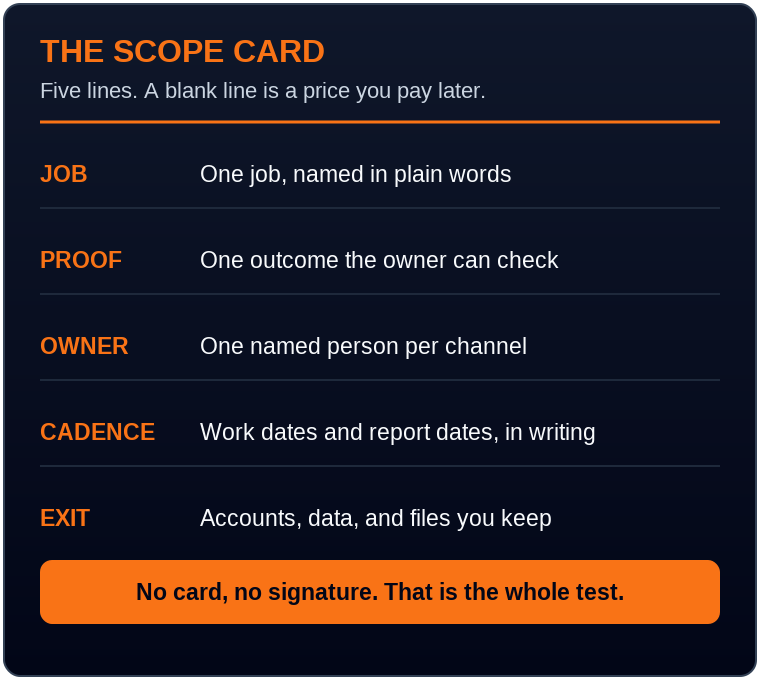
Job means one job, named in plain words. "Grow the business" is not a job. "Fill weekday lunch tables from local search" is a job. "Book twenty consultations a month from paid search" is a job. A service can serve more than one job over time, but a single engagement should start with one, so everyone knows what winning looks like.
Proof means one outcome the owner can check without asking the agency to interpret it. Bookings, calls from a tracked number, form fills that reach your inbox, and sales from a named campaign are proofs. Rankings alone are not proof, because a page can rank for a query nobody buys from. Traffic alone is not proof either, for the same reason.
Owner means one named person per channel. Not a team. Not a department. A person whose name appears on the report and who answers when the number moves the wrong way. If the proposal names a team for every channel, ask who writes the report. That person is the owner, whether the proposal says so or not.
Cadence means work dates and report dates, in writing. What ships each week, what ships each month, and when the report arrives. A monthly report that arrives six weeks late is not a monthly report. A content rhythm with no dates is a wish, not a plan.
Exit means what you keep if you leave. Your ad accounts, your analytics, your content files, your email list, and your website access. If the agency owns the ad account, you do not own the history inside it.
If the agency owns the content files, you do not own the pages that rank. The exit line is the cheapest insurance in the whole contract, and it is the line most proposals skip.
The way a service handles measurement decides whether the rest of the scope means anything. A scope card with a strong proof line and a weak measurement line is a contradiction. Fix the measurement line first, or the proof line is just a promise.
Read a proposal in ten minutes
You do not need to become a marketer to judge a proposal. You need ten minutes and a short list of questions. Work through them in order, and stop at the first answer that goes vague.

Read for the blank lines. A good proposal has none.
First, what is the one job? If the proposal opens with five goals, ask which one comes first and what gets cut if the budget tightens. A service that tries to do everything first does nothing first.
Second, what ships in month one, in plain nouns? Pages, campaigns, emails, and fixes are nouns. Optimization, synergy, and visibility are not nouns. They are fog. Ask for the nouns.
Third, what is excluded? Every honest proposal has an exclusion list. Website rebuilds, photography, video production, and public relations usually sit outside a standard retainer, and that is fine. What is not fine is learning about the exclusion after you needed the work. A proposal with no exclusions is a proposal that has not thought about its edges.
Fourth, who approves what, and how fast? Ads, pages, and emails all need an approval step, and that step needs a deadline on your side too. A campaign that waits three weeks for a client approval is not a slow agency. It is a slow system, and the system belongs to both sides.
Fifth, how is the money split? The fee, the ad spend, and the tool costs are three different piles. Ad spend goes to the platforms. Tool costs go to software.
The fee pays for people and time. Scope templates from agency operators draw the same line: keep spend separate from the fee, and commit to deliverables rather than guaranteed outcomes. If a proposal folds all three into one number, ask for the split before you ask anything else.
Sixth, what happens when a platform changes the rules? Platforms now rewrite ads, redirect clicks, and change settings without asking. Our October post on Meta's AI ad terms showed what that looks like in practice: an approved ad can become an edited ad, and the liability question lands on the advertiser.
Your scope should say who watches those settings, who can turn an automated change off, and how fast that happens. A service that never mentions platform changes is a service that will bill you for discovering them.
Seventh, what do you keep when it ends? Ask the exit question before you sign, not during the breakup. The answer should be one sentence, and it should include accounts, data, and files.
If a proposal answers all seven clearly, it is worth a conversation. If it answers three and fogs the rest, the fog is the answer.
Five flags that end the conversation
Some proposals do not need a second reading. They need a polite no. Watch for these five flags, and treat any one of them as enough.
A guaranteed ranking is the first flag. Nobody can guarantee a search position, because nobody owns the search engine. A service can promise work, effort, and a process. It cannot promise a position. A guarantee here is either ignorance or a sales line, and neither improves with time.
A hidden ad spend is the second flag. If you cannot see what went to the platform and what went to the agency, you cannot judge either one. Ask for platform invoices or direct platform billing. A refusal here is a refusal to be measured.
A report full of activity is the third flag. Posts published, keywords tracked, and hours logged are inputs. Inputs are not results. A report that celebrates inputs while bookings stay flat is a report designed to keep you from asking about bookings.
A service that owns your accounts is the fourth flag. Your ad account, your analytics property, and your business profiles should sit in your name, with the agency added as a manager. An agency that insists on owning them is building a hostage, not a service.
A contract with no exit is the fifth flag. Long terms are fine when the work needs time, and search work does need time. A term with no exit clause, no notice period, and no handover is not a commitment device. It is a trap, and traps do not get better with loyalty.
A service that cannot say what it will not do has not decided what it will do. The exclusion list is where honesty lives.
The first thirty days
The first month tells you almost everything about the service you bought. It will not tell you whether search rankings moved, because honest search work rarely moves that fast. It will tell you whether the system exists.

The first month should build the system, not just spend the budget.
Week one should be access and baseline. Accounts in your name, tracking checked, and a baseline written down. How many bookings, calls, and form fills arrived before the work started, and from where. Without a baseline, every later report is a story, not a measurement.
Week two should be the plan in nouns. Which pages get fixed, which campaign launches first, which emails go out, and who approves each one. This is also the week your inputs get collected: offers, prices, claims, and limits. A service that launches ads before it collects your limits is a service that will advertise an offer you cannot honor.
Week three should be the first real work in public. A campaign live, a page published, or an email sent, with the tracking to prove it happened. Not a deck about the campaign. The campaign.
Week four should be the first honest report. What shipped, what it cost, what it produced, and what changes next month. The numbers will be small. Small and honest beats large and vague, every single time.
If month one ends with a strategy document and no live work, ask why. Strategy has a place, but a service that sells months of strategy before it ships anything is selling the document, not the system.
A funnel that never connects to a booking is a familiar failure, and the first month is where that failure starts.
What to ask about money
Price talk makes buyers nervous, and agencies know it. That nervousness is exactly why the money questions belong early, in plain language, before the work starts.
Ask how the fee is set. Some services charge a flat monthly fee. Some charge by project. Some take a share of ad spend, which creates a direct incentive to spend more, whether or not more spend helps you.
None of these models is automatically wrong. A spend share model paired with a clear cap and a booking target is very different from an open spend share with no cap at all. Ask which model you are in, and what would make the fee change.
Ask what the fee excludes. Photography, video, website development, and extra ad creative often sit outside the retainer. That is normal. What matters is knowing it now, not discovering it in a change order later.
Ask how you pause or stop. A service with a clear notice period and a clean handover is a service that expects to earn the next month. A service that makes stopping hard is telling you, in advance, how it plans to keep you.
And ask one question most buyers skip. If this service stopped tomorrow, what would keep working? The honest answer is the compounding bucket: ranked pages, useful content, and an owned email list. If the answer is nothing, you have not bought a service with assets. You have bought a tap, and you should price it like one.
Service guides written for buyers draw the same boundary: core services, optional add-ons, and work outside agency scope are three different lists, and a proposal should keep them apart. Use that boundary as your test.
If a proposal cannot sort its own offer into those three lists, it has not finished thinking about its own service.
Frequently asked questions
An internet marketing service includes search, paid ads, content, social, email, and measurement, connected to one named job. The service part is not the channel list. It is the system: work delivered on a rhythm, owned by named people, proven by bookings or sales, and handed over cleanly if you leave.
A freelancer usually owns one channel well. A service owns the connection between channels: the page the ad points to, the email that follows the click, and the tracking that proves the chain worked. If you only need one channel done well, a freelancer may be the better buy. If you need the chain, buy the service.
Expect access, a baseline, a plan in plain nouns, one piece of live work, and one honest report. Do not expect search rankings to transform in thirty days. Do expect to see the system working, and to know exactly what shipped and what it cost.
No, not as one blended number. Ad spend should be visible separately, paid to the platforms, with the agency fee listed apart from it. A blended number hides both piles, and you cannot judge a service you cannot see. Ask for the split in writing before you sign.
Search work needs time, so a term of several months is normal. What matters more than the length is the exit: a notice period, a handover of accounts and files, and a clear list of what you keep. A long term with a clean exit is a commitment. A long term without one is a lock-in.
Check the proof line on your scope card. Bookings, tracked calls, form fills, and sales tied to a named campaign are proof. Rankings, traffic, followers, and post counts are supporting signals, not proof on their own. If the monthly report cannot connect work to bookings, the service is not proving itself, whatever the charts show. The next time a service page promises everything, do not ask for more channels. Ask for the card. One job, one proof, one owner, one cadence, one exit. Then watch how fast the conversation gets honest. The services worth hiring will welcome the card, because it is the document they already use to run their own work. The rest will change the subject, and that tells you everything you need before you spend a dollar.