
Bookshop.org found an illustration in one of its Meta ads that nobody at the company had made. An automated account update had opted the bookseller into a generative AI feature, and the feature had decorated an ad that people had designed. The company called the ad enhanced, or ruined, by Meta without its knowledge, and it has since turned off all of Meta's AI ad features.
In any other week this would have been a minor complaint about an overeager tool. This week it came with a contract attached.
Adweek reported on October 22 that Meta's revised Commercial Terms add a new "AI Features" section making advertisers "solely responsible" for whatever Meta's AI features create or change in their ads, including features Meta switches on itself. The previous terms put liability on advertisers too, but only when they chose to use Meta's AI tools. The new section drops that condition. The terms were supposed to take effect October 30.
Today, Meta delayed them to November 20 after publishers and advertisers complained to EU and UK antitrust authorities. That delay is your audit window. This post is the audit.
What the new section actually says
The clause sits in Meta's updated Commercial Terms, the contract that governs business use of Facebook, Instagram, WhatsApp, and Messenger. It opens with Meta's own action: Meta may use or make available products and features powered by artificial intelligence, machine learning, generative AI, or other automated products or features that help businesses optimize, enhance, or create content. Then it concedes the obvious.
AI features may make mistakes and may not always produce accurate, complete, or suitable results. Then it assigns the consequences in one sentence: you are solely responsible for and assume any and all risks associated with such AI features and any resulting content.
The change from the old language is the whole story. Meta's earlier generative AI ad terms began with a choice: "You may choose to use the Ad Creative AIs in your sole discretion." Liability attached to that choice. The new section carries no such condition.
Nothing in its wording depends on whether you switched a feature on. Adweek asked Meta whether the new terms make advertisers liable for AI features they never switched on. A Meta spokesperson did not directly address the question and said advertisers can turn off individual Advantage+ features in Ads Manager at any time. Meta framed the update as housekeeping, folding its existing generative AI ad terms into its main ad terms.
Acceptance is passive. Continuing to use Meta's products for business after notice of the update counts as agreement. The terms state the alternative plainly: stop all access or use of Meta's products for business or commercial purposes. There is no partial opt-out and nothing to sign. The only vote you get is with your feet.
The consent gap
Here is the operator's core problem. The settings that decide what Meta's AI does to your ads can move without you touching them, and the contract now says the movement is your problem.
Digital agency Exverus told Adweek that Meta's AI is tacking on sitelinks, translating copy, and spinning up AI images and carousels out of a brand's own photos, sometimes on ads where advertisers did not switch the feature on. The agency has pulled live ads to strip out changes that survived several rounds of quality checks.
Ryan Adams, the agency's paid search and social specialist, described the mechanics: Meta auto-applies the enhancements, and many of the options are tucked away in hidden or collapsed menus, so if every one of those is not manually unchecked, the enhancements still apply.
This is not a one-agency anecdote. Meta's own Advantage+ creative help page says some enhancements may be turned on by default, among them AI-written summaries of an advertiser's selling points. In July, ads specialist Jon Loomer found Advantage+ Creative rewriting headline text on images advertisers had uploaded.
Bookshop.org was opted in by an account update it did not request. The pattern is consistent: the defaults drift, the menus hide the switches, and the contract now assigns you the output.
Go Fish Digital's president David Dweck put the timing bluntly. Meta is opting advertisers into AI features a month before Black Friday and Cyber Monday, the biggest selling season of the year. His agency has its legal team reviewing the terms but will not tell clients to pull back in the fourth quarter, when brands expect high sales volume from Meta.
He called it the tax of advertising on Meta. Emarketer senior analyst Asa Hiken added the brand risk that no toggle can fix: automatic generative AI revisions can run against a brand's strategy and values, and consumers are unaware of Meta's ad policies, so they are likely to assume the brand willingly used AI. We have written before about AI attribution hiding ROI, and this is the same trust problem wearing a contract.
The robot edits your ad. The contract says the mistakes are yours.
The audit playbook
You cannot negotiate the clause. You can decide your posture before November 20. Programmatic agency AdCellerant already has one: it systematically turns off Meta's default AI automation across every campaign, to keep ads on the exact audience and geo requested without unwanted modifications or legal liability.
Whether you copy that posture or a looser one, make the decision deliberately and write it down. Here is the pass to run.
First, inventory every active ad's Advantage+ creative enhancements. Each enhancement is a separate setting, and Meta publishes a guide to turning them off. Do this per ad, not per account, because the switches live at the ad level and an account-level glance will miss them.
Second, run a creative-diff pass on a weekly cadence through the holiday season. Compare what is actually live against what your team uploaded. Exverus needed several rounds of quality checks and still had to pull live ads, so treat one pass as the start, not the finish.
Screenshot the live creative each week. The week something changes without a human touching it, you will have the receipt.
Third, guard against account updates. Bookshop.org was opted into a feature by an automated update. After you set your posture, re-check it after every Meta account or Ads Manager update notice. Put the re-check on the calendar as a recurring task, not as something someone will remember.
Fourth, brief your designers on the watermark rule. The new section bars businesses from altering or removing any watermark or content-authenticating metadata generated by AI in connection with content.
Read plainly, that covers cropping an AI watermark out of an ad image Meta generated for you. Nobody is writing about this clause, and it is the one most likely to bite a creative team working fast in November.
Fifth, calendar November 20 and re-read the final text when it posts. Meta delayed the date once under regulatory pressure, and the final language could still move.
Last week we mapped Meta's October product and terms changes as one closed loop, and the crawl section of these same terms is already on its second reading. Treat every clause as provisional until the binding version lands.

The switches live at the ad level, some in collapsed menus. Check each one, then check again after every account update.
The liability chain, drawn
The three parts of the story are usually covered separately: the product behavior, the contract language, and the advertiser response. Drawn as one chain, the shape is simple.
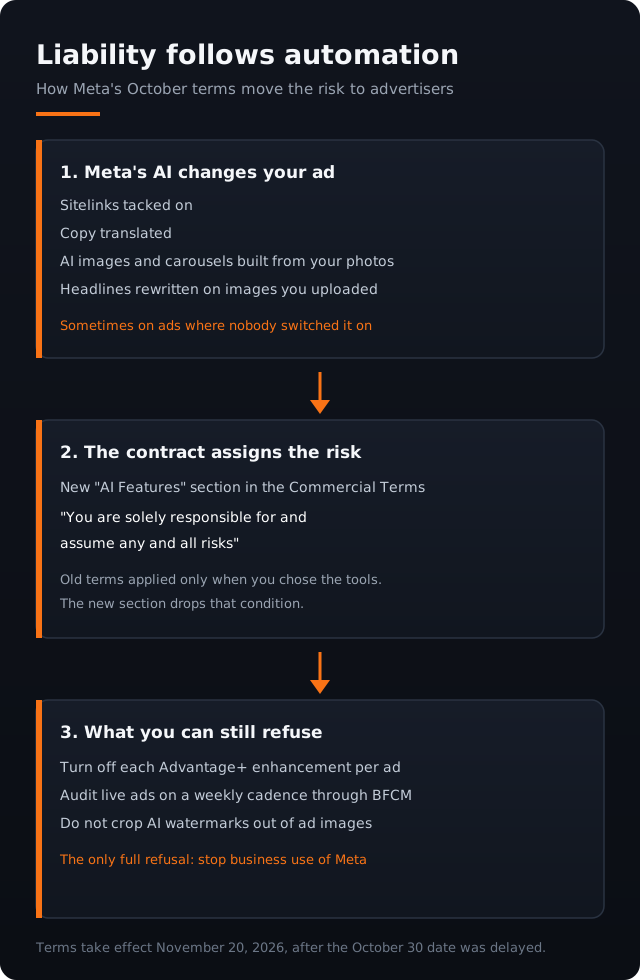
The AI edits first, sometimes without opt-in. The contract assigns the risk second, without requiring your choice. Your remaining moves are third: switch off each enhancement, audit on a cadence, or leave. The chain has no fourth step where Meta takes the risk back. Understanding that shape is what turns the story from outrage into operations.
What moved at the edges
Three developments sit around the main clause, and each changes the reading slightly.
The delay is the most useful. Reuters reported today that Meta pushed the effective date to November 20 from October 30 to address concerns from publishers and advertisers who had complained to EU and UK antitrust authorities.
A delay won under regulatory pressure is a window, not a reprieve. Use it for the audit above, and do not assume the final text will be friendlier.
The crawl section got a softening. A Meta spokesperson told Adweek that the crawling terms consolidated in this update only applied to ads and business products, and that content owners can use robots.txt to signal their preferences.
That is gentler than the preview text we read last week, which mentioned neither robots.txt nor that scope limit. Credit the clarification, and keep watching the final text, because a spokesperson's statement is not the contract.
The third development is at a different company. OpenAI is switching on creative enhancements for ChatGPT Ads on October 29, letting it rewrite and translate ads without per-ad approval. One platform changes a setting. The other changes the contract.
A setting can be flipped back next quarter. A contract clause, once accepted by continued use, is much harder to undo. If other platforms copy Meta's contract language the way they copy its product features, the November 20 text becomes the template for the whole industry.
Honest limits
A few things this post is not claiming. The "solely responsible" reading is Adweek's, supported by a clause-by-clause summary from The Keyword. Meta's spokesperson did not directly answer the central question, whether the clause covers features you never switched on.
Until Meta answers it or a court reads the text, treat the broad reading as your working assumption and the narrow reading as a hope. The terms are untested in court, and the delay to November 20 means the final language could still move.
The agency reports are testimony, not a survey. Exverus, Bookshop.org, Go Fish Digital, and AdCellerant describe their own accounts.
Your account may behave differently, which is exactly why the audit pass matters more than anyone's anecdote. And there are no vendor lift statistics in this post to caveat, because none are asserted. The numbers here are dates and quotes, both checkable.
What to watch next
The binding text lands November 20. Watch whether Meta answers the never-switched-on question before then, because the answer decides whether the audit playbook is caution or necessity. Watch whether the final terms keep the watermark clause, since that is the part creative teams will trip over first.
Watch whether other ad platforms copy the contract language, because OpenAI's October 29 setting change shows the industry is moving the same direction by a different mechanism. And watch the first holiday season under the new regime: Black Friday is November 27, one week after the terms bind, which means the first real test of the liability clause happens at the highest ad volume of the year.
Your move before November 20 is an audit, not an argument. Open every live ad, check every enhancement toggle, and decide your default posture in writing. The contract will not ask whether you meant to agree.
Frequently asked questions
It is a new section in Meta's Commercial Terms, the contract governing business use of Facebook, Instagram, WhatsApp, and Messenger. It says Meta may use AI features to optimize, enhance, or create ad content, concedes those features may make mistakes, and makes the advertiser solely responsible for any and all risks from the features and the content they produce. The terms take effect November 20, 2026, delayed from October 30.
That is the open question. The clause's wording does not depend on whether you switched a feature on, and Adweek reports it covers features Meta switches on itself. Meta's spokesperson did not directly address whether it covers features the advertiser never turned on. Until Meta clarifies or a court rules, assume the broad reading.
Exverus reports sitelinks added, copy translated, and AI images and carousels built from brand photos, sometimes on ads where nobody switched the feature on. Bookshop.org had an AI illustration added to a human-made ad after an account update opted it in. Jon Loomer found Advantage+ Creative rewriting headline text on uploaded images in July.
Each Advantage+ creative enhancement is a separate setting at the ad level, and Meta publishes a guide to turning them off. Check collapsed and hidden menus, since enhancements can remain applied unless every option is manually unchecked. Re-check after every account update, because updates have opted advertisers into features automatically.
The new terms say businesses must not alter or remove any watermark or content-authenticating metadata generated by AI in connection with content. Cropping an AI watermark out of an ad image Meta generated likely breaches the clause. Brief your creative team before the holiday rush.
November 20, 2026, after Meta delayed the original October 30 date following complaints to EU and UK antitrust authorities. Note that October 28 is a separate product change: product browsing switches on by default for existing ads unless you opt out, which we covered in our breakdown of Meta's closed loop.