# The Attribution Collapse: Why AI Marketing Is Hiding Your Real ROI
Your SMS notification just proved a customer was of legal age. Your retail partner reported a sale. Your email showed a discount to a loyal repeat buyer. Your compliance team logged the age verification. One problem: your AI attribution system didn't see any of it.
Google's algorithm measured the paid search click. Meta tracked the ad impression. Your marketing stack says 80% of revenue came from these channels. Your CFO cuts SMS and PR budgets because the data says they don't convert. Three months later, your compliance audit reveals you have zero documentation of age verification touchpoints. You're exposed.
This is happening to cannabis operators right now. And it's not a tools problem. It's a system design problem that AI attribution made much worse.
What AI Attribution Actually Sees
Modern attribution systems are built on a single principle: measure what you can automate, optimize toward that, and ignore everything else.
Google Ads can see clicks. Meta can see impressions and pixel fires. Your email platform can see opens and clicks. Affiliate networks report their sales. These channels all play nice with attribution software because they generate machine-readable events.
But here's what AI attribution *can't* see:
A customer calls your phone number and speaks to a human. That's unmeasured.
A person walks into a retail partner's location because they saw your brand in a community event. Unmeasured.
A compliance officer logs an age verification, which is legally required but happens offline. Unmeasured.
A repeat customer receives an SMS reminder about a sale and drives to the store. The SMS app knows the send happened, but not that a store visit resulted. Unmeasured.
A PR mention lands your brand in a dispensary's newsletter. The newsletter gets forwarded. A sale happens. Completely invisible to AI.
According to recent AppsFlyer research, 58.6% of marketers now underinvest in channels their AI systems can't measure. The reasoning is simple: if the algorithm can't see it, the algorithm can't optimize for it. If you can't optimize for it, why spend money?
Except when you can't see it, you're also starving channels that actually drive results. And for cannabis brands, some of those invisible channels are compliance requirements.
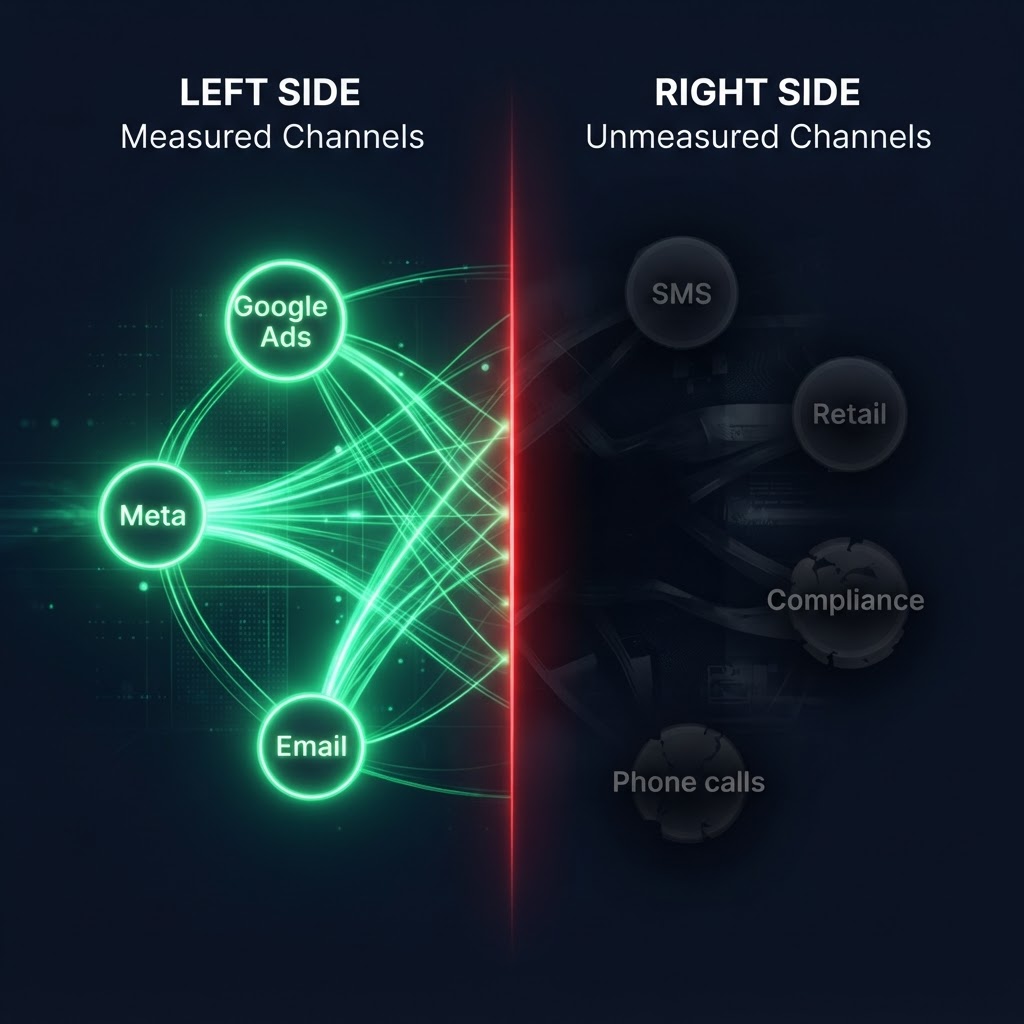
Left side shows bright, connected nodes for measured channels (Google Ads, Meta, Email). Right side shows faded,...
Why Cannabis Brands Get Hit Hardest
Here's what most cannabis brands measure:
- Paid search clicks
- Social media impressions and engagements
- Email opens and link clicks
- Website traffic and pixels
Here's what they don't (because AI can't):
- Age verification flows that happen on partner sites
- Retail loyalty program signups tied to offline purchases
- Compliance documentation storage and retrieval
- Community event attendance that influences word-of-mouth
- Dispensary staff interactions and personal recommendations
The problem is that AI optimization starves measurement budget toward the measurable channels. A CFO looks at the data, sees that paid search drives measurable ROI, and cuts funding for offline compliance touchpoints that AI says contribute nothing.
But those compliance touchpoints? They're not optional. A cannabis brand needs documented evidence that it:
- Verified customer age before sale
- Provided required warning labels
- Tracked inventory through regulatory checkpoints
- Complied with local marketing restrictions
These are not optional brand-building activities. They're legal requirements. But because they're invisible to AI attribution, they get treated as wasteful spend.
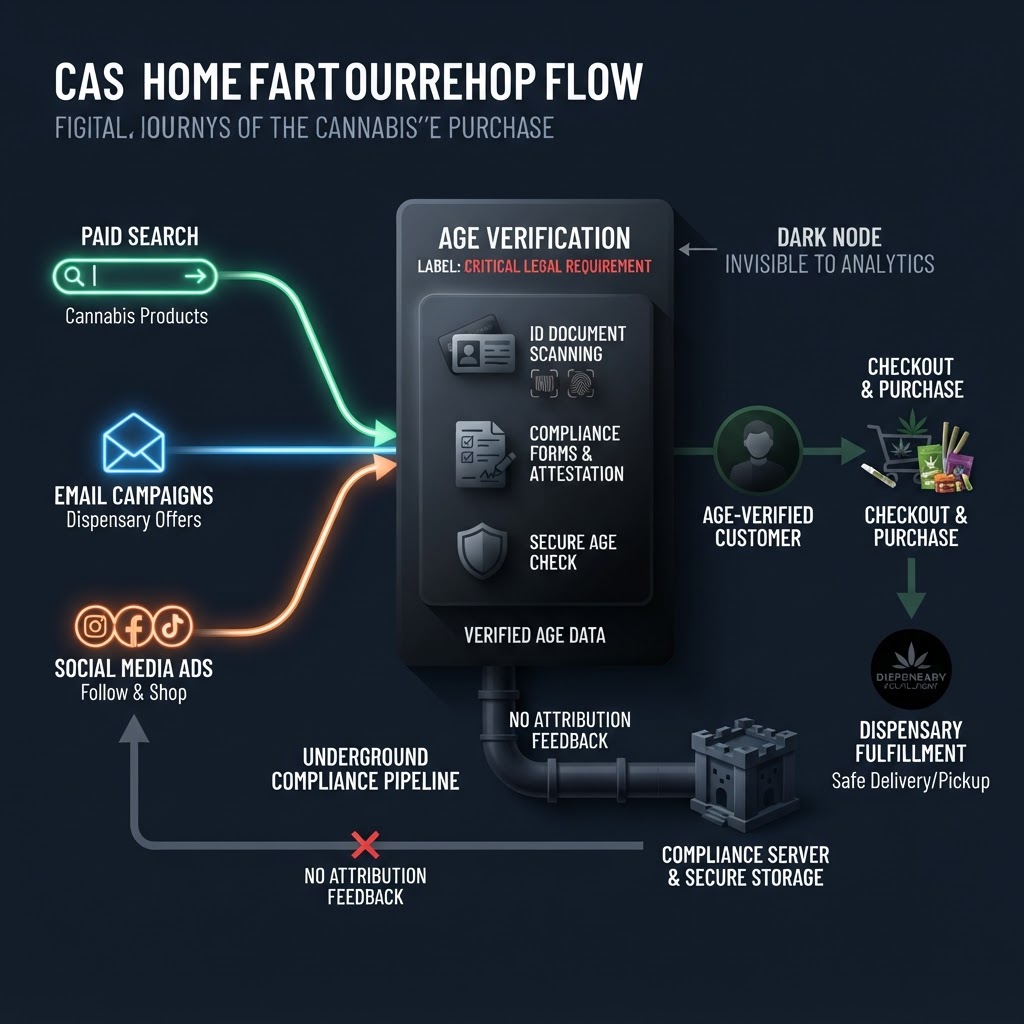
Customer journey flows through bright digital touchpoints (green, blue, orange), then reaches age verification step which...
The Blind Spot Effect
Let me walk you through what actually happens.
Month 1: Your attribution system says paid search is your top performer. You increase PPC budget.
Month 2: Your email sends are invisible to the system (because the customer clicked email, visited the site, and then visited a retail partner to buy). The algorithm doesn't see the full path. Email looks weak. You cut email budget and staff.
Month 3: Your compliance audit comes back. The audit requires documentation of age verification at sale. You realize your email reminders contained a link to age verification for online orders. But you cut the email team. Now there's no one maintaining that flow. Compliance flag.
Month 4: Your CFO asks why three channels that seemed productive (email, SMS, offline partnerships) are no longer generating measurable ROI. You explain that AI attribution couldn't see them, so you defunded them. CFO asks: "If they don't exist in attribution, do they actually exist?" You realize the answer is no, at least according to the data.
But here's the kicker: Your actual revenue hasn't shifted. Paid search went up. Email went down. SMS went down. But overall revenue stayed flat or grew slightly. You're spending more on measured channels to get the same results you got from a mix that included unmeasured ones.
The blind spot created a false narrative. You optimized toward channels that report well, not channels that work well.
For cannabis brands, this blind spot gets expensive fast. As detailed in our research on cannabis AI visibility gaps, the cost compounds when you can't measure what matters for compliance. According to the 2026 Cannabis AI Visibility Index, early-moving cannabis brands are getting 3-5x more AI visibility than smaller operators.
But that visibility is only in channels that AI can measure (search, social, review sites). Brands measuring compliance as a core metric are getting left behind in the attribution race.
The measurement gap becomes a competitive gap.

A marketing professional at their desk, looking puzzled at an attribution dashboard on their laptop. Printed reports showing...
Why Your Current Data Won't Fix This
You might think: "We'll just add more tracking. Tag every email. Pixel every page. Monitor all social."
That's the wrong move. More tracking inside the same system just adds noise. You're still blind to offline conversions, retail partnerships, and compliance documentation that happens outside your digital stack.
The real issue is that you've accepted AI's definition of "measurable" and built your entire budget allocation around it. Going deeper into that same system doesn't solve the problem. It deepens it.
Here's what recent research on AI governance in marketing found: Most brands treat measurement as a byproduct of marketing. They run campaigns, see what the pixels capture, and call that data. What they should be doing is designing measurement *first*, then choosing channels that fit the measurement design.
For cannabis brands especially, this flip is essential. Your compliance measurement has to come first. Your ROI measurement has to fit around it. Your AI attribution system has to be designed to support both, not hide one.
How to Actually Fix It
The fix isn't "replace AI." The fix is "don't let AI be the system designer."
Step 1: Define what you actually need to measure. For cannabis brands, this means:
- Legal compliance touchpoints (age verification, warning display, inventory tracking)
- Revenue by channel (paid, organic, SMS, email, retail partnership, referral)
- Customer lifetime value by acquisition source
- Risk exposure (compliance documentation completeness)
These are different metrics than what Google's algorithm optimizes for. But they're *your* metrics.
Step 2: Design a measurement system that captures these first. Don't start with "what can our tools measure?" Start with "what do we need to know?" Then pick tools that support that design.
For cannabis brands, this might mean:
- A CRM that tracks customer age verification source (paid search vs. SMS vs. retail referral vs. brand site)
- A compliance database that links marketing touchpoints to regulatory checkpoints
- A separate attribution model (separate from Google/Meta optimization) that measures what your brand actually needs
Step 3: Give AI attribution its proper lane. Let Google optimize for what Google can see. Let Meta optimize for what Meta can measure. But don't let their optimization determine your entire spend allocation.
Use AI attribution for optimizing within the measured channels. Use your custom measurement design for allocating spend across *all* channels. This approach mirrors how top cannabis brands are building strategies that bypass algorithmic measurement gaps.
The brands winning at this are doing something counterintuitive: they're *increasing* spend on unmeasured channels (SMS, offline partnerships, compliance touchpoints) *while also* letting AI optimize the measured channels. This creates redundancy. It also creates resilience.
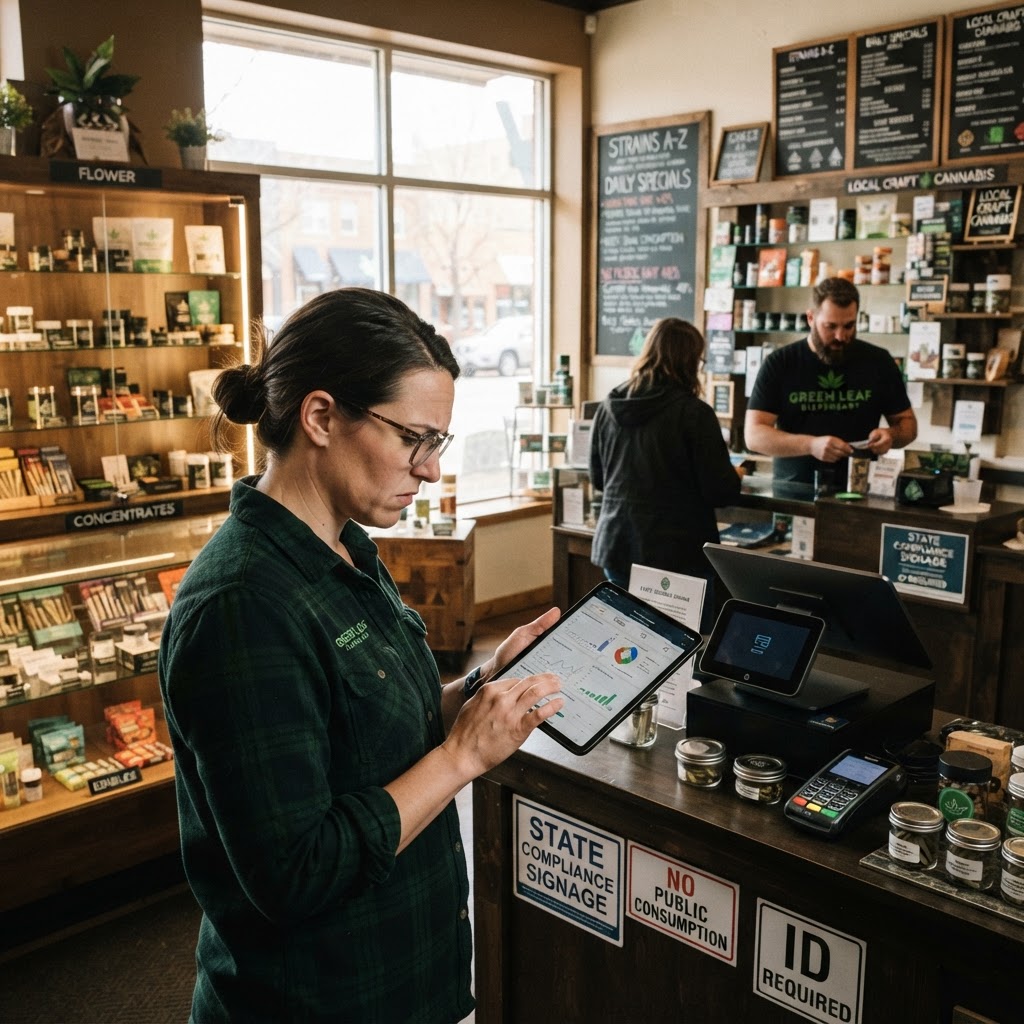
A dispensary manager stands behind the counter holding a tablet, looking down at it with concern. The retail environment...
FAQ
A: No. They're optimized for what they can measure, which is smart engineering. The problem is treating their measurement as your complete measurement. They're tools, not strategy.
A: Start simpler. Have your compliance team track the source of every age verification (was it from your website, from retail partner, from an email campaign?). Compare that to what your attribution reports. That gap is your blind spot.
A: Yes. But so is cutting SMS because it's invisible to attribution, then realizing SMS drives your compliance documentation flow. Measure what matters first. Let the cost follow.
A: AI attribution will always optimize toward measurable channels. That's what it's designed to do. The fix isn't fixing AI. It's building a measurement system that AI is a *part* of, not the whole of.
A: Because your competitors are probably making budget decisions based on invisible data, same as you. But the cannabis operator who measures compliance *first*, then optimizes paid channels around that, will have both better ROI and a complete compliance audit.
A: Audit your current attribution system for blind spots. List your compliance requirements. Compare revenue to what attribution reports. That gap is your roadmap. --- You've built a marketing stack. What you haven't built is a measurement design that came first. Flip that order, and suddenly the blind spots become visible. The invisible channels become strategic. And your CFO can actually answer the question: "Does this channel work, or are we just blind to it?" That distinction will save you money. For cannabis brands, it might also save you from a compliance violation you didn't know you were creating. ---