# Why AI Search Rewards Strong Digital Marketing Fundamentals
AI search isn't replacing digital marketing fundamentals. It's making the consequences of ignoring them harder to hide.
A brand can survive a mediocre search snippet for years. It can rank on page one while its offer remains vague, its reviews say very little, and its conversion path asks visitors to do all the work. Traditional search often gave those weaknesses enough traffic to stay profitable.
Answer engines are less forgiving. They have to decide which brands, products, and claims deserve to appear in a short response. That means they look for the same things a good marketer should have been building anyway: a clear point of view, consistent facts, credible proof, and a useful next step.
Google's own guidance on AI features and your website doesn't ask publishers to create a special category of AI content. It points back to useful, accessible, indexable content and the same people-first standards that have always mattered.
The lesson is simple. Don't start with an AI visibility tool. Start by asking whether your marketing gives a customer, a search engine, and an answer engine a clean reason to believe you.

Visibility gets easier when the signal is clear
The offer still comes first
Many teams approach AI search as a distribution problem. They want more mentions, more citations, and more appearances in recommendation prompts. Those are reasonable goals, but they come after the offer.
An answer engine needs to understand what a company does, who it's for, when it makes sense, and how it differs from the alternatives. If the website uses broad language such as "solutions for modern businesses," the model has very little to work with. The customer has the same problem.
A strong offer contains a few hard edges:
- A defined audience with a recognizable problem
- A specific outcome the customer can picture
- A reason to choose this brand instead of a familiar substitute
- Evidence that makes the promise believable
- A next step that matches the customer's current level of intent
This is not just copywriting polish. It is data structure for the market. Clear positioning gives every page, profile, review, and third-party mention the same story to repeat.
The marketing offer strategy before media spend principle applies here too. Buying more distribution cannot repair an offer that nobody can explain in one sentence.

A focused offer gives the market fewer ways to misunderstand you
Proof beats volume
The next foundation is proof. AI search systems can repeat a claim, but repetition isn't credibility. A brand that publishes fifty pages saying it is trusted has less persuasive power than a brand with five pages supported by specific customer outcomes, transparent policies, and independent evidence.
Proof has a hierarchy. A named case study with a measurable result is stronger than a vague testimonial. A detailed product comparison is stronger than a list of features. A clear return, shipping, licensing, or compliance policy is stronger than a sentence about caring deeply about customers.
Reviews matter, but not because a high star rating is magic. The useful part is the language inside the review. Customers describe the situation they were in, the objection they had, and what changed after they bought. That language helps future customers recognize themselves. It also gives search systems more context than a five-star badge ever could.
The same rule applies to regulated categories. A cannabis retailer cannot rely on broad claims about quality when the customer needs facts about product availability, testing, age requirements, delivery boundaries, or store experience. In a restricted market, accurate information is part of the offer.
That connects directly to regulated retail SEO from the operator side. Visibility without operational truth is not growth. It's a faster route to disappointment.

The strongest proof answers the objection before the sales call
Content needs a job
The content race has produced an unfortunate habit: teams publish because the calendar says Tuesday. The result is a library full of topics, but very few useful decisions.
Every important page should have a job. It might explain a problem, compare options, answer a purchase objection, prove a result, or move an existing customer toward a second purchase. If a page has no job beyond attracting traffic, the team will struggle to judge whether it worked.
AI makes this more obvious because generic content is easy to produce. A model can create another overview of a familiar topic in seconds. That does not mean the page deserves attention. It means the bar has moved toward specificity, firsthand knowledge, and a useful point of view.
A practical editorial filter is:
- What decision should this page help someone make?
- What does the brand know from actual customer or operator experience?
- What evidence can the page show instead of merely claiming?
- What would make the page useful even if it received no search traffic?
The last question is the one most content programs avoid. It forces the team to separate publishing activity from customer value.
A content distribution plan still matters. The content distribution strategy beyond posting more approach is a good reminder that strong material needs a path to the people who can use it. But distribution should amplify useful thinking, not camouflage a lack of it.

More content is not the same thing as more signal
Build for the whole journey
Search visibility is often measured at the first touch. The customer experiences something longer.
They may discover a brand through a search answer, visit the site on a phone, check a review, compare two products, leave, return through email, and finally buy in a store. If the message changes at every stage, the journey feels unreliable. If the next step is unclear, even strong visibility leaks away.
That is why customer journey mapping remains useful. The goal is not to draw an elaborate diagram that nobody opens again.
The goal is to identify the moments where a customer changes their mind, needs more proof, or gets blocked by an avoidable step. The customer journey mapping framework for digital marketing can be reduced to a working table with four columns: customer situation, question, evidence needed, and next action.
AI search adds another entry point to that journey. It may introduce a brand before the customer has visited the website or formed a category preference. That makes consistency more important. The product page, review profile, local listing, email, and sales conversation should not feel like separate companies.
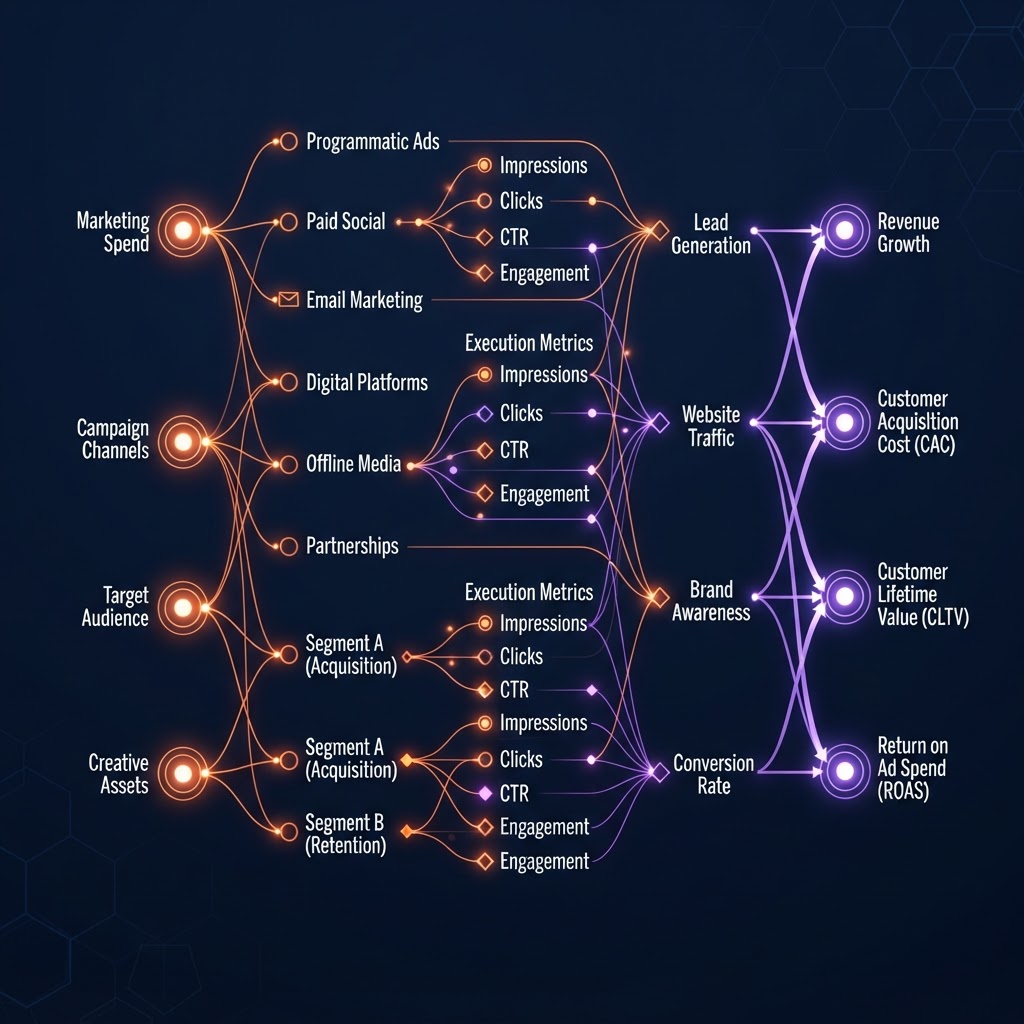
A journey is only useful when it ends in a decision
Measure decisions, not mentions
AI visibility creates a tempting new dashboard. Teams can count citations, recommendation appearances, and share of answers. Those signals can be useful, but they are not business outcomes.
A mention matters when it changes behavior. Did qualified traffic increase? Did more people reach a product page? Did calls become more relevant? Did store visits, sign-ups, purchases, or repeat orders improve? If the answer is no, the brand may be winning an attention contest rather than building demand.
The measurement stack should connect three layers:
| Layer | What to track | Why it matters |
|---|---|---|
| Visibility | Search appearances, citations, branded queries | Shows whether the market can find the brand |
| Engagement | Qualified visits, product views, calls, email actions | Shows whether the message creates interest |
| Business result | Revenue, margin, leads, repeat purchase, retention | Shows whether interest became value |
Teams often skip the middle layer. They jump from impressions to revenue and then argue over attribution. A cleaner system defines the decision first, then chooses the signal that can inform it. Conversion tracking before channel spend is still the right order, even when the channel is an answer engine.
First-party data helps close the gap. Search platforms can tell you that a person arrived. Your own customer data can show what they bought, whether they returned, and which promise attracted them. That is why a first-party data strategy for small teams matters more as measurement gets noisier.

The best measurement systems begin with a real customer decision
AI is an amplifier
The most useful way to think about AI search is as an amplifier. It can amplify a clear position, a strong proof system, and a well-organized body of useful content. It can also amplify contradictions, thin claims, stale information, and a broken path to purchase.
That is why shortcuts feel so attractive and disappoint so quickly. A team can generate more pages, tune more prompts, and buy another visibility platform. None of that answers the core question: why should the right customer believe this brand and take the next step?
The operating sequence is less exciting than a new hack, which is probably why it works:
- 1Clarify the audience, problem, offer, and difference.
- 2Collect proof in the language customers actually use.
- 3Give every important page a decision to support.
- 4Make the path from discovery to action obvious.
- 5Measure business movement, then inspect visibility as a contributing signal.
- 6Use AI to speed up the work without outsourcing judgment.

Technology helps, but the customer still decides whether the promise holds
Editor's Note: The strongest AI search strategy may look surprisingly ordinary from the inside. It is usually better positioning, better proof, better information architecture, and cleaner measurement.
What the next audit should find
A useful AI search audit should not begin with a list of prompts. It should begin with a customer and a decision.
Pick one high-value question someone asks before buying. Search it as a customer would. Compare what the answer engine says with what the brand says about itself. Then inspect the gaps. Is the offer unclear? Is the product hard to compare? Are reviews too generic? Are facts inconsistent across listings? Does the next step feel safe and obvious?
Fix the largest gap first. A clearer offer may improve conversion before it improves visibility. Better product facts may help customer service before they help rankings. A more honest review request may produce less volume and far more useful proof.
That is the part of AI search strategy that will age well. The tools will change. The customer will still need a reason to believe, a reason to act, and a reason to come back.
Frequently asked questions
Does AI search replace SEO?
No. It changes where visibility appears, but technical accessibility, useful content, structured information, reputation, and customer value still matter. Search optimization remains the foundation, not a discarded phase.
Should every brand create content for AI answer engines?
Every brand should create useful content for its customers. If the content is specific, accurate, easy to access, and supported by evidence, it has a better chance of being understood by both people and search systems.
What should a small team measure first?
Start with one business decision, such as qualified calls, purchases, booked consultations, or repeat orders. Then connect visibility and engagement signals to that result instead of building a large dashboard with no owner.
Are AI visibility tools worth buying?
They can be useful once the fundamentals are in place and someone knows what decision the data will support. Buying a tool before fixing the offer usually creates more reporting, not more demand.
How does this apply to regulated brands?
Accuracy becomes even more important. Product facts, eligibility rules, licensing details, local availability, and customer policies should be consistent across the website and external profiles. A confident answer built on bad information is a liability.
AI search will keep changing the surface where customers discover brands. The brands that last will not be the ones with the most clever prompts. They'll be the ones whose marketing is clear enough to repeat, specific enough to trust, and useful enough to act on.