
Starting Friday, October 30, 2026, OpenAI's help page says creative enhancements will be enabled automatically for new and existing ChatGPT Ads campaigns. You can opt out before that date, or change the setting after it.
Campaign settings take priority over the account default, and any opt out you already set stays in place.
That paragraph sounds like a minor default change. Read the next paragraph of the same help page and it stops sounding minor. Enhancements can take into account the conversation, your existing ad, and content from your landing page.
OpenAI may adjust headlines and descriptions, resize images, optimize destination URLs, or translate ad text. Variations may be prepared in advance or created in real time. When enabled, these ads can run automatically without you reviewing or approving each version.
So the decision due today is not whether you like AI written headlines. It is whether you are willing to run ads you have not read, in languages you may not speak, sending clicks to pages you did not pick. For most accounts, the right move is blunt.
Turn the account default off today. Then, if you want the upside, earn your way back in with one controlled test, on one campaign, against a matched twin.
Four levers, one toggle
OpenAI lists four changes, and one toggle controls all of them together. You cannot allow image resizing while blocking copy rewrites. You cannot allow a headline tweak while blocking a destination change. That bundling is the first thing to understand, because it kills the comfortable middle option where you keep the safe parts and switch off the risky ones.
Headlines and descriptions are the visible change. OpenAI's own example is gentle: a grocery ad that says "Fresh groceries delivered" becomes "Groceries for quick weeknight dinners" when the conversation is about weeknight dinners. The example assumes the original ad and landing page support the product and delivery details shown. Real campaigns are messier.
A headline rewritten for a conversation can soften a condition, drop a qualifier, or turn a specific offer into a general promise. The user reads the rewritten version as your ad. Your team never saw it.
Translation is the change with the least visibility. An ad translated into another language is still your ad, carrying your name, your price, and your claims.
If nobody on your team reads that language, nobody can check whether a regulated term translated cleanly, whether a price condition survived, or whether a local idiom changed the meaning. A translated ad you cannot read is an unreviewed ad in a market you cannot monitor.
Image resizing sounds harmless until a crop cuts a logo, a price badge, or a product detail that carried the claim. Resizing is the smallest risk on the list, and it still belongs in the same decision, because the toggle does not let you separate it from the rest.
Destination URL optimization is the change most coverage rushes past. OpenAI says the destination may be optimized to direct people to a relevant page on your website. Relevant to whom, and relevant for what, is not defined in the help page.
A click sent to a different page on your site is a click sent to a different conversion path, a different tracking setup, and possibly a different offer. That is not a cosmetic change. It is a routing change, made in real time, inside a conversation you do not see.
The approved ad is dead
Agencies built approval around a fixed artifact. A copywriter wrote a headline, a reviewer checked it, a client signed it, and that exact text ran. Creative enhancements break that chain in a specific way. The signed text becomes an input, not the output. The output is a set of variations, some prepared in advance, some created live, none of which get individual approval.
That means the approval document has to change shape. Stop asking a client to sign a headline. Ask them to sign a claims file for the campaign, with three columns.
Locked claims are facts that cannot change without a new signoff. Price, end date, guarantee terms, regulated claims, delivery promises, and anything a lawyer or a regulator would ask about. If a campaign carries locked claims, it does not belong in an enhancement test at all, because the toggle cannot promise to leave those claims alone.
Flexible phrasing is wording that can change without changing the promise. Tone, example, sentence order, and the way a benefit is framed for a conversation. This is the only column enhancements are allowed to touch in a test, and even then you cannot enforce the boundary through the toggle. You enforce it by keeping locked claims out of the test campaign entirely.
Forbidden claims are things that must never appear, even if they sound helpful. A new product, a new price, a comparison you have not verified, a testimonial style claim for a product with no testimonial on file. Write them down anyway. A forbidden list is how a reviewer spots a bad variation fast, instead of arguing about taste after it ran.
A claims file will not stop OpenAI from rewriting a headline. It will stop your team from arguing about whether a rewritten headline crossed a line, because the line was written before the rewrite ran.

Check the claims first. The headline is the least important thing a rewrite can change.
The quiet destination swap
Most advertisers will check the copy first and miss the routing. Do the routing check first.
OpenAI's help page says to keep ads and landing pages current, including prices, promotions, product details, and availability. That advice reads as housekeeping. Under enhancements, it is a warning. The rewrite draws on landing page content, so a stale promotion left on a landing page is not just a stale page.
It is source material for an ad variation. A price you changed in the ad but left on an old landing page can come back in a rewritten headline. An expired offer on a page you forgot can become the offer in a live ad.
Run a source diet before October 30. Open every landing page tied to a ChatGPT Ads campaign and remove anything you would not want quoted in an ad. Expired offers, old prices, discontinued products, testimonial quotes with specific results, and partner pages that carry claims you did not write.
Fix pages that have no conversion tracking, because a destination swap can send paid clicks there without you noticing for a week. If a page cannot convert and cannot be tracked, it should not be reachable from a paid click at all, let alone by an automated routing decision.
The reporting gap makes this worse. OpenAI's help page says Ads Manager reports at campaign, ad group, and ad level, with impressions, clicks, spend, click through rate, and attributed conversions where measurement is set up. It then says, plainly, that changes over time do not on their own establish the effect of creative enhancements. There is no report described that splits enhanced creative from your original.
So a before and after comparison after October 30 proves nothing about enhancements. Traffic, seasonality, and conversation mix all move at the same time. If you want to know whether enhancements helped, you need a twin, not a timeline. That protocol is below.
A translation you cannot read
Translation deserves its own rule, because it fails differently from a bad headline. A bad headline in English gets spotted by someone on your team, a client, or a customer who complains. A bad translation gets spotted by nobody you know, in a market where your brand has the least oversight.
If your campaign runs in more than one language, or if ChatGPT could translate it into a language your team does not read, keep enhancements off for that campaign. There is no partial translation control in the toggle.
You cannot allow English rewrites while blocking translation. The choice is the whole bundle or nothing, and for a multilingual account the bundle includes ads your team cannot review.
Single language campaigns still need a language check. Confirm the campaign targets one language, the landing pages are in that language, and the team reviewing complaints reads it. If any of those three fails, the campaign is multilingual in practice, whatever the settings say.
Three dates, one deadline
OpenAI's own material has shown three dates for this change, which is why waiting for clarity is the wrong move. The advertiser email quoted by Search Engine Land on October 21 says Friday, October 30. The help page read on October 29 says the same date.
Other coverage in the same week noted October 29 in earlier material and October 31 in a later help page version, with a weekday that did not match the calendar. Dates moved while the feature did not.
Plan around the earliest date you have seen, which has already passed in the sense that matters: today is October 29, and the switch lands tomorrow. Do not wait for a corrected help page to tell you the deadline.
The setting takes under a minute to change, and the cost of acting a day early is nothing. The cost of acting a day late is a live campaign running variations you never chose.
Keep a receipt. Screenshot the Creative enhancement toggle in Ads Manager under Manage settings, with the date visible, for each account you manage. Save it with the claims file.
If a partner or agency manages the account, ask in writing which setting they applied, and keep the reply. The help page says campaign settings override the account default, so an account level opt out does not protect a campaign whose own setting was left on. Check both levels, and check them again after any account update, because updates have a habit of re-enabling defaults on other platforms.
We flagged this switch in our October 23 post on Meta's AI ad terms, when the date in circulation was October 29. The date moved. The decision did not.
Meta's change, which takes effect November 20, makes advertisers solely responsible for content its AI features create or change, and it offers no single toggle that undoes the contract. ChatGPT at least gives you a toggle. Use it while it is still a choice, not a cleanup job.
The 30 minute preflight
Do this today, in this order, for every account that runs ChatGPT Ads. Thirty minutes is enough if you do not turn it into a strategy meeting.
Turn the account default off first, before you debate any test. Open Ads Manager, go to Manage settings, find the Creative enhancement card, and switch it off at account level. This protects every existing campaign while you sort the rest. You can turn a single campaign back on later, deliberately, and that campaign setting will override the account default.
List every campaign with locked claims, and leave those off permanently for now. Regulated categories, price pinned offers, time limited promotions, guarantees, and delivery promises all belong here. If a campaign would need a lawyer to approve a new headline, it does not need an automated headline writer.
Run the source diet on the remaining campaigns. Remove stale offers and old prices from their landing pages. Confirm conversion tracking on every page a click could land on, not just the page you chose. Archive a copy of each landing page as it stands today, so a later rewrite can be checked against the source it drew from.
Screenshot the setting at account level and at campaign level for the campaigns you touched. Date the screenshots. Put them in the same folder as the claims file. That folder is the only evidence you will have if a customer quotes a version of your ad that you never wrote.
Ask your agency or partner, in writing, which setting they applied to each account they manage. A verbal assurance is not a setting. If they run partner managed campaigns, confirm whether the self serve language in the email covers those campaigns, because the help page does not draw that line as clearly as the email does.

A twin campaign tells you what enhancements did. A before and after timeline tells you nothing.
Test it as a twin
If a campaign passes the locked claims check, the language check, and the source diet, it can earn a test. The test has to be a twin, not a before and after.
Pick one broad, evergreen campaign with stable volume, a single language, and one clear landing page. Clone it as closely as Ads Manager allows, with the same budget structure, the same offer, and the same landing page. Turn enhancements on for one version and off for the other.
Let both run for at least two weeks, longer if volume is thin. Compare click through rate, cost per conversion, and landing pages hit, side by side, for the same period. The measurement setup still matters more than the headline: if the plumbing is not wired, a twin test measures noise, not enhancements.
Do not compare October against November and call the difference an enhancement effect. OpenAI says so itself: changes over time do not establish the effect. Seasonality, conversation mix, and the switch itself all move at once. A twin holds those variables still, as far as any live test can.
Watch landing pages hit as closely as you watch conversion rate. If the enhanced twin sends clicks to pages the original never sent them to, that is a finding, even if the conversion rate looks fine.
Those pages may convert today and break tomorrow, when an offer changes and the tracking does not follow. Log every landing page the enhanced twin touches in the first week, and check tracking on each one before you expand the test.
Set a kill rule before the test starts, in writing. If a variation carries a locked claim, a forbidden claim, or a price that does not match the landing page, the test ends that day, not at the next review meeting. If the enhanced twin underperforms the twin on cost per conversion after two weeks, it ends too. A test without a kill rule is just a default with extra steps.
What to watch next
Three platform moves will decide whether this toggle stays a choice or becomes a template. Watch them in order.
First, whether OpenAI adds a split report for enhanced versus original creative. Until it does, every performance claim about enhancements, from OpenAI or from an agency, rests on a before and after read that OpenAI itself warns against. A split report would turn this from a policy decision into a measurement decision. Its absence is the reason to keep the test small.
Second, Google's review summaries in Search ads, which arrived the same week. Google now writes positive only summaries of online reviews into eligible Search ads in the United States, the United Kingdom, Australia, and India, and advertisers cannot edit the text. PPC Land's read of the Google help page notes there is no screenshot, no example, no reporting column, and no instruction for switching the feature on or off. ChatGPT gives you a toggle.
Google, on this feature, does not name one. The pattern is the same in both cases: the platform writes part of your ad from material you did not write for the ad. The control differs, and that difference is worth more than any single feature announcement.
Third, Meta's November 20 terms, where the advertiser carries sole responsibility for AI created or changed content. Put the three together and the direction is clear.
Platforms are moving from asking you to approve an ad to asking you to approve a system that writes ads. Approval has to move with it, from copy to claims, from one headline to a file that says what can change and what cannot.
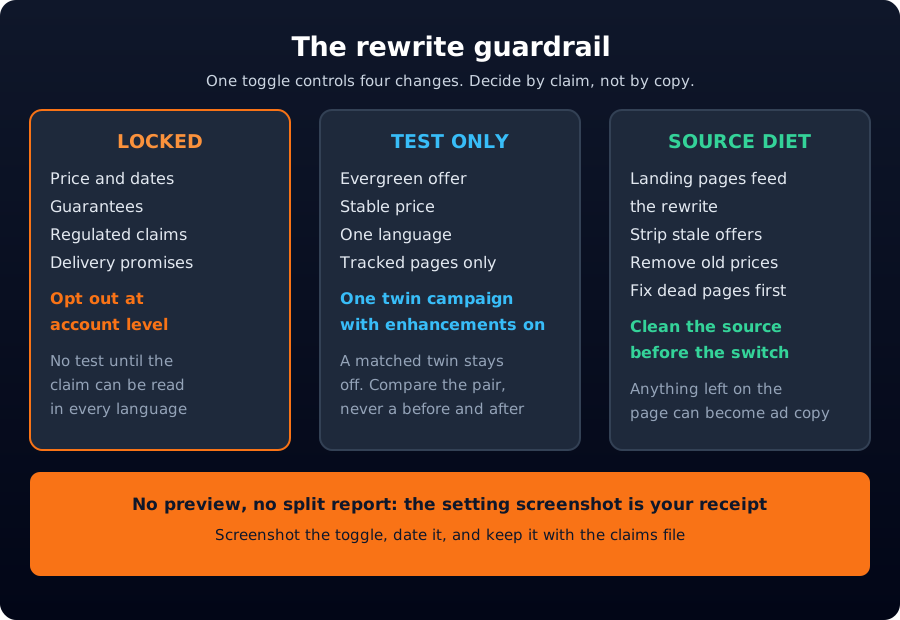
Your move today is small. Open Ads Manager, turn the account default off, and screenshot it. Then decide, campaign by campaign, which single test, if any, earns its way back on.
The brands that do that work today will have a claims file, a twin, and a receipt when someone quotes their ad back to them. The brands that wait will have a screenshot of someone else's version of their ad, and no record of when it changed.
Frequently asked questions
Creative enhancements are an OpenAI feature that adapts your ChatGPT ad to the conversation and to user interests. It can create new or updated headlines and descriptions, translate ad text, resize images, and optimize the destination URL to a different page on your website. Variations may be prepared in advance or created in real time, and they can run without you approving each version.
OpenAI's help page, read October 29, says Friday, October 30, 2026, for new and existing campaigns. Earlier OpenAI material showed other dates in the same week, so treat October 29 as the working deadline and check the setting today. You can opt out before the switch, or change the setting after it, in Ads Manager under Manage settings.
No, not through the toggle OpenAI has shown. One Creative enhancement setting controls headlines, translation, image resizing, and destination URL changes together. If you want only one kind of change, the current control does not offer it. That bundling is why the account level decision matters more than any single variation.
An account opt out protects campaigns that follow the account default. Campaign specific settings take priority, so a campaign with enhancements left on will still run them. Check both levels, and recheck after account updates. Existing opt outs are preserved, according to OpenAI, but a setting you never checked is not an opt out.
No. OpenAI says the experience does not provide a preview of every variation, and enhanced creatives can run automatically without review or approval of each version. That is why the preflight matters more than the review step: clean the source, lock the claims, and screenshot the setting before anything runs.
Run a twin, not a before and after. Clone one evergreen, single language campaign with a stable price and tracked landing pages. Turn enhancements on for one version and off for the other, run both for at least two weeks, and compare click through rate, cost per conversion, and landing pages hit for the same period. Set a kill rule in advance: a locked or forbidden claim, or a mismatched price, ends the test that day.