Agentic AI is running your marketing funnel now. Your content agent published three posts last week. Your attribution AI assigned credit to channels you didn't even know were active. Your optimization agent rebalanced your ad spend by 18 percent overnight.
The results look clean in dashboards. Performance up 30 percent. Cost per acquisition down 24 percent. Content throughput doubled.
The problem? You don't actually know if those numbers are real.
The measurement gap nobody talks about
AI marketing tools are built on a shared assumption: that the data flowing through your marketing stack tells the full story of a customer's journey. Google Analytics tracks clicks. Your CRM logs conversions. Your ad platform reports impressions. Attribution AI stitches it together and declares winners and losers.
This works when the system is closed. When all the signals are first-party. When the customer path is linear: ad to click to conversion.
AI broke that assumption.
Agentic AI systems don't just optimize within your existing data. They generate new data. Content agents write copy that competes with your brand's voice. AI optimization creates variant audiences you didn't define. Attribution models infer influence across channels that historically couldn't be measured together.
That's the gap: the AI is producing signals your measurement tools were never designed to validate.
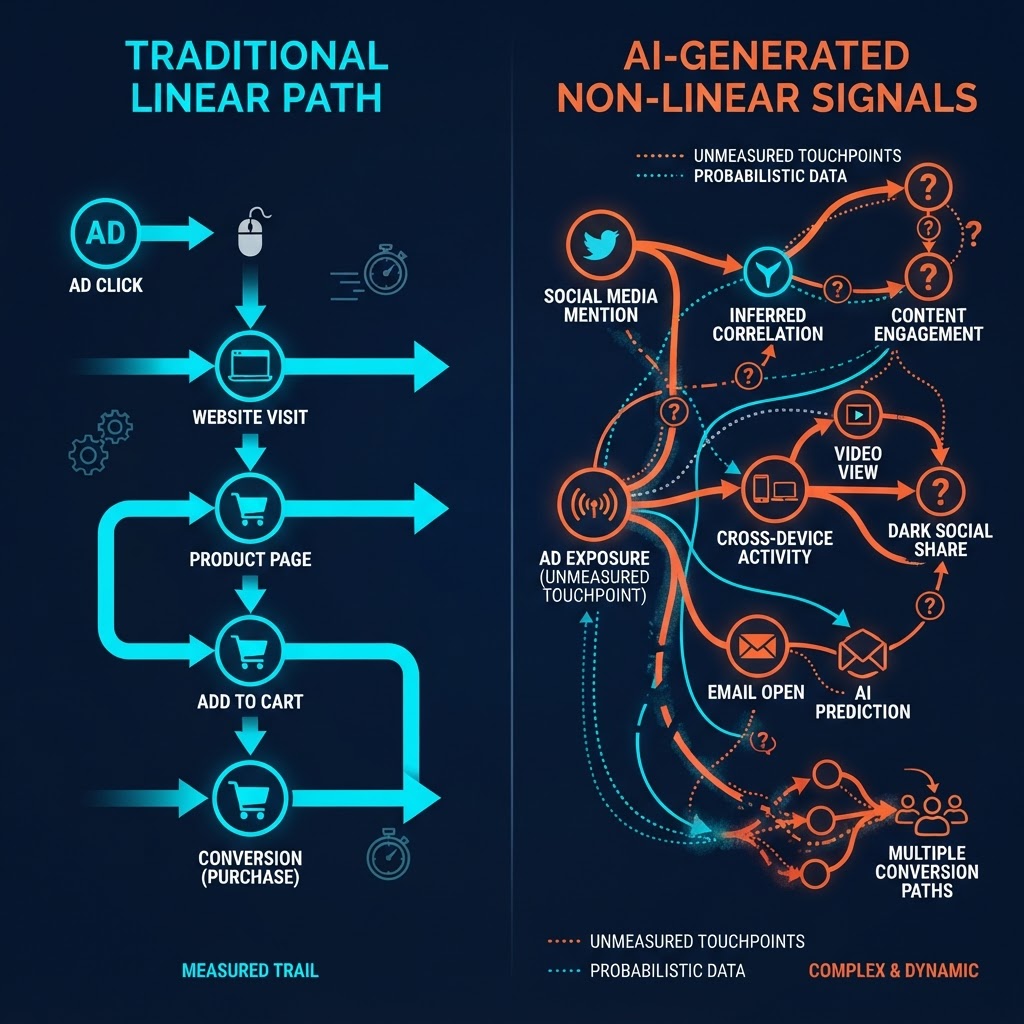
Traditional linear measurement vs AI-generated signals
Why the cannabis operator is trapped hardest
Cannabis marketing operators are facing a double-bind.
First, the compliance and data reality: state regulators require you to be able to defend every marketing claim, every audience targeting choice, every influencer disclosure. Your audit trail needs to be bulletproof. You can't say "the AI optimized this" and call it done. You need proof.
Second, the tool reality: the AI platforms promising 30-40 percent performance gains are black-boxing attribution at the exact moment you need transparency the most. You run a Facebook campaign targeting 21+ users in California. The AI agent reallocates budget to a lookalike audience that performed better.
Did it perform better, or did something in the data sampling break the accuracy? You need to prove the first one happened. You can't.
This isn't a theoretical problem. Operators are already hitting this wall:
- A Colorado dispensary ran an agentic content campaign that outperformed their baseline by 28 percent. They can't audit which content variants actually drove the lift because the agent didn't log the creative decisions it made.
- A California operator used AI attribution to shift budget away from SMS and toward email. The model showed email had 2.3x higher ROAS. Three weeks later, platform data corrections showed the SMS revenue was undercounted by 40 percent. The budget was already moved. The quarter is already tracked.
- A Nevada operator's AI agent automatically adjusted audience targeting to age-verified users only in response to a regulatory change. The agent executed the change correctly but didn't notify the compliance team. So the team kept running the old creative in the wrong version. It took them two weeks to notice.

Cannabis operator facing AI measurement and compliance challenges
The real cost of this gap
It's tempting to ignore this. The dashboards look good. Your team is shipping faster. Your cost per result is down.
But the cost shows up in three places:
Regulatory exposure: If you're audited and can't prove your AI-driven decisions were accurate, you're not just explaining a bad campaign. You're explaining why you didn't control your own marketing stack. Cannabis regulators are watching.
Compounding attribution debt: Each quarter you run with unexplainable AI decisions, your measurement baseline gets less reliable. You can't build next quarter's forecast on ground you can't stand on. You're planning from bad data.
Opportunity cost: You're shipping campaigns faster, but you're also optimizing based on signals you can't verify. You might be killing channels that actually work but look bad in the model. Or doubling down on channels that look good but are fragile to platform changes.
What operators should do now
You don't need to stop using AI. You need to stop treating your measurement system like it's optional.
- 1Map what the AI is deciding - Every autonomous system in your stack should log its decisions in a format you can audit. Not just results. The reasoning.
- 1Validate the validation - Pick your highest-trust channel (probably email or SMS) and compare what the AI says happened to what you can verify independently. If they match, trust the AI a bit more. If they diverge, find out why before you scale.
- 1Sandbox compliance-critical decisions - Don't let the agent make regulatory-facing choices without a human loop. Audience targeting adjustments. Age verification logic. Influencer disclosure tagging. Those decisions need to be auditable by design.
- 1Separate speed from truth - Your AI can run faster than you can measure. Accept that. Don't confuse speed with accuracy. Slow down the decisions that matter.
FAQ
A: You need to be able to explain what drove your marketing decisions and how you verified them. Whether or not you explicitly mention "AI" depends on your state's guidance. Err toward transparency. Most regulators are less upset about the technology than about not being able to explain it.
A: Yes, but run them in parallel, not in sequence. Don't let AI results override your traditional model without a sanity check first. The two systems often tell different stories. Both stories are data. Your job is to figure out which one's closer to truth for this quarter.
A: That's a problem. It means you've outsourced a decision you're ultimately responsible for. Either get a system that logs decisions or don't use the autonomous features. That might sound like it defeats the purpose, but it doesn't. It just means you're using the tool to execute faster, not to decide what happens.
A: Yes, but you own the output. The AI generates copy. You verify it against state rules before it ships. Your compliance team needs to sign off on AI-generated content the same way they would human-written content. The tool doesn't change the responsibility.
A: A regulator asks you to justify a campaign decision. You can't. You say "the AI decided." They ask you to show the data. You can't. They ask who verified the data. You say nobody did, the AI handled it. You're now the operator who doesn't control their own marketing system. In cannabis, that's regulatory exposure and fines. In other verticals, it's just reputation damage.
The AI speed-truth tradeoff
AI marketing tools are genuinely better at some things. Faster content production. Quicker optimization cycles. Broader pattern recognition across noisy data.
But they're not better at the thing that matters most in regulated markets: explaining what they did and why it was right.
You can have fast or you can have true. Right now, most operators are trading true for fast and hoping no one notices.
The operators who'll win are the ones who figure out how to get both.