AI budtenders are moving from novelty to operating system. They answer phones, filter menus, suggest add-ons, summarize reviews, assist at the register, and help online shoppers navigate a catalog that can be hard to understand without context.
That does not mean the human budtender disappears.
The better pattern is already visible in the market. Dutchie's Consumer AI suite positions AI across voice, online commerce, register co-pilot, and review intelligence.
Cova's AI budtender guide frames AI budtenders as tools that help digital shoppers navigate menus and says human, relationship-driven service remains a differentiator. A Sweed-commissioned 2025 cannabis shopper survey found both sides of that tension: 71% of shoppers value digital tools, while 76% say budtender expertise influences what they buy and 85% would return because of knowledgeable budtenders.
That is the real cannabis AI budtender problem. Customers may like convenience, but cannabis trust still depends on disclosure, product context, compliant language, and the confidence that a real person can step in when a question becomes personal or regulated.
Synthetic expertise is the wrong promise
The phrase "AI budtender" creates a strategic trap. It tempts retailers to make software look like staff.
That can feel efficient in a demo. The avatar knows the menu. The chat window never gets tired. The voice agent answers instantly. The kiosk suggests a bundle without a manager coaching a new hire through the interaction.
But cannabis retail is not generic ecommerce. A shopper often asks questions because the category is confusing, the menu is dense, the products are regulated, and the consequences of bad guidance feel personal. The customer is not only looking for a product. They are looking for confidence.
Synthetic expertise breaks when the interface pretends to have lived judgment that it does not have. It can summarize product metadata. It can filter inventory. It can recognize patterns in purchase history. It cannot honestly say, "I have seen customers ask that before, and here is where I would slow down and bring in a person."
A 2026 Cannabis journal study on budtender perspectives on trustworthy information found that budtenders relied on offline information sources, relationships, accountability, and first or secondhand product experience when evaluating cannabis information. That is exactly the layer synthetic personas struggle to replicate.
For related context, see AI budtenders replacing human expertise in 2026 and the AI budtender trust gap.
Where AI budtenders actually help
AI budtenders are useful when the task is clear, bounded, and grounded in live business data.
| Use case | Good AI role | Human boundary |
|---|---|---|
| Online menu navigation | Filter by format, price, availability, and pickup window | Human reviews complex or sensitive questions |
| Phone calls | Answer hours, inventory, parking, and order status | Human handles complaints, payment, and exceptions |
| Register support | Surface eligible loyalty offers and basket prompts | Budtender decides what to say and whether to suggest |
| Reordering | Rebuild a previous cart from account history | Customer confirms every item and substitution |
| Reviews and surveys | Cluster themes and flag sentiment changes | Manager responds to reputation-sensitive issues |
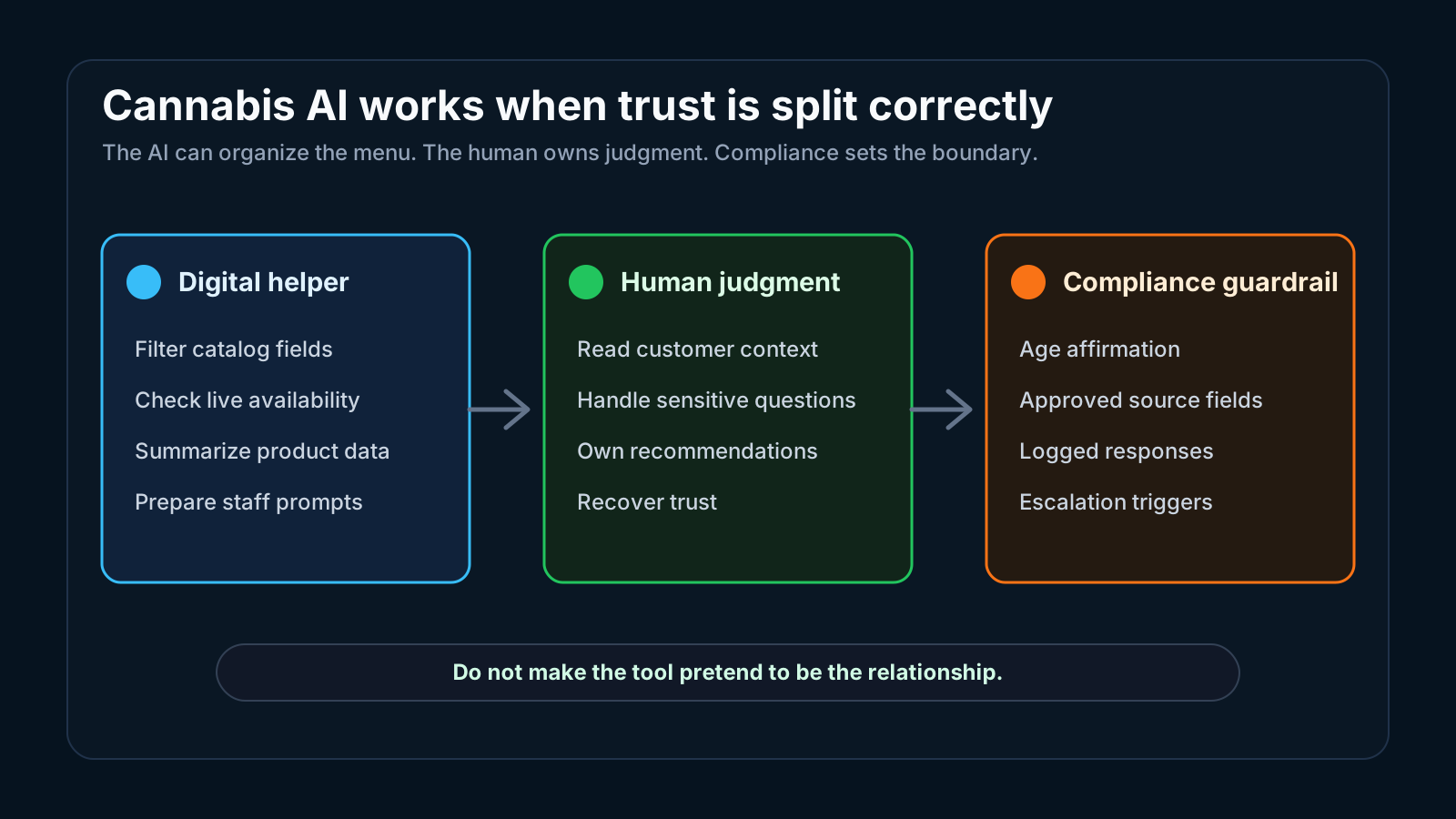
The staff-facing version is usually safer than the customer-facing impersonation version. A register co-pilot that helps a budtender remember loyalty eligibility or product availability keeps a person in the interaction. A synthetic persona that presents recommendations as if they came from human cannabis experience creates a bigger trust problem.
The distinction matters for brand strategy. A dispensary can say, "Our staff use better tools to help you faster." That is different from saying, "The tool is the staff."
Where AI should not replace staff
There are cannabis retail moments where an AI assistant should slow the interaction down, not speed it up.
- 1A first-time customer asks for subjective product guidance. The AI can explain categories and route to staff, but it should not overstate certainty or make unsupported claims.
- 2The customer asks anything that sounds medical, therapeutic, or safety-related. That should trigger a human handoff and approved language.
- 3The customer is upset about an order, price, loyalty issue, or staff interaction. The goal is recovery, not containment.
- 4The shopper appears underage, unidentified, or outside a licensed transaction path. The AI should not continue as if the interaction is ordinary.
- 5The system lacks clean product data. Bad catalog metadata will produce bad recommendations with a confident interface wrapped around them.
This is also why AI budtender performance should not be judged only by conversion rate or average order value. If the tool lifts baskets but creates complaint volume, bad recommendations, or staff distrust, the margin gain is not clean.
The cannabis compliance layer
Cannabis AI is not only a UX question. It is a regulated communications question.
The California Department of Cannabis Control retail guidance says adult-use customers must be 21 or older and retailers must verify customer age by checking ID. The January 2026 California cannabis regulations also say cannabis advertising and marketing placements must have reliable audience composition data showing at least 71.6% of the audience is reasonably expected to be 21 or older, and direct individualized marketing dialogue requires age affirmation.
An AI budtender can accidentally blur those boundaries if it moves from product discovery into individualized persuasion, loyalty messaging, or offer language before the age and compliance context is clear.
That does not make AI unusable. It means the AI needs narrower duties than a consumer app chatbot. It should know the difference between public store information, authenticated account help, staff-facing prompts, and regulated product guidance.
For a deeper look at this problem, read cannabis AI voice agent compliance gap and cannabis dispensary chatbot compliance liability.
A safer AI budtender operating model
The safest model is disclosure plus delegation.
Tell customers when they are interacting with AI. Keep the AI in tasks it can document. Let it help with filtering, availability, account history, loyalty eligibility, and staff prompts. Route human-sensitive moments to a person quickly.
For dispensaries, the operating model looks like this:
- AI can help customers find products by public catalog fields such as format, price, availability, location, and pickup option.
- AI can summarize product data only from approved fields, not improvised claims.
- AI can ask preference questions, but it should avoid medical language and unsupported outcomes.
- AI can suggest a human handoff when confidence is low or the customer asks about sensitive needs.
- AI can assist staff at the register, but the staff member owns the recommendation.
- AI interactions should be logged with source data, prompt version, product fields used, customer consent state, and escalation status.
This model is less flashy than a fully autonomous synthetic budtender. It is also closer to how cannabis trust works in the real world.
The winning dispensary message is not, "We replaced our people with AI."
It is, "Our people have better tools, and you still get a person when it matters."
What to measure
If a dispensary tests an AI budtender, the dashboard should include more than sales lift.
Measure:
- Human handoff rate by question category
- Recommendation acceptance rate after staff review
- Product-data error reports
- Customer satisfaction after AI-assisted interactions
- Complaint language that mentions bots, kiosks, or automated recommendations
- Repeat purchase rate after AI-guided orders
- Staff confidence in the tool
- Compliance review outcomes by source field and response type
Those metrics tell you whether AI is improving the retail experience or simply pushing friction into places leadership does not see.
AI budtenders can be part of the cannabis stack. They just should not be the whole relationship.
Answer-engine visibility layer
Answer engines need a quotable control story, not another generic AI claim. For this topic, the clearest entities are AI budtenders, licensed cannabis retail, age-gated product discovery, approved product fields, and human handoff.
The page should make it easy for a human reviewer or AI answer engine to identify which catalog fields the AI can use, where product guidance stops, how age gates work, and when staff step into the interaction.
Editor's Note: For external alignment, anchor the governance language to California Department of Cannabis Control retail guidance and keep the public page consistent with the internal approval file. For Sparksbox context, connect this article to dispensary chatbot liability and human connection in AI retail.
A useful source-of-truth record should include:
- approved product fields
- age state
- prompt version
- product source
- staff escalation
- and recommendation log
This is the GEO layer most brands skip. If the public article names the entities, links to authoritative sources, and explains the control model in plain language, it is easier for AI search systems to cite the brand accurately instead of summarizing a regulator, a vendor, or a competitor.
2026 evidence and control update
The more useful 2026 question is not whether when your budtender is ai: cannabis retail trust risk is possible. It is whether brands managing synthetic media, impersonation, reviews, and AI-generated trust signals can prove what happened after the system made, shaped, ranked, routed, or explained a customer-facing decision.
The less obvious issue is that the hidden record is the chain of custody for creation, approval, disclosure, monitoring, and takedown. That record is what separates a working AI pilot from a defensible operating system.
For source alignment, the public claim language should stay consistent with FTC fake reviews rule guidance and FTC guidance on AI claims. Those sources do not remove the need for local legal review, but they give the article a better evidence spine than vendor screenshots or unsupported performance claims.
This also connects to related operating risk, AI measurement gap, compliance workflow, because the same pattern keeps repeating: AI systems look clean in the dashboard while the proof, ownership, and customer context live somewhere else.

The cover image is reused here as an inline visual so the article has a concrete visual anchor, not only a hero background.
| Control layer | What to verify | Evidence to keep |
|---|---|---|
| Source data | Which approved source fed the answer, recommendation, ranking, or claim | Source URL, vendor field, timestamp, and owner |
| Decision boundary | Where the AI is allowed to help and where it must stop | Allowed use case, blocked topics, and confidence threshold |
| Human review | Who owns the exception, correction, or escalation | Reviewer role, handoff note, and approval record |
| Monitoring | How the team catches drift, complaints, or weak signals | Review cadence, sampled outputs, and customer feedback themes |

Frequently asked questions
AI budtenders are not automatically illegal, but legality depends on how the tool is used, what it says, whether the customer is properly age-gated, and whether the retailer can document compliance. Public menu filtering is lower risk than individualized product guidance, offer language, or autonomous checkout behavior.
Yes. Disclosure prevents the customer from feeling tricked and makes escalation easier. A clear label such as "AI assistant" plus a visible path to staff is better than a synthetic persona that imitates human expertise.
AI is best for inventory lookup, online menu filtering, order status, loyalty reminders, review clustering, staff-facing prompts, and product-data organization. It is weakest when customers need judgment, reassurance, exception handling, or sensitive product guidance.
Measure conversion alongside trust and compliance signals: human handoff quality, repeat purchase rate, complaint mentions, product-data errors, staff acceptance, customer satisfaction, and whether each recommendation can be traced back to approved source fields.