For decades, the cannabis retail experience lived on human expertise. A knowledgeable budtender was the gatekeeper, the trusted source who cut through product confusion and built loyalty. Now, dispensaries are shipping AI systems into that exact role, and the shift is revealing something uncomfortable.
The budtender was never just a consultant. They were a sales mechanism, a data point, and a moat against competitors.
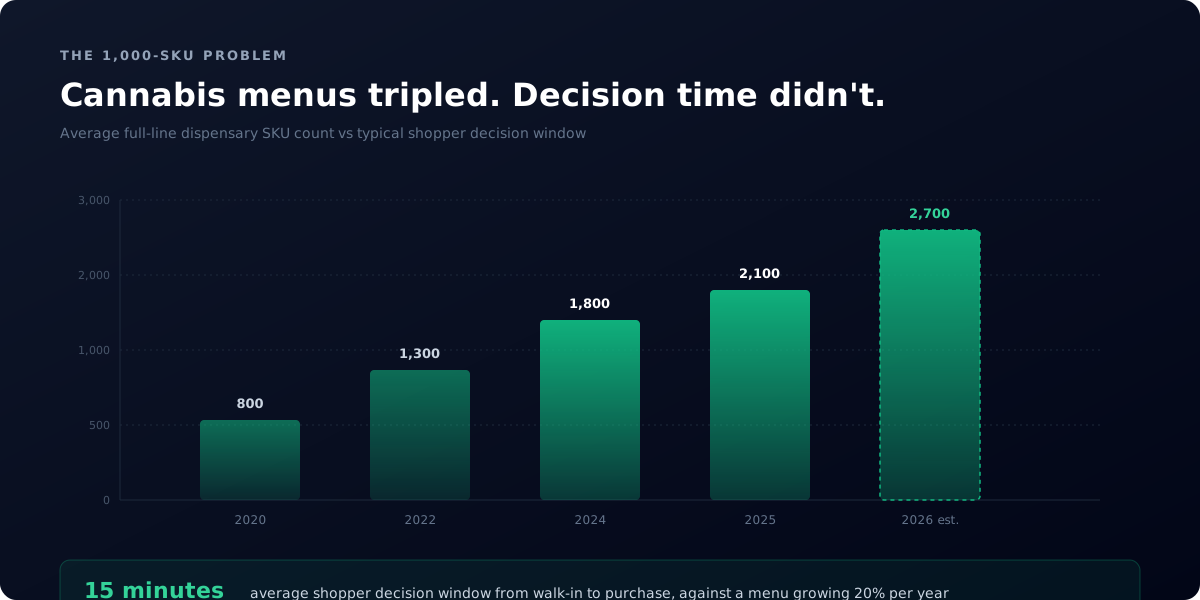
What is the 1,000-SKU problem in cannabis retail?
A stock keeping unit (SKU) is a single sellable variant of a product, the unique pairing of brand, format, strain, weight, and potency. Walk into a modern cannabis dispensary and you hit a wall of them. Headset's 2025 retail benchmarks put the average full-line dispensary at 2,000+ SKUs, with top-tier stores carrying 3,000+.
Strains, edibles, vapes, concentrates, topicals, wellness products. Each with their own effects, terpene profiles, potency levels, and price tiers.
A customer with 15 minutes and a specific problem (insomnia, focused creativity, pain relief) faces what behavioral economists call choice paralysis.
The budtender's job was to compress that chaos into three or four recommendations. Experience, intuition, familiarity with local customer data. It worked, but it didn't scale. You needed trained staff on the floor every hour the store was open.
Enter the AI budtender. Systems like Herbie AI, Ask Bud-i, and emerging competitors are now handling that exact task 24/7, across online and in-store channels. They do it in seconds. No bias, no fatigue, no knowledge gaps across shifts.
According to operator case studies shared at MJBizCon 2026, regulated retailers deploying AI budtenders are reporting a 40% reduction in customer support tickets, a 23% increase in average order value, faster checkout times, and higher post-purchase satisfaction scores. That's not anecdotal. That's adoption metrics that matter.
Who is actually making the recommendation when an AI budtends?
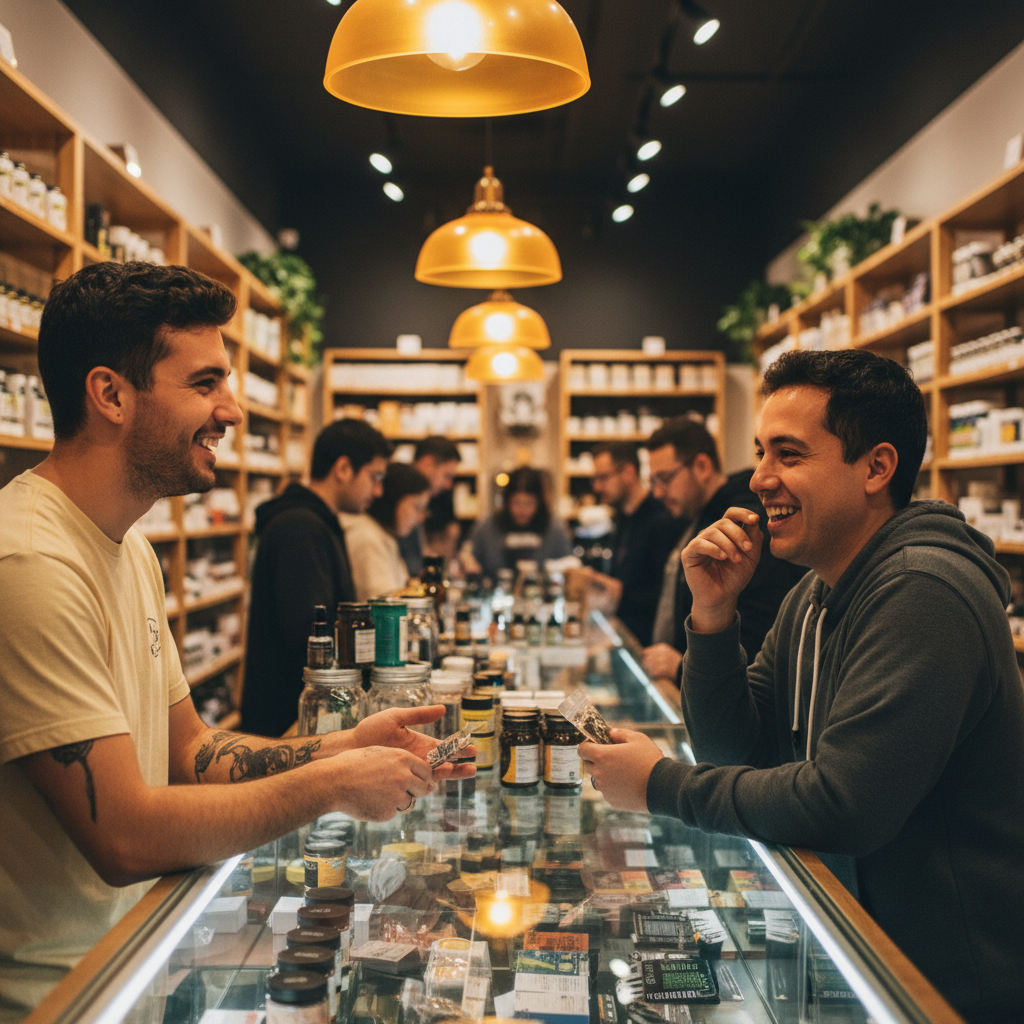
Here's where it gets strange. When a human budtender recommends a product, you're buying their recommendation. You trust their experience, their motives, their stake in your satisfaction.
When an AI recommends it, you're not buying expertise. You're buying algorithmic optimization trained on dispensary sales data, inventory levels, profit margins, and customer behavior patterns. The AI budtender has zero stake in whether you love the product. It has every incentive to clear inventory, optimize order value, and move you through checkout.
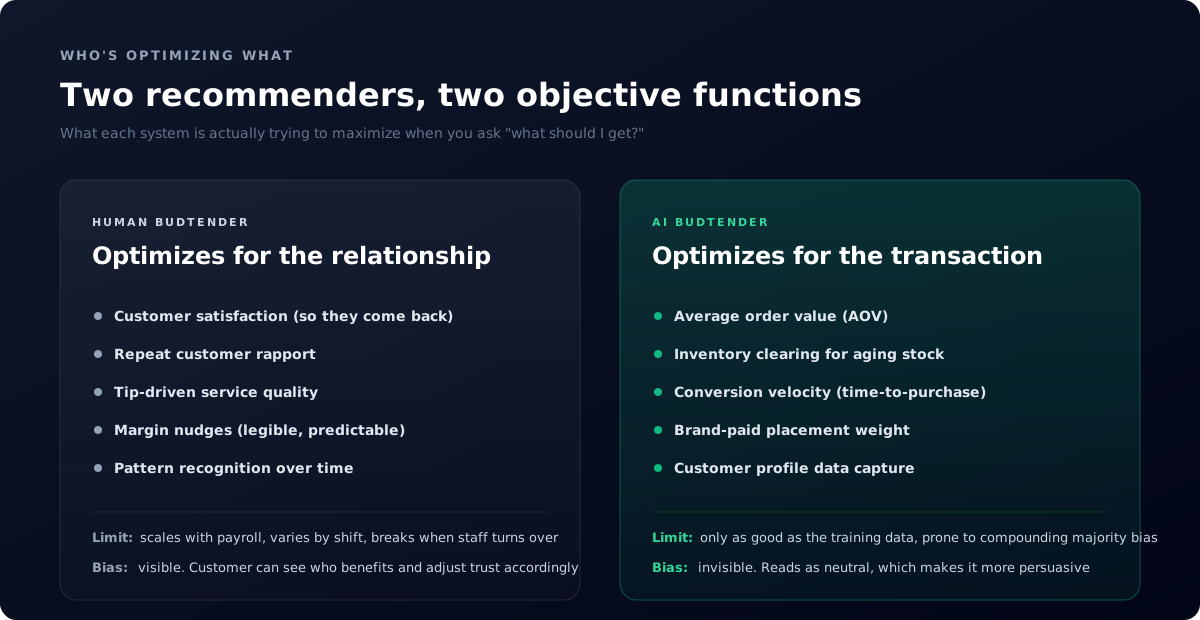
Regulated retailers aren't hiding this. They're actively marketing it as a feature: "Our AI learns your preferences and recommends what you'll love." But what it's actually doing is predicting what you'll buy based on historical shopping patterns and what's most profitable to sell.
The interesting part: customers don't seem to care. In early 2026 adoption data referenced by BDSA's cannabis consumer reports, cannabis consumers reported higher trust in AI recommendations than human budtenders, citing reduced pressure, better product diversity suggestions, and 24/7 availability.
This mirrors what we've seen in other sectors where the trust gap between humans and AI systems is narrowing based on perceived neutrality rather than actual competence.
Why? Because the human budtender's motives were always legible. Recommendations favored higher-margin products. Repeat customers got better service. New customers got a standard pitch. Everyone knew it.
The AI budtender operates under the veil of neutrality. It feels objective. And that perceived objectivity is more powerful than actual expertise.
Editor's Note: We covered the underside of this in Cannabis Personalization Has a Liability Problem, the same data fueling the recommendation engine is the data regulators will eventually subpoena.
Who owns the customer relationship when an AI is the front door?
This is the real shift. A human budtender built repeat customer relationships through face time, memory, and personal rapport. Those relationships were sticky but not portable. The budtender leaves, the relationship breaks.
An AI budtender builds a data file. Every interaction trains the system. Purchase history, browsing behavior, time of day preferences, product format preferences, price sensitivity, effect preferences. Over months, the AI knows you better than any human ever could.
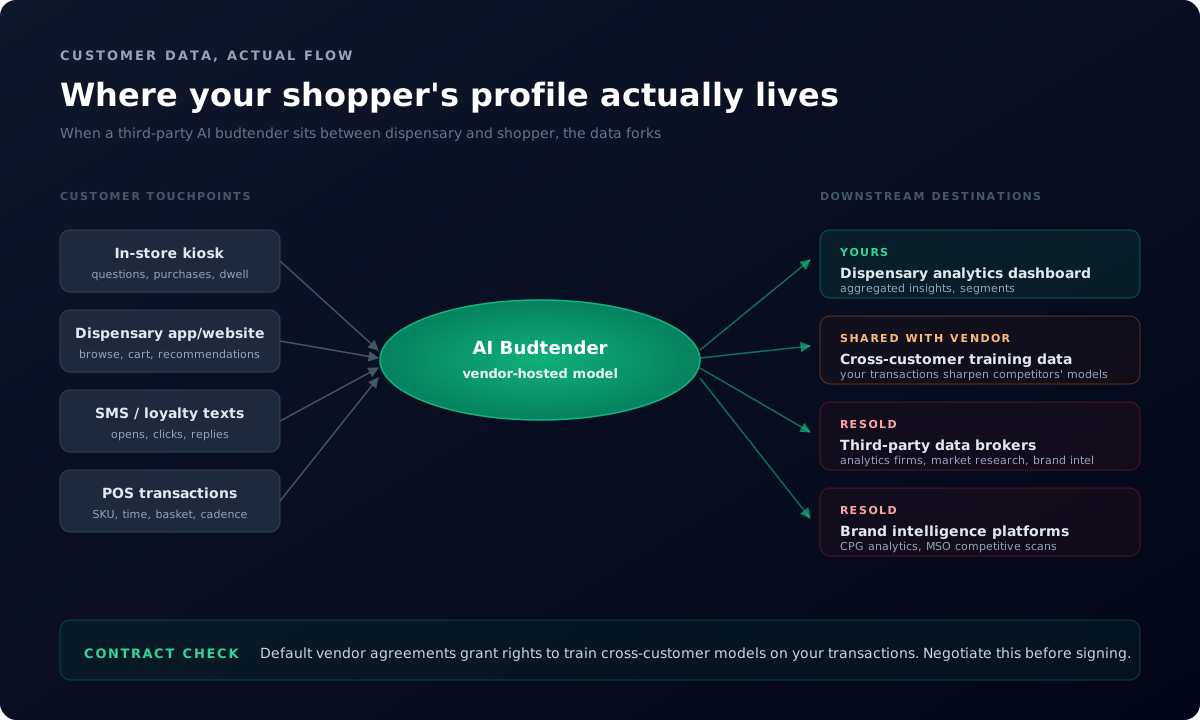
That data lives with the dispensary, not with the customer. And often it lives with the AI vendor, not the dispensary. Retailers using third-party AI systems now have what amounts to a behavioral profile of every customer, but the vendor has the same profile and can resell it.
That's valuable for upsell. It's also becoming valuable for analytics firms, brand tracking, and competitive intelligence.
Cannabis is highly regulated, but data capture isn't. Retail locations are building customer models that border on surveillance capitalism without the compliance friction they'd face in other industries.
The AI budtender doesn't replace human expertise. It replaces the need for the human relationship to access that expertise. And that's a much larger shift.
Can independent dispensaries compete with MSO AI budtenders?
Here's the uncomfortable part for independent dispensaries. An AI budtender is only as good as the data it's trained on. Multi-state operators (MSOs) with millions of transactions have massive datasets. Their AI systems are more accurate, more personalized, better at predicting behavior.
The data gap shows up in three forks for independents:
| Path | Trade-off | Realistic outcome |
|---|---|---|
| Use a third-party AI budtender | Lose proprietary customer data to a vendor that resells signal | Faster lift, weaker moat |
| Build your own | Falls behind MSOs on model accuracy from day one | High cost, no parity |
| Don't adopt | Lose customers to competitors who do | Steady erosion |
| Co-op shared model with other independents | Data pooled with peers, governance complexity | Best long-term play, hardest to start |
This is consolidation by another name. The brands with the most customer data win. The brands with the best AI budtender tech win. Independents get squeezed.
For customers, this means loyalty is increasingly to the platform, not the brand. You're loyal to the dispensary with the best AI experience, not the one with the best budtender or community vibe. And that loyalty transfers the moment a competitor's AI gets smarter.
This accelerates the shift toward AI-driven discovery over brand discovery, fundamentally rewriting how cannabis products get found and purchased. Regulated brand teams thinking through this should look at our dispensary marketing services for the data architecture side.
What actually gets lost when AI replaces the floor budtender?
Human expertise in cannabis isn't gone. But it's being repositioned. Instead of floor expertise, it's becoming edge expertise: product development, compliance strategy, inventory curation, community building.
The transactional expertise, the "what should I buy for this problem" moment, is now algorithmic. And that matters more than it sounds because that's where customer habit forms, where trial happens, where brands get discovered.
The budtender was never just answering a question. They were a discovery mechanism disguised as customer service. Now the AI is the discovery mechanism, trained to optimize for conversion and repeat purchase, not for honest product feedback.
Retail locations that double down on this will grow faster, serve more customers, and capture more data. Retail locations that rely on human expertise as a differentiator will find it harder to compete.
The last thing to note: customers aren't demanding better AI budtenders because the service is bad. They're demanding them because the choice problem is real and getting worse as product menus expand. AI is a solution to a problem retailers created. And in solving it, it's subtly changing who controls the cannabis retail relationship.
How to deploy an AI budtender without losing customer data control
If you're a dispensary or MSO weighing this, the order of operations matters.
- 1Audit what customer data your current vendor or candidate vendors actually see. Get the data dictionary in writing, not the sales-deck summary.
- 2Negotiate data ownership and resale clauses before signing. Default contracts let the vendor train cross-customer models on your transactions.
- 3Run the AI on first-party data infrastructure when possible. Even when the model is hosted, the training and feature data should live in storage you control.
- 4Set explicit data retention windows and deletion mechanics. Cannabis regulators in California, New York, and Massachusetts are starting to ask about this in audits.
- 5Build human override paths for high-value or high-risk customers. The AI should hand off to a budtender or compliance officer when purchase patterns flag medical use, repeated high-potency edibles, or first-time buyers.
The dispensaries doing this well are treating the AI budtender as a layer, not a replacement. The ones treating it as a replacement are the ones who'll find their customer relationship belongs to a vendor in 18 months.
The human expert didn't disappear. They just got optimized into efficiency, which is another way of saying they got replaced by something cheaper, faster, and more profitable. The question for retailers isn't whether to adopt. It's whether the customer relationship still belongs to you when you do.
FAQ
An AI budtender is a recommendation system trained on a dispensary's product catalog, sales data, and customer interactions that helps shoppers choose products. It runs in chat interfaces, kiosk screens, dispensary apps, and in some cases inside in-store displays. The leading systems in 2026 include Herbie AI, Ask Bud-i, and AI features built into POS providers like Dutchie and Leaflogix.
On consistency, availability, and SKU coverage, yes. AI budtenders don't have off shifts and they know every product equally well. On nuance, ethical disclosure, and edge-case medical conversations, human budtenders are still ahead. The realistic answer is that they solve different parts of the problem and the strongest dispensaries are running both.
Early 2026 data from cannabis consumer surveys (BDSA, Headset) shows trust in AI recommendations matches or exceeds trust in human budtenders, mostly because customers perceive the AI as neutral. That perception is doing more work than the actual recommendation accuracy. The AI is optimizing for inventory turnover and order value, not customer satisfaction.
It depends on the contract. Most third-party vendor agreements grant the vendor rights to train cross-customer models on your transaction data. That means a competitor running the same vendor benefits from your data. Independent dispensaries should negotiate this aggressively before signing or use vendors that contractually isolate training data.
Pricing in 2026 ranges from $300-$2,000 per location per month for SaaS recommendation engines, plus implementation. Custom-built systems for MSOs run $250K-$1M for initial deployment depending on POS integration depth. The ROI math usually favors adoption, the contract math doesn't always.
Not in the near term. Floor budtenders are being repositioned toward complex consultations, medical conversations, and high-LTV customer relationships, while AI handles the standard transactional discovery. Retail locations cutting headcount entirely are the ones that lose differentiation fastest because the AI experience becomes commoditized.
Not on data scale. Independents that compete by joining co-op AI initiatives with peer dispensaries, doubling down on community and curation, or partnering with brands directly to inject brand-level intelligence into recommendations have the best path. Going head-to-head on AI accuracy with a vertically integrated MSO is a losing fight.
2026 evidence and control update
Cannabis recommendation systems now sit between retail advice and automated persuasion. That means the control model should borrow from the California DCC retail rules, the FTC's warning around deceptive AI claims and schemes, and the NIST AI Risk Management Framework principle that AI systems need governance, mapping, measurement, and management.
The point is not to turn every chatbot answer into legal review. It is to make the default path defensible before the shopper ever sees it.
| Control area | Why it matters now | What to document |
|---|---|---|
| Data source | AI quality depends on the inputs behind the answer | Vendor feed, POS field, menu source, or policy document |
| Rule layer | Cannabis rules still vary by market and channel | State rule, platform policy, age gate, claim restriction |
| Human review | Edge cases should not be decided only by automation | Reviewer, escalation threshold, approval or rejection note |
| Evidence trail | Future audits need more than screenshots | Timestamp, prompt/output pair, creative version, final URL |

