Cannabis retailers are facing a silent trap. They're buying AI-powered attribution tools because everyone else is, because the pitch deck says "30% ROI uplift," because their CMO is nervous about falling behind. But when regulators ask for proof, the whole stack collapses.
The FTC doesn't care that your AI vendor says the model works. They care about substantiation. Cannabis retailers operate in one of the tightest regulatory environments in American marketing.
Your state regulator may require proof for claims, audience controls, and campaign approvals. Your local jurisdiction may add another layer. And now you're building attribution models on top of AI outputs that can be hard to reproduce?
This is the cannabis AI attribution squeeze: you need measurement to compete, but measurement claims have become a liability.

Attribution is only useful in cannabis if the operator can defend how the model reached its conclusion.
The Compliance Teeth
Cannabis marketing compliance has always been strict. AI has added a new proof problem.
The FTC has already brought deceptive AI claims actions, and the same substantiation logic applies when marketers claim an AI system produced a specific lift, audience improvement, or compliance benefit.
The pattern: A brand claims "AI-powered targeting reduced CAC by 28%." The FTC asks for the methodology. The vendor's response: "Our proprietary model uses machine learning to..." The FTC doesn't accept that. They want reproducible math. They want to see the data. They want to know where the 28% came from and whether it holds under different conditions.
For cannabis retailers, this gets worse. Cannabis is state-legal but federally illegal. States tightly restrict cannabis advertising, age gating, audience composition, claims, and placement. Some of the signals AI models love to discover can turn into targeting, privacy, or compliance issues when they are used in a cannabis campaign.
When you buy an AI attribution tool, you're trusting the vendor's compliance. Most cannabis retailers don't have in-house counsel. They don't have the budget to audit machine learning models. They're just hoping the tool is legal to use in their state.
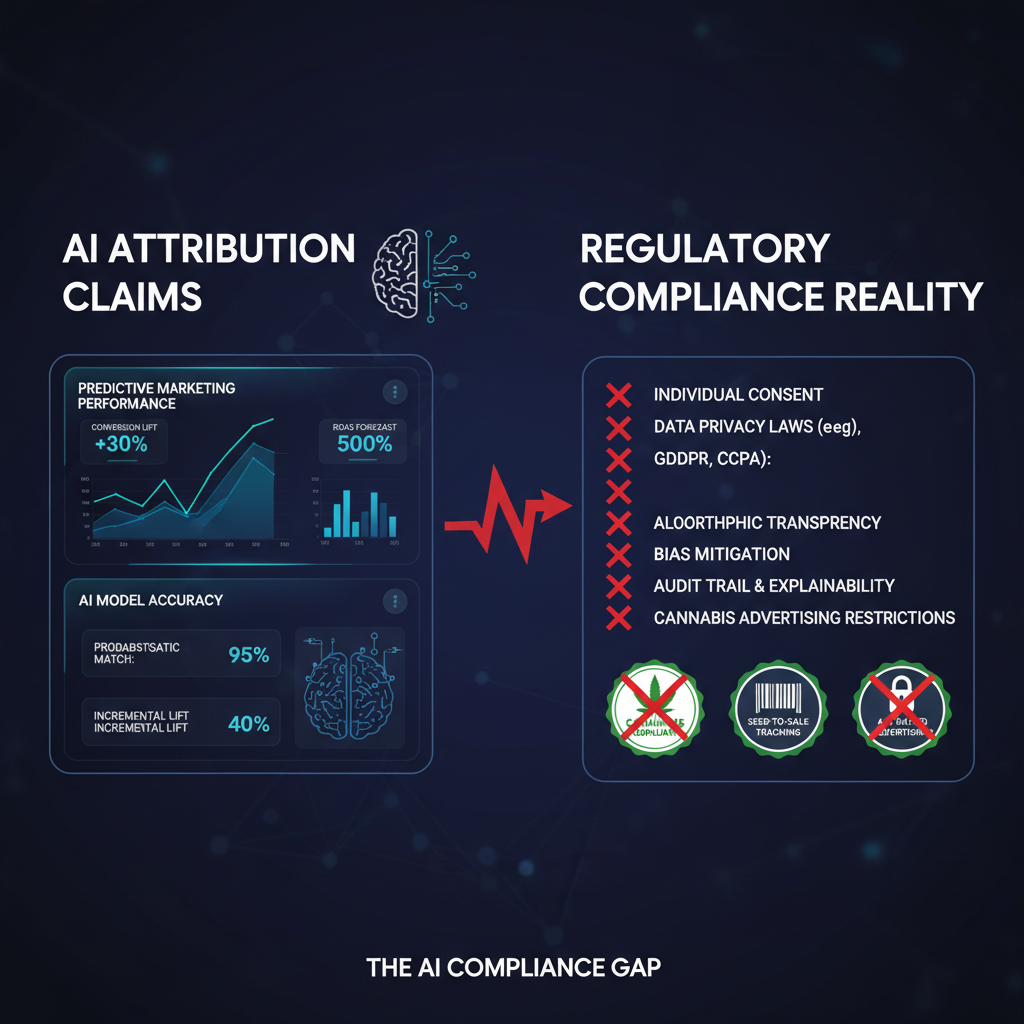
The gap between AI claims and regulatory reality
Where the Models Break
AI attribution models make specific claims: "This customer converted because of this touchpoint." But LLMs are pattern-matching engines, not causal inference machines. They're good at finding correlations that feel real but aren't.
For a cannabis retailer, the consequences are tangible. You scale spend on a channel that the model says is working, say, Instagram ads targeting lookalike audiences. You hit a 3-month growth period. Then a regulator asks: Can you prove this model is accurate? Can you show your work? Can you guarantee it's not using prohibited attributes?
If the answer is "our AI vendor says it works," you've got a problem.
The bigger problem: many AI attribution tools don't disclose their training data. They don't tell you which attributes they're using to make predictions. For a cannabis retailer in a regulated state, that opacity is a liability.
The Budget Illusion
Here's the squeeze: Cannabis retailers often operate on thin margins. They need efficiency. They hear about AI attribution that promises to cut waste, and the math looks good.
A $50K spend on an AI attribution tool could hypothetically save $200K in misspent ad budget. That's a 4X ROI. It's hard to say no to that math.
Except: That math assumes the model is accurate. It assumes the regulator agrees. It assumes the model doesn't accidentally use prohibited attributes. Cannabis retailers are betting their compliance on vendor claims they can't verify.
And they're doing it because the alternative, running marketing blind, no measurement, feels riskier.
The real pressure: thin margins and tight regulation
What Cannabis Marketers Are Actually Doing
Smart ones are hedging. They're using AI attribution tools for tactical insights, what's working, what's not, but they're not making regulatory claims based on the model's output.
They're keeping a human in the loop. They're documenting their methodology. They're asking vendors hard questions about training data and compliance. They're running A/B tests to verify the model's claims before scaling.
And they're preparing for the inevitable: a regulator asking "How do you know this works?" The answer can't be "The AI told us."
The Real Risk
The risk isn't that AI attribution is bad. It's that cannabis retailers are adopting it without understanding the compliance burden.
A regulator could argue: If you're using an AI model to make marketing decisions, you have an affirmative duty to prove the model is accurate and that its outputs don't violate state cannabis marketing rules. That's not a small bar.
AI transparency, privacy, and automated-decision rules are moving toward more scrutiny of algorithmic systems. Even when a rule does not name cannabis attribution directly, a retailer should assume regulators can ask how the model worked, what data it used, and whether the resulting marketing decisions stayed inside state cannabis rules.

Due diligence takes time most vendors can't withstand
The Path Forward
Cannabis retailers need to ask vendors:
- Where was this model trained? What data?
- Can you show the mathematical basis for your claims?
- How do you ensure prohibited attributes aren't being used?
- Can you provide compliance documentation for your state?
- Will you indemnify me if a regulator challenges your outputs?
Most vendors can't answer these questions. That's the squeeze.
The retailers who survive this will be the ones building internal measurement capacity. Running their own tests. Not outsourcing compliance to a vendor. That costs more upfront. It pays dividends when a regulator asks how you know your campaigns work.
For more on cannabis marketing in a regulated environment, read AI budtender compliance risk. And if you're thinking about measurement frameworks, the personalization paradox in cannabis marketing is worth understanding.
2026 evidence and control update
The more useful 2026 question is not whether the cannabis ai attribution trap is possible. It is whether marketing and revenue teams trying to measure AI-influenced decisions can prove what happened after the system made, shaped, ranked, routed, or explained a customer-facing decision.
The less obvious issue is that the hidden record is the gap between visible traffic and the agent-assisted decision that happened before the click. That record is what separates a working AI pilot from a defensible operating system.
For source alignment, the public claim language should stay consistent with NIST AI Risk Management Framework and FTC guidance on AI claims. Those sources do not remove the need for local legal review, but they give the article a better evidence spine than vendor screenshots or unsupported performance claims.
This also connects to related operating risk, AI measurement gap, compliance workflow, because the same pattern keeps repeating: AI systems look clean in the dashboard while the proof, ownership, and customer context live somewhere else.
| Control layer | What to verify | Evidence to keep |
|---|---|---|
| Source data | Which approved source fed the answer, recommendation, ranking, or claim | Source URL, vendor field, timestamp, and owner |
| Decision boundary | Where the AI is allowed to help and where it must stop | Allowed use case, blocked topics, and confidence threshold |
| Human review | Who owns the exception, correction, or escalation | Reviewer role, handoff note, and approval record |
| Monitoring | How the team catches drift, complaints, or weak signals | Review cadence, sampled outputs, and customer feedback themes |


Frequently asked questions
It is the pressure cannabis retailers feel when they need better measurement, but the AI models providing that measurement cannot easily prove how they reached their conclusions.
Cannabis campaigns are constrained by state rules, age gates, claims limits, and platform policies. If an AI model uses opaque signals to justify spend, the retailer may not be able to prove the campaign stayed compliant.
Some can, but many cannot provide enough methodology, training-data detail, or test evidence for a regulated audit. Retailers should ask for documentation before relying on a vendor's lift claim.
No. They should use them as decision support, then validate important claims with controlled tests, human review, and documented methodology before scaling spend.
Create a substantiation file for every major AI-attributed performance claim. Include the data window, model output, human decision, test method, and any compliance review.