Marketing teams have spent years buying AI measurement tools, and many still cannot prove what is working.
The problem isn't a tool gap. It's that AI measurement became theater, a performance of precision where real precision doesn't exist. Every attribution model, every dashboard, every incrementality test sits one hallucination away from breaking.
The shift isn't to better AI measurement. It's to trust as the measurable asset.
The Measurement Pile-Up
Marketing teams today operate five measurement systems simultaneously: last-click attribution (dying, stubborn), marketing mix models (expensive, brittle, requiring constant recalibration), multi-touch attribution (theoretically superior, practically inaccurate), AI-powered dashboards (black boxes that change their recommendations), incrementality tests (methodologically sound, logistically impossible to run at scale).
All five exist. None agree. Brands pay for all of them.
The cost is measurable. The output is theater. A CMO points to a dashboard and says, "our AI says channel X is working." No one can challenge it because no one understands how the AI arrived at that conclusion. It's not insight. It's plausible deniability with a neural network backing it.
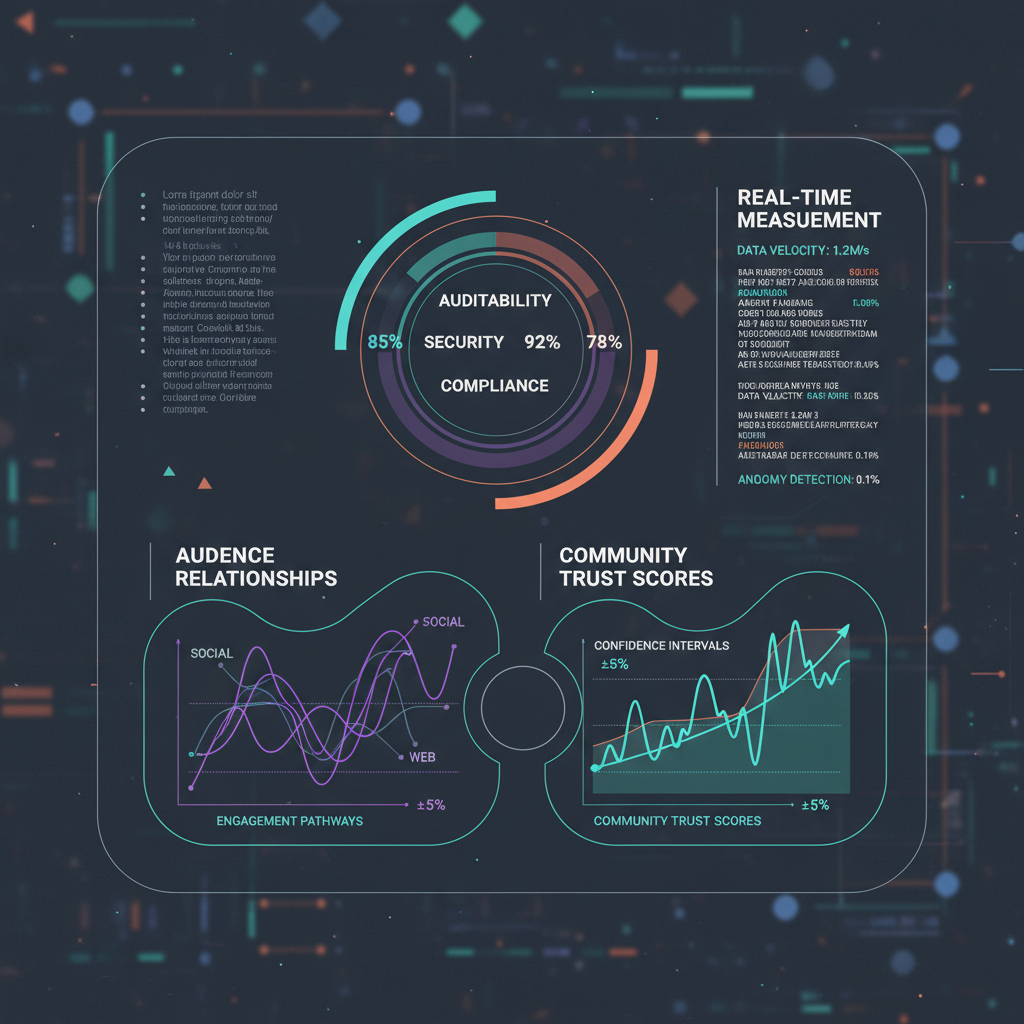
Real measurement: trust metrics replace attribution theater
Why AI Made the Problem Worse, Not Better
AI was supposed to solve attribution. Instead, it introduced failure modes that didn't exist before.
Model decay. An AI model trained on old campaign data can be stale before the dashboard admits it. Ad platforms change algorithms. Consumer behavior shifts. Competitors move. The model drifts silently, still producing confident recommendations that are subtly, systematically wrong.
Hallucination patterns. AI doesn't just get facts wrong. It gets systematically wrong in ways that *sound* credible. An LLM recommending a budget reallocation isn't just making a mistake, it's confabulating a logical reason why the mistake is right.
Confidence inversion. Humans know when they're guessing. AI systems often output precise-looking confidence, and the number can sound more authoritative than the evidence behind it.
Adversarial feedback loops. AI systems trained on marketing data learn to optimize for what they're measured on. Spend money in channel X, see a conversion, the system learns "X works." It doesn't learn the conversion was coming anyway. It learns to correlate spend with the metric, not cause with effect.
The Trust Signal
In the AI search economy, attention metrics are weaker than they used to be. A click can disappear into an answer engine. A recommendation can happen inside an agent. A prospect can arrive convinced without ever touching the old funnel.
Trust survives that measurement noise. If your audience trusts your brand, they come directly. They do not wait for Google, and they do not depend on your attribution model's guess about which ad they clicked. They return because your content proved something to them.
Trust also survives AI hallucinations. A brand with high trust can absorb a few bad recommendations. The underlying relationship is solid. A brand with low trust collapses the moment an AI system makes a visible mistake.
The implication is massive: the brands winning in 2026 aren't optimizing for attribution accuracy. They're optimizing for audience relationships that are resilient to measurement noise.
The New Framework: From Attribution to Relationship Stability
The brands winning right now aren't the ones with the most sophisticated dashboards. They're the ones with the most stable audience relationships.
Owned channel growth. Email subscribers, app installs, direct traffic. These aren't dependent on platform algorithms or attribution models.
Repeat visit rate. How many people come back? This is harder to game than click-through rate.
Content resonance score. Not engagement metrics like shares and likes, which are easy to inflate. Real resonance asks whether the content taught something or shifted a decision. Measure through post-interaction behavior, not during-interaction noise.
Decoupled paid testing. Stop trying to attribute everything. Run small, fast incrementality tests on specific campaigns. Treat attribution as "good enough for decisions," not "gospel."
Trust sentiment tracking. Monitor brand sentiment in forums, reviews, social signals as a hard leading indicator of revenue, not as soft brand data.

The move from attribution certainty to relationship resilience is already happening
Why Regulated Industries Are Winning
Cannabis, pharma, finance, healthcare. Any regulated industry with compliance requirements is already solving this.
They're forced to instrument everything. They can *audit* what's actually working. They can't hide behind an attribution model. When they claim a campaign drove revenue, they need documentation. That documentation becomes real data.
Meanwhile, unregulated brands are building increasingly complex measurement systems that produce increasingly false confidence. The irony: compliance is now a competitive advantage. The guardrails create visibility. Visibility creates real measurement.
Three Changes Required Now
Abandon the attribution monoculture. Stop building one system that explains everything. Build five systems that each explain one thing well. Live with the contradiction.
Measure trust metrics directly. Track owned-channel growth, repeat visit rates, brand sentiment, direct traffic. These are harder to game and more predictive.
Treat AI measurement as hypothesis generation, not truth. Use AI dashboards to suggest ideas. Test every recommendation in controlled incrementality tests before scaling.
---
The ROI crisis is real. Brands are losing visibility into what works. But the solution is not just a better AI tool. It is recognizing that perfect measurement precision is a myth.
The new era runs on trust as a measurable asset, not a soft brand attribute. Brands investing in owned channels and relationship stability will outperform brands building bigger attribution towers.
The measurement theater will continue. The smart money is already gone.
2026 evidence and control update
The more useful 2026 question is not whether measurement theater: trust is now the metric is possible. It is whether marketing and revenue teams trying to measure AI-influenced decisions can prove what happened after the system made, shaped, ranked, routed, or explained a customer-facing decision.
The less obvious issue is that the hidden record is the gap between visible traffic and the agent-assisted decision that happened before the click. That record is what separates a working AI pilot from a defensible operating system.
For source alignment, the public claim language should stay consistent with NIST AI Risk Management Framework and FTC guidance on AI claims. Those sources do not remove the need for local legal review, but they give the article a better evidence spine than vendor screenshots or unsupported performance claims.
This also connects to related operating risk, AI measurement gap, compliance workflow, because the same pattern keeps repeating: AI systems look clean in the dashboard while the proof, ownership, and customer context live somewhere else.
| Control layer | What to verify | Evidence to keep |
|---|---|---|
| Source data | Which approved source fed the answer, recommendation, ranking, or claim | Source URL, vendor field, timestamp, and owner |
| Decision boundary | Where the AI is allowed to help and where it must stop | Allowed use case, blocked topics, and confidence threshold |
| Human review | Who owns the exception, correction, or escalation | Reviewer role, handoff note, and approval record |
| Monitoring | How the team catches drift, complaints, or weak signals | Review cadence, sampled outputs, and customer feedback themes |


Frequently asked questions
Measurement theater is the appearance of precision without reliable proof. Dashboards look confident, but the underlying signals are incomplete or contradictory.
AI answers, agents, and recommendation layers can influence decisions without creating trackable clicks, clean referral data, or stable attribution paths.
Trust shows up in repeat visits, direct traffic, owned-channel growth, customer research, review quality, and resilience when platform data gets noisy.
No. Attribution still helps with directional decisions. It should be paired with incrementality tests, first-party data, trust signals, and qualitative customer evidence.
Track repeat direct engagement: returning users, email replies, repeat purchases, branded search, and customer-reported source of awareness.