Agentic marketing vendors are selling a clean story: autonomous agents make decisions faster than teams, optimize campaigns in real time, and produce return on investment that dashboards can prove.
But here's what the dashboard usually cannot show: whether the agent caused the outcome, which decision created the lift, and whether the result would survive an external audit.
Agentic AI marketing platforms are shipping faster than measurement standards can keep up. Your CMO approved a six-figure annual contract for autonomous optimization, and right now, there may be no decision log, no conversion-to-action visibility, and no way to connect a single customer win back to the agent's decisions.
This isn't a feature gap. It's the core vulnerability of autonomous systems in regulated spaces like marketing, where spend accountability is non-negotiable.

A vendor dashboard can report ROI without proving which autonomous decision caused the lift.
The ROI Claim vs. The Measurement Reality
The agentic AI marketing vendors are not lying exactly. What they're doing is worse: they're measuring ROI in a vacuum.
When a vendor says "136% uplift in lead quality," they're measuring:
- What the agent decided to optimize for (lead volume? engagement? conversion?)
- How the agent tracked that metric (through their own dashboard, which sees zero third-party data)
- What they excluded (channel mix changes, seasonal trends, competitor moves, creative fatigue, budget shifts)
What they're NOT measuring:
- Attribution across channels (a customer might convert on Google after seeing your email, but the agent won't know that)
- Cross-functional impact (did the agent's email cadence cannibalize your paid social? Unknowable without external audit)
- Real customer lifetime value (agents optimize for short-term metric goals, not long-term retention)
- Null tests (what would've happened if you did nothing? Agents don't run those)
This is the same problem that plagued Google Analytics 4 in 2023, shifting from event-based to AI-estimated attribution. Except with agentic marketing, it's worse, because the agent is not just measuring; it's also actively making autonomous decisions based on invisible data.
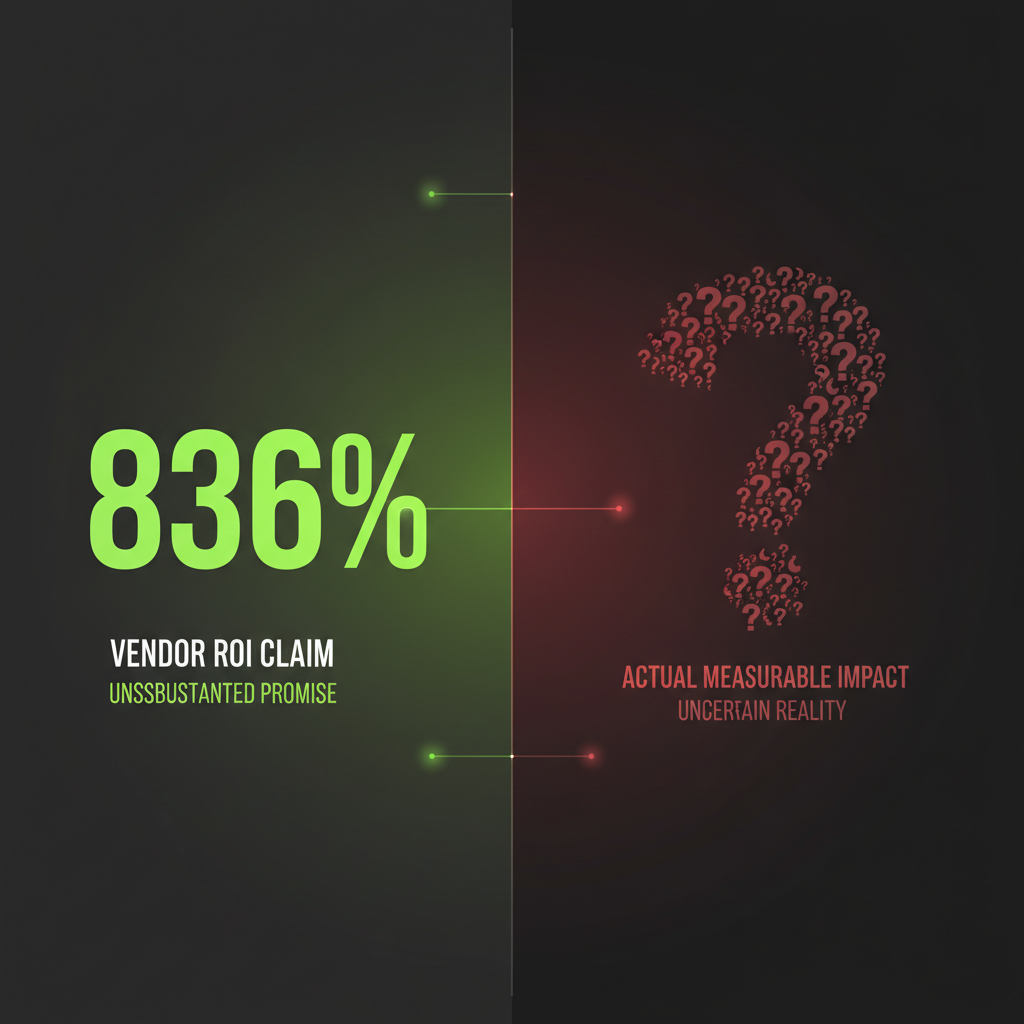
What vendors claim vs what's actually auditable
Why This Matters for Cannabis and Regulated Markets
For sparksbox clients in cannabis, alcohol, healthcare, or finance, agentic marketing agents introduce a new compliance blind spot.
An autonomous agent adjusts audience targeting, bid caps, or messaging based on internal optimization. It doesn't leave a breadcrumb trail. Six months later, your CFO asks, "Why did we spend $50k on this cohort?" Your team can't answer, because the agent made the decision in real-time with zero human sign-off.
In regulated industries, that's audit risk. In cannabis specifically, where FTC oversight is intensifying around age-gating and disclosure, having an autonomous agent make targeting decisions without human-reviewable audit trails is a liability trap.
If an agent decides to loosen age-verification targeting by 0.2% because it optimizes for conversion, and that decision isn't logged, reviewed, or explainable, your compliance team has no defense if questioned by regulators. This mirrors the compliance gaps we've documented in AI age verification systems.
The Vendor Lock-In Layer
Here's where it gets dark: agentic marketing platforms benefit directly from measurement opacity.
If your agent lives inside Salesforce, and Salesforce measures ROI using Salesforce data, you have zero incentive to look outside Salesforce's window. When the agent reports "27% increase in qualified leads," you see that number only through Salesforce's lens.
You don't see channel overlap, attribution decay, or the fact that your organic traffic dropped by the same 27% (a classic cannibalization pattern that agents never catch).
Third-party measurement vendors (Nielsen, Measured, Lifts) don't have access to agentic agent decision logs. They can see the output (increased spend, changed audiences) but not the reasoning (why the agent made that change). So they can measure campaign results, but not agent behavior.
This creates a comfortable moat for vendors: "Our agents delivered this result. You can't verify it independently, but trust us."

The daily reality: multiple dashboards, zero alignment
What Real Measurement Would Look Like
A properly instrumented agentic marketing system would require:
- 1Agent decision logs: Every autonomous decision (bid change, audience adjustment, creative swap, spend reallocation) is logged with timestamp, reasoning (which metric triggered it?), and expected outcome.
- 1Null cohorts: For every automated intervention, a randomized hold-out group that did NOT receive the agent's treatment, so you can measure actual lift vs. correlation.
- 1Multi-touch attribution: Not just "who converted," but "what was the chain of touchpoints?" Did the agent's email drive awareness, then the agent's retargeting close the deal? Or did the organic search do the heavy lifting?
- 1Audit trail for compliance: Every decision that touches regulated audiences (age-gated cohorts, health claims, financial disclosures) is human-reviewable before the agent deploys it.
- 1External validation: Third-party auditors can see agent decision logs (without access to raw customer data) and validate ROI claims independently.
Most major platforms are still stronger at optimization than independent proof. Salesforce, HubSpot, and Netcore are shipping agentic features that optimize metrics teams may not be able to independently verify.
The parallel to audit trail collapse in AI agent systems is stark: agents operate, changes happen, nobody can explain why.
The Sparksbox Angle
This is where strategic analytics separates winners from tag-along agencies.
If you're running agentic marketing for a client, you need:
- A dashboard that shows agent decisions in real-time (not just results)
- A measurement contract that includes external null-test validation
- A compliance log for regulated industries (cannabis, healthcare)
- Automated alerts when agent behavior deviates from expected patterns (e.g., agent suddenly expanding age ranges, increasing claim strength, or shifting to lookalike audiences)
Vendors won't volunteer this. You have to architect it.
The simplest lever: use your own CDP or analytics layer as the source of truth, not the vendor's dashboard. Force the agent to report its decisions to your system, not just your system reporting the agent's results. Then you own the audit trail.
Clients who do this will have defensible ROI claims and regulatory compliance. Clients who don't are building their growth on numbers they can't audit.
The Math on High ROI Claims
Let's be precise: when a vendor claims unusually high ROI, they're usually measuring incremental revenue per dollar of agent licensing cost.
If you pay $30k a year for an agentic marketing tool and the agent generates $280k in incremental revenue, that math looks excellent. But it assumes:
- The incremental revenue is actually incremental (not cannibalized from other channels)
- The $280k didn't happen because of parallel marketing efforts (your creative refresh, a viral post, a product launch)
- The agent's decisions caused the revenue, not correlated with it
Spoiler: vendors almost never prove that last part.
What to Do Now
If you're evaluating or have deployed an agentic marketing platform:
- 1Ask for null-test data: How many campaigns did the agent run with randomized hold-out groups? If zero, the ROI is unvalidated.
- 1Request decision logs: Export the last 30 days of autonomous decisions. If you can't understand why the agent made each change, it's a black box.
- 1Cross-check with external attribution: Run the agent's claimed results against your CDP or Google Analytics. Do they match? If not, the agent's measurement is off.
- 1Compliance audit: For regulated industries, verify every audience-targeting decision the agent made. Can a regulator understand it? If not, it's a liability.
- 1Set measurement requirements in contracts: Don't renew vendor agreements without external validation clauses. It's non-negotiable.
The vendors will resist. They'll say "Our platform's data is proprietary" or "We can't expose decision logs for IP reasons." That's your signal to look elsewhere.
Agentic marketing is real. The ROI is probably real too. But you need to see the work before you pay the bill.
2026 evidence and control update
The more useful 2026 question is not whether agentic marketing's invisible roi problem is possible. It is whether marketing and revenue teams trying to measure AI-influenced decisions can prove what happened after the system made, shaped, ranked, routed, or explained a customer-facing decision.
The less obvious issue is that the hidden record is the gap between visible traffic and the agent-assisted decision that happened before the click. That record is what separates a working AI pilot from a defensible operating system.
For source alignment, the public claim language should stay consistent with NIST AI Risk Management Framework and FTC guidance on AI claims. Those sources do not remove the need for local legal review, but they give the article a better evidence spine than vendor screenshots or unsupported performance claims.
This also connects to related operating risk, AI measurement gap, compliance workflow, because the same pattern keeps repeating: AI systems look clean in the dashboard while the proof, ownership, and customer context live somewhere else.
| Control layer | What to verify | Evidence to keep |
|---|---|---|
| Source data | Which approved source fed the answer, recommendation, ranking, or claim | Source URL, vendor field, timestamp, and owner |
| Decision boundary | Where the AI is allowed to help and where it must stop | Allowed use case, blocked topics, and confidence threshold |
| Human review | Who owns the exception, correction, or escalation | Reviewer role, handoff note, and approval record |
| Monitoring | How the team catches drift, complaints, or weak signals | Review cadence, sampled outputs, and customer feedback themes |


FAQ
Agentic systems make many small decisions across channels, audiences, bids, timing, and creative. If those decisions are not logged and tested against holdout groups, the dashboard can show correlation without proving causation.
It should include timestamp, trigger metric, decision made, expected outcome, affected audience, affected channel, budget impact, compliance rule checks, and the version of the agent or prompt that made the decision.
Usually not. Finance teams need a source of truth outside the vendor dashboard, plus null tests or holdout groups that show what would have happened without the agent.
They should limit autonomous action until audit logs, human review rules, audience controls, claim controls, and external measurement are in place.