Your analytics dashboards are lying to you. Not maliciously. Just incompletely.
Recent Similarweb research found something unsettling: brands recommended by ChatGPT can receive 2.5x more site traffic within 7 days than comparable brands that are not recommended. That's massive. That's the kind of movement that should trigger immediate budget reallocation decisions.
Except most CMOs won't notice it happening.
That traffic is arriving through a dark channel, one that doesn't fit neatly into your attribution model, doesn't map to any ad spend, and won't show up in your multi-touch analysis. It's invisible not because it's small, but because it's categorically different from how we've learned to measure marketing impact.

AI recommendation traffic can look like direct traffic even when an answer engine created the demand.
The 2.5x Problem Nobody's Talking About
The Similarweb data is straightforward: ChatGPT recommendations produce outsized traffic. But here's what matters: this traffic arrives without a trackable source. It's not paid search. It's not organic search in the traditional sense. It's direct.
When someone opens an AI answer engine and asks "what's a good project management tool" or "which SaaS has the best onboarding," the model may mention your brand by name. That click may have no UTM parameter, no clean referrer tag, and no ad network behind it.
In your analytics platform, it can show up as direct traffic. Maybe branded search if you're lucky and the user clicked a search result first.
Your attribution model, whether it's last-click, first-touch, or some fancy Markov chain, wasn't built to understand this. It assumes all meaningful traffic comes from channels you're actively bidding on or optimizing. AI recommendations blow that assumption apart.
The worse part: you didn't spend money to earn that traffic. ChatGPT decided your product was worth mentioning. And now you have to decide whether to count that win or ignore it because your attribution tool doesn't have a bucket for it.
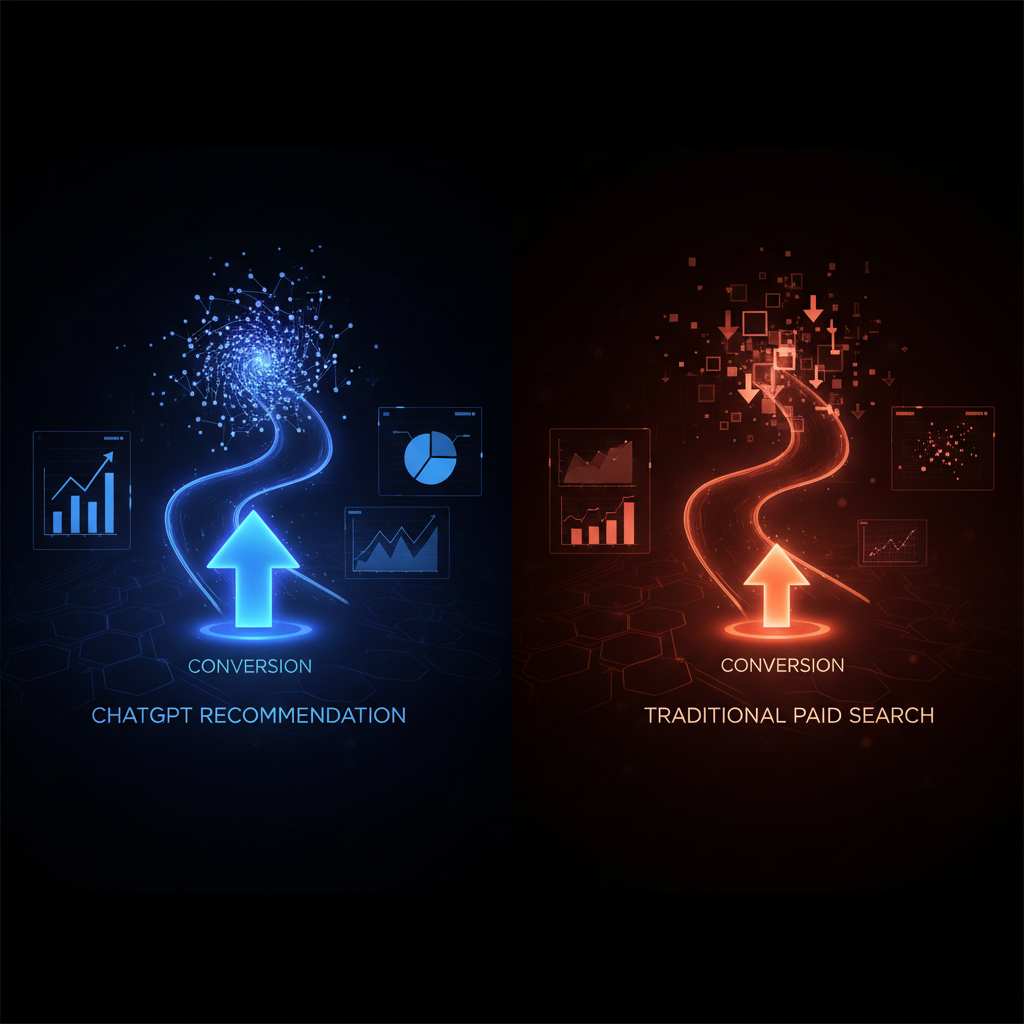
The blind spot: high-intent traffic arriving from channels your attribution model can't track.
The Attribution Collapse Is Already Underway
This isn't new. The breakdown in deterministic attribution started years ago, accelerated by iOS privacy changes and cookie deprecation. But what's happening with AI is different. It's not a technical problem. It's a category problem.
Your traditional attribution model works like this: user sees an ad, clicks an ad, lands on your site, converts. The ad network tracks that journey. Data flows back. You see ROI. You optimize.
AI recommendations don't fit this model at all:
- There's no ad. There's a mention.
- There's no network. There's a language model.
- There's no click-to-conversion tracking. There's a user typing a query.
- There's no optimization feedback. You don't control what ChatGPT says about you.
What you get instead is blind traffic arriving at scale. And because you can't see the mechanism, you can't optimize it, you can't bid on it, and you can't allocate budget to it.
So you don't. You keep spending where you can measure.
The Budget Allocation Crisis This Creates
Here's the cascading problem:
If you're allocating budget based on what your attribution platform tells you, and that platform is categorizing ChatGPT-sourced traffic as "direct" or "branded," you're not seeing the real ROI generator. You're seeing ghosts.
A brand that gets 1,000 visitors from ChatGPT per week might be allocating budget as if that traffic doesn't exist, pulling money from channels that are trackable, when the actual high-intent traffic is coming from AI.
The measurement lag makes it worse. That Similarweb stat is a 7-day window. Your attribution window might be 30 days. Your budget planning happens quarterly. By the time you realize ChatGPT is your top traffic driver, you've already committed Q3 spend to paid search.
This is where the math breaks down: most marketers are now running split budgets across two universes. Universe A is trackable. Universe B, AI recommendations, word-of-mouth, brand-earned channels, is invisible. They're allocating 90% of their optimization effort to Universe A because that's where the data lives.
But the traffic is shifting to Universe B.
What's Really Happening Behind the Scenes
You don't control whether ChatGPT recommends you. You can't buy that recommendation. You can't run an ad campaign that says "mention us in ChatGPT." You can't even reliably influence it with classic SEO tactics the way you would with Google organic.
What you CAN do is accept that the game has changed. High-quality products and strong brand reputation now funnel directly into LLM training data. If your product is genuinely good, ships features competitors don't have, and your brand shows up in reliable sources (reviews, forums, case studies, news), ChatGPT will mention you when relevant.
And when it does, people come. A lot of them. Qualified. High-intent. Ready to evaluate.
But this means:
- Your traditional attribution models are dead for measuring this traffic
- Budget allocation is now guesswork relative to how "recommend-able" your brand is
- You can't track which brand position you earned, in which model (GPT-4, Claude, etc.), to which user cohort
- There's no feedback loop between ad spend and LLM recommendation frequency
- Your competitors are probably just as blind, which means early movers have an advantage

The current state: staring at dashboards that don't show the full picture.
The Uncomfortable Math
If ChatGPT is sending you 2.5x more qualified traffic than your typical channel, but you can't see it, measure it, or directly bid on it, what's your strategy?
Most teams do nothing. They keep optimizing within their attribution platform. They shuffle budget between Google, Meta, TikTok, and all the channels they can measure. They trust their dashboards because dashboards are how marketing became a science instead of a guess.
And they leave millions of high-intent traffic on the table because it's arriving from somewhere their dashboards don't track.
The smarter move is uglier: you have to stop trusting your attribution platform as the single source of truth. You have to start asking: what percentage of my traffic is coming from AI recommendations that my platform can't see?
What's driving my brand's mention frequency in ChatGPT? Am I optimizing for the channels I can measure, or for the channels generating the most revenue?
This is why some teams are starting to treat brand visibility and reputation as a direct marketing lever rather than as a byproduct. If you can't measure ChatGPT recommendations directly, you optimize for what makes recommendations more likely: product quality, clear documentation, strong brand positioning, presence in trusted sources.
How to Spot This Blind Spot in Your Data
The signs are subtle but detectable:
Spike in direct traffic without a campaign running. If your direct traffic jumps 30% and you didn't run a PR campaign or launch a viral moment, that's a red flag. It might be AI recommendations.
Branded search volume staying flat while branded site traffic grows. Users who ask ChatGPT for recommendations don't necessarily search for your brand afterward. They visit directly. If branded search is flat but direct traffic is climbing, unmeasured channels are pulling weight.
High-quality traffic from unidentifiable sources. Run a cohort analysis. Segment "direct" traffic by behavior: bounce rate, pages per session, conversion rate. If a segment of direct traffic shows conversion rates that match your paid search channels, you're looking at high-intent traffic. That's your AI-recommendation cohort.
Customer interviews revealing "I didn't search, ChatGPT suggested you." This one's the clearest. If your sales team or customer research is hearing this phrase repeatedly, your blind spot is real and it's material.
What Gets Better, What Gets Worse
The brands that figure this out first will win:
Better: Product quality becomes your marketing moat. If your product is genuinely strong, reviewed well, and documented clearly, you'll earn more AI mentions. That's a durable advantage.
Better: Long-term brand building works again. The old playbook, strong product, good documentation, engaged community, earned press, actually matters now, because all of that feeds into what LLMs say about you.
Worse: Attribution gets more fragmented. You'll be measuring traffic from 5+ uncorrelated channels, each with different ROI dynamics, and no unified model to explain them.
Worse: Budget planning becomes harder. How do you allocate spend across Google, Meta, organic, partner channels, and "be so good ChatGPT recommends us" when the last one isn't a channel at all?
Getting Ready for the Blind Spot
Three moves to make now:
First: Segment "direct" traffic more granularly. Not all direct is created equal. Use IP geolocation, device fingerprinting, and session behavior to distinguish between ChatGPT-sourced traffic, bookmarked visits, and actual direct navigation. It's imperfect, but it's better than lumping it all together.
Second: Monitor your brand mentions in LLMs. Services like Brandwatch and Semrush now track AI-generated mentions across ChatGPT, Claude, Gemini, and other models. You won't get user-level data, but you'll get trend data.
Watch those trends. They're leading indicators. Understanding how AI models reference and recommend products gives you a playbook for visibility.
Third: Reframe your marketing as competing for mention-worthiness. Stop asking "how do I drive clicks?" Start asking "why would an LLM recommend us?" Make sure your product documentation is clear, your brand reputation is solid, your feature set is differentiated, and your presence in trusted sources is strong.
The brands that treat this as a measurement problem will lose budget to brands that treat it as a product and reputation problem.
In an AI-recommended world, attribution isn't just broken. It's pointing you in the wrong direction.
2026 evidence and control update
The more useful 2026 question is not whether chatgpt traffic is breaking your attribution model is possible. It is whether marketing and revenue teams trying to measure AI-influenced decisions can prove what happened after the system made, shaped, ranked, routed, or explained a customer-facing decision.
The less obvious issue is that the hidden record is the gap between visible traffic and the agent-assisted decision that happened before the click. That record is what separates a working AI pilot from a defensible operating system.
For source alignment, the public claim language should stay consistent with NIST AI Risk Management Framework and FTC guidance on AI claims. Those sources do not remove the need for local legal review, but they give the article a better evidence spine than vendor screenshots or unsupported performance claims.
This also connects to related operating risk, AI measurement gap, compliance workflow, because the same pattern keeps repeating: AI systems look clean in the dashboard while the proof, ownership, and customer context live somewhere else.
| Control layer | What to verify | Evidence to keep |
|---|---|---|
| Source data | Which approved source fed the answer, recommendation, ranking, or claim | Source URL, vendor field, timestamp, and owner |
| Decision boundary | Where the AI is allowed to help and where it must stop | Allowed use case, blocked topics, and confidence threshold |
| Human review | Who owns the exception, correction, or escalation | Reviewer role, handoff note, and approval record |
| Monitoring | How the team catches drift, complaints, or weak signals | Review cadence, sampled outputs, and customer feedback themes |


FAQ
AI answer engines do not always pass clean campaign parameters or referrer data. A visitor can discover a brand in ChatGPT, type the URL manually, search the brand, or click through in a way that analytics tools classify as direct or branded traffic.
They can estimate it, but they usually cannot measure it with the same precision as paid search or paid social. The best signals are direct-traffic cohorts, branded-search anomalies, customer interviews, sales notes, and AI visibility monitoring.
They should stop treating all direct traffic as one bucket. Segment direct traffic by landing page, session quality, geography, device, conversion behavior, and timing around AI visibility changes.
No. It changes the job of SEO. Brands still need clear pages, credible sources, documentation, reviews, and entity consistency, but the goal expands from ranking in search to being cited or recommended in answer engines.