AI marketing has a source-of-truth problem. Teams can now produce copy, images, audience ideas, campaign variants, and search answers at a speed their review process was never built to handle. The result is not always better marketing. Often, it is more versions of the brand, each carrying a slightly different claim, promise, or customer story.
The fix is not another prompt library. It is a trusted layer of facts, proof, constraints, and decisions that every human and AI system can use before it creates anything. Without that layer, automation compounds drift. With it, automation becomes useful because the machine has something real to stay faithful to.
The content boom is not the strategy
Marketing teams have spent the first wave of generative artificial intelligence on production. Draft a landing page. Rewrite an email. Turn a webinar into six social posts. Make the product description sound more confident.
That work can save time. It can also hide a dangerous assumption: that the main bottleneck was writing. For most brands, the bottleneck is deciding what is true, what is approved, what is differentiated, and what can be promised without creating legal or commercial trouble.
<a href="https://www.mckinsey.com/capabilities/quantumblack/our-insights/the-state-of-ai" rel="nofollow noopener noreferrer" target="_blank">McKinsey's 2025 State of AI survey</a> describes broad enterprise adoption alongside uneven business value. That gap makes sense.
A team can add an AI writing tool in an afternoon. Building a reliable knowledge system takes decisions from product, sales, legal, customer success, and leadership.
The uncomfortable part is that AI makes organizational disagreement visible. One prompt says the product is built for enterprise teams. Another says it is for small businesses. One page claims same-day support. A sales deck says support depends on the plan. The model did not create the contradiction. It just made the contradiction easier to publish.

The work before automation is deciding what the brand can stand behind.
AI search repeats the mess
The source-of-truth problem becomes more expensive when the output is not a page you control. It is an answer generated by a search engine or assistant.
<a href="https://developers.google.com/search/docs/appearance/ai-features" rel="nofollow noopener noreferrer" target="_blank">Google's guidance for AI features in Search</a> makes one point clear: the same fundamentals still matter. Pages need to be accessible, useful, and understandable.
That does not mean a brand can assume its preferred description will appear in an AI answer. The system assembles an answer from what it can find and interpret across the web.
<a href="https://www.pewresearch.org/short-reads/2025/07/22/google-users-are-less-likely-to-click-on-links-when-an-ai-summary-appears-in-the-results/" rel="nofollow noopener noreferrer" target="_blank">Pew Research Center found that users were less likely to click traditional links when an AI summary appeared</a> in the result. That creates a different marketing job.
You are not only trying to earn the click. You are trying to become one of the entities an answer can describe accurately when the click never happens.
That is where weak brand documentation hurts. If your site, review profiles, partner pages, product docs, and executive interviews describe the company in conflicting ways, an AI system has to choose. It may choose the version with the strongest external evidence, not the version your brand team prefers.
This is the same visibility gap behind the AI answer problem for Google rankings. Ranking is still useful. It is just no longer the whole visibility story.
If your brand facts disagree across the web, AI will not resolve the disagreement for you. It will publish one version and move on.
Build a fact layer first
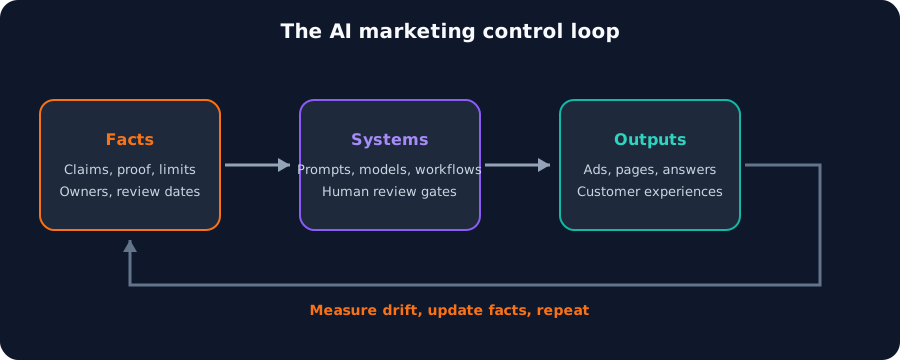
A usable source of truth is not a giant brand document that nobody opens. It is a maintained set of small, answer-ready records.
For each important claim, capture five things:
- The approved statement in plain language
- The evidence that supports it
- The audience and situation where it applies
- The owner responsible for review
- The date when it needs another check
Add the constraints that matter to your category. For a cannabis brand, that may include state-specific product language, age-gating requirements, platform restrictions, and claims that need substantiation.
For a business-to-business software company, it may include contract limitations, security representations, implementation timelines, and customer proof that can be named publicly.
The point is not to make every output cautious and bland. The point is to give the system enough context to be specific without inventing confidence.
<a href="https://www.nist.gov/publications/artificial-intelligence-risk-management-framework-generative-artificial-intelligence" rel="nofollow noopener noreferrer" target="_blank">The National Institute of Standards and Technology's Generative AI Profile</a> frames this as a risk management problem, including confabulation, data provenance, and human oversight. Marketing teams do not need to turn every campaign into a research project.
They do need a repeatable way to know which facts can flow into automation and which ones require review.
The review gate is a feature
Teams often describe review as the thing AI is supposed to remove. That is backwards. Review is how the system learns where the boundaries are.
A good review gate asks a short set of questions:
- Is the claim true today?
- Can we prove it with a source a customer could inspect?
- Is this audience allowed to receive the message?
- Does the output sound like this brand, or like a generic model?
- What would be costly or embarrassing if the sentence were wrong?
The answers should change the workflow. Low-risk formatting can move quickly. Product claims, regulated language, customer results, pricing, and comparisons need a named owner. Speed is not the removal of judgment. It is the reduction of unnecessary judgment around work that has already been defined.
Teams that skip this step usually end up with a second problem: attribution becomes harder to trust. If ten AI systems create ten versions of the promise, you cannot tell whether a campaign worked because of the channel, the offer, the audience, or an accidental claim.
That is why the AI attribution crisis is also a message governance problem.
Give the model fewer ways to guess
The practical playbook is smaller than most AI transformation plans.
Start with the twenty facts that show up most often in sales calls, product pages, customer questions, and search results. Mark each as approved, conditional, outdated, or unknown. Assign an owner. Then connect those records to the workflows that generate public copy.
Next, test the outputs where buyers actually see them. Search your category in Google AI features, ChatGPT, Perplexity, and Gemini. Save the answers. Note which brands appear, which claims are repeated, and where the answer gets your company wrong. Treat that log as a product feedback loop for your marketing system.
Finally, audit the places your team does not think of as marketing. Sales enablement. Partner listings. Review sites. Help center articles. Founder interviews. Recruitment pages. AI systems read the whole public footprint, not only the pages your content calendar tracks.
That broader audit is the difference between publishing more content and becoming easier to understand.
If your team is already producing AI-assisted copy, the brand voice problem is a useful warning. Voice is not a list of adjectives. It is the result of consistent choices about what you say, what you refuse to say, and what evidence you bring when the claim gets challenged.

Check the answer a buyer sees, not only the dashboard your team owns.
The next marketing system
AI will keep making production cheaper. That part is already happening. The scarce skill is deciding which version of reality the system is allowed to repeat.
The strongest marketing teams will not be the ones with the most prompts or the highest content volume. They will be the ones with clear facts, visible proof, owners who maintain them, and enough nerve to leave an answer blank when the evidence is weak.
That sounds less exciting than another content automation demo. It is also much closer to the work that protects a brand.
What is a source of truth in AI marketing?
It is a maintained set of approved brand facts, evidence, audience rules, owners, and review dates. It gives people and AI systems the same reference point before they create or publish marketing output.
Why does AI-generated content drift from brand strategy?
Models are good at producing plausible language, but they do not automatically know which claims are approved, current, differentiated, or safe for a specific audience. Drift appears when the system has more examples than decisions.
Does search engine optimization still matter for AI search?
Yes. Search engine optimization still helps systems find, access, and understand your content. It is not enough by itself, because AI answers also depend on entity clarity, external evidence, and how consistently your brand is described across the public web.
How should marketers measure AI visibility?
Track whether your brand appears in representative questions across the AI tools your customers use, what claims those tools repeat, which competitors appear instead, and whether the answer is accurate. Pair that visibility log with branded search, direct traffic, assisted conversions, and qualitative sales feedback rather than pretending one metric explains the whole journey.
What should marketers automate first?
Automate low-risk transformations of approved material, such as formatting, summarizing, and adapting a message for a defined channel. Keep human review around new claims, regulated language, customer proof, pricing, comparisons, and anything that could materially change how the brand is understood.