ChatGPT ads went live on February 9, 2026. The minimum spend is $200,000. CPMs hover around $60. And the format excludes entire categories of brands from participating at all.
Most marketing teams cannot even get in the door. The ones who can are paying a premium to sit next to a conversation they may have already lost.
Here is the part nobody is saying out loud: buying ads on ChatGPT is not the same as being visible on ChatGPT. The real game is the answer, not the ad slot below it.
What ChatGPT Ads Actually Do
OpenAI announced its advertising approach in January 2026 and <a href="https://openai.com/index/our-approach-to-advertising-and-expanding-access/" rel="nofollow noopener noreferrer" target="_blank">launched it weeks later</a>. The ads appear at the bottom of ChatGPT responses for logged-in U.S.
users on the free and Go tiers. They are clearly labeled as sponsored. They do not influence the answer itself.
That last sentence matters more than most marketers realize. The ad is not the answer. The answer comes first, then the ad. If your brand is not in the answer, your ad is a footnote to someone else's recommendation.
OpenAI excluded regulated topics from ad inventory: health, mental health, and politics. Cannabis and other restricted categories are effectively locked out. Even if you had $200K to spend, you might not be allowed to spend it.
For cannabis brands, the visibility gap is even sharper. We documented in our cannabis AI visibility analysis how dispensaries winning on Google can still vanish in AI answers.
The financial logic for OpenAI is clear. The company hit 900 million weekly active users by February 2026, but only about 50 million of them pay. That is a 5.5% conversion rate on a user base larger than Instagram's. OpenAI is burning an estimated $17 billion in 2026. Advertising is how they close the gap between massive usage and massive costs.
But OpenAI's revenue problem is not your marketing solution.
The Price of Admission
The economics of ChatGPT ads are not built for most brands. A $200,000 minimum commitment and $60 CPMs put this in the territory of enterprise test budgets, not growth marketing spend. For context, Google Search average CPMs run between $10 and $30 depending on industry.
This is a pilot with training wheels. OpenAI has started requesting insertion orders from select advertisers, according to <a href="https://bunkerdb.com/en/blog/ads-chatgpt" rel="nofollow noopener noreferrer" target="_blank">Adweek reporting summarized by Bunker DB</a>, which means it is moving past informal experiments. But the platform lacks the self-serve infrastructure of Google Ads or Meta Ads. There is no dashboard.
No bidding strategy. No optimization layer. You are buying premium inventory in a format that is still being defined.
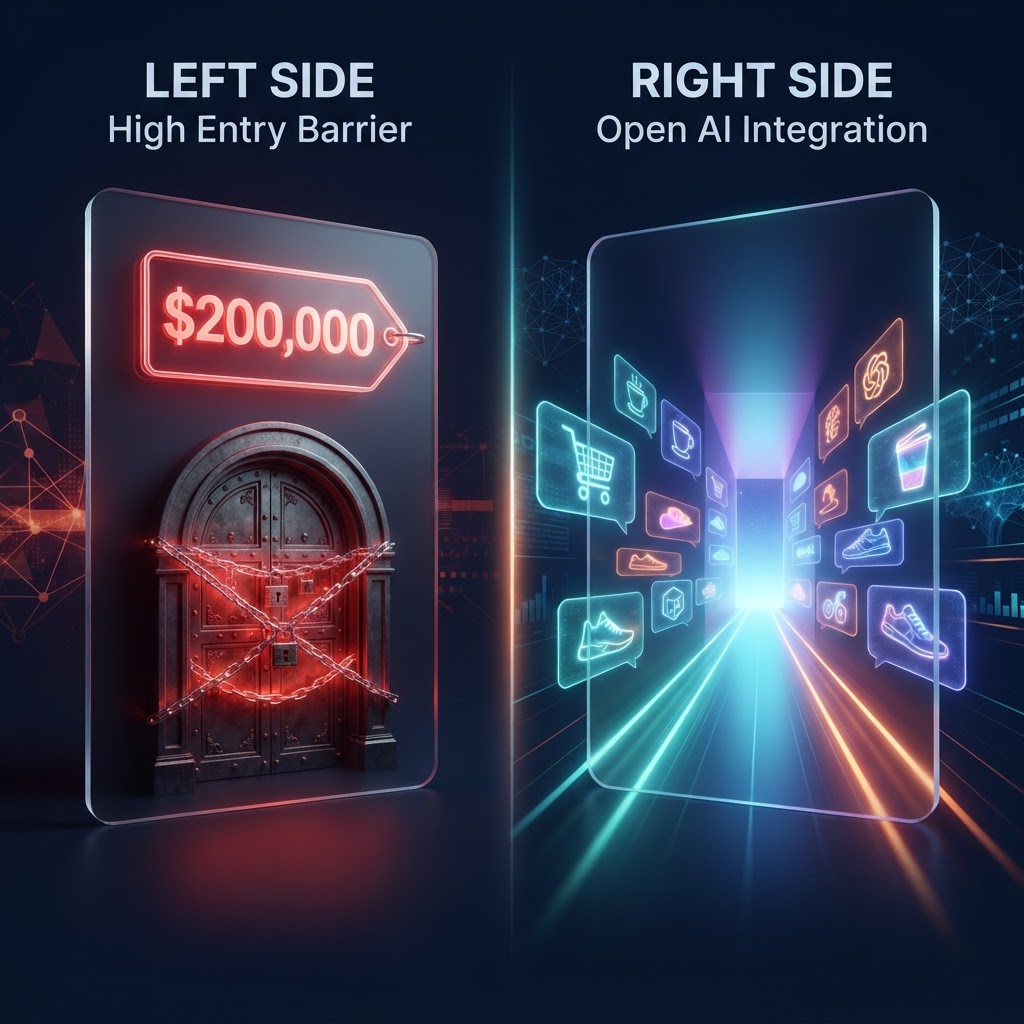
Buying ads on ChatGPT is paying for the slot below the answer. Being in the answer is free.
The brands spending $200K on ChatGPT ads right now are doing two things: buying early positioning and subsidizing OpenAI's ad product development. Neither of those is a marketing strategy.
The Answer Is the Ad
Here is where the research gets uncomfortable.
A <a href="https://www.semrush.com/blog/the-operational-gap-ai-seo-study/" rel="nofollow noopener noreferrer" target="_blank">Semrush study of 481 marketers</a>, business owners, and SEO professionals found that 85% say AI has changed their search strategy. Only 22% have fully integrated their SEO and AI search efforts across strategy, execution, and reporting.
The performance gap between the integrated and the fragmented is stark. Among teams with fully integrated SEO and AI search execution, 81% report seeing more traffic or leads connected to AI platforms. Among teams running them completely separately, that number drops to 36%.
A separate <a href="https://www.businessofapps.com/news/89-of-marketers-report-ai-search-gains-in-2025-but-struggle-to-measure-the-impact-accurately/" rel="nofollow noopener noreferrer" target="_blank">Branch study of 300 enterprise marketing leaders</a> found that 89% say AI-powered search improved their marketing performance in 2025. But 26% cannot track the user journey from AI discovery to conversion.
24% say their analytics tools are not ready for AI attribution.
The brands winning are not the ones writing $200K checks to OpenAI. They are the ones who merged their SEO and AI visibility workflows. They show up in the answer because their content, citations, and entity coverage give AI systems something to quote.
We covered this gap in our analysis of AI answer invisibility: brands that rank well on Google can still vanish in ChatGPT and Perplexity answers. The visibility split is not theoretical. It is measurable, and it is widening.
The same dynamic showed up in our AI marketing measurement collapse piece. Teams are pouring budget into AI search without the attribution infrastructure to know if it works. Adding ChatGPT ads on top of broken measurement does not fix the measurement. It adds another blind spot.
What Integrated Brands Actually Do
The Semrush data points to a clear pattern. Teams that treat AI search as an extension of search engine optimization (SEO), not a separate channel, are the ones seeing results. Here is what that looks like in practice.
Content that answers questions directly. AI systems pull from content that is structured, specific, and citation-friendly. FAQ sections, clear definitions, and data-backed claims give AI systems quotable passages. This is not about keyword stuffing. It is about making your content the best answer to the question someone is asking ChatGPT.
Entity coverage across platforms. A brand that exists only on its own website gives AI systems one source. A brand covered in authoritative third-party sources, directories, and industry publications gives AI systems confidence. The more independent sources confirm your story, the more likely AI is to recommend you.
Structured data and schema. FAQPage schema, Article schema, and Organization schema help AI systems parse and trust your content. We wrote about this in our SEO after AI overviews guide: structured data is the bridge between your content and the AI answer layer.

The frustration of checking your AI visibility manually. 40% of marketers still do this.
Cross-platform citations. Perplexity pulls from citation-rich sources. Gemini grounds in Google's ecosystem. ChatGPT pulls from a mix of licensed content and the open web. Each platform reads different signals. Building citations across all of them is how you show up everywhere, not just on one.
Internal alignment. The Semrush study found that ownership for AI search is scattered across seven functions, with no single owner above 18%. One in ten teams has no clear owner at all. The integrated teams that outperform are the ones where SEO, content, and AI visibility sit under one workflow, not three competing ones.
What Happens Next
The Branch study found something that should reshape every marketing roadmap: 87% of enterprise leaders believe AI platforms will directly close sales within the next 12 months. Not just drive discovery. Close sales.
<a href="https://www.emarketer.com/content/faq-on-search-advertising--ai-assistants--shifting-traffic--new-demand-capture-mix" rel="nofollow noopener noreferrer" target="_blank">eMarketer describes this as a fundamental shift</a> in how demand capture works. The old model was search, click, convert. The new model is ask, answer, convert.
Sometimes the answer includes a purchase. Sometimes the answer IS the purchase.
That means the AI answer is about to become the point of purchase. The brand mentioned in the answer will be the brand that gets the transaction. The ad at the bottom will be an afterthought.

The moment your brand shows up in the AI answer. No $200K ad buy required.
If you are spending your AI marketing budget on ads before you have solved visibility, you are paying to lose. The $200K ChatGPT ad buy does not fix the fact that your brand does not appear when someone asks "best [your category] near me" or "which [your product] should I buy." It just puts a sponsored link below a recommendation that names your competitor.
The brands that win the next 18 months are the ones investing in being the answer, not buying space next to it. Structured content, entity coverage, cross-platform citations, and integrated workflows. Boring work. High return. The kind of work that compounds while everyone else is chasing the shiny new ad platform.
FAQ
Yes, but with significant restrictions. OpenAI launched ads in ChatGPT on February 9, 2026, for logged-in U.S. users on the free and Go tiers. The program is not self-serve. Advertisers need insertion orders and meet a reported $200,000 minimum spend. Regulated categories including health, mental health, and politics are excluded.
According to Adweek reporting, ChatGPT ads carry CPMs around $60 and require a minimum investment of approximately $200,000. These are early-stage pilot economics, not optimized self-serve pricing. For comparison, Google Search CPMs typically range from $10 to $30 depending on industry.
For most brands, no. The minimum spend and premium CPMs make it inaccessible to growth-stage companies. More importantly, buying ads on ChatGPT does not address the underlying visibility gap. If your brand is not mentioned in AI answers, the ad appears next to a recommendation that names your competitor. The better investment is AI visibility and content that AI systems naturally cite.
ChatGPT ads are paid placements that appear below ChatGPT responses. They do not influence the answer itself. AI visibility is the practice of ensuring your brand appears in the AI-generated answer through content, citations, and entity coverage. The answer is what users trust. The ad is what they scroll past.
You show up by building content that AI systems can quote: structured data, FAQ schema, authoritative third-party citations, and direct answers to category questions. The Semrush study found that 81% of teams with integrated SEO and AI search execution see more traffic and leads from AI platforms, compared to 36% with separate workflows.
OpenAI has excluded health, mental health, and politics from ad inventory. Cannabis and other restricted categories are effectively locked out due to the regulated-topic exclusion. Brands in these categories must focus entirely on organic AI visibility rather than paid placement.