Who Made This?
You publish a whitepaper. An AI agent scrapes it, remixes three paragraphs with a competitor's case study, adds synthetic imagery, and republishes it under a different brand. You don't own it anymore. Neither do they. Nobody does.
This is what 2026 looks like for marketers obsessed with content scale.
For the last ten years, the rule was simple: you created content, you owned it. You could track it. Measure it. Claim it. Attribution was messy but traceable. Every piece of collateral had a fingerprint.
AI agents have weakened that fingerprint.

AI agents can turn one original asset into many untraceable summaries, snippets, and remixes.
The moment your content becomes consumable by machines, it becomes remixable. Recombineable. Redistributable. Copyright law hasn't caught up. Detection tech is guessing. And your content measurement? It's already broken.
The Provenance Collapse
The legal picture is still unsettled. Intellectual-property lawyers are already warning marketers that generative AI creates hard ownership and provenance questions: who owns the output, what was copied, what was transformed, and what a brand can safely claim.
When content provenance gets fuzzy, attribution gets weaker.
Here's the mechanics: an AI agent running customer support, lead qualification, or content distribution for a competitor ingests your published content as context. It then generates new content that echoes your phrasing, structure, and data without copying you outright. Is that plagiarism?
Is that theft? Is that lawful transformation? Courts and regulators are still working through those questions.
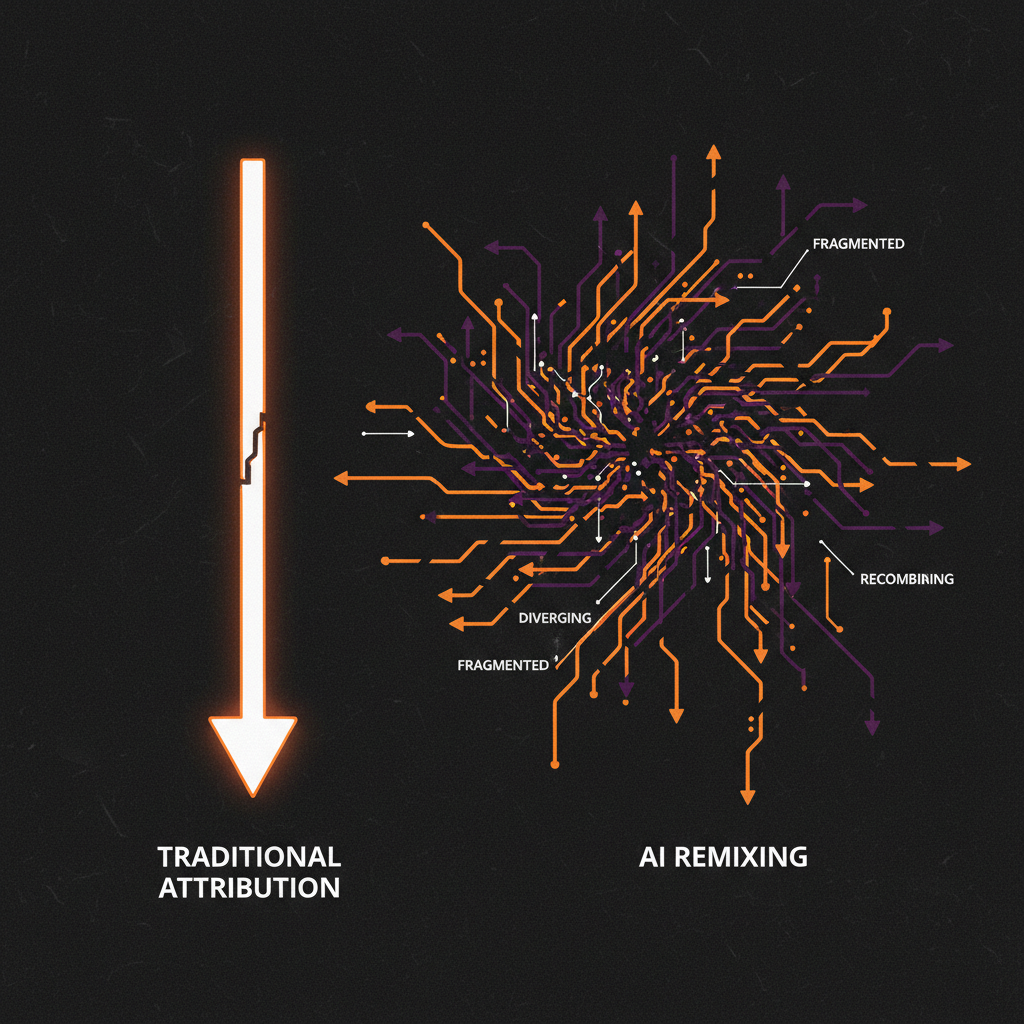
Traditional attribution vs. AI remix fragmentation
Meanwhile, your content measurement is already collapsing. You can't distinguish between:
- People who actually read your published content
- People who read a synthetic remix of it
- People who read an AI summary that compressed your argument
- People who never saw any of it but bought because an AI agent mentioned your brand
All of these look identical in your attribution model. They're not.
Why CMOs Can't Measure Attribution Anymore
The traditional marketing attribution stack assumes human behavior: a human sees an ad, clicks a link, reads a page, fills a form. Each step is discrete. Trackable. Attributable.
But an AI agent doesn't click. It doesn't fill forms. It reads your entire website in parallel, synthesizes your brand position against twelve competitors simultaneously, and then makes a recommendation without leaving a trace of how it got there.
Some attribution platforms are trying to track AI agents. Most are failing because they're measuring at the wrong layer. They're looking for cookies and pixels. AI agents don't use cookies. They use APIs.
And here's the real problem: even if you could track what an AI agent read about your brand, you can't track what it remixed or redistributed before recommending you. Your competitive position might hinge entirely on how favorably an AI agent represented you in a conversation you'll never see.
You can't measure what you can't see.

The frustration of attribution measurement in an AI-mediated world
The Content Velocity Trap
Brands are doubling down on volume to compensate. More blogs. More whitepapers. More case studies. The idea is: if we create ten times the content, maybe the attribution algorithms will pick up the signal.
It's backwards.
Higher volume makes attribution worse, not better. More content equals more surfaces for remix. More remixes equals more diffusion of provenance. More diffusion equals less clarity on what's actually working.
Some CMOs have started watermarking content with invisible metadata or blockchain signatures. But if an AI agent can read the content, it can strip the watermark. If it can't strip it, it just remixes from the text itself and the metadata vanishes.
You're fighting thermodynamics. Content wants to be remixed. Machines make remixing effortless.
What Actually Breaks
Three things break first:
Brand positioning. When AI agents remix your content with competitors' claims, your brand narrative fragments. You don't control how you're represented in AI-mediated conversations.
Lead quality. An AI agent that learned about you by synthesizing fifty sources isn't the same as a decision-maker who read your content intentionally. They're cold leads wearing warm clothes.
Budget accountability. Marketing spend becomes impossible to justify when attribution is too diffuse to measure. CMOs who can't prove ROI lose budget.
CMOs who lose budget lose leverage. See how AI personalization breaks compliance frameworks and AI visibility creates entirely new market risks for more on cascading measurement failures.
The Uncomfortable Truth
The uncomfortable truth is that content attribution didn't die because AI made it hard. It died because humans never owned it in the first place.
You owned the server it was on. You owned the copyright claim. But the moment it existed on the internet, it was a public good waiting to be remixed.
AI agents just made the remix automatic.
Brands that are still betting on content scale in 2026 are building on sand. The ones that matter are investing in direct relationships, proprietary data, and conversion mechanisms that don't depend entirely on attribution. Because attribution is no longer strong enough to carry the whole measurement model.
The question isn't how to measure it. It's what you do when measurement becomes noise.
2026 evidence and control update
The more useful 2026 question is not whether death of content attribution is possible. It is whether marketing and revenue teams trying to measure AI-influenced decisions can prove what happened after the system made, shaped, ranked, routed, or explained a customer-facing decision.
The less obvious issue is that the hidden record is the gap between visible traffic and the agent-assisted decision that happened before the click. That record is what separates a working AI pilot from a defensible operating system.
For source alignment, the public claim language should stay consistent with NIST AI Risk Management Framework and FTC guidance on AI claims. Those sources do not remove the need for local legal review, but they give the article a better evidence spine than vendor screenshots or unsupported performance claims.
This also connects to related operating risk, AI measurement gap, compliance workflow, because the same pattern keeps repeating: AI systems look clean in the dashboard while the proof, ownership, and customer context live somewhere else.
| Control layer | What to verify | Evidence to keep |
|---|---|---|
| Source data | Which approved source fed the answer, recommendation, ranking, or claim | Source URL, vendor field, timestamp, and owner |
| Decision boundary | Where the AI is allowed to help and where it must stop | Allowed use case, blocked topics, and confidence threshold |
| Human review | Who owns the exception, correction, or escalation | Reviewer role, handoff note, and approval record |
| Monitoring | How the team catches drift, complaints, or weak signals | Review cadence, sampled outputs, and customer feedback themes |


FAQ
Content attribution is the process of connecting a business outcome back to the content that influenced it. In traditional marketing, that might mean a blog post, whitepaper, landing page, email, or video.
AI agents can summarize, remix, and redistribute content without preserving the original path. A buyer may act on an AI-generated answer that used your work, but your analytics may never see the original content interaction.
Watermarking can help with some owned media workflows, but it does not solve summaries, paraphrases, screenshots, copied ideas, or AI answers generated from multiple sources.
Brands should still measure content performance, but they should add entity visibility, AI citation share, direct-traffic quality, sales-call source notes, and owned-audience growth. Attribution becomes a signal, not the single source of truth.