
Google now sells ads on the follow-up question. That sentence changes more than a campaign setting. For years, paid search bought a query. A person typed words, an ad appeared, and the auction ended there.
In AI Mode, the query is the start of a conversation, and on October 28, 2026, Google announced that ads in the United States can now appear on follow-up questions inside that conversation. The ad adapts as the person refines, compares, and narrows. The unit you are buying is no longer one search. It is a thread.
So here is the direct answer. Stop optimizing only for the first question. Map the four follow-ups a buyer asks before spending money: which one, does it fit, who proved it, and what does it cost to get it.
Give each follow-up a page that answers it in its first lines, a product feed entry the answer can pick, and an ad that can adapt to it. The operator who owns the second question will win the sale that the first question started.
What changed on October 28
Google announced two changes on the same day. First, ads in AI Mode expanded to ten more countries: Australia, Canada, India, Kenya, Malaysia, New Zealand, Nigeria, Pakistan, the Philippines, and Singapore. Brazil, Mexico, and the United Kingdom are planned for the fourth quarter of 2026.
Second, and more important for operators in the United States, Google launched multiturn ads. An ad can now appear on a follow-up question, not just the opening query. Existing Search, Shopping, and Performance Max campaigns are automatically eligible, with no new campaign type to build and no separate switch to flip for this placement.
The announcement landed on Alphabet's third-quarter earnings call, and the pairing matters. Google Search and other revenue reached $63.35 billion in the quarter, up 12% from a year earlier. Chief Business Officer Philipp Schindler said AI Mode earns less per search than classic search. He also said AI Mode queries run about three times longer than traditional searches, and that most of them are extra searches rather than replacements for old ones.
Google's own claim, from internal United States data covering August 20 to September 3, 2026, is that click-through rates are already similar between sponsored and organic product listings inside AI Mode. Treat that as Google's claim, not an independent benchmark. Nobody outside Google has verified it.
Read those two facts together and the plan writes itself. Google has a surface people use more, in longer conversations, that currently earns less per search. The way to close that gap is to put more paid placements inside the answers.
Multiturn ads are the first step, not the last. Expect more inventory inside answers, more sponsored product units, and more pressure on the organic answer itself. An operator who waits for a stable layout will be optimizing for a page that no longer exists.
Google said AI Mode earns less per search, then sold ads inside the follow-up. That is not a contradiction. It is a forecast.
Do not move the budget on the headline
The other headline from earnings week invites a bad decision. Meta reported advertising revenue of $63.06 billion for the third quarter, up 26% from a year earlier, with ad impressions up 10% and the average price per ad up 14%.
That puts Meta's ad business about $290 million behind Google Search and other at $63.35 billion, the narrowest gap in years. It is tempting to read that as a verdict: Meta won, Google lost, move the money.
Resist it. The two businesses sell different jobs. Meta monetizes attention inside feeds it owns, where its AI tools sharpen targeting and creative for advertisers already inside the app.
Google monetizes questions, and its AI answers now resolve some of those questions before a click ever happens. A growth rate does not tell you which job your buyer is doing. A person scrolling a feed and a person asking a five-part buying question are not the same buyer at the same moment, even when the same company reports both numbers in the same week.
The useful comparison is narrower. Meta's quarter shows that AI applied to targeting and creative inside an owned feed can lift price, not just volume. Google's quarter shows that AI applied to answers changes what a search is worth before anyone clicks. Your budget question is not which company grew faster.
It is which of your offers depends on a feed moment and which depends on an answered question. Move money offer by offer, not platform by platform. Meta's own AI ad changes already showed how a platform edit can rewrite an approved ad, so a budget moved on a headline is a budget moved without checking what the platform will do to the creative after it moves.
The follow-up map
Every money conversation runs through the same four follow-ups, in roughly the same order. A buyer asks a first question, then compares, then checks a constraint, then looks for proof, then asks what it costs and how to get it. Most campaigns answer only the first question and hope the landing page improvises the rest.
In a multiturn thread, improvisation is visible. The answer either carries the buyer to the next question or loses the thread to a competitor whose page, feed entry, or ad answered it first.
Build one map per money offer, not one map per account. Pick the five offers that carry the quarter. For each one, write down the actual follow-ups buyers ask, in their words, from sales calls, support tickets, and search terms.
Then fill in three jobs for each follow-up: the page that answers it, the feed entry the answer can pick, and the ad that can adapt to it. A follow-up with only one of the three is a gap. A follow-up with none of the three is a leak.
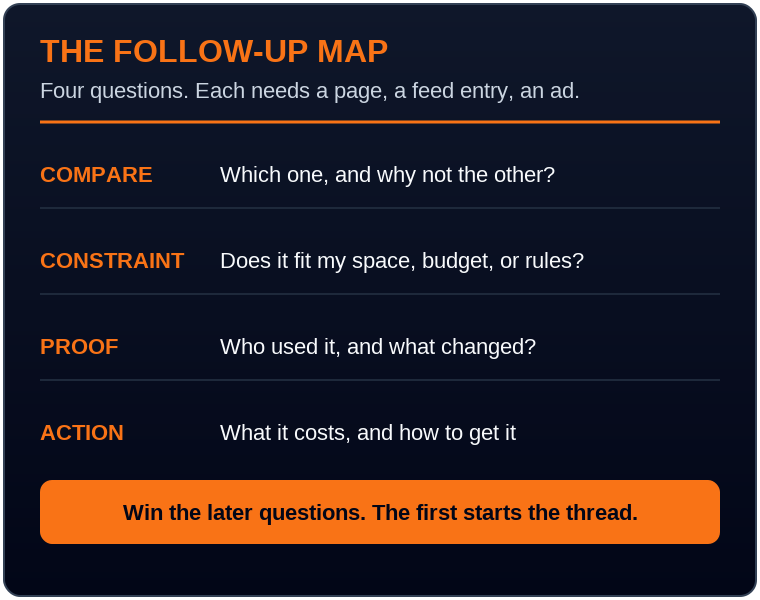
| Follow-up | The buyer is really asking | Page job | Feed job | Ad job |
|---|---|---|---|---|
| Compare | Which one, and why not the other | One honest comparison page, with the tradeoff stated early | Distinct titles and attributes per variant, so the answer picks the right one | Copy that names the choice, not the category |
| Constraint | Does it fit my space, budget, or rules | Specs, limits, and exclusions above the fold | Accurate availability, price, and variant data | Landing page matched to the constraint, not the homepage |
| Proof | Who used it, and what changed | A named result, a real customer situation, and the limit of the claim | Reviews and ratings tied to the exact product | Creative that carries the proof, not a slogan |
| Action | What does it cost, and how do I get it | Price, delivery or booking step, and the next action in plain words | Current price and stock, with no stale offer | An offer the landing page can actually fulfill |
Notice what the map does to keyword work. The first question is short and competitive. The follow-ups are long, specific, and cheap to answer well, because they come from real buyers rather than keyword tools.
AI Mode queries already average about three times the length of traditional searches, per Google. A page written for a three-word query will sound thin inside a thirty-word conversation. A page written for the follow-up will sound like it was listening.
The product feed is now part of the answer
For product sellers, the feed deserves its own section, because the evidence points there. A Findrix study of 55,198 AI-generated answers, covering 18,400 buyer questions across 35 United States markets from October 14 to 17, 2026, found that 57% of links in AI Mode product answers pointed to Google Shopping product pages.
In 46.5% of product answers, the links pointed only to Google pages. Search Engine Land reported the study on October 29.
Read that finding with its limit attached. The study measured links shown in answers, not clicks and not purchases. It does not prove that 57% of buyers clicked a Shopping link or bought through one.
What it does prove is where the answer looks first when a product question arrives. The answer reaches for structured product data: price, ratings, availability, and variant attributes. A category page with a vague description cannot compete with a feed entry that states the exact thing, at the exact price, in stock now.

If the feed is wrong, the answer is wrong. The buyer never sees the correction.
So audit the feed the way you would audit a sales rep. Check that every money product has a distinct title, a current price, honest availability, and attributes that match the follow-ups buyers actually ask: size, fit, compatibility, and the difference between variants.
Fix stale prices first, then missing variants, then thin titles. A stale price inside an AI answer is worse than a stale price on your own site, because the buyer meets the wrong number before meeting you, and has no reason to believe your correction over the answer that stated it confidently.
Service businesses should not copy this playbook wholesale. The same study found that only 5.1% of links for local service questions went to Google pages. A plumber, a lawyer, and a dentist are not picked from a product grid.
Their follow-ups are answered by pages, reviews, and local signals, not by a feed. If you sell services, put the map work into pages and proof first, and treat Shopping as someone else's problem. That split is why recommendations now matter more than raw clicks, and why a visibility score has to measure being picked, not just being shown.
Measure the thread, not just the click
Here is the uncomfortable part. Google reports AI Mode performance inside ordinary Search and Shopping campaigns, so you cannot cleanly see what an AI Mode click cost or converted at. An October review of paid search noted exactly that reporting gap.
Any vendor who shows you a precise AI Mode conversion rate this month is showing you a model, not a platform report. Say so in the room before someone builds a budget on it.
Measure what you can observe instead. For each mapped offer, track four proxies over two weeks: landing pages that receive AI-style long queries, search terms that read like follow-ups rather than first questions, assisted conversions where a mapped page appears in the path, and feed errors or disapprovals for the mapped products. None of these proves an AI Mode sale.
Together, they show whether the thread is reaching your pages or stopping at the answer. If long-query landings rise while mapped pages stay flat, the answer is absorbing the thread and your pages are not in it.
One more measurement warning, because a small study is already being quoted too loudly. A one-site test by Cyrus Shepard measured about a 0.9% click-through rate from AI Overviews and AI Mode, and found that opting out of the AI features also lowered clicks on regular organic results. That is one site, not a market rate, and the opt-out result cuts against the obvious reaction.
Do not opt out of AI features on the strength of one test, and do not quote 0.9% as your expected rate. Watch your own Search Console AI report, which shows impressions rather than clicks, and treat any single-site number as a prompt to test, not a reason to retreat.

The follow-up is a conversation. Write the page the way a good counter conversation sounds.
A two-week test before Black Friday
Multiturn ads arrived weeks before the holiday shopping peak, and that timing is the deadline. Run this test now, while the layout is still new and competitors are still reporting the news instead of answering the follow-ups.
First, pick five money offers and write their follow-up maps. Use real buyer language from calls and tickets, not keyword suggestions. Second, fix the pages for the compare and constraint follow-ups first, because those are where threads die. Put the tradeoff and the limit in the first lines, not at the bottom. Third, audit the feed for those five offers only, and fix price, availability, and variant attributes before expanding to the catalog.
Fourth, check that existing campaigns can actually serve the follow-ups: landing pages matched to the constraint, ad copy that names the choice, and no homepage catch-all for a specific question. Fifth, set the measurement proxies above and review them after two weeks, offer by offer. Keep what moved a thread forward. Cut what only bought a first question.
The Meta side of the same test needs its own check, because closed-loop measurement changes what a click is worth. And if you score visibility at all, score it on being picked for a follow-up, not on ranking for a first question.
Our visibility scorecard already points that way. The thread is the ranking now.
Frequently asked questions
A multiturn ad is an ad that can appear on a follow-up question inside a Google AI Mode conversation, not just on the first search. In the United States, existing Search, Shopping, and Performance Max campaigns are automatically eligible, and the ad adapts as the person refines the conversation.
No. Google made existing Search, Shopping, and Performance Max campaigns eligible for AI Mode placements. The work is not a new campaign type. It is matching landing pages, feed data, and ad copy to the follow-up questions those campaigns will now serve.
Google has said AI Mode monetizes below classic search, while AI Mode queries run longer and mostly add new searches rather than replacing old ones. The company is adding paid placements inside answers, including multiturn ads, to raise what each AI Mode search earns. Read the admission as a description of the plan, not as a reason to leave the surface.
Not on the headline alone. Meta's ad revenue grew 26% in the quarter while Google Search and other grew 12%, but the two sell different jobs: feed attention versus answered questions. Move budget offer by offer, based on which job each offer depends on, and check what each platform does to your creative after the move.
No. The Findrix study measured links shown in AI Mode product answers, not clicks or purchases. It shows where answers look first for product questions. Treat it as a feed-quality warning, not a click share, and audit price, availability, and variant data accordingly.
Not as a first move. The same study found only 5.1% of local service links went to Google pages. Service follow-ups are answered by pages, reviews, and local signals. Put the map work into comparison, constraint, and proof pages first.
Not on the evidence available. A one-site test put AI click-through near 0.9% and found opting out also lowered regular organic clicks. That is one site, not a market rule. Test on your own traffic, watch your Search Console AI report, and do not trade a known surface for an untested retreat. The search is not ending. It is getting longer, more conversational, and more paid at the exact moment a buyer stops browsing and starts deciding. The first question was never the sale. It was the opening line. Win the follow-up, and the thread closes with you in it. ChatGPT ads are a different placement with different rules, and shopping agents will keep rewriting how brands get picked. The map above is the piece you control this week: five offers, four follow-ups each, and an answer ready before the buyer has to ask twice.