# ChatGPT Ads Are Not Search Ads
The first mistake marketers will make with ChatGPT ads is treating them like Google Search ads with a chat window attached.
That framing is convenient. It is also wrong.
That creates a real media opportunity. It also creates a different measurement problem. Search ads intercept a query. ChatGPT ads sit inside a longer decision process where the user may be comparing options, asking follow-ups, rewriting the question, or never clicking at all.
The playbook cannot be “copy the best search ad and add more conversational language.” The playbook has to start with how people make decisions in an assistant.

The new ad unit sits inside a decision, not just beside a query.
The query is only the opening move
A search query often tells an advertiser what the person typed at one moment. A conversation can reveal the shape of the decision over several turns.
Someone looking for a meal kit might ask for cheap options, then compare delivery areas, then ask which choice works for a family of four. Someone choosing marketing software might begin with a vague problem and end by asking for a shortlist their finance team can approve.
OpenAI says ad selection during the test can use the topic of the conversation, past chats, and past ad interactions. The company also says advertisers receive aggregate performance information rather than chats, chat history, memories, or personal details.
That combination matters. The platform is trying to make the ad relevant to the decision context while keeping the user's private conversation away from the advertiser. The result is more contextual than keyword-based, but less inspectable than the search report marketers know.
The marketer's job is moving upstream. You are no longer only writing a headline for a known query. You are deciding which customer problem your brand can credibly enter, what proof the assistant can find, and what happens after the recommendation.
That is a much bigger job than keyword insertion.
Relevance beats interruption
Traditional paid search rewards a tight relationship between query, ad, landing page, and conversion. The system can be tested in pieces. A team can change the headline, isolate a keyword, and watch what happens to cost per click (CPC) or conversion rate.
An assistant experience has a different rhythm. The user may not want a hard sell. They may want help making sense of a category before they are ready to choose a brand.
That changes the creative brief. A useful ChatGPT ad should answer a nearby need without pretending to be part of the answer. It needs a clear sponsored label, a specific reason to care, and a next step that matches the user's level of intent.
A weak brief says:
- Put the product in front of people researching the category.
- Use the highest-volume audience.
- Send everyone to the homepage.
A stronger brief says:
- Identify the decision the user is trying to make.
- Offer one credible reason the brand belongs in that decision.
- Give the user a low-friction next step that continues the task.
That might be a comparison page, a fit guide, a calculator, or a store locator. It probably is not a generic home page with six competing calls to action.

The work is less about writing one ad and more about defining the decision it should enter.
This is where many teams will waste money. They will buy a new placement before they fix the page the placement sends people to.
The same failure already appears in AI Max paid search campaigns. More automation cannot rescue a vague offer, thin proof, or a landing page that makes the customer start the research again.
Measurement gets less comfortable
The easy metric is the click. It is familiar, reportable, and usually too small to explain what happened.
ChatGPT ads may produce value through a sequence that does not look like a direct response funnel. A person sees a sponsored recommendation, asks another question, visits the brand later through a browser, and converts after a retailer interaction. The first exposure may be important without receiving the last click.
That does not mean every unmeasured impression deserves credit. It means teams need to define what they are testing before they buy traffic.
A practical test plan should separate at least four questions:
| Question | Useful evidence |
|---|---|
| Did the ad reach a relevant decision context? | Qualified exposure, topic fit, dismissal, feedback |
| Did it change consideration? | Branded search, direct visits, engaged sessions, assisted actions |
| Did the destination continue the task? | Scroll depth, tool use, comparison completion, lead quality |
| Did the channel create incremental demand? | Holdouts, geo tests, matched-market tests, new-customer rate |
The exact reporting options will change as the product develops. The discipline should not.
OpenAI's current public description emphasizes aggregate views and clicks, not a complete picture of downstream influence. That is a signal to build your own measurement design instead of waiting for a perfect platform dashboard.
Teams already wrestling with why AI attribution hides return on investment should recognize the pattern. The system will report what it can observe. Your job is to decide what the business needs to know.
If the channel changes how people decide, last-click reporting will make it look weaker or stronger than it really is.
Trust becomes part of the media buy
Advertising inside an assistant is not just a placement decision. It is a trust decision.
OpenAI says ads are not eligible near sensitive or regulated topics such as health, mental health, or politics during the test. It also says the company will keep developing safeguards around scams and misleading ads. Those statements are useful boundaries, but they do not remove the advertiser's responsibility for the claim, destination, or customer experience.
For regulated categories, the bar is higher. Cannabis brands should be especially careful about confusing an AI recommendation with an endorsement, using health language, or sending a curious user toward restricted sales language. The safer path is educational content, clear age and location boundaries, and a review process that checks every claim before it becomes media.
That is not a reason to ignore the channel. It is a reason to treat it like a new surface with its own compliance checklist. The AI chatbot liability problem in cannabis shows why a helpful interface can still create risk when the business has not defined what the system may say.

A recommendation is only as trustworthy as the next step the brand can support.
Build for answer-shaped demand
The most valuable preparation is not a new ad account. It is a stronger source of truth.
Before testing ChatGPT ads, audit the material an assistant could use to understand your business:
- Product and service pages that answer real comparison questions.
- Proof that names the customer, context, result, and limits.
- Policies that explain availability, privacy, shipping, age, geography, or eligibility.
- Fresh business details that do not conflict across your website, profiles, and partner pages.
- A destination that gives the visitor a useful next action instead of starting the pitch from zero.
This is also why AI search visibility is becoming a scorecard problem, not a single ranking problem. Teams need to see whether the brand is represented accurately, in the right contexts, with enough evidence for a system to quote or recommend it.
The visual below is a simple way to think about the path. An ad can create awareness, but the brand still has to earn the recommendation, continue the task, and prove whether the exposure changed behavior.
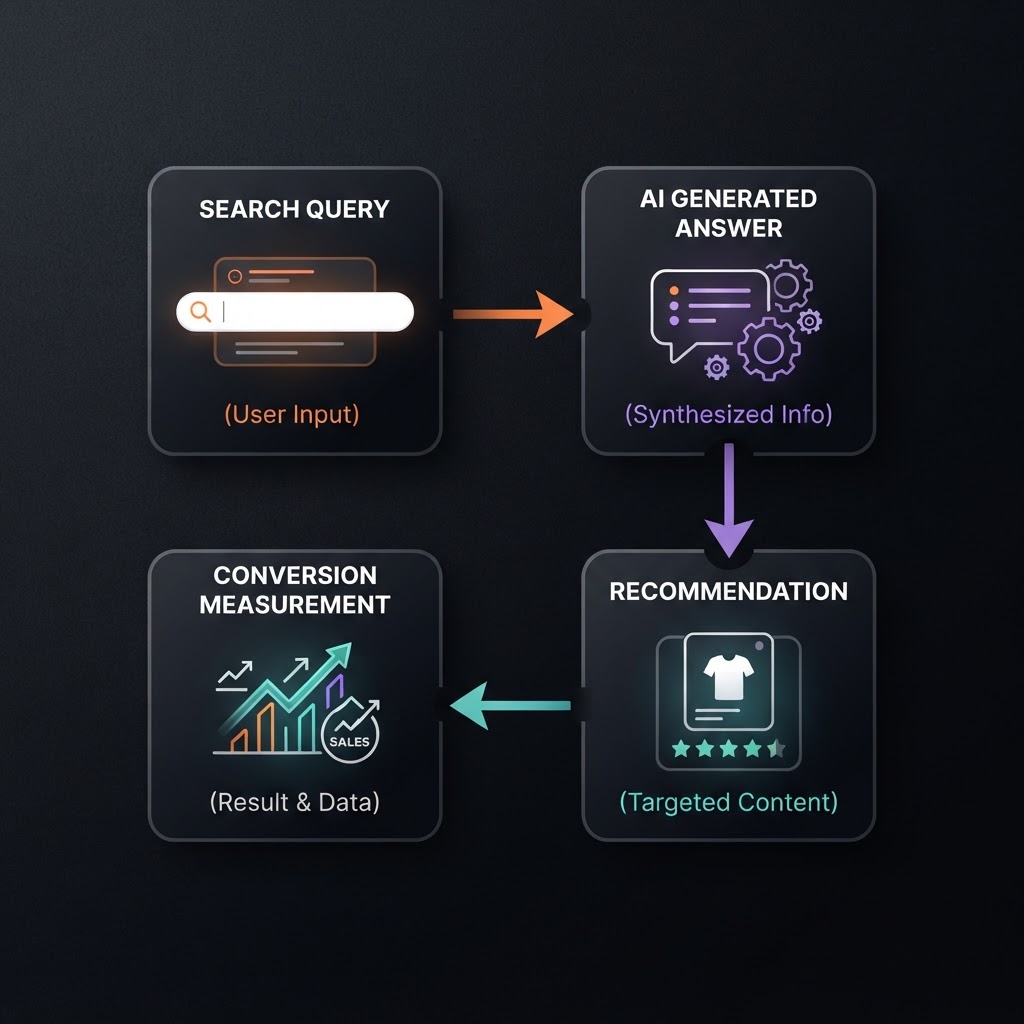
The useful unit is not the click. It is the full decision path.
A good test brief should name the decision context, the evidence the brand can contribute, the destination experience, the guardrails, and the incrementality method. If those fields are blank, the campaign is not ready, no matter how attractive the audience estimate looks.
What marketers should test first
Start narrow. Pick one customer decision where the brand has a real advantage and enough evidence to support the claim.
Then run a controlled test with a destination built for that decision. Compare it against a similar audience or market where the placement is absent. Track direct response, assisted behavior, branded demand, and new-customer quality. Keep the test long enough to observe delayed actions, but not so long that the team cannot learn from the first version.
Do not judge the channel against search using one blended return number. Ask whether it is doing a different job. Search may capture demand that already exists. Assistant advertising may influence the shape of the demand before the customer knows which brand to search for.
That distinction matters for budget allocation. It also protects the brand from the usual automation trap, where a platform's first available metric becomes the entire strategy.
Frequently asked questions
#### Are ChatGPT ads the same as Google Search ads?
No. ChatGPT ads appear inside a conversational decision process, while Google Search ads are usually matched to a typed query and search results page. The creative, landing page, and measurement plan should reflect that difference.
#### Do ChatGPT ads change the answer the user receives?
OpenAI says ads do not influence ChatGPT answers and are visually separated from the organic answer. That is the platform's stated design principle, but advertisers should still monitor how sponsored placements affect trust and behavior as the product expands.
#### Can advertisers see a user's private ChatGPT conversations?
OpenAI says advertisers do not receive chats, chat history, memories, or personal details. The company describes advertiser reporting as aggregate performance information such as views or clicks.
#### What should a brand measure in ChatGPT ads?
Measure more than clicks. Include relevance, dismissals or feedback where available, destination behavior, branded demand, qualified leads, new-customer rate, and incremental outcomes from a holdout or matched-market test.
#### Should small businesses advertise in ChatGPT now?
Only if the business has a specific customer decision it can support with clear evidence and a useful destination. A narrow test can make sense, but broad spending before the measurement model is ready is a fast way to buy ambiguity.
#### What should regulated brands do first?
Start with a claim and destination review. Confirm the ad, landing page, availability language, age or location controls, privacy copy, and escalation process before testing a sensitive category.
The next budget meeting
ChatGPT ads will be tempting because they look like a new answer to an old problem: reach people while they are choosing.
That is probably the right opportunity. The wrong move is forcing the opportunity into a search-shaped spreadsheet.
The teams that win here will be the ones that understand the decision context, publish evidence an assistant can use, and measure influence without pretending every outcome is a click. The placement is new. The discipline cannot be.