# Google Made AI Search Visibility Measurable
AI search visibility just became easier to report and harder to misunderstand. Google has introduced dedicated Search Console views for appearances in generative AI features, which gives marketing teams a better signal than a spreadsheet of screenshots.
It doesn't solve the hard part. A brand can show up in an AI answer, earn an impression, and still be described incorrectly, cited beside the wrong competitor, or attract nobody worth selling to. The new report is a measurement layer, not a strategy.
The teams that benefit will treat it as the top of a scorecard. They will connect visibility to accuracy, source quality, customer behavior, and qualified business outcomes.

The dashboard got better. The question underneath it stayed the same: did the right buyer understand you?
The report changes the starting point
Google's announcement of Search Generative AI performance reports matters because it moves AI visibility out of the pure anecdote category. Marketers can now inspect performance tied to generative AI features in Search Console instead of relying only on manual prompt checks and third-party estimates.
That distinction matters. Manual checks are still useful for accuracy and competitive context, but they are snapshots. A first-party report can show patterns across a site's actual search presence, which gives teams a stronger baseline for deciding what to investigate.
It also creates a temptation to celebrate too early. New reporting often becomes a new target. Someone adds generative AI impressions to the weekly deck, the number rises, and the team quietly treats the metric as demand.
Don't do that. Start with three questions:
- Which pages are appearing?
- What kind of query produced the appearance?
- What happened after the answer was shown?
The report helps with the first question. Your measurement system has to answer the other two.
Visibility is not the same as accuracy
An answer can include your company and still damage your positioning. It may call a specialist agency a generalist, confuse two similarly named products, use an old service description, or attach a competitor's proof to your brand's category.
That is why AI search visibility needs a quality check beside the volume report. For every important prompt cluster, log four fields:
| Check | What to record | Why it matters |
|---|---|---|
| Presence | Was the brand included? | Measures reach in the answer layer |
| Position | Was it recommended, compared, or merely mentioned? | Separates influence from decoration |
| Accuracy | Was the description current and specific? | Protects brand meaning |
| Evidence | Which page or source supported the claim? | Shows what the system trusted |
A mention with poor accuracy is not a win. It is a repair ticket.
This is where the AI marketing source of truth problem becomes operational. If your homepage, business profiles, service pages, reviews, and case studies describe different versions of the company, a language model has to reconcile the conflict. It may choose the version you like least.
Create an approved source-of-truth sheet with the company's category, customers, locations, services, exclusions, proof points, and last-checked dates. Keep it boring. Boring is good when a system is trying to identify an entity.
The citation deserves an audit
Google's guidance for succeeding in AI features still points back to familiar fundamentals: helpful content, crawlable pages, clear structure, and a good experience. AI reporting doesn't replace those foundations. It shows where they are being interpreted.
A citation audit should ask more than whether a URL appeared. Ask whether the cited page actually supports the sentence the answer made. If the answer says a service is available in a location, can the page prove it?
If it describes a product as compliant, where is the current policy or documentation? If it recommends a brand for a specific customer, is that audience visible anywhere in the content?
The Princeton research on generative engine optimization helped establish an important idea: generative systems may respond to source and content characteristics that don't map neatly to classic ranking position. The lesson for operators is straightforward.
Make claims easy to understand, easy to verify, and useful without forcing the reader through a form first.
That doesn't mean giving away your whole business. It means not hiding the answer behind empty thought leadership. A page that makes a clear claim and shows its evidence is more useful to a customer and easier for a system to quote responsibly.

The best citation is not the flashiest one. It is the one that can carry the claim without stretching it.
Build a scorecard, not a vanity metric
The practical scorecard has four layers.
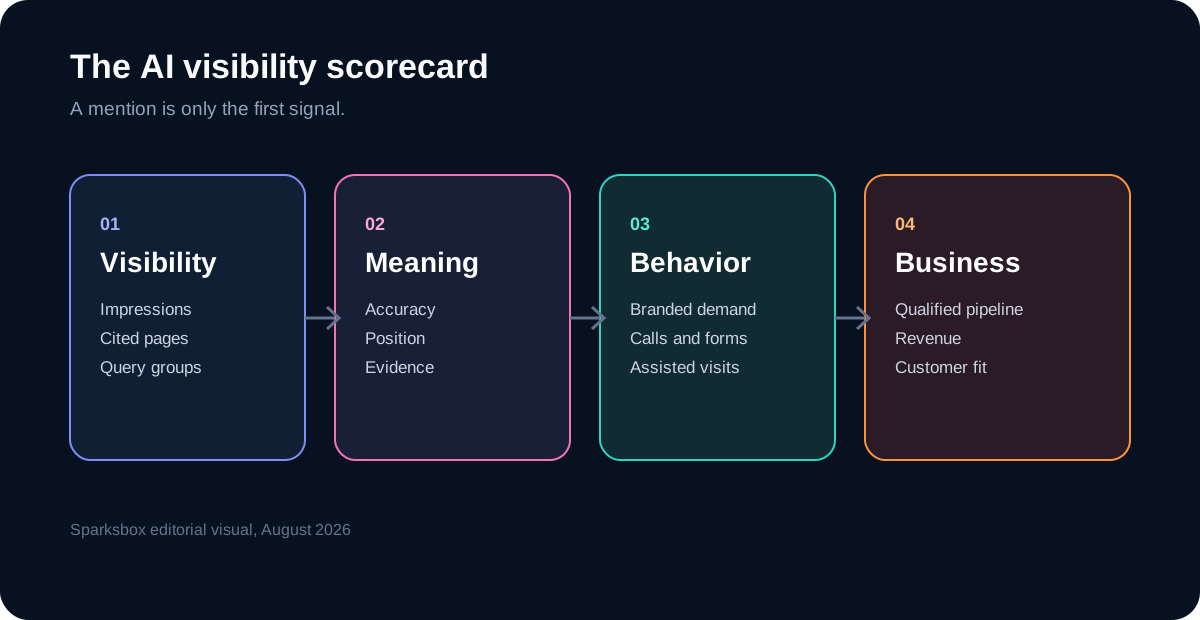
Visibility. Track generative AI impressions, cited pages, inclusion rate for priority query groups, and changes over time. Treat this as reach, not revenue.
Meaning. Score whether the answer describes the brand correctly, names the right service, and matches the audience you want. A simple accurate, partially accurate, inaccurate rating is enough to start.
Behavior. Compare branded queries, direct visits, calls, form quality, and assisted conversions against the periods when visibility changed. Use customer relationship management (CRM) notes and post-purchase questions to capture what analytics misses.
Business. Follow qualified pipeline, close rate, revenue, and customer fit. If visibility climbs while the sales team sees worse leads, the problem may be positioning or audience selection, not content volume.
Google's Search Console documentation remains useful for the measurable web journey, including queries, pages, impressions, and clicks. Pair it with analytics and sales evidence, but don't pretend those systems provide a perfect customer timeline. They don't.
The important shift is language. Say, “AI visibility increased for commercial comparison prompts, with accuracy improving on the service pages.” Don't say, “AI visibility drove revenue,” unless you can defend that causal claim.
Sparksbox's work on AI attribution drift covers why influence may surface later as branded search, direct traffic, a phone call, or an untracked conversation. The answer is not to abandon measurement.
It is to label evidence honestly. The broader AI search visibility operating system gives the measurement loop a place inside the rest of the marketing system.

Someone still has to decide whether the machine got the brand right. That job belongs to a human.
What to do every week
Give one person ownership of a lightweight review loop.
Audit. Pull the new Search Console report. Group the visible pages and queries by intent. Run a fixed set of high-value prompts across the answer engines your customers use.
Inspect. Compare the answer with the cited page. Mark presence, position, accuracy, and evidence. Save the result so a future review can see what changed.
Repair. Fix the source page before creating another article. Update the service description, proof, author information, business profile, or internal links that caused the confusion.
Recheck. Look for improvement in the next reporting window. Keep a changelog. AI answers vary, so a single clean result is not a trend.
This loop is smaller than most marketing stacks. That's part of the point. The advantage won't come from collecting every possible visibility score. It will come from seeing a bad answer, finding the weak source, and fixing it before the buyer makes a decision.
Frequently asked questions
AI search visibility is the extent to which a brand appears, gets cited, or is accurately described inside generative answers from search engines and AI assistants. It includes more than a traditional ranking position because the system may summarize several sources before a click happens.
No. Search Console can provide stronger evidence of appearances and search performance, but it cannot prove the full path from an AI answer to a sale. Connect it with analytics, CRM records, calls, and customer-reported discovery, then describe the result as assisted influence unless the evidence supports more.
Start with a fixed prompt set, a monthly or weekly review, and four ratings: presence, position, accuracy, and evidence. Add Search Console data when available, then track branded demand and qualified leads. A consistent small system is better than an expensive dashboard nobody trusts.
There is no guaranteed citation formula. Pages have a better chance when they are accessible, clear, specific, useful, current, and supported by evidence. Write for the person's question first, then make the important claim easy for a retrieval system to identify and verify.
No. AI features still depend on strong underlying content, technical access, clear entities, and a credible web presence. Treat AI visibility as another surface of search, not a replacement for the fundamentals that help customers find and trust you. The report is a useful beginning because it gives marketing teams something better than a screenshot. It won't tell you whether your brand is being understood, whether the citation is deserved, or whether the visibility reached a customer worth winning. That part still requires judgment. And, for now, a person willing to read the answer all the way through.