The promise of AI in retail is simple: show each customer exactly what they want to buy. But in cannabis, that promise breaks the law.
Curaleaf can't email a customer their favorite strain because email marketing to cannabis consumers is a regulatory minefield. Trulieve can't build a recommendation engine based on purchase history if that history touches more than three states.
Green Thumb Industries' chatbots have to pass compliance review before they can suggest anything beyond "we have this product in stock.
This is the wall every cannabis operator hits. And it's reshaping how AI actually gets deployed in the sector.
The Personalization Paradox
Personalization in retail works because it drives two things operators love: lifetime value and conversion rate. The numbers are real.
A <a href="https://www.mckinsey.com/capabilities/growth-marketing-and-sales/our-insights/unlocking-the-next-frontier-of-personalized-marketing" rel="nofollow noopener noreferrer" target="_blank">McKinsey study on personalized marketing</a> found that personalized experiences increase conversion by 10 percent and reduce acquisition cost by up to 30 percent. For cannabis, where customer acquisition is expensive and margins are thin, that's the difference between scaling and struggling.
Generative AI made personalization cheap. In 2024 and 2025, every point-of-sale system, dispensary website, and cannabis software vendor released an "AI personalization" feature. Dutchie added AI product recommendations.
Leafline built AI chatbots. <a href="https://www.moonsauceagency.com/guides/cannabis-marketing/" rel="nofollow noopener noreferrer" target="_blank">StrainBrain promised AI budtender tools</a>. The message was consistent: AI will help you know your customers better.

Cannabis operators are shifting from behavioral tracking to explicit loyalty program consent
The result: a gap between what's technically possible and what's legally safe. Operators know it. Compliance officers know it. And they're solving it in ways that don't look like personalization at all.
How Operators Are Actually Winning
The smart money isn't personalizing the pitch. It's personalizing the experience without triggering compliance risk.
First-party data collection is winning. Dispensaries that ask customers simple, direct questions at checkout, "How often do you buy edibles?" "What effects do you prefer?" "What's your budget range?" get data they can act on without triggering state disclosure rules. No algorithms. No behavioral tracking. Just ask.
Loyalty programs are the backdoor. A customer who enrolls in a loyalty program at Trulieve or Curaleaf has already given permission to track their visits, note their preferences, and send them relevant offers. The regulatory framework around loyalty programs is more forgiving than around targeted advertising.
Operators are layering AI on top of loyalty data, not to build creepy profiles, but to surface inventory that matches known preferences without making claims. <a href="https://sparksbox.com/blog/cannabis-ai-personalization-regulatory-risk" rel="noopener noreferrer">Compliance-first personalization is how smart operators move fast</a>.
Local inventory optimization is the sleeper win. Cannabis customers are hyper-local. A customer in downtown Portland buys different products than someone in a suburb.
AI is being deployed not to personalize recommendations, but to manage the supply chain, showing customers what's actually in their location, what's about to sell out, and what's coming in. That's personalization without the liability. Dutchie and other <a href="https://sparksbox.com/blog" rel="noopener noreferrer">cannabis software platforms</a> are building this layer now.
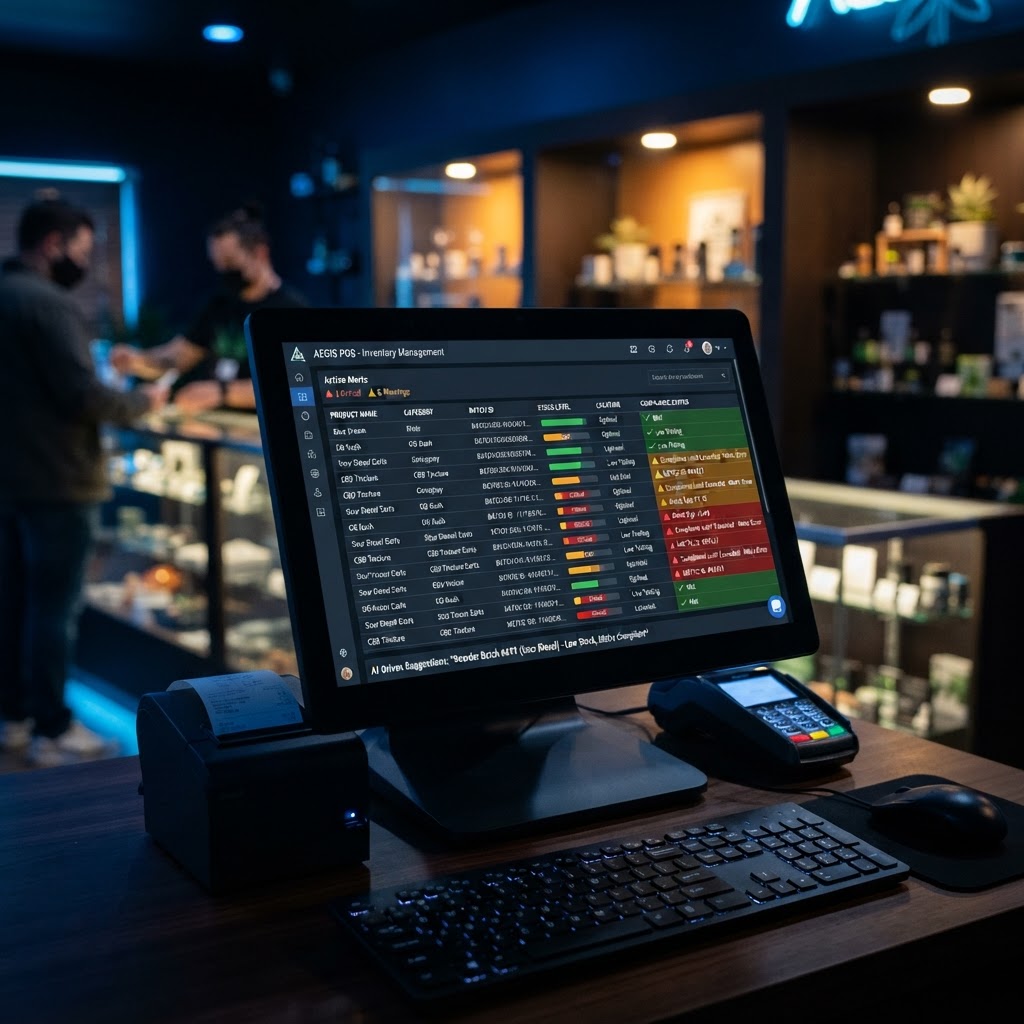
Smart dispensaries use AI for inventory forecasting and compliance alerts, not customer-facing personalization
Third-party data is almost gone. The <a href="https://www.iab.com/events/modernizing-mmm-attribution-incrementality-ai/" rel="nofollow noopener noreferrer" target="_blank">cookieless future that's been coming for years has finally arrived</a> in cannabis. Without cookies, pixel tracking, and cross-site behavioral data, old-school personalization engines break.
Operators are doubling down on first-party signals instead, and that's actually better for compliance. First-party means consent is explicit. Algorithmic targeting was always the higher risk play.
The Compliance Reality
Here's the part vendors won't tell you: every cannabis operator who's deployed "AI personalization" is playing a quiet game with regulatory ambiguity.
California allows "marketing communications targeted to the consumer base in the retailer's dispensary." That's broad enough to let operators send newsletters to their customer list. But "targeted based on individual AI-driven preference profiling" is a different question, and no state AG has blessed that yet.
Nevada prohibits "any direct advertising, promotional, or marketing materials" to the general public. That's tighter. Loyalty email that's sent only to enrolled members is defensible. Behavioral AI recommendations based on purchase history are riskier.
The workaround: make personalization look less like personalization. Don't call it "AI-driven recommendations." Call it "products we think match your interests based on your past visits." That's true. It's also vague enough that it's defensible.
What's Actually Scaling
The cannabis operators winning with AI right now aren't the ones trying to out-personalize Amazon. They're the ones solving operator pain:
- Demand forecasting: predict which products will sell out this week so you can stock accordingly
- Inventory optimization: route stock to the location where it'll sell fastest
- Compliance automation: flag marketing copy that might violate state rules before it ships
- Customer segmentation for bulk operations: organize your loyalty data by frequency, category preference, and spend, but send the same templated message to each segment, not individual AI-driven recommendations
This is still personalization, but it's one layer removed from the customer. It's more defensible. And it works. <a href="https://sparksbox.com/blog/cannabis-ai-personalization-compliance-wall-2026" rel="noopener noreferrer">Real case studies show loyalty-first operators are outperforming personalization-first ones</a>.
The Long Game
The cannabis industry is in compliance purgatory with AI. Operators know personalization can drive revenue. They know the technical tools exist. They also know that being the test case for the first aggressive AI marketing lawsuit is a business-ending bet.
The operators who'll win over the next 18 months are the ones who:
- 1Build first-party data collection into their loyalty programs
- 2Use AI for operational efficiency, inventory, forecasting, compliance automation
- 3Personalize the experience without personalizing the marketing
- 4Document their compliance reasoning for any AI deployment
The vendors who'll scale are the ones selling tools for operator-side AI, not customer-facing personalization bots.
When federal rescheduling finally unlocks more explicit marketing authority, the operators who've been patient will have the data infrastructure to move fast. The ones who got aggressive with "AI personalization" in 2026 will be dealing with compliance teams and legal review.
FAQ
Yes, but with guardrails. The chatbot can answer "Do you have this product?" and "What are your hours?" It can't make health claims, suggest products based on user health history, or say "customers like you bought X." Most states treat customer-facing chatbots like marketing claims, so compliance review is required before launch.
They can, but within strict limits. Email to an opted-in loyalty list is defensible. Email to a purchased list, or behavioral email such as "we noticed you bought edibles, here's an edible sale," is riskier and sometimes prohibited depending on the state. First-party loyalty email is the safer play.
Legally and practically, yes. Loyalty data is explicit consent, "I joined this program." Behavioral tracking without explicit consent crosses into targeting that states restrict more aggressively. Cannabis operators are moving loyalty-first because it's both more effective and more defensible.
Effectively, yes. If you have stores in California, Nevada, and Colorado, each state has different ad rules. Building a unified customer profile across states can cross state advertising restrictions. Large multi-state operators are handling this by keeping customer data segmented by location and applying state-specific compliance rules.
Not immediately. Even if cannabis moves to Schedule III, it'll still be a regulated product with state-level marketing restrictions. Federal rescheduling will open some doors, email marketing, content advertising, affiliate partnerships, but personalized algorithmic marketing will still hit the same guardrails as alcohol or tobacco. Don't expect a free-for-all.
2-3 years out, as state regulations catch up to AI technology. California and Nevada are already drafting more specific AI rules. Once a few states create explicit AI personalization frameworks, others will follow. Until then, operators are right to stay cautious.
What's Next
Cannabis is a preview of how AI regulation will work for restricted categories. Alcohol, sports betting, and financial services will all hit similar walls: the technology is good, but the laws aren't written for it yet.
The operators who succeed won't be the ones fighting the regulation. They'll be the ones who built first-party data moats while playing defense, so that when the rules finally clarify, they move faster than their competitors who were still waiting for permission.