The prompt is not the control
Cannabis AI marketing gets framed as a speed problem. Teams want faster product descriptions, more local pages, quicker answers, and a cleaner publishing calendar. The real constraint is proof. If a model writes a sentence that nobody can trace to an approved source, the workflow has produced a liability with good grammar.
The practical fix is a claim ledger. Before artificial intelligence drafts anything customer-facing, the operator records what the business is allowed to say, which source supports it, who owns the decision, and when the information needs to be checked again. That turns AI from an improviser into a production assistant.
For cannabis operators, this matters because the rules are not abstract. California's Department of Cannabis Control advertising guidance and Nevada's Cannabis Compliance Board advertising guidance set boundaries that content systems cannot safely infer. The ledger is where those boundaries become usable.

The useful AI workflow starts with a review trail, not a clever prompt.
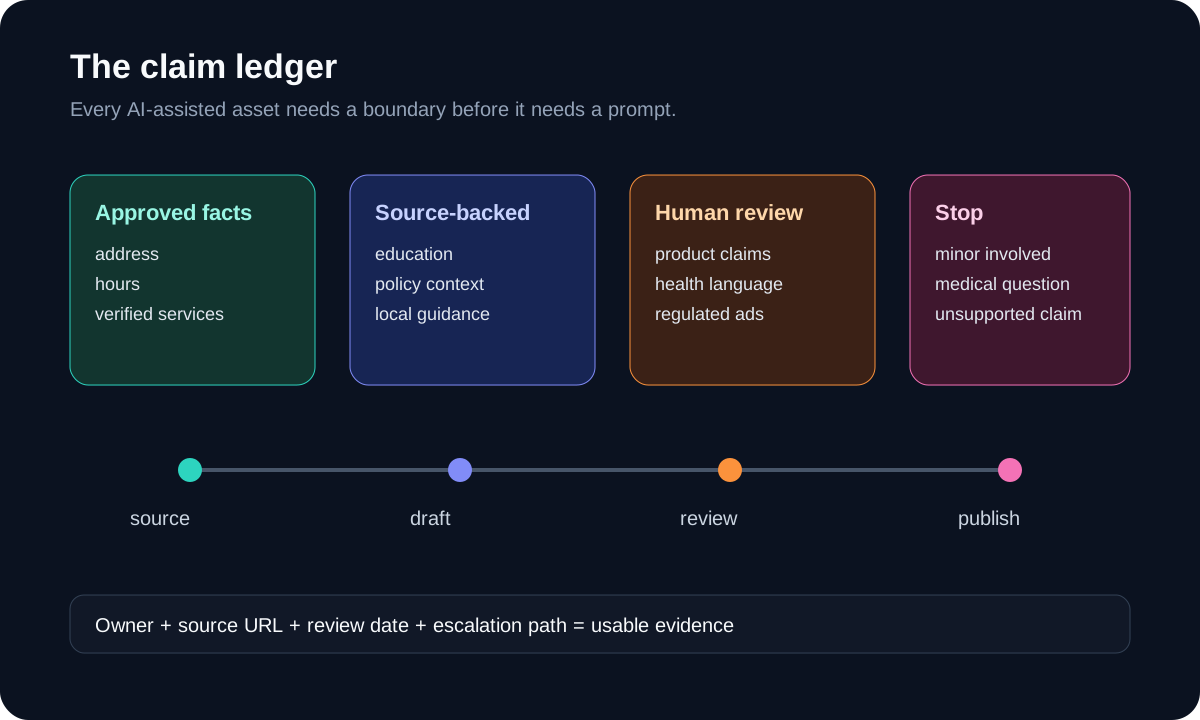
Four lanes for every claim
A claim ledger doesn't need to be an expensive platform. A shared table is enough if it is specific, maintained, and connected to the publishing process. Start with four lanes.
Approved facts cover details the business can verify directly, such as an address, hours, service area, license information, accessibility details, and confirmed menu fields. These facts still need an owner because stores move, hours change, and inventory feeds go stale.
Source-backed education covers explanations that should point to a current regulator, standards body, or other authoritative source. Google Search Central's guidance on AI-generated content is a useful reminder that the goal is helpful content for people, not mass-produced pages built to manipulate ranking systems.
Human review covers product language, regulated advertising, health-related wording, comparative claims, and anything that could be interpreted as a promise. A model can flag these phrases. It should not be the final approver.
Stop and hand off covers medical questions, adverse reactions, minors, intoxication, legal disputes, complaints, or a request that the source set cannot answer. The correct automation is a clear handoff, not a confident guess.
This is the same operating principle behind Sparksbox's human-gate approach to cannabis AI marketing. The human gate is not an admission that AI failed. It is the part of the system that knows where the system ends.
Source ownership beats prompt cleverness
Most teams try to improve outputs by refining prompts. That helps with format, but it does not solve stale sources or unclear authority. A better ledger gives each entry five fields: the approved wording, the source URL, the owner, the last-reviewed date, and the escalation path.
Add a sixth field for what the source does not prove. A state advertising rule can support a compliance explanation. It cannot prove that a product treats a condition. A menu feed can confirm that a product is listed.
It cannot guarantee the item is still available when a customer arrives. A review can describe one person's experience. It cannot replace a required disclosure or age gate.
That negative boundary is where many automated workflows break. The model sees a nearby fact and fills the gap with language that sounds reasonable. In Sparksbox's work on AI visibility and proof, the important distinction is simple: a source trail makes an answer easier to verify, not automatically true.
NIST's Generative Artificial Intelligence Profile gives teams a useful risk-management vocabulary. Map the risk, measure the failure, govern the process, and manage what happens next.
A cannabis content ledger is a small, practical version of that loop.
Local search needs a fact layer
Generic AI copy is cheap because it has no operational burden. It can say that education matters, customers value quality, and a store offers a welcoming experience. None of those lines answers the local question that brought a person to the page.
A useful local brief starts with what the location can actually confirm. Is the storefront open today? What access or delivery details are current? Which services are available at this location? Where should a customer go for a question the marketing team cannot answer?
That is why cannabis menu data is becoming trust infrastructure. Clean product, location, and service data gives search systems something better to summarize. It also gives the operator a smaller set of facts to review when the business changes.
The content team can use AI to group customer questions, spot missing fields, rewrite an approved explanation for different reading levels, or create a draft FAQ. It should not decide whether a location detail is current or whether a health-related claim is safe. Those are source and ownership questions.
The review record is the product
A safe workflow leaves a record. Keep the original brief, source set, model output, human decision, published version, and review date. The record can be lightweight, but it should answer one uncomfortable question: why did this exact wording appear on a customer-facing surface?
This is especially important when content appears in multiple places. A product description can travel to a website, menu, local profile, email, chatbot, and an answer engine's source set. A correction in one place does not automatically correct the others.
The FTC's artificial intelligence work is a useful warning for marketers outside cannabis too. Claims about what AI can do, what it improves, or what it guarantees still need support. Adding AI to a workflow does not lower the standard for truthful advertising.
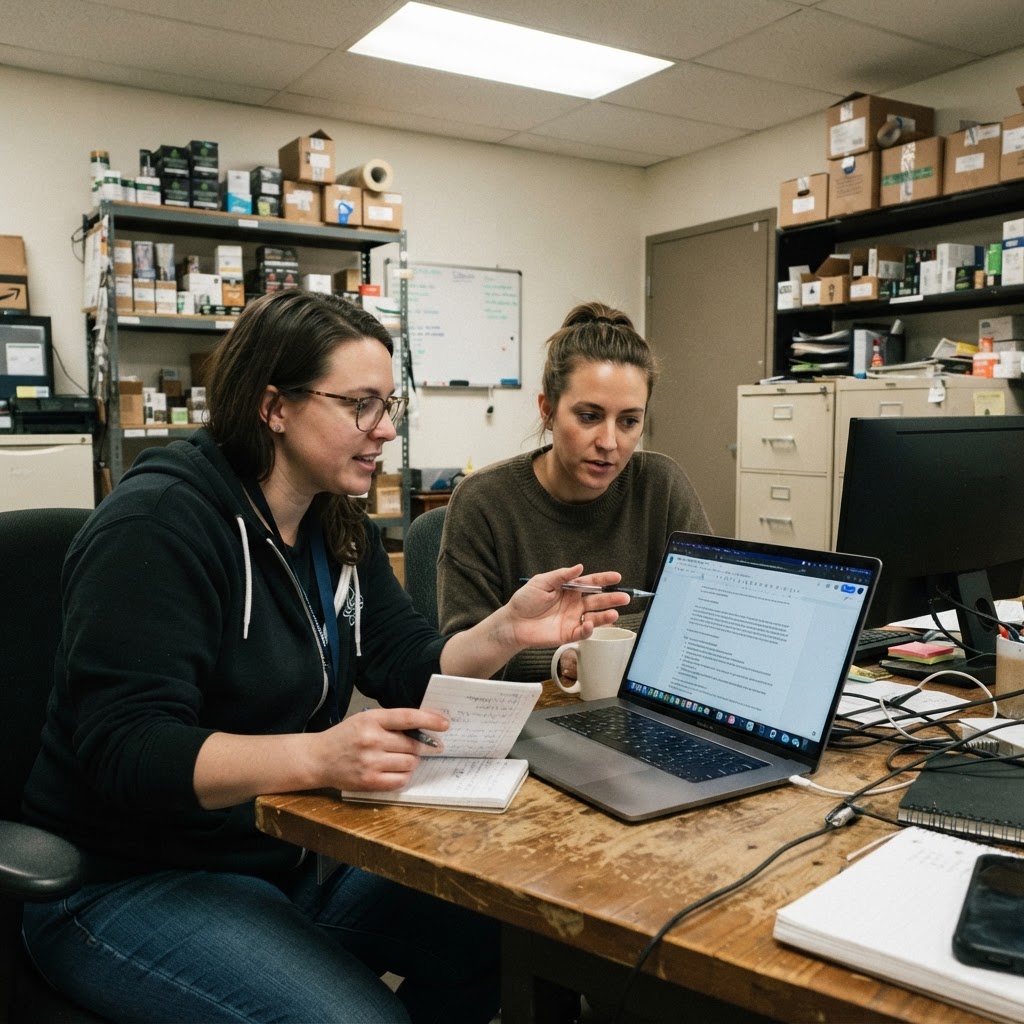
The handoff is part of the workflow, not a failure state.
Start with ten questions
Do not begin by trying to govern every possible prompt. Pick ten customer questions that matter to the business and run them through the ledger. Include a location question, a service question, a product-category question, an educational question, and at least one question that should trigger a human handoff.
For each question, name the approved sources and write the answer boundary. Then ask the model to draft inside that boundary. Review for unsupported precision, medical language, age-related issues, local inaccuracies, and statements that go beyond what the source says.
Publish only after the reviewer signs off. Sample the live page and the business profile after publication.
If the same answer is appearing through a chatbot, menu, or AI search result, check those surfaces too. Sparksbox's evidence-first AI marketing framework treats this monitoring step as part of the work, not an optional analytics project.
The ledger will expose gaps quickly. That is good. A missing owner is cheaper to fix in a table than after a claim has spread across six channels.
Questions operators ask
Can AI write cannabis marketing copy?
Yes, if the workflow limits what the model can claim and a qualified human reviews the output before publication. AI is useful for organizing approved facts, creating drafts, and finding missing information. It should not make final decisions about health claims, regulated advertising, or customer safety questions.
What should a cannabis marketing claim ledger include?
At minimum, include the approved wording, source URL, owner, last-reviewed date, and escalation path. Add a field for what the source does not prove, because that is where models often overreach. Connect each entry to the channels where the claim appears.
Does California require cannabis advertising to be age appropriate?
California rules prohibit cannabis advertising, marketing, products, packaging, and labeling that are attractive to children or people younger than 21. Operators should review the current Department of Cannabis Control guidance and confirm how the rule applies to the specific campaign and audience.
How should a dispensary use AI for local search?
Use AI to organize real location facts, customer questions, and approved educational content. Keep hours, address, services, menu fields, and local restrictions tied to owners and review dates. A longer publishing schedule cannot compensate for inaccurate local information.
What should an AI cannabis chatbot do with a medical question?
It should stop and hand the conversation to a trained human or direct the person to an appropriate professional resource without improvising medical advice. The handoff should preserve the question and context so staff can respond consistently. That boundary should be tested before launch, not discovered in production.
The next advantage in cannabis AI marketing will not come from the team with the most prompts. It will come from the team that can show its sources, explain its boundaries, and correct an answer before a bad version becomes the public one.