# Cannabis AI Visibility Needs Proof
Artificial intelligence search is making cannabis marketing look like a content problem. It isn't. The brands most likely to be represented accurately in an answer need a source trail behind every important claim, from store hours to product education to delivery boundaries.
That means an operator should be able to answer four questions before a page goes live: where did this fact come from, who approved it, when was it last checked, and what should the system do when the answer is uncertain?
Google's guidance on helpful content does not say a person must type every sentence. It does say content should help people rather than exist to manipulate search.
For cannabis brands, that standard needs one more layer: the content must stay inside the approved claim boundary for the state, channel, and audience.
The citation gap
A shopper may ask an answer engine which dispensary is open, whether delivery reaches a neighborhood, or how two product categories differ. The answer engine is likely to combine a business profile, a menu feed, a review, a state page, and the brand's own site.
Those sources do not prove the same thing.
A state regulator can support a rule. A menu can show that a product is listed. A business profile can show an address or hours. A review can describe a customer's experience. None of those sources automatically proves that a product treats a condition, that inventory is available right now, or that a recommendation is suitable for a specific person.
This is why a source trail matters. The goal is not to make an artificial intelligence system cite your brand at all costs. The goal is to give it fewer opportunities to turn a partial fact into a confident mistake.
OpenAI's ChatGPT search overview describes answers that can include links to web sources. That is useful, but a link does not make an answer correct. Your public pages still need clear ownership, current details, and language that says exactly what the source supports.

The strongest AI answer is usually built on the least glamorous document in the room: a current source log.
Build a claim register
Start with the claims your team repeats most often. Do not begin with every sentence on the website. Begin with the facts that change, carry risk, or influence a buying decision.
A useful register has five fields:
- The approved claim, written in plain language
- The primary source that supports it
- The person responsible for review
- The date it was last checked
- The escalation path when the answer is outside the approved boundary
For a California operator, the Department of Cannabis Control's consumer guidance can help establish a baseline for what is legal, but it does not replace a review of the campaign, audience, placement, and current state rules. Nevada operators should start with the Nevada Cannabis Compliance Board and confirm the current advertising requirements before adapting a California workflow.
The Federal Trade Commission's advertising guidance is also a useful reminder that disclosures and claims need to be truthful, clear, and supportable. It is not a cannabis rulebook. It is a floor for thinking about substantiation and consumer interpretation.
The register should separate four lanes:
- Verified business facts, such as address, hours, license information, service area, and contact details
- Education, which needs careful wording and a current authoritative source
- Product claims, which need the appropriate compliance review before publication
- Restricted requests, where an automated system should stop and hand the question to a trained person
That separation turns a vague prompt library into an operating control.
Local detail beats volume
Artificial intelligence makes it cheap to produce generic pages. That is exactly why generic pages are a weak strategy.
A page about “the benefits of cannabis education” says very little about the customer standing outside a store, trying to understand whether delivery reaches their address or whether a location is open on a holiday. A useful local page explains what the operator can confirm, what changes by jurisdiction, and where the reader can verify the detail.
This is the same operator-side logic behind dispensary SEO and local search for cannabis businesses. The page earns its place by reducing uncertainty, not by adding another keyword variation to the archive.
A strong local content brief might include the service area, access rules, current hours, delivery limits, menu freshness, parking or entrance details, and a clear human contact path. It should also name which details require a last-minute check.
The content team can use artificial intelligence to group customer questions, identify missing fields, and draft plain-language explanations. It should not decide whether a regulated claim is safe or whether a stale business detail can be presented as current.
If a claim has no owner and no review date, it is not a fact. It is a guess with formatting.
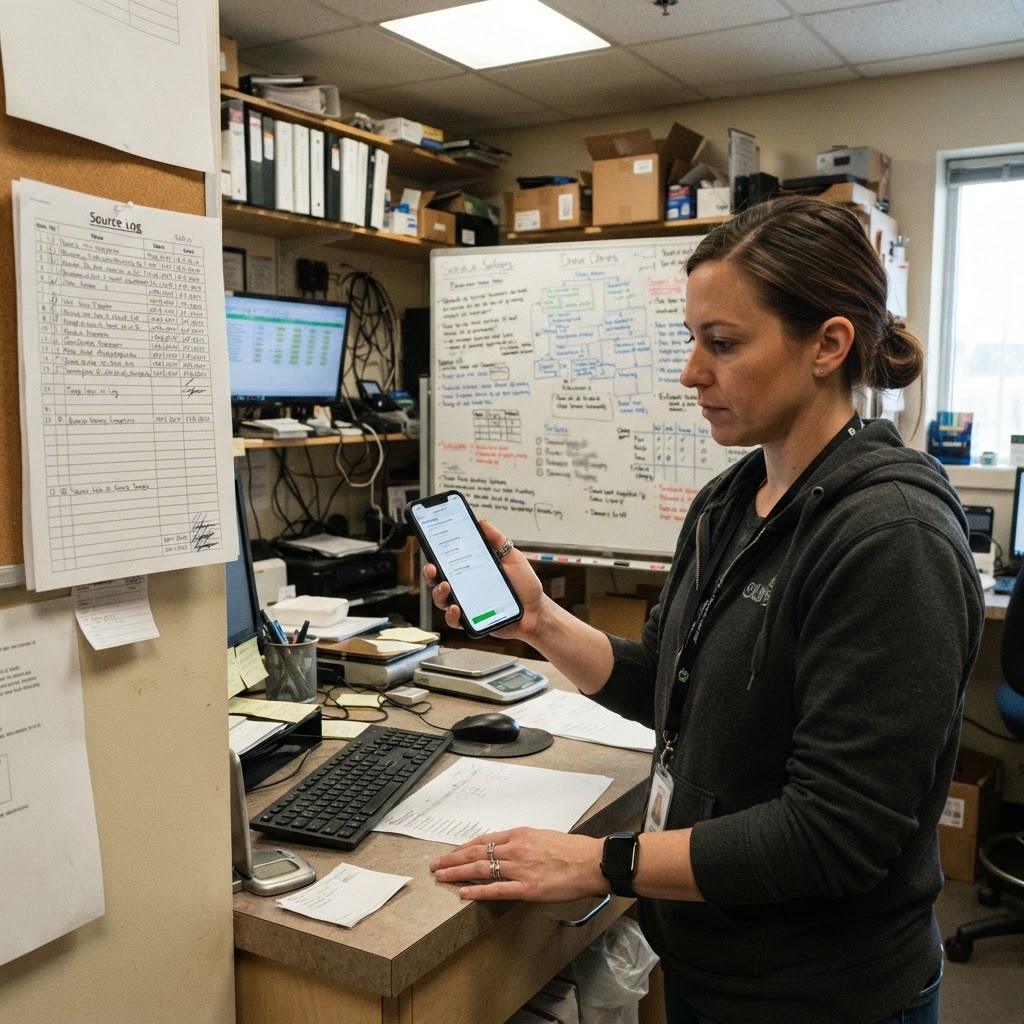
AI governance becomes real when someone has to check the page before the doors open.
Give the model a stop sign
A safe workflow needs more than approved prompts. It needs explicit refusal and handoff rules.
The system should stop when a question touches a medical condition, dosage, adverse reaction, intoxication, a minor, a legal dispute, or a complaint. The handoff should identify the responsible team and preserve enough context for that person to respond without starting over.
That is the lesson behind human review for cannabis AI. The human gate is not a ceremonial final read. It is a decision point that prevents the system from improvising where the business cannot defend the output.
A small operator does not need a giant governance department. It does need a practical record of the original question, source set, generated answer, human decision, published version, and review date. Keep the record proportional, but keep it.
The same discipline applies to measurement. AI marketing measurement becomes dangerous when a dashboard fills missing data with plausible predictions. A source trail for content and a source of truth for performance are the same underlying habit: do not confuse a polished output with verified evidence.

A workable review loop
Use a small loop that the team can actually run:
- 1Choose the customer question and define the intended answer.
- 2Assign the source, claim owner, review date, and escalation path.
- 3Draft only from those approved inputs.
- 4Review for unsupported precision, medical language, local inaccuracies, age-related issues, and stale details.
- 5Publish the page with visible dates or review states where they help the reader.
- 6Sample the live page, business profile, menu connection, and answer engines that matter to the audience.
- 7Update the register when a source or operating fact changes.
The last step is the one most teams skip. They update the page and forget the system that produced it. A month later, the next draft pulls from the old answer, and the error starts moving again.
A source register is not busywork. It is a compact memory for the business. It lets a new employee, agency partner, or AI workflow see what the brand can stand behind without guessing at institutional knowledge.
FAQ
Yes, but artificial intelligence does not remove responsibility for the published claim. Use it for question discovery, organization, and drafting after approved sources and boundaries are defined. Human review still needs to cover regulated claims, local facts, customer safety questions, and the final published version.
Google's guidance focuses on whether content is helpful, original, and made for people, not simply on who typed the first draft. Repetitive pages created to manipulate rankings are the bigger risk. For cannabis operators, useful content also needs current sources and language that stays inside the approved claim boundary.
At minimum, include the claim, primary source, owner, last-reviewed date, and escalation path. Separate verified business facts from education, product claims, and restricted requests. Add a version or published URL when the claim appears across multiple customer-facing surfaces.
It can answer low-risk educational questions when the approved source set and boundaries are clear. Questions about medical conditions, dosage, adverse reactions, minors, intoxication, complaints, or legal disputes should trigger a human handoff instead of a generated recommendation.
Review changing facts whenever the source, law, inventory, hours, or operating policy changes, and set a review date for everything else. The right interval depends on the claim. A store address and a seasonal promotion should not be treated as if they age at the same speed.
No. A citation or mention is not a performance guarantee. The more defensible goal is accurate representation, then measurement through channels the business can actually verify, such as owned traffic, qualified inquiries, customer records, and point-of-sale reconciliation. The next advantage in cannabis search will not come from publishing faster than everyone else. It will come from being the brand an answer engine can describe without inventing the missing parts.