The shortcut is the risk
Cannabis brands are adopting artificial intelligence faster than their review processes can keep up. Teams use it to draft product pages, answer shopper questions, summarize regulations, and suggest local content.
The output looks efficient right up until a model turns a soft product description into a health claim, invents a store detail, or repeats an old rule as if it were current.
That makes cannabis AI marketing less like a copywriting exercise and more like a compliance test. The question isn't whether a model can produce fluent language. It can. The question is whether the business can prove where each claim came from, who approved it, and where the system is not allowed to improvise.

The useful AI workflow starts with a review trail, not a clever prompt.
Search has become a source test
AI search changes the path between a question and a brand. A shopper may ask ChatGPT, Google's AI features, or another answer engine for a dispensary nearby, a plain-language explanation of a product category, or a comparison of local options. The system then decides which pages, business profiles, and third-party sources are credible enough to summarize.
Google's own guidance on AI-generated content does not ban artificial intelligence. It asks whether content is useful, original, and made for people rather than mass-produced to manipulate rankings. That distinction matters for cannabis operators.
Publishing more pages isn't the strategy. Publishing pages that explain a real local question, cite the rule that supports the answer, and stay inside the brand's approved claims is.
A cannabis brand also needs to understand what a source can and cannot prove. A state rule can support an advertising restriction. It cannot prove that a specific product treats a condition. A menu feed can confirm a product is listed.
It cannot guarantee that inventory is still available when a shopper arrives. A review can describe a customer experience. It cannot replace a licensee's own disclosure or age-gate requirements.
That source discipline is the difference between being visible in an answer and becoming the reason an answer is wrong.
Make the claim boundary explicit
The first practical move is to create a claim boundary before asking a model to write. Put every recurring claim into one of four lanes:
- Approved facts, such as store hours, address, license information, service area, and verified menu details.
- Educational explanations that need a current primary source and careful wording.
- Product or health claims that require legal and regulatory review before publication.
- Restricted requests where the system should stop and hand the question to a trained human.
California's Department of Cannabis Control advertising guidance is a useful baseline for California operators, but it isn't a substitute for state-specific review. Nevada operators should start with the Nevada Cannabis Compliance Board and then confirm how a campaign, channel, and audience fit the current rules.
The claim boundary should live somewhere the team can maintain, not inside one employee's prompt library. Give each rule an owner, a source URL, a last-reviewed date, and an escalation path. If nobody owns the update, the document is decoration.
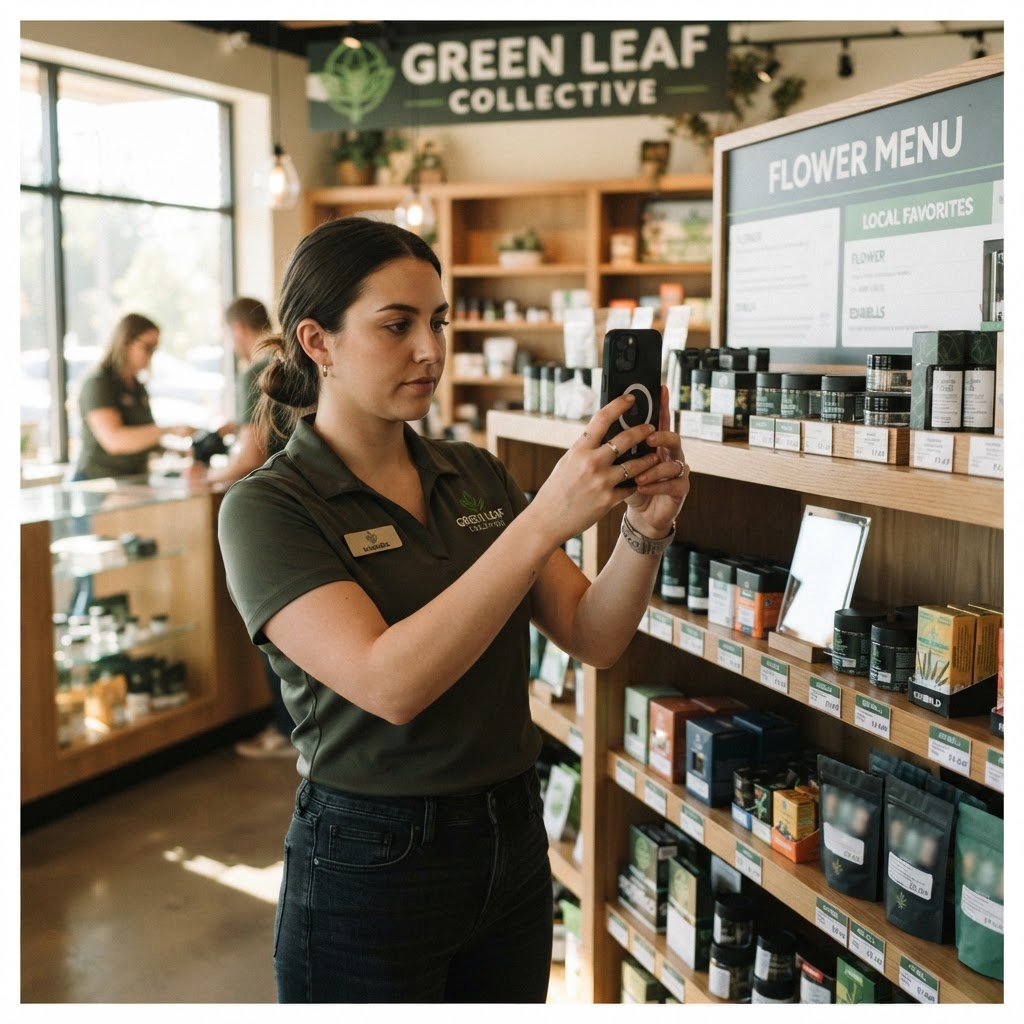
Local content earns trust when it reflects the store customers will actually visit.
Local detail beats generic volume
The easiest AI content to produce is also the easiest to ignore. Ten generic posts about why cannabis education matters won't make a dispensary more useful to a person trying to understand delivery boundaries, store access, product categories, or current hours.
A better brief starts with the actual operating question. What can this location confirm? Which customer needs a human answer? Which details change by city or state? What source will be checked before the page is updated?
That approach fits the operator-side discipline in Dispensary SEO from the operator side. It also connects to Google Business Profile optimization and local search changes for cannabis businesses, where accurate local data does more work than a larger publishing schedule.
AI can help turn approved information into clearer drafts. It can group questions, identify missing fields, and create variants for different reading levels. It should not decide whether a claim is legally safe, whether a location detail is current, or whether a customer needs a licensed professional.
Build the human handoff
A safe workflow has a visible stop sign. When a question touches a medical condition, dosage, adverse reaction, intoxication, a minor, a legal dispute, or a complaint, the system should hand off instead of guessing.
That handoff needs more than a sentence saying “contact support.” Name the responsible team, give staff the context they need, and record what happened. The same principle applies to an AI budtender.
In the AI budtender compliance trap, the operational risk isn't only the recommendation itself. It's the missing record behind the recommendation.
A useful review record includes the original question, the source set used, the model output, the human decision, the published version, and the date the source was checked. Keep it proportionate.
A small local operator doesn't need a giant enterprise bureaucracy, but it does need enough evidence to answer a basic question: why did this wording appear on a customer-facing surface?
Don't confuse access with trust
Some cannabis marketers treat AI visibility as a ranking contest. That misses the harder part. A brand can appear in an answer and still lose trust if the answer is stale, vague, or overconfident.
OpenAI's overview of ChatGPT search makes the shift clear: search answers can include links to web sources, which means the quality of a brand's public evidence affects how it can be represented. That isn't a promise of traffic or citation. It is a reason to make the underlying pages clear enough to quote accurately.
The strongest cannabis content usually has an unglamorous shape. It names the location, separates education from product promotion, shows the date or review state of changing information, and points to a primary source where the reader can verify the claim. That structure is less exciting than an automated content calendar. It is far more durable.

A source, decision, reviewer, and monitoring trail is more valuable than another batch of generic posts.
A workable operating loop
Start with a small set of high-value customer questions. For each one, assign an approved source, a claim owner, and a review date. Draft with artificial intelligence only after those inputs are fixed. Then review the output for unsupported precision, medical language, age-related issues, local inaccuracies, and claims that the source does not actually support.
After publication, sample the page in the environments where customers will see it. Check the live page, the business profile, the menu or inventory connection, and the answer engines that matter to the audience. Update the source record when something changes, not only when a campaign ends.
This is where first-party data strategy becomes useful. The goal isn't to collect every possible signal. It's to know which customer questions, store facts, and approved answers the business can stand behind.
FAQ
Yes, but the tool does not remove the business's responsibility for what it publishes. Use artificial intelligence for drafting, organization, and question discovery, then apply human review to claims, local facts, medical language, and regulated customer interactions.
Google's guidance focuses on whether content is helpful and made for people, not simply on whether a person or a model typed the first draft. Thin, repetitive, or manipulative content can create search problems regardless of who produced it.
It should stop and hand off questions involving medical advice, dosage, adverse reactions, minors, intoxication, legal disputes, complaints, or anything outside the approved source set. The exact boundary should be reviewed for the jurisdictions where the business operates.
Make the public evidence easy to understand and verify. Keep location, hours, services, license information, product categories, and educational pages accurate, locally specific, and connected to credible sources. Visibility is a byproduct of useful evidence, not a substitute for it.
It should build a simple review loop, not necessarily buy a large platform. A maintained claim list, source register, named reviewer, escalation path, and periodic output check can prevent many avoidable errors.
The standard is proof
The next phase of cannabis AI marketing won't be won by the brand that publishes the most machine-written pages. It will be won by the operator that can show its work when the answer matters.
That means fewer unsupported claims, better local detail, and a clear human handoff when the system reaches a boundary. Artificial intelligence can make that process faster. It can't make the boundary disappear.