The fall 2026 cannabis launch cycle is making one retail tactic hard to miss: limited seasonal drops are becoming a reason to refresh the shelf. A September 11 trade report describes brands using fall flavors, finishes, and short-run products to create movement without committing every seasonal idea to the permanent assortment.
That is the useful part of the trend. A seasonal drop is not just a pumpkin-spice flavor or a darker package. It is a bounded product and marketing test with a clear reason to exist, a finite window, and a decision waiting at the end.
The distinction matters for operators. A seasonal idea can create attention and still leave a team with slow inventory, unclear attribution, or creative that needs to be pulled. The brief has to come before the SKU.
The trend is bigger than pumpkin spice
Fall gives product teams a familiar cultural cue, but current releases show the mechanic spreading across formats. Insa’s 2026 fall collection uses limited-edition edible and vape formats. PAX’s Oxblood Edit applies the seasonal idea to a finish across existing devices, with a related cultural activation.
One release changes the product assortment. Another changes the visual treatment around an established product architecture.
That range is the signal. Seasonal drops can be flavor-led, color-led, format-led, or collection-led. The customer-facing idea may feel small, while the operational implications are not. Packaging, forecasting, menu updates, retail staff knowledge, content production, and end-of-window decisions all arrive with it.
The broader consumer playbook is familiar. Starbucks’ 2026 fall launch announcement frames the seasonal menu as a recurring ritual supported by product, creator activity, and a defined launch moment.
Cannabis operators cannot copy that scale or its claims environment, but they can borrow the discipline: make the moment recognizable, give it a start, and decide what happens when the moment is over.
Why limited drops work
Limited releases solve a common retail problem: a permanent assortment has to earn its space every week, while a seasonal release gets a built-in reason for someone to look again. That reason can be a familiar time of year, a local event, a color story, or a collection that will not stay unchanged forever.
The mechanism has four parts:
| Seasonal cue | What the audience recognizes | What the operator must prove |
|---|---|---|
| Flavor or format | The product feels different from the everyday shelf | The team can produce, label, and explain it consistently |
| Color or finish | The release belongs to a particular moment | The treatment still fits the brand and the channel |
| Short-run collection | There is a reason to browse more than one item | The assortment is small enough to merchandise clearly |
| Finite availability | Waiting has a cost | Supply, sell-through, and the stop date are defined |
The commercial advantage is not automatic urgency. It is a smaller decision surface. A team can ask a focused question about a focused release instead of trying to change the entire assortment at once.
The risk is also clear. Too many limited releases create noise. Seasonal packaging can arrive after the moment has passed. Forecasting can be wrong in both directions. An operator may end up discounting a product that was supposed to create a premium moment, or extending a “short run” until customers stop believing the language.
The right response is not to avoid seasonal products. It is to make the test small enough that the result is legible.

A seasonal drop is easier to manage when its product change and inventory window stay visibly distinct from the permanent...
Build the brief before the SKU
An operator brief should fit on one page. If the team cannot explain the release in a few sentences, adding more formats or more creative will not solve the problem. Start with four decisions.

1. Name one seasonal signal
Pick one reason this release belongs now. “Fall” is a calendar label, not a strategy. The signal might be a flavor profile that shows up in the season, a color direction connected to a local cultural moment, or a limited collection that helps the store merchandise a specific week.
One signal keeps the copy clear. It also keeps the creative reviewable. If the brief needs three unrelated references to justify the product, the concept is probably trying to do too much.
2. Choose the smallest useful product change
The strongest seasonal test may not require a new formula. It could use an existing product architecture with a controlled change in finish, pack design, assortment, or content treatment. That reduces the number of new things the team has to learn at once.
This is where brand fit matters. A dark colorway, autumn cue, or playful illustration still has to look like it came from the same company. The release should be easier to recognize, not harder to place.
Write down what is changing and what is not. That sentence becomes a guardrail for procurement, merchandising, creative, and customer-facing teams.
3. Set the window and supply ceiling
“While supplies last” is not an operating plan. Choose a launch date, a planned end date, and a supply ceiling that the team can explain. If inventory reaches the ceiling early, decide whether the release ends, moves to another location, or becomes a normal item. Make that decision before launch.
The same applies to creative. A seasonal landing page, email, menu tile, or social sequence should have an expiry plan. Schedule the removal alongside the launch, not as a future task someone will remember when the season is already gone.
4. Write the measurement question
Do not start with “How do we make this go viral?” Start with a question the team can answer from its own systems. Examples include:
- Will a seasonal menu tile increase qualified visits to the product page during the test window?
- Does a small collection create more repeat browsing than a single seasonal SKU?
- Can the store sell through the planned quantity without extending the end date?
- Which creative cue earns attention without creating compliance rework?
The question determines the instrumentation. It also makes the post-launch meeting shorter because the team knows which signal it came to inspect.
A limited drop is a test only when its end point is real.
Make the test measurable
Cannabis marketing measurement gets messy when teams treat every touch as proof of demand. A product may appear on a menu, in an email, in a creator post, and in a store conversation before it moves. Those are useful signals, but they answer different questions.
Use a small measurement map:
| Signal | What it can tell you | What it cannot tell you alone |
|---|---|---|
| Menu or product-page visits | Whether the seasonal message earns qualified attention | Whether the item will sell through |
| Saves, replies, or direct questions | Whether the idea is memorable enough to prompt action | Whether the audience matches the legal buying audience |
| Location-level sell-through | Whether the planned quantity moved during the window | Which message caused each transaction |
| Staff questions and objections | Where the brief or product explanation is unclear | Whether the issue is demand, price, placement, or training |
| End-of-window inventory | Whether the finite plan was operationally realistic | Whether the concept deserves a permanent SKU |
Give the release a source label and a consistent naming convention across the menu, site, email, and social creative. Use one landing page or one canonical product-content route when possible.
This is the same discipline behind a useful offer strategy and a clean cannabis menu SEO process: name the thing consistently, then inspect what people do around it.
Keep the test window honest. If the team quietly extends the drop every time inventory is slow, the measurement becomes a story about persistence instead of a test of the original idea. If the product sells through early, record that as a supply decision, not as permission to rewrite the original window after the fact.
The postmortem should be short. Capture the brief, the planned quantity, the launch and end dates, the channels used, the basic traffic and sell-through signals, and one decision: retire, repeat with a change, or move into a separate permanent-assortment review. A permanent review is a new decision. It should not happen by accident because the seasonal asset never got removed.
Compliance is part of the creative brief
Compliance is not the final export check for a seasonal campaign. It shapes the idea from the first moodboard.
California’s Department of Cannabis Control advertising and marketing guidance says cannabis advertising and packaging cannot be attractive to children or people under 21. That makes audience, illustration style, characters, color choices, placement, and copy part of the brief.
The safest creative review asks what a person could infer from the complete package, not just whether an individual asset contains a forbidden word. A cute seasonal character, candy-coded palette, school-adjacent setting, or youth-oriented creator relationship can create avoidable review work even when the product description itself is restrained.
Vape products need extra care. The same California guidance includes disposal and labeling considerations for vape cartridges and integrated vaporizers. Keep those requirements attached to the product and packaging review, where the responsible team can verify the current rule for the actual item and jurisdiction.
California’s Cannabis Product Image Analyzer can help a team perform an independent child-attraction risk check. Treat it as an additional review input, not a legal clearance or a substitute for the team’s own compliance process.
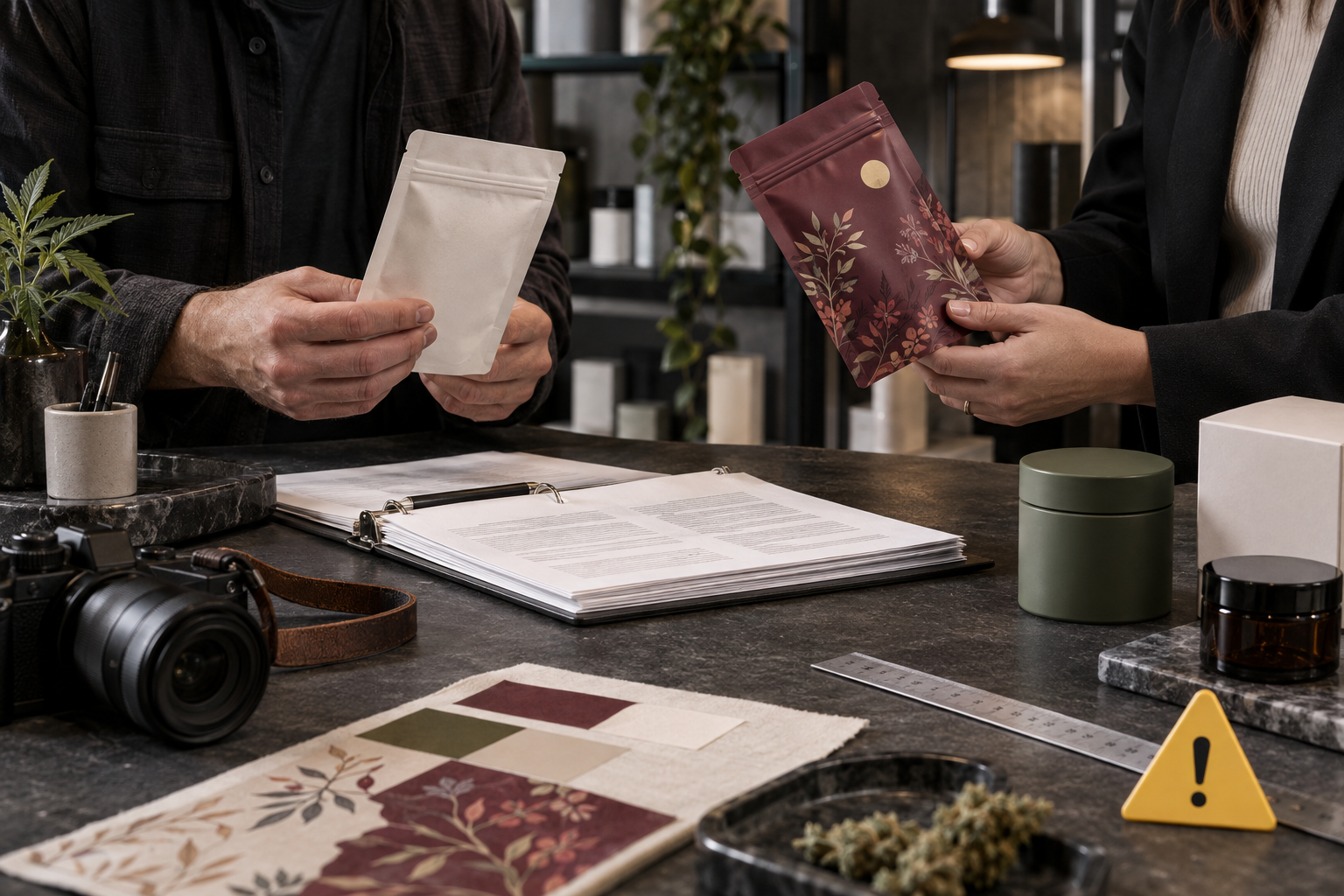
Compliance review should happen while the seasonal concept is still easy to change, before the campaign is packaged for...
Write the compliance questions directly into the brief:
- Who is the intended adult audience, and where will the message appear?
- Does any visual cue borrow from children’s entertainment, candy, school culture, or youth-oriented design?
- Are product, packaging, labeling, and disposal requirements being reviewed for the right format?
- Can every channel use the same approved language and image set?
That list creates a clean handoff between marketing, creative, retail, and legal or compliance counsel. It also protects the team from the false speed of launching an idea that must be rebuilt after distribution.
What operators should borrow from the playbook
Seasonal cannabis drops are not a shortcut around product strategy. They are a way to make a narrower strategy visible for a limited period. The useful playbook has a few durable habits:
- 1Start with a recognizable moment, then narrow it to one signal.
- 2Reuse as much product and channel architecture as the test allows.
- 3Set the end date, supply ceiling, and removal plan before launch.
- 4Measure attention, movement, and operational friction as different signals.
- 5Make audience and compliance review part of the creative brief.
The best seasonal release may be the one that ends cleanly, leaves the team with a useful answer, and gives the next brief a sharper starting point. If the test needs better channel naming, landing-page structure, or content distribution strategy, fix that system around the release instead of asking the product to carry the entire result.
For operators building a broader plan, Sparksbox’s cannabis marketing services can connect the seasonal test to the rest of the customer journey, from the brief and content system through local discovery and measurement.
FAQ
A seasonal cannabis product drop is a limited release tied to a recognizable time, cultural cue, format, finish, or collection. It should have a defined product change, availability window, supply plan, and measurement question. “Limited” should describe the operating plan, not only the promotional language.
Seasonal drops give brands a reason to refresh the assortment and give customers a reason to look again. They can also let operators test a smaller product or creative idea before considering a permanent change. The benefit depends on keeping the assortment, inventory, and message narrow enough to evaluate.
Start with one seasonal signal, use the smallest useful product change, set a supply ceiling and end date, and name the measurement question before launch. Track channel attention, location-level movement, staff feedback, and end-of-window inventory separately. Decide in advance whether the release will retire, repeat with a change, or enter a new permanent-assortment review.
A seasonal concept still has to meet California cannabis advertising, marketing, packaging, and labeling requirements. Creative cannot be attractive to children or people under 21, and product format can add requirements. Review the current rules for the actual product, audience, placement, and jurisdiction with the responsible compliance team before distribution.
Measure the signals that match the brief: qualified menu or product-page visits, replies or questions, location-level sell-through during the planned window, staff objections, and end-of-window inventory. No single signal proves the whole concept. The useful output is a decision about whether to retire, revise, or separately evaluate the idea for a permanent assortment.