Most content teams do not have a content problem. They have a distribution problem.
They publish a blog post, share it once, maybe turn it into a social caption, and move on. Then they wonder why the content did not produce enough traffic, leads, sales support, or trust.
The issue is not always quality. Often, the asset was never given a real distribution job.
Content distribution strategy is the plan for how an idea moves through the channels, moments, and formats where it can actually help people. It decides what the asset is supposed to do, who should see it, where it should live, how it should be reused, and how performance will be judged.
Content distribution is not the afterthought after publishing. It is part of the content strategy itself.
This matters even more when the team is building around a customer journey map. Different journey stages need different content formats and different distribution paths.
Assign a job before creating the asset
Every content asset should have a job.
Common jobs include:
- Discovery: help the right audience find the brand
- Education: explain the problem or approach
- Comparison: help buyers evaluate options
- Proof: build trust with evidence, examples, reviews, or process
- Conversion support: reduce friction before the next step
- Sales enablement: help sales answer recurring questions
- Retention: help customers get value and return
- Authority: make the brand easier to cite, reference, or trust
If the asset has no job, the distribution plan becomes "post it everywhere." That usually creates weaker versions across more channels.
A strong distribution plan starts with one lead job and then chooses the supporting formats.

Stop treating repurposing as resizing
Repurposing is not just turning one blog post into five captions.
Good repurposing changes the shape of the idea so it fits the decision moment and channel.
A long article may become:
- A sales call prep sheet
- A short LinkedIn point of view
- A comparison table
- A landing page section
- An email sequence
- A local profile update
- A webinar outline
- A customer checklist
- A founder video prompt
- A FAQ block
- A pitch deck slide
The idea stays consistent. The format changes because the context changes.
For example, an article about offer strategy can become a landing page checklist, a sales qualification prompt, a short email about low-risk next steps, and a team scorecard. Those assets serve different moments but carry the same strategic point.

Choose channels by audience behavior
Channels are not interchangeable.
Search helps when people already express intent. Social helps create familiarity, demand, and point of view. Email helps deepen a relationship with people who gave permission. Sales enablement helps when buyers need confidence during evaluation.
Local profiles help when action is nearby and practical. Partnerships help borrow trust. Paid distribution helps speed up learning when the offer and measurement plan are clear.
The question is not "Where should we post?" It is "Where does this audience already look for this kind of answer?"
That question prevents channel vanity.
If the buyer is comparing vendors, the asset may need to be on the website and in the sales process. If the buyer is trying to take action locally, the asset may need to support the profile, location page, reviews, and appointment path.
If the buyer is not aware of the problem, the asset may need social distribution, partnerships, or founder-led framing before search demand exists.
This is also where timing matters. A deep guide may be useful for search over time, but a shorter point of view may be better for a conversation happening this week. A customer checklist may have low public reach and still be the asset that reduces support friction. A sales one-pager may never show up in analytics and still help the team close better-fit work.
Distribution strategy should respect where the buyer is, not where the content team wishes the buyer would spend time.
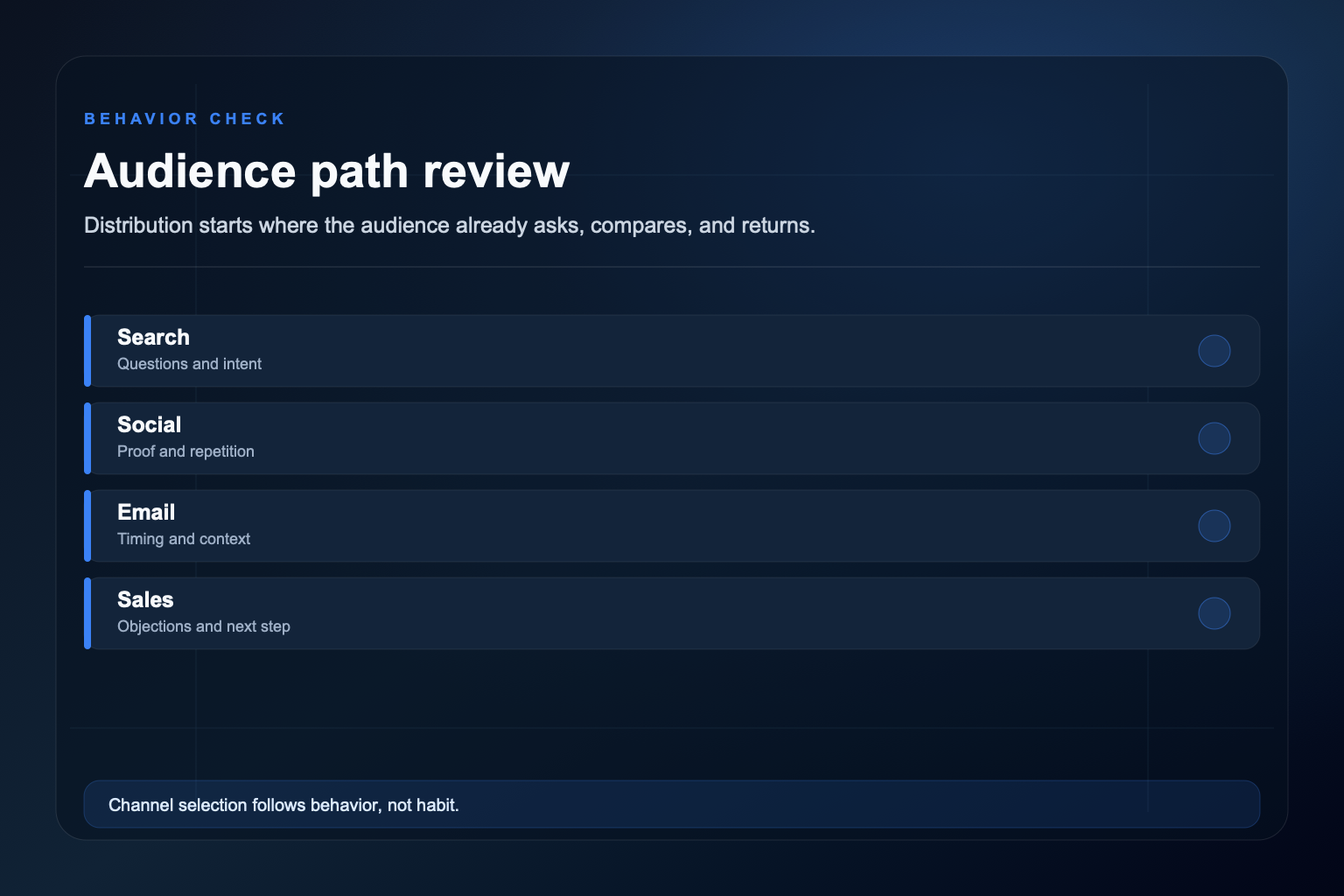
Distribution choices should follow where the audience already asks, compares, and returns.
*Channel selection gets cleaner when the team starts with audience behavior instead of posting habits.*
Build a distribution brief
A distribution brief does not need to be complicated.
It should answer:
- 1What is the asset's primary job?
- 2Who is it for?
- 3Which journey moment does it support?
- 4What is the core idea?
- 5Which channels will carry it?
- 6What format does each channel need?
- 7What internal team should use it?
- 8What action should the audience take next?
- 9What metric will show whether it worked?
This brief keeps content from dying at publication.
It also helps the team avoid creating assets that sound good in a planning meeting but have no obvious home in the marketing system.
The brief should also name what not to do. Not every article needs a webinar. Not every idea belongs on every social channel. Not every asset deserves paid support. A clear distribution brief protects the team from turning one strong idea into scattered noise.
The best use of the brief is during production, before the asset is finished. That lets the writer, designer, editor, and channel owner shape the piece for reuse instead of trying to retrofit distribution after publication.
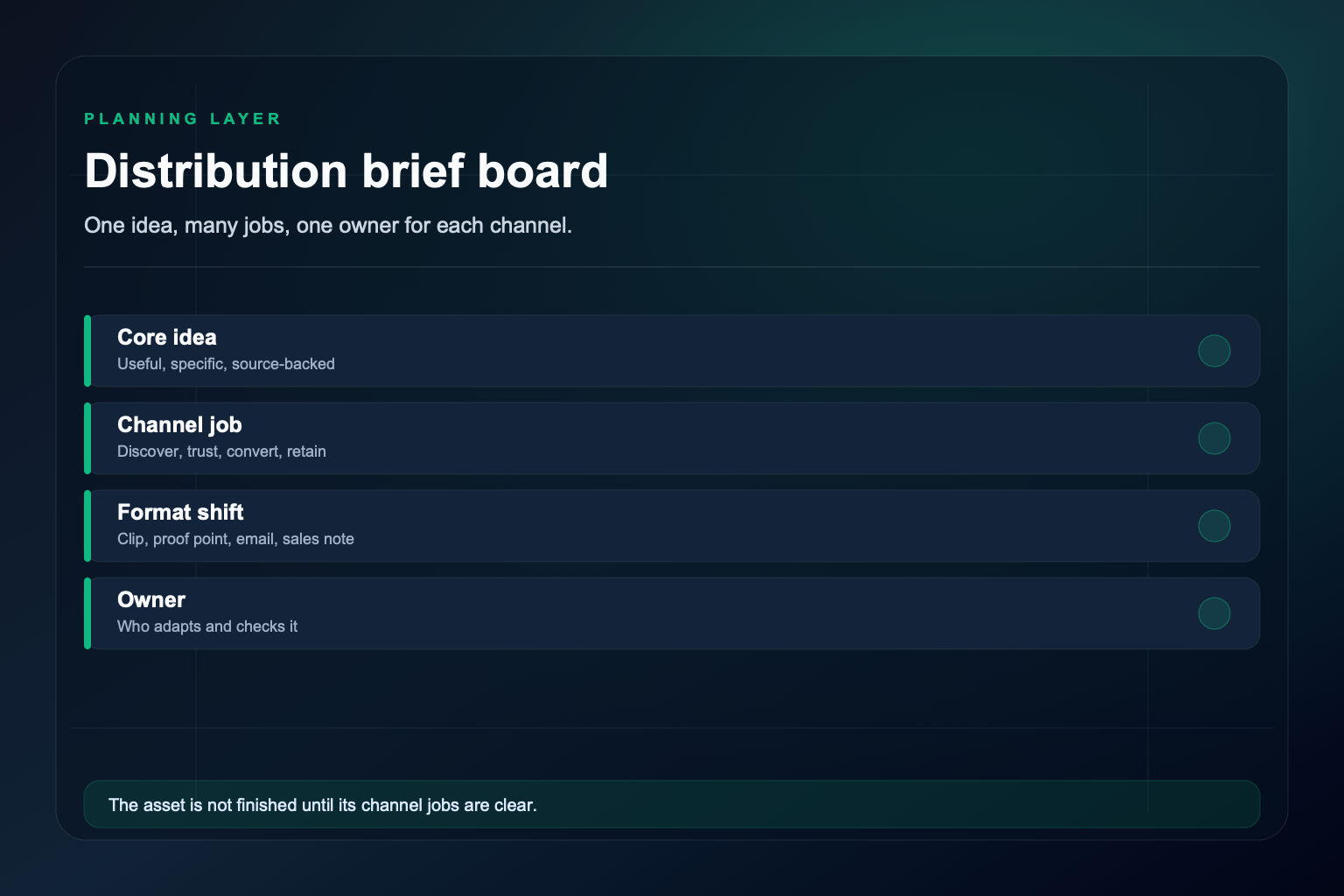
A distribution brief gives every asset a job, channel fit, format shift, and owner.
*The brief is where a useful idea becomes an operating asset instead of a one-time post.*
Make sales and retention part of distribution
Distribution is not only public posting.
Some of the highest-value distribution happens inside sales conversations, onboarding, lifecycle emails, customer support, partner follow-up, and internal training.
Sales might need a one-page explainer more than the audience needs another blog post. Customers might need a post-purchase guide more than a brand manifesto. Support may need a clear resource that answers the same question before it becomes a ticket.
For Sparksbox services, a strategic article should not live only as website content. It can become sales prep, diagnostic questions, internal QA criteria, social proof framing, and client onboarding language.
Content distribution gets stronger when the asset is used by the business, not just published by marketing.
Measure distribution by the job
The metric should match the asset job.
Discovery content may be judged by qualified visits, search visibility, referral traffic, or new audience reach. Comparison content may be judged by assisted conversions, sales usage, time on page, or call quality.
Retention content may be judged by repeat purchase, activation, response, or support reduction. Authority content may be judged by citations, links, mentions, and inclusion in sales or partner conversations.
Do not judge every asset by the same metric. That punishes useful work that sits later in the journey.
A comparison guide might never go viral and still improve close rate. A customer checklist might get low traffic and still reduce support friction. A local proof asset might matter most when it helps a buyer choose in a high-intent moment.
What this means for AI-native marketing
AI can help turn one strong idea into channel-specific briefs, email drafts, social posts, FAQs, sales sheets, and presentation outlines. That is useful when the underlying idea is sharp.
The danger is volume without intent. If the team asks AI to "repurpose this everywhere," it may create noise. If the team gives AI the audience, channel job, journey stage, tone, and next action, it can create useful variations faster.
The future of content distribution is not more posting. It is cleaner translation of strong ideas into the places where they can do work.
Frequently asked questions
Content distribution strategy is the plan for how a content idea reaches the right audience through the right channels, formats, and moments. It includes public promotion, owned channels, sales enablement, lifecycle messaging, partnerships, and reuse.
Promotion usually means pushing an asset after it is published. Distribution is broader. It decides the asset's job, channel fit, format, internal use, reuse path, and measurement before the asset is created.
Common channels include the website, search, email, social, sales enablement, paid media, partnerships, local profiles, webinars, customer support, and lifecycle automations. The right mix depends on the audience and content job.
Repurpose by translating the idea for a new context. A long article can become a checklist, sales sheet, email sequence, short post, comparison table, FAQ, or landing page section. The point is usefulness, not resizing.
Yes. AI can create channel-specific variations, briefs, summaries, outlines, and internal enablement assets. It works best when the content strategy already defines the audience, channel job, format, and next action.