# Cannabis menu SEO is a data problem
Cannabis menu SEO is not mainly a keyword exercise. It is a consistency exercise.
A shopper sees one product name on the menu, another on a directory, and a third in an artificial intelligence (AI) answer. The store has the right inventory, but the web has three competing versions of the truth. Search engines do not need more adjectives. They need a clean, current record of what the store is, where it is, what it carries, and what it can safely say.
That is the operator-side opportunity. Treat the menu as structured business data, not a decorative list of products. Then connect that data to local pages, Google Business Profile, review responses, and compliance review. The goal is not to promise a ranking. The goal is to make the business easier to identify, quote, and trust.

If the source record is messy, every channel repeats the mess.
The menu is the source of truth
Most dispensary websites treat the menu as a feed from a point-of-sale system. That is useful for inventory, but it is not enough for search.
A feed can tell a customer that a product exists. It may not explain the product in stable, indexable language. It may omit the brand, category, format, size, cannabinoid fields, availability timestamp, or location context. It may also publish copy that the compliance team would never approve on a landing page.
Google’s Product structured data guidance explains how product pages can communicate details such as name, image, description, brand, and offers. That documentation does not mean every cannabis product will receive a rich result or a free listing.
It does mean the page should give crawlers clear facts instead of forcing them to infer the catalog from a JavaScript widget.
Start with a product record that has an owner and a review date. At minimum, track:
| Field | Why it matters | Owner |
|---|---|---|
| Product name and brand | Prevents duplicate or drifting names | Merchandising |
| Product type and format | Helps match category intent | Menu manager |
| Package size and listed potency | Gives the page factual detail | Compliance |
| Ingredients and required warnings | Keeps claims inside approved language | Compliance |
| Availability and location | Stops stale inventory promises | Operations |
| Canonical product URL | Gives every channel one destination | Marketing |
Do not turn missing data into creative writing. If the source system lacks a field, say less. A thin, accurate product page is safer than a persuasive page built on a guess.
Product pages need a job
A product page should answer a narrow question clearly. It does not need to become a mini magazine article.
The page should identify the product, show the licensed retailer or brand context, state the relevant product facts, explain how availability works, and route the shopper to the next legitimate step. That might be checking the live menu, viewing pickup instructions, or contacting the store. Avoid language that implies a medical outcome or promises a personal result.
Google’s structured data documentation makes a useful distinction: markup helps machines understand visible page content. It does not rescue content that is hidden, contradictory, or unsupported.
If a page says one thing and the structured data says another, the implementation has created a new audit problem.
Use the same naming convention across the page title, visible heading, product feed, image alt text, internal links, and analytics events. Keep the canonical URL stable when possible. If a product disappears, do not leave a page that looks available forever. Explain the status or redirect it according to the site’s inventory and search rules.
This is where dispensary SEO from the operator side differs from generic agency advice. The work starts with how the store actually runs. Search copy follows the operating model, not the other way around.
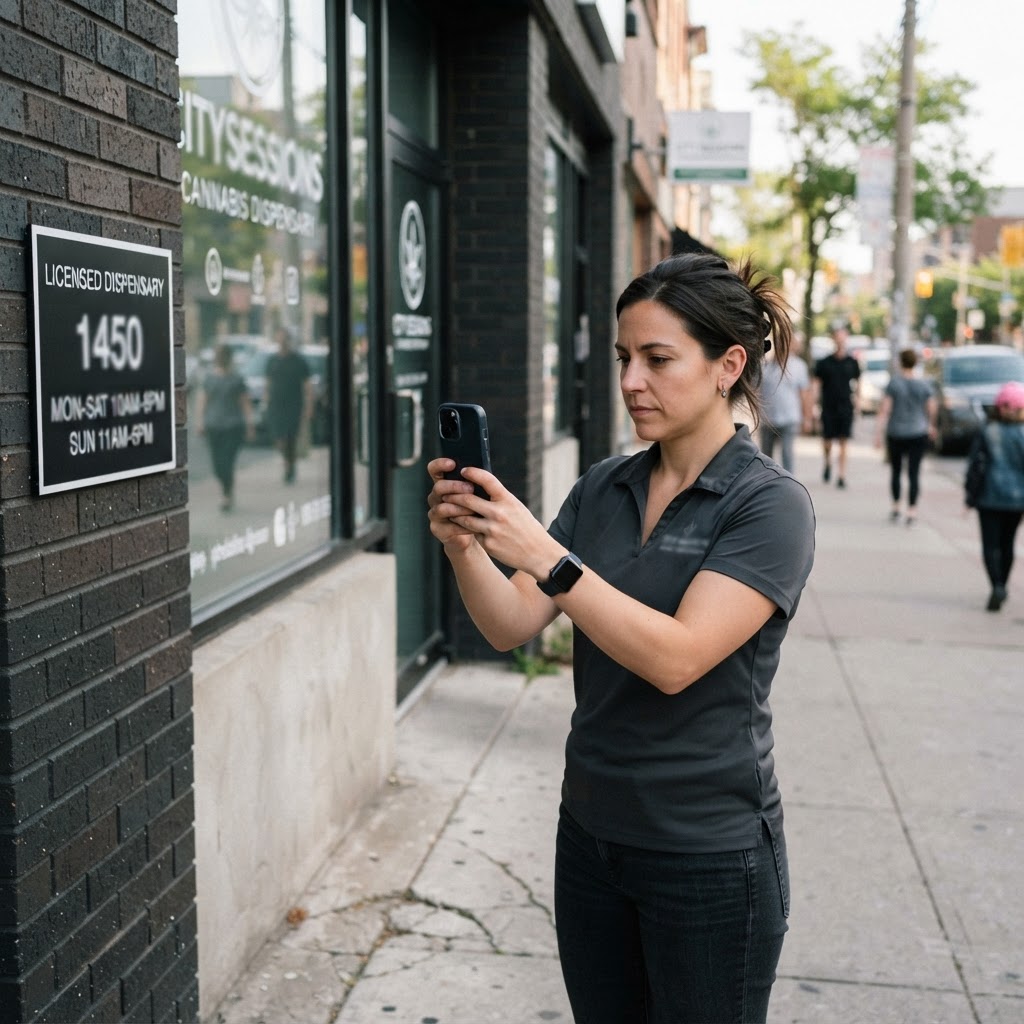
Local search starts with the details a real person needs at the curb.
Local signals expose bad data
Local search is unforgiving because the customer can verify the claim in minutes. If the website says the store closes at 10, the profile says 9, and the phone recording says 8, the brand has created a trust problem before the shopper reaches the door.
Google’s guidelines for representing a business require businesses to represent themselves accurately. That is the standard to apply to names, addresses, categories, hours, service areas, photos, and descriptions. Do not stuff a business name with neighborhoods or keywords.
Do not use a description as a coupon block. Do not ask customers to post incentivized reviews.
For a licensed retailer, the local audit should compare four records:
- 1The website location page.
- 2The Google Business Profile.
- 3The live menu and pickup flow.
- 4The license or public regulator record.
The point is not to make every field identical. A menu can change hourly while a location page changes rarely. The point is to make the relationship obvious and current. The store name, address, phone number, hours, license context, ordering path, and service details should not contradict each other.
California operators should read the Department of Cannabis Control’s advertising and marketing guidance and the current DCC regulations before treating a local page as ordinary retail copy. Nevada operators need a different review against the Nevada Cannabis Compliance Board advertising guidance.
State rules are not interchangeable, and a page that works in one market may need different controls in another.
AI answers read the seams
AI search does not create a clean record from nothing. It assembles an answer from pages, profiles, directories, reviews, and other signals.
Google’s guidance for AI features and websites says the same foundational practices still matter: make pages accessible, keep content useful, and use structured data that matches visible content.
That has a practical implication for dispensaries. The question is not only, “Do we appear in an AI answer?” Ask, “Would the answer be safe if a machine quoted our page without the surrounding context?”
A product description that says “best for anxiety” is not made safer by being placed in a schema field. A location page that buries age and ordering information is not made clearer by adding a local business script. A review that names a product no longer in stock can create confusion that the menu team has to resolve.
The Google Business Profile update that reshuffled cannabis local search is part of the same pattern. Local visibility depends on connected facts, not on one clever page.
The cannabis AI search discovery guide goes further on the citation side, but the operating move is simple: publish fewer contradictions.
A better audit cadence
A monthly SEO report is too slow for menu data. Inventory and hours can change before the report reaches the operator.
Use two cadences instead. Operations owns a lightweight weekly check for location details, menu availability, broken URLs, and major product fields. Marketing and compliance run a deeper monthly review across pages, structured data, profile content, internal links, and sampled search results.
Track the evidence, not just the outcome:
| Check | Pass condition | Escalation |
|---|---|---|
| Location identity | Name, address, phone, and hours agree | Operations owner |
| Menu freshness | Removed items do not look available | Menu owner |
| Product facts | Visible copy matches source fields | Compliance owner |
| Structured data | Markup describes visible content | Technical owner |
| Local profile | Category, photos, description, and links are accurate | Marketing owner |
| Search answer | Sample queries return safe, current facts | Cross-functional review |
This is also why Sparksbox cannabis SEO services start with an audit instead of a content calendar. More pages will not solve a source-data problem. They can multiply it.
Frequently asked questions
Cannabis menu SEO is the work of making a dispensary’s products, locations, availability, and approved descriptions understandable to search engines and customers. It combines technical page structure, local search data, internal links, inventory freshness, and compliance review. It is not a promise that a product will rank for every search.
Not always. Create a dedicated page when the product has stable information, a useful search intent, and a clear availability or discovery path. If inventory turns over too quickly, a well-structured category or brand page may be more honest than hundreds of thin URLs that go stale.
A retailer can evaluate structured data against Google’s documentation, but eligibility for a search feature is never guaranteed. The markup must match visible page content, and the business still needs to follow applicable platform and cannabis rules. Treat it as a clarity layer, not a shortcut around policy.
Check operational details whenever hours, phone numbers, services, or locations change, with a recurring review at least monthly. Compare the profile to the location page, live menu, ordering flow, and license information. A profile audit should also include recent photos, reviews, questions, and links.
Avoid medical claims, treatment promises, unsupported safety claims, and language that implies a guaranteed effect. Use approved factual information and explain what the page can and cannot establish. State-specific review matters, especially when one site serves multiple jurisdictions.
Run a contradiction audit before publishing more content. Compare the store’s identity, hours, location, menu status, product names, and compliance language across the website, Google Business Profile, ordering path, directories, and regulator records. Fix the highest-impact mismatch, then measure whether discovery and qualified store actions improve. A dispensary does not need to make the internet say more. It needs to make the right facts easier to repeat.