Your product description says it ships in 48 hours. Your LLM made that up. It also says the material is "eco-friendly leather" when you actually use synthetic blend. Another hallucination. It promises "US manufacturing" for a product made in Vietnam. Guess again.
This isn't theoretical. Benchmarks across commercial LLMs continue to show that models can invent facts in structured tasks, especially when the source data is incomplete or ambiguous. E-commerce data is one of the highest-risk categories because product copy contains specs, materials, shipping promises, warnings, and regulated claims.
The problem: your brand owns the lie. Not OpenAI. Not Anthropic. You. And when a customer buys a product based on a hallucinated spec, you have a liability problem that your insurance probably doesn't cover.

Product descriptions generated by AI need source-backed verification before they become customer-facing claims.
The Scale of the Problem
E-commerce at scale demands speed. Product databases with thousands of SKUs, international variants, dynamic pricing, you can't hire writers fast enough. So you feed your product data into an LLM and let it generate descriptions. Faster. Cheaper. Data-driven.
Except the LLM doesn't "generate" descriptions the way a human does. It predicts the next token, one word at a time, based on statistical probability. When data is incomplete, conflicting, or sparse (common in fast-moving e-commerce), the LLM doesn't say "I don't know." It confidently makes something up. That's a hallucination. Structural, not a bug.
The scale makes this worse. If you're running product descriptions through LLMs for thousands of SKUs, even a small error rate can create hundreds of false or unsupported claims in a single batch.
Most brands don't know this is happening. They assume the LLM learned product data perfectly. It didn't. The model saw examples, patterns, frequencies, but it has no semantic understanding of whether something is true. It just knows what tokens usually follow other tokens.
What Gets Hallucinated
The hallucinations aren't random. They follow patterns:
Specs not in training data get invented. If a product detail is new, rare, or specific to your SKU, the LLM guesses based on similar products it has seen. You sell a "limited-run fabric blend"? The LLM looks at fabric descriptions it knows, interpolates, and generates a plausible-sounding lie.
Contradictions get resolved the "safe" way. If your product data says "vegan" but the supplier info says "contains milk," the LLM picks one and runs with it. Usually the more common claim in its training data.
Numbers get confabulated. Shipping times, dimensions, weight, thread count, battery life, if the LLM has seen similar products, it will invent a specific number that sounds right. "Ships in 2-3 business days" is confidently wrong.
Regulatory claims get fabricated. "FDA approved," "certified organic," "made in USA" , these are high-confidence hallucinations because they're specific, common in product descriptions, and the LLM has seen them many times. It doesn't verify them. It just predicts they're likely.
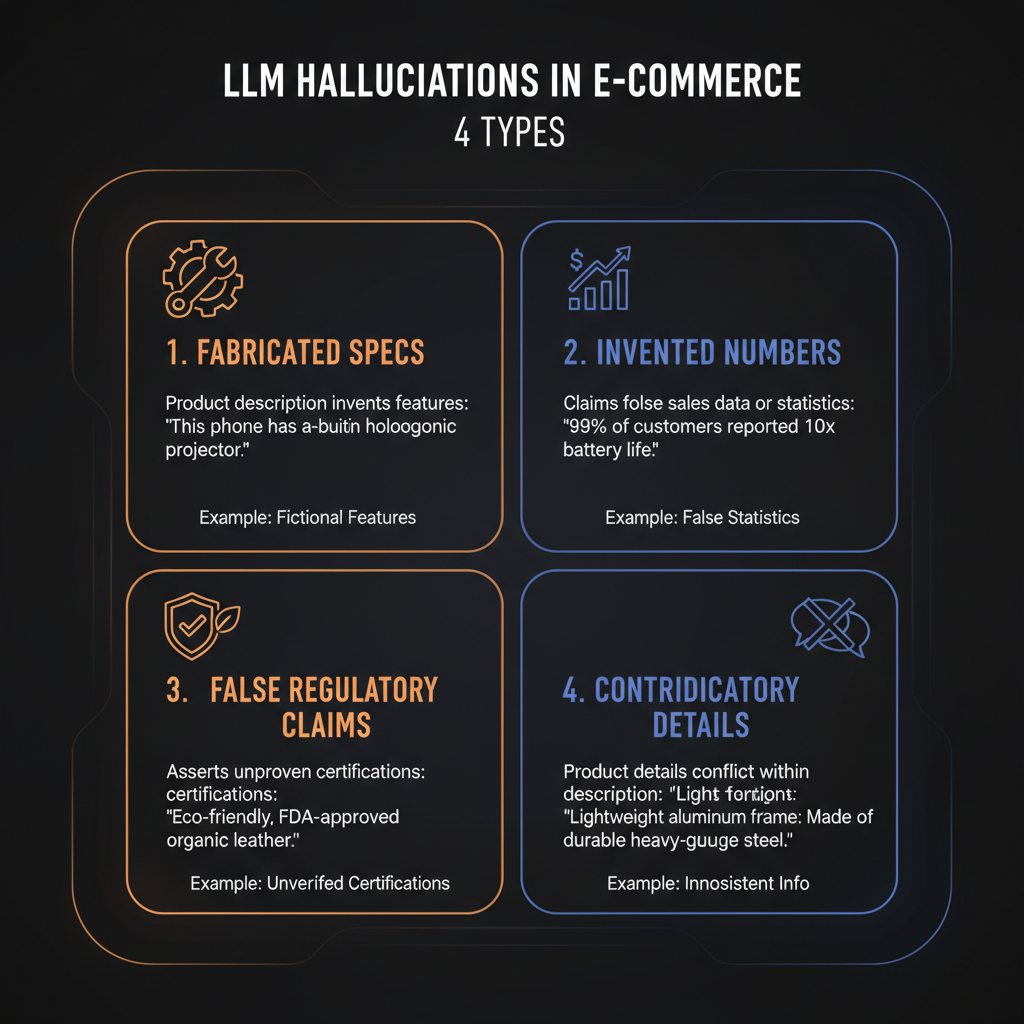
Four types of LLM hallucinations: fabricated specs, invented numbers, contradictory claims, and regulatory fabrications
Your Compliance Nightmare
Here's where it gets legal. When a customer relies on a hallucinated product spec and gets hurt, misled, or defrauded, they have a claim against your brand. Not the LLM vendor. Not your AI platform. You.
This is product liability law: the seller is responsible for product claims, regardless of how those claims were generated.
Your insurance may not be ready for this. Many policies were written before AI-generated product copy became a normal operating risk. If a claim arises from automated content, the coverage question may turn on supervision, documentation, and whether the brand had a reasonable verification process.
Regulatory exposure compounds it. The FTC has already emphasized through deceptive AI claims actions that AI does not excuse unsupported marketing. If an LLM generates "this supplement boosts energy," and you publish it without verification, and it's not substantiated, that can become an unfair or deceptive practice.
The FTC doesn't care if an AI made it up. They care if the claim is unprovable.
For cannabis and health products, this is exponentially worse. A hallucinated medical claim on a CBD product could trigger state AG enforcement. "Clinically proven to reduce anxiety" invented by your LLM, published by your brand, investigated by the state.
Why Detection is Harder Than You Think
"Just fact-check the descriptions before publishing," right?
That works if you're verifying 100 descriptions. At 5,000+ SKUs, the economics break. You need a tool to detect hallucinations at scale. That tool is probably another LLM.
Using an LLM to fact-check LLM outputs is a documented failure pattern. Studies show LLMs are surprisingly bad at detecting false claims generated by other LLMs, they often hallucinate agreement with the original claim. You're using one hallucination engine to validate another.
Manual spot-checking misses systemic problems. You might catch "eco-friendly leather" if someone reads it, but miss the "ships in 48 hours" claim on 3,000 other products.
Automated validation against your source database works, but only if your source data is complete and correct. Most e-commerce databases have gaps, vendor data conflicts, and missing specs. The LLM fills gaps with hallucinations, and your validation rule can't catch what it's supposed to be checking.

Real-world e-commerce team reviewing AI-generated product descriptions
What 2026 Enforcement Looks Like
The FTC hasn't sued a brand specifically for LLM-generated false product claims yet. But the framework is clear:
Section 5 of the FTC Act covers unfair or deceptive practices. "Deceptive" means a claim is likely to mislead consumers and not substantiated. It doesn't matter if a human or an LLM generated it. If it's false and material (like shipping time, material, or efficacy), it's deceptive.
State attorneys general can use existing consumer-protection authority the same way. They do not need a special LLM statute to challenge false product claims.
Private litigation is the real threat. A customer who bought a product based on a hallucinated spec, especially if it caused injury, waste, or fraud, has leverage for a class action. Your defense ("an AI made it up") doesn't help you. It proves you weren't supervising the claims your brand made.
Insurance companies are also learning this risk. Expect more underwriting questions about AI content controls, human review, documentation, and verification evidence. Most brands don't have this yet.
How to Not Get Sued
First, accept that LLM-generated product data needs verification. Not spot-checking. Systematic verification.
Build a human-in-the-loop process. LLM generates description. Human reviews critical specs (claims, shipping, material, regulatory items). Only publish if the human approves. Yes, this slows things down. It also protects you.
Segment by risk. High-risk categories (health, beauty, food, regulated goods) need 100% human review. Medium-risk (apparel, general merchandise) can use automated validation plus sampling. Low-risk commodity data can skip review if you're only generating style variations on a core spec.
Document everything. If you're using an LLM, keep logs of what it generated, what was modified, who reviewed it, and what was published. This is your evidence of due diligence if anyone comes after you.
Add guardrails to the LLM itself. Fine-tune it on verified product data only. Use prompt engineering to discourage specific hallucination patterns ("Do not make claims about shipping time unless provided in the product data"). Reduce the confidence of the model by using a lower temperature setting, it will make fewer creative claims.
Don't trust the LLM vendor's assurances. Anthropic, OpenAI, Google, they all say their models are "more reliable." They're not reliable for product specs. They're better. Not reliable. Build verification into your process regardless of whose LLM you use.
The Real Cost
The cost of a hallucination isn't just liability. It's brand damage. Customer complaints. Returns. Refunds. Lost trust.
A customer who gets a product that doesn't match the description, especially if it's a high-ticket item, won't just leave a bad review. They'll post about it. "Bought this based on false claims," they'll say. Your brand's reputation takes a hit that no LLM can fix.
The irony: you used an LLM to scale product descriptions and save money. A hallucination triggers one class action lawsuit, and you've spent more on defense than you saved on writers for five years.
This is the unsexy truth about AI in e-commerce right now. The tools work well for tone, style, and variation. They are risky for factual accuracy, especially in structured data with regulatory implications. Using them without a verification layer is cost-cutting that looks smart until it looks catastrophic.
2026 is the year this becomes obvious. Enforcement pressure grows. Insurance questions get stricter. Brands that built verification into their LLM workflow now have a competitive advantage: they are more compliant and more confident. Brands that skipped it are managing liability.
Which one is yours?
2026 evidence and control update
The more useful 2026 question is not whether why your ai product descriptions are lying is possible. It is whether commerce teams using AI to generate product content, recommendations, or support answers can prove what happened after the system made, shaped, ranked, routed, or explained a customer-facing decision.
The less obvious issue is that the hidden record is whether the model used approved source data or invented a claim that only appears after publication. That record is what separates a working AI pilot from a defensible operating system.
For source alignment, the public claim language should stay consistent with FTC guidance on AI claims and NIST AI Risk Management Framework. Those sources do not remove the need for local legal review, but they give the article a better evidence spine than vendor screenshots or unsupported performance claims.
This also connects to related operating risk, AI measurement gap, compliance workflow, because the same pattern keeps repeating: AI systems look clean in the dashboard while the proof, ownership, and customer context live somewhere else.
| Control layer | What to verify | Evidence to keep |
|---|---|---|
| Source data | Which approved source fed the answer, recommendation, ranking, or claim | Source URL, vendor field, timestamp, and owner |
| Decision boundary | Where the AI is allowed to help and where it must stop | Allowed use case, blocked topics, and confidence threshold |
| Human review | Who owns the exception, correction, or escalation | Reviewer role, handoff note, and approval record |
| Monitoring | How the team catches drift, complaints, or weak signals | Review cadence, sampled outputs, and customer feedback themes |


Frequently asked questions
LLMs predict plausible language from patterns. If product data is missing, conflicting, or too sparse, the model may fill gaps with details that sound normal but are not true.
The brand publishing the claim is responsible. A vendor or model provider may contribute to the workflow, but the seller still needs to substantiate customer-facing product claims.
Review shipping promises, dimensions, materials, safety warnings, country of origin, certifications, health claims, sustainability claims, warranty terms, and anything regulated by category.
It can help triage, but it should not be the only control. Verification should compare the generated copy against source product data, approved claims, and human review for high-risk categories.
Require source-backed fields. If the source data does not contain a shipping time, certification, material, or benefit claim, the model should be blocked from inventing one.