The fastest way to sound like everyone else
You know the copy. You've seen it a thousand times.
"Unlock the power of X. Transform your Y. Join thousands of satisfied customers."
It's everywhere. SaaS landing pages, e-commerce email sequences, paid ad copy. The reason is simple: marketing teams are feeding their brand voice, tone guidelines, and competitor websites into Jasper, Copy.
ai, or in-house fine-tuned LLMs. The LLMs are trained on derivative content that already sounds generic. Stack standardized training data on top of standardized tools, and what you get is standardized copy.
This is the copywriting flattening effect, and it's destroying brand differentiation at scale.
Brands are paying for competitive advantage and getting commodity output.

Identical copies rolling off the assembly line of mediocrity
The training data problem
Most marketing LLMs are trained on publicly available copy: ad libraries (Meta, Google, LinkedIn), landing pages indexed by Google, case studies, product pages, sales emails. The content is already optimized, already polished, already safe. It's also already derivative of previous content that was derivative of content before that.
When your LLM's entire understanding of "compelling marketing copy" comes from what billions of marketers already wrote, it can't generate anything that isn't already echoing existing patterns. The model doesn't have access to what works, it has access to what's been published.
This is fundamentally different from human copywriters, who read, absorb, and synthesize across domains. A great copywriter steals voice from novelists, comedians, sports commentators, journalists. The LLM steals from previous copywriters stealing from copywriters.
The result: All AI-generated copy begins converging toward the statistical center of "acceptable marketing language."
Brand voice fine-tuning doesn't fix it
Some brands tried to solve this by fine-tuning LLMs on their own content: past emails, landing pages, product copy. This sounds smarter than it is.
If your brand voice is already generic (which most B2B brands are, if we're honest), you're fine-tuning the model to replicate generic better. You're not adding differentiation, you're adding consistency to sameness.
And here's the trap: the more successful a brand was at generating clicks and conversions before AI, the more copy it fed into the model. So the model learns what already worked, not what could work differently. You get better at doing yesterday's playbook.
Brands that had unique, distinctive voice? They had less training data, so the model reverts to the statistical center anyway. The median voice wins.
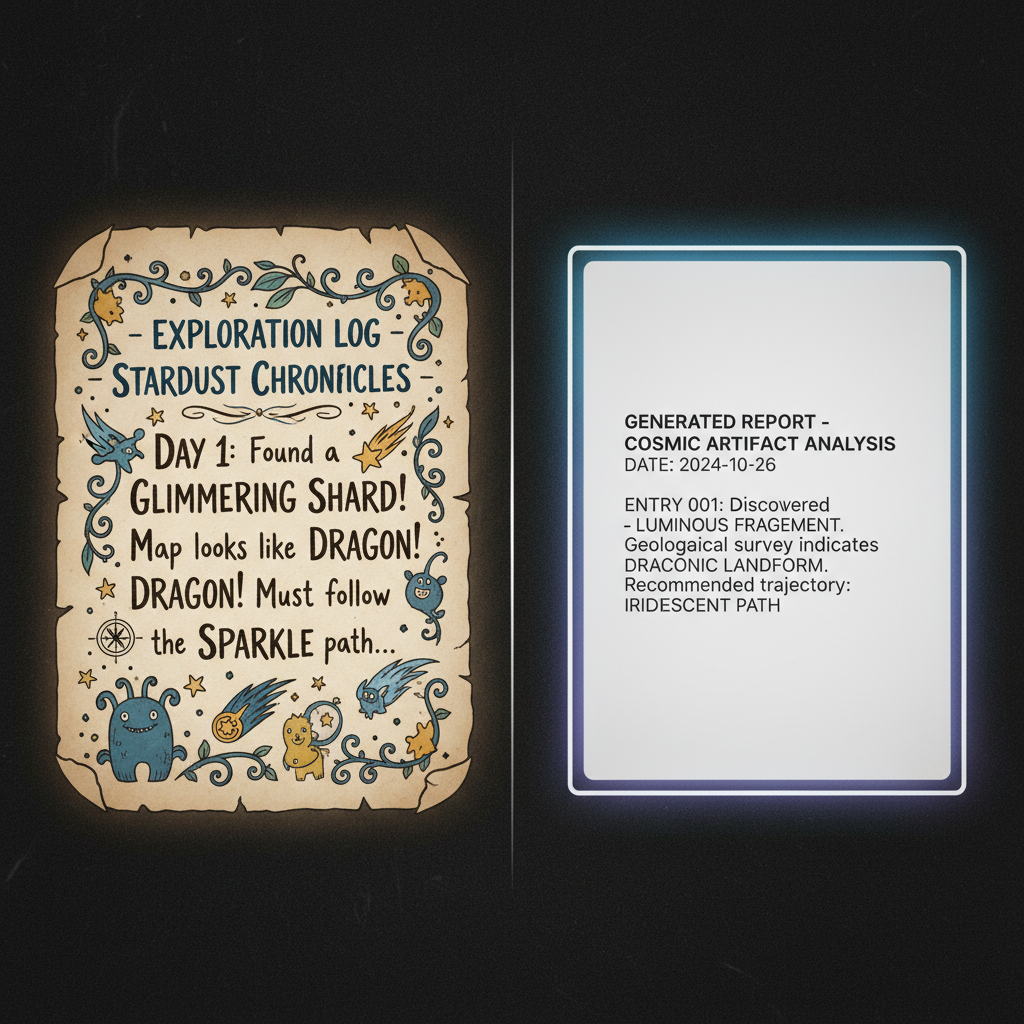
Left side: messy authenticity. Right side: sterile perfection. Guess which one converts.
The competitive flattening effect
Six months ago, Competitor A launches with an edgy, irreverent tone. Three weeks later, Competitor B uses Jasper to scrape Competitor A's landing page and fine-tune on it. Now both sound similar, just one does it more consistently because it's powered by LLM.
Multiply this across an entire market. Every brand in the space is using the same tools (Jasper, Copy.ai, HubSpot's AI), trained on overlapping datasets, fine-tuned on the same competitors' copy. The voice that stood out six months ago is now the statistical center of what the LLM learned.
This is different from "AI commoditizes labor." It's specifically about AI commoditizing voice. The scarcest resource in marketing used to be authentic, distinctive tone. Now the scarcest resource is not having an AI-generated voice.
What works instead
This is where most AI marketing advice fails: "Use AI to scale your brand voice!" But if the voice itself is generic, scaling doesn't help. It amplifies the problem.
Brands that are winning right now are doing the opposite:
First: They're using LLMs for structure and speed, not voice.
- Prompt: "Write a cold email outline for a B2B prospect who uses Salesforce." (LLM writes skeleton)
- Human rewrites the skeleton with distinctive voice, specific details, personality.
- The model saved time staring at a blank screen. The human preserved differentiation.
Second: They're treating voice as a competitive moat, not a tool to automate.
- If your voice can be replicated by an LLM in seconds, it was never that distinctive.
- The brands that sound different are protected by the fact that you can't copy their voice into a tool without it immediately sounding like a bad copy.
Third: They're using LLMs to challenge their voice, not reinforce it.
- Prompt: "Write this same email in the voice of a stand-up comedian, a sports announcer, a noir detective."
- This forces you to see what your default voice is (usually invisible until contrasted).
- Then the human picks which voice works, or steals elements across them.

Late-night copy review. Same copy. Different day.
The cost of homogenization
If every brand in your market sounds the same, switching costs drop. If your subject line sounds like everyone else's subject line, your open rate collapses. If your landing page copy is indistinguishable from five competitors' landing pages, your CTA doesn't stand out.
And here's where it gets expensive: when differentiation dies, the only way to compete is on features, price, or ad spend. Brands that used to win on voice now have to win on dollars. The cost of customer acquisition skyrockets because no creative is breaking through the noise. So brands buy more ads. Which trains more LLMs on more ads. Which flattens voice further.
This is a death spiral for brands that used to compete on authenticity, personality, or distinctive tone.
The brands that stay differentiated
The trap isn't that AI makes bad copy. It's that AI makes safe, average copy, and safe, average copy is contagious. In a market where more copy is generated from the same tools and overlapping training data, the one thing you can't do is sound like everyone else's LLM.
The brands that stay differentiated will be the ones that use AI to automate everything except voice. Use the model to write fast. Then add the one thing a model can't: the specific, strange, unrepeatable personality that made someone choose your brand in the first place.
That's not a copywriting problem anymore. That's a brand problem. And no LLM can fix it for you.
2026 evidence and control update
The more useful 2026 question is not whether ai copywriting flattens brand voice is possible. It is whether teams deploying voice agents in regulated customer workflows can prove what happened after the system made, shaped, ranked, routed, or explained a customer-facing decision.
The less obvious issue is that the hidden record starts before the conversation, with consent, identity, call purpose, recording status, and the handoff path. That record is what separates a working AI pilot from a defensible operating system.
For source alignment, the public claim language should stay consistent with FCC ruling on AI-generated robocall voices and FTC guidance on AI claims. Those sources do not remove the need for local legal review, but they give the article a better evidence spine than vendor screenshots or unsupported performance claims.
This also connects to related operating risk, AI measurement gap, compliance workflow, because the same pattern keeps repeating: AI systems look clean in the dashboard while the proof, ownership, and customer context live somewhere else.
| Control layer | What to verify | Evidence to keep |
|---|---|---|
| Source data | Which approved source fed the answer, recommendation, ranking, or claim | Source URL, vendor field, timestamp, and owner |
| Decision boundary | Where the AI is allowed to help and where it must stop | Allowed use case, blocked topics, and confidence threshold |
| Human review | Who owns the exception, correction, or escalation | Reviewer role, handoff note, and approval record |
| Monitoring | How the team catches drift, complaints, or weak signals | Review cadence, sampled outputs, and customer feedback themes |


Frequently asked questions
Most models learn from a huge body of already-published marketing copy. When teams ask for safe, polished, high-converting copy, the model often returns language near the category average.
Not by itself. If the source material is generic, fine-tuning only makes the model more consistent at sounding generic.
Use AI for structure, research, outline variations, and draft speed. Keep final voice, examples, tension, and point of view in human hands.
Specific stories, unusual judgment, real operational detail, and a clear opinion. Generic adjectives and brand-pillars language are easy for AI to imitate.
Compare AI-generated copy against competitor pages. If the language could appear on five competitor sites with no one noticing, the voice is not differentiated enough.