The Gap Nobody Is Tracking
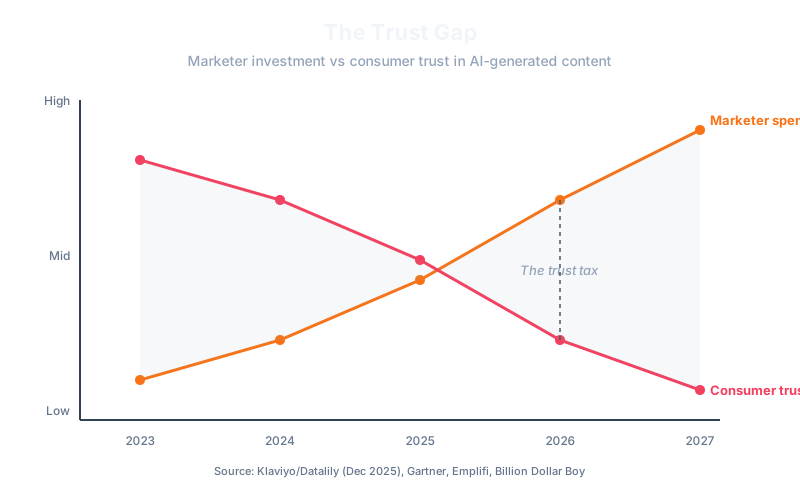
Marketers are spending more on AI content than ever. Consumers trust it less than ever. Both things are happening at the same time, and almost nobody is measuring the distance between them.
That distance has a cost. Call it the trust tax. Every dollar that goes into AI-generated content that looks AI-generated carries a penalty at the point of conversion. The production is cheap. The trust drag is expensive. And most marketing teams are only counting the first number.
The data comes from a December 2025 Klaviyo and Datalily survey of 8,000 consumers across eight countries. It is not a fringe finding.
<a href="https://www.emarketer.com/content/shoppers-aren-t-impressed-by-ai-generated-marketing" rel="nofollow noopener noreferrer" target="_blank">eMarketer summarized it bluntly</a>: visible AI in marketing content is a trust risk, not a trust builder.
Meanwhile, 77% of senior marketing decision-makers plan to shift budgets from traditional creator marketing toward generative AI creator content, according to Billion Dollar Boy. The industry is sprinting toward the cliff.
When More Means Less
The math is uncomfortable. If 31% of consumers trust your brand less when they see AI-generated content, and 52% say they would stop buying from a brand after an inauthentic experience (per Emplifi), then every piece of detectably AI-generated content is actively shrinking your customer base.
Not in theory. In purchase behavior.
This is not an argument against using AI in marketing. It is an argument against showing your work. The brands getting value from generative AI are the ones using it behind the scenes: in research, in drafting, in iteration. The brands losing trust are the ones publishing raw AI output with visible tells and calling it content.

When every post looks the same, nothing stands out. Including yours.
Gartner found that nearly half of consumers now prefer brands that avoid generative AI in customer-facing content altogether. Not avoid AI entirely. Avoid it in the content they see.
There is a difference between efficiency and visibility. AI makes production efficient. Visibility makes it suspicious. Confusing the two is the expensive mistake.
The Engagement Penalty Is Real
Content perceived as AI-generated suffers engagement penalties of 20 to 35% compared to human-created alternatives, according to multiple studies compiled in recent research on the <a href="https://blog.thewitslab.com/the-ai-content-flood-of-2026-why-brands-are-running-back-to-authentic-human-voices" rel="nofollow noopener noreferrer" target="_blank">AI content saturation crisis</a>. That is not a soft metric. Lower engagement means lower reach.
Lower reach means higher acquisition costs. Higher acquisition costs mean worse unit economics.
The funnel is leaking at the top because the content looks like it was made by a machine. Because it was.

AI fatigue is not a buzzword. 54% of Americans already report experiencing it.
This connects to a broader pattern we have written about: the collapse of brand voice when AI writes the copy. When every brand uses the same tools to generate the same types of content, differentiation disappears. The content gets cheaper to produce and harder to distinguish. Brand voice flattens into a generic average.
What AI Slop Actually Costs
The advertising industry has a name for this now: AI slop. <a href="https://www.adexchanger.com/data-driven-thinking/ai-slop-is-the-new-mfa-and-we-all-need-to-fight-it/" rel="nofollow noopener noreferrer" target="_blank">AdExchanger compared it to made-for-advertising sites</a>, the low-quality content farms that polluted programmatic ad inventory for years.
AI slop is the same problem at a different scale. It is cheaper, faster, and more pervasive.
For advertisers, the cost shows up in wasted budget. Ads placed next to AI-generated filler content perform worse. Brand safety tools struggle to filter it. And the content itself degrades the platform experience, pushing users toward ad-free or ad-light environments where brands have no reach at all.
This is why the disclosure theater around AI content matters. 91% of consumers expect brands to disclose when they are using AI in marketing. But disclosure without authenticity is just a label on a problem. Consumers do not want to know that content is AI-generated. They want content that is not AI-generated.
The distinction is small in language and enormous in practice.
The Proof Problem
The deeper issue is not about content quality. It is about proof. When AI can generate convincing photos, videos, reviews, and testimonials, the value of all digital evidence drops. Consumers know this. They are adjusting their behavior accordingly.
54% of Americans report experiencing AI fatigue, according to a 2026 survey cited in the New York Post. 43% of users no longer trust most online content, per O'Dwyer's PR News. These numbers describe a market where the default assumption has flipped: content is guilty until proven human.
This creates an opening for brands that can prove they are real. Not claim it. Prove it.
The brands winning right now are investing in signals that are hard to fake: real video from real locations, actual employees on camera, verifiable customer stories with timestamps and context. The collapse of social proof in the AI era is already happening. The response is not better synthetic content. It is less synthetic content.
What Actually Works
The response to the trust tax is not abandoning AI. It is changing where AI sits in the process.
Use AI for research, competitive analysis, first drafts, data processing, and workflow automation. These are back-office functions. The consumer never sees them. They reduce cost without reducing trust.
Use humans for anything the consumer sees, reads, or hears directly. Not because AI cannot produce good output. Because the perception of AI output carries a trust penalty that wipes out the production savings.
This is the same dynamic we wrote about in the personalization trap in AI marketing: the technology works until the consumer feels it working. The moment they feel it, trust drops. The best AI marketing is invisible to the audience.
The brands that understand this are building a two-layer model. Layer one is AI-powered efficiency: faster research, cheaper drafting, automated distribution, data-driven optimization. Layer two is human-powered authenticity: real voices, real footage, real opinions, real expertise. The first layer makes the second layer affordable.
The Forward Lean
The trust tax will get worse before it gets better. AI detection tools are improving, which means consumers will get better at spotting AI content. But detection is an arms race, and the side that wins is the side that does not need to hide.
The brands that will own the next 18 months are the ones investing in proof of presence: video, location, people, and process that AI cannot fake. Not because it is expensive. Because it is scarce. And scarcity is what makes content valuable again.
The question is not whether to use AI. It is whether your audience can tell. If they can, you are paying the trust tax. If they cannot, you are not. But "they cannot tell" is a strategy that breaks the moment detection improves or a competitor calls you out.
The durable strategy is not hiding the AI. It is making the human parts visible enough that the AI parts do not matter.
FAQ
Yes, when consumers can detect it. Klaviyo's December 2025 survey found 31% of consumers trust a brand less when they see visible AI-generated marketing content, while only 7% trust it more. The trust penalty is measurable and growing as AI detection awareness increases.
No. Brands should stop publishing raw AI output as finished content. AI is effective for research, drafting, data analysis, and workflow automation behind the scenes. The trust problem appears when AI-generated content is visible to the audience without human editing, voice, or oversight.
AI slop is low-effort, repetitive content generated at scale by AI tools that looks polished but signals nothing to the audience. AdExchanger compared it to made-for-advertising sites that polluted programmatic ad inventory. It wastes ad budget, degrades platform quality, and accelerates consumer disengagement.
Brands can prove authenticity through signals that are hard to fake: real video from real locations, actual employees on camera, verifiable customer stories with timestamps, and human-created content that carries a distinct voice. The goal is not to claim authenticity but to demonstrate it with evidence AI cannot replicate.
The trust tax is the hidden cost of publishing detectably AI-generated content. It shows up as lower engagement (20 to 35% penalties in some studies), higher acquisition costs, reduced conversion rates, and brand trust erosion. The production savings from AI are offset by the trust penalty at the point of conversion.
91% of consumers expect brands to disclose when they are using AI in marketing, according to Emplifi. However, disclosure alone does not solve the trust problem. Consumers do not want to be told content is AI-generated. They want content that is not AI-generated.