
For five years, one sentence in Google's privacy policy drew a clean line. Google did not show personalized ads based on content from Drive, Gmail, or Photos. No conditions, no small print. The sentence arrived in July 2021 and survived unchanged through every policy version up to October 1, 2026.
On October 16, the sentence gained a second half. Google now writes that it does not show personalized ads based on that content "unless you choose to make data from these services available to other Google services that support personalized ads." The change sat in the policy for a week before most people noticed it.
Android Authority spotted it first, and The Verge reported it on October 23. The Hacker News summary confirms the same sequence: the policy took effect October 16, and the exception applies when users connect those services to Search or Gemini.
The trigger has a name: Personal Intelligence. It is the opt-in feature that lets Search and Gemini read your Gmail, Photos, and other Google apps so AI Mode can answer with your own context, like suggesting things to do near a hotel it found in a booking email.
Google's updated policy says Search may process the data you allow it to access "to personalize content, including ads". That one phrase, including ads, is the whole story.
What actually changed
The October 16 revision rewrote three sentences in the advertising section and added a note. Read together, they move the line from a wall to a gate.
First, a new sentence gives the permission. You may choose to allow services like Search or Gemini Apps to access data from other Google services, such as Google Photos and Workspace apps like Gmail and Drive, for a more personal experience, subject to the policies and settings of the accessing service.
Directly after it comes the example that matters: Search may process some of the data you allow Search to access to personalize content, including ads.
Second, the general description of personalized ads gained a third basis. The October 1 text said ads could be based on your interests and activity across Google services.
The new text says interests, activity, or personalized content from Google services. Personalized content is now a separate ground for ad selection, standing beside interests and activity rather than inside them.
Third, the old promise got its condition. The bullet that used to end at Photos now ends with the exception for data you make available to other Google services that support personalized ads.
Two protections did not move. Google still says it does not show personalized ads based on sensitive categories such as race, religion, sexual orientation, or health. It still says it does not share information that personally identifies you with advertisers. Those sentences are the outer limits of the new arrangement, and they matter more now that the inner line moved.
The summary loophole
Google's help page for connecting content apps is more candid than the policy, and operators should read it before they brief anyone. Ads will not be based directly on your Gmail inbox or your Google Photos library, the page says.
Instead, Search works from summaries, excerpts, generated media, and inferences drawn from your emails and files. Then comes the sentence that closes the gap: that same info may be used to show you ads, so they are even more helpful for you.
That distinction between directly and derived has a limit the page states itself. In some cases, where an email or file is brief or particularly relevant to the inquiry, the summary may just be the email or file. A short booking confirmation does not survive summarization as something different from itself. It survives as itself, wearing a different label.
The same page sets the scope of a single connection wider than most users will guess. Connecting your content apps permits all Search services to access Workspace data, and Search services means Google Search including AI Mode and Discover, Maps including Ask Maps, and Shopping. One toggle in one product covers four surfaces.
The feature is limited to users 18 and up on personal accounts, and connecting Photos is not available in every region. It is not available in the European Union, the United Kingdom, or Switzerland, which tells you how Google itself reads the regulatory risk.

Google says ads are not based directly on your inbox. They are based on summaries of it, and a short email survives...
One consent, three uses
Here is the framework that makes this change useful to an operator instead of just alarming. Personal Intelligence bundles three distinct uses under one consent, and Google never asks about them separately.
Use one is the advertised one. Better answers. AI Mode reads a booking, a reservation, a photo, and tailors its response. This is what the user thinks they agreed to, and it is genuinely useful.
Use two is ad personalization. The same summaries and inferences that produced the answer can select the ad. There is no second prompt, no separate ad consent, and no toggle that says answers yes, ads no.
Personalized ads are governed by My Ad Center, a different setting from the app connection. A user who connects apps for better answers and leaves ad personalization on falls inside the new exception without ever making a decision about ads as such.
Use three is training and review. Search services do not train generative AI models directly on your inbox, the help page says, but they do train models off the summaries, excerpts, generated media, and inferences.
A subset of data processed by AI Mode and Ask Maps is reviewed by human reviewers. Google's own advice on the page is blunt: do not connect content apps if they contain personal or confidential information you would not want used for training generative AI models.
Then there is the exit, which is narrower than the entrance. Disconnecting a connected app or deleting data in that app does not delete data already held by Search services. That data can still be used for product improvement, including training.
The toggle stops new access. It does not recall what was already saved. Any client conversation about this feature has to start there, because the common assumption, that switching it off undoes it, is wrong.
The toggle was sold as better answers. The policy spends it three ways.
What advertisers cannot do with this
The most important operator fact in this story is a negative one. Nothing in the policy or the help page describes a new targeting control, audience segment, or report tied to connected app data.
Advertisers get no access to anyone's inbox or photo library, and Google publishes no figures on how many users have connected apps. The value, if any arrives, comes through Google's own ad selection, not through a product you can buy.
That kills the pitch some agencies will be tempted to make this month. You cannot target people whose Gmail shows a competitor's order confirmation. You cannot build an audience of travelers with hotel bookings in their inbox.
You cannot buy intent inferred from private photos. There is no segment, no checkbox, no bid adjustment for it. Anyone selling one is selling something Google has not built.
It also breaks a measurement habit. Google has started testing ads in AI Mode for users who connected apps through Personal Intelligence, confirmed around October 16 after Google said in March 2026 that those users saw no ads.
An ad shown in that test may have been selected partly on a connected app inference, and you cannot see that in reporting. We have written before about AI attribution hiding ROI, and this is the same problem in a new costume: a signal you cannot isolate, inside a result you cannot attribute.
So do not let a client report claim a lift from connected app data. Do not let a dashboard imply it. Treat any AI Mode performance movement as unassigned until Google gives advertisers a way to see the signal, and say so in the report. The honest sentence is short: we cannot tell how much of this came from the new signal, because Google does not show us.
The client conversation
Clients will ask about this, because the headlines will read worse than the policy. "Google is reading your Gmail to sell ads" is already the shorthand, and it is wrong in the specific way that makes clients either panic or shrug. Your job is to give them the precise version before someone else gives them the scary one.
Start with what did not happen. Google did not start scanning inboxes for ads. Gmail ads were never selected by reading messages, and that has not changed. What changed is the treatment of data a user deliberately makes available to another Google service. If a user never connects their apps, the old promise still holds in full.
Then give them the three uses, in plain order. Better answers, ad personalization, training. Then the exit rule: disconnecting stops new access and does not delete what Search already saved. Then the advertiser rule: no inbox access, no new segment, no new report.
Then the part clients actually need from an agency: what not to build. Do not write ad copy that presumes private knowledge, the wink that says we know what you booked.
An ad that feels like it read someone's email will read, to the person seeing it, exactly like an ad that read their email, whether or not the targeting worked that way. Trust is already the tax on AI content, and a clever line that trades on inbox intimacy will cost more trust than it earns in clicks.
And apply the same rule inside your own house. Google advises users not to connect apps containing personal or confidential information. Agency staff should not connect work accounts holding client material to personal AI features on the same logic. The policy question and the client data question are the same question.
There is no answers yes, ads no toggle. My Ad Center is a different switch from the app connection.
The consent stack, drawn
The three uses are usually covered as separate stories: a feature launch, a policy edit, a training disclosure. Drawn as one stack, the shape is simple.
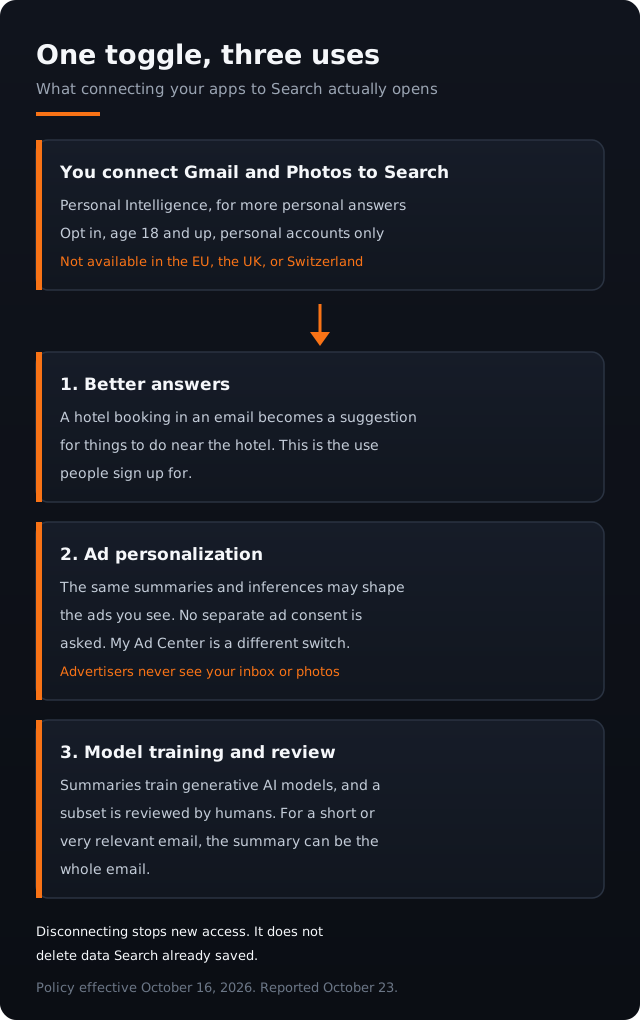
The toggle sits on top. The uses sit underneath, all fed by the same permission. There is no layer where the user picks among them. That shape is the reason this story matters beyond one policy edit.
Consent in AI products is increasingly bundled: one friendly opt-in, several downstream uses, and an exit that only stops the future. Meta's November 20 contract changes, which we covered last week, bundle consent the other way, through continued use rather than a toggle. Different mechanism, same shape. Watch for the shape, not just the headline, because it is the pattern the next platform change will follow.
What to watch next
Five things, in order of when they will bite.
First, whether Google adds anything advertisers can actually use or see: a segment, a control, a reporting split for AI Mode ads selected with connected app inferences. Until then, treat the signal as invisible lift, not as a product.
Second, whether the feature reaches Europe and the United Kingdom. Its absence there is the clearest signal of regulatory exposure in the whole story. A launch in those markets would mean Google believes the consent stack survives stricter scrutiny. Continued absence means it does not.
Third, the Gemini question. In January 2026, Google said there were no ads in the Gemini app and no current plans to change that. The October policy names Gemini Apps as a service that may access other services' data, but only Search is described as processing that data for ads. If Gemini ever gains ads, the same stack applies there with a much larger surface.
Fourth, the deletion question. Disconnecting does not delete saved data today. Watch whether Google adds a real recall, a delete path for Search services data tied to connected apps, or at least a clearer statement of how long summaries persist. That is the single product change that would most change the risk picture.
Fifth, the user reaction. In November 2025, Gmail publicly denied changing anyone's AI data settings after a viral claim that users had been opted in to AI access of their messages. The October change differs in the one respect that matters: it is written into the policy, and it is opt-in by the policy's own description.
But opt-in on paper and understood consent in practice are different things, and the gap between them is where backlash lives. The first time a user sees an ad that plainly reflects a private email, the policy wording will not be what they remember. The ad will be.
Your move this week is not a campaign change. It is a language change. Stop describing Personal Intelligence as a targeting opportunity, because it is not one. Start describing it as a consent stack: one toggle, three uses, an exit that only faces forward. Clients who hear that version from you first will not need the scary version from anyone else.
Frequently asked questions
Only if you connect Gmail, Drive, or Photos to Search or Gemini Apps through Personal Intelligence. Google's policy, effective October 16, 2026, says it does not show personalized ads based on that content unless you choose to make it available to other Google services that support personalized ads. If you never connect those apps, the old promise still holds.
No. Google says advertisers do not get access to your Gmail inbox or Google Photos library. Ads may be shaped by summaries, excerpts, generated media, and inferences drawn from connected content, but the underlying inbox and library stay out of advertisers' hands, and Google does not share information that personally identifies you with advertisers.
It is Google's opt-in feature that lets Search and Gemini read your connected Google apps so AI Mode can answer with your own context, for example suggesting things to do near a hotel found in a booking email. It launched in beta in January 2026 and expanded widely in May 2026. It is limited to users 18 and up on personal accounts, and it is not available in the European Union, the United Kingdom, or Switzerland.
No. Disconnecting a connected app or deleting data in that app does not delete data already held by Search services. That data can still be used for product improvement, including training generative AI models. Disconnecting stops new access. It does not recall what was already saved.
No. Google describes no targeting control, audience segment, or report tied to connected app data. Any value from the new signal arrives through Google's own ad selection, not through a segment you can buy or a report you can read. Do not brief a client otherwise.
No. Ads inside Gmail were never selected by reading messages, and the October policy change does not alter that. The change concerns data a user deliberately makes available to another Google service, such as Search through Personal Intelligence, and how Search may use summaries of that data, including for ads.