
Search your business on your phone, the way a customer would. If the listing that comes back has no photo, no stars, no hours, and no button to call you, you are looking at a test Google started running in the last few days. Your business name is still there. So is a short paragraph Google's AI wrote about you. Everything else is gone.
Here is the direct answer, before the details. Read your profile the way the test version shows it, name plus a few AI-written lines and nothing else. If a stranger could not tell what you do, who it is for, and where you work from those lines alone, rewrite your description, fill in your services and attributes, and name your real service towns.
Do it this week, on every location, and check it monthly. The fix takes about an hour per location. It pays off whether this test sticks or not, because the words you fix are the same words Google quotes everywhere else.
What Google took away
The story broke on November 10, 2026, when Search Engine Roundtable reported that Google is testing a stripped-down version of the local pack inside AI Overviews. The report rests on two people who watch local search for a living.
Joy Hawkins posted on X that she had been seeing the new version for a few days. Barry Schwartz reproduced it and published side-by-side screenshots of the new version against the normal one.
Hawkins put it plainly. "I'm seeing a new version of the AI powered local pack in the last few days. On mobile, every time I get this version, the traditional local pack is gone.
It uses the Google Business Profile but yet removes a ton of its features (reviews, address, hours etc). This is probably the ugliest version of the AI Overview I've seen in local thus far. Hoping this one reverts soon.
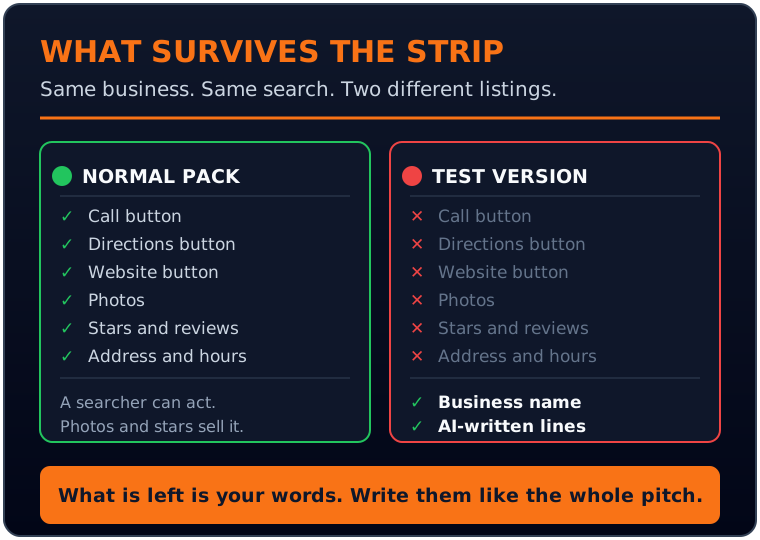
Here is what is missing in the test version. The action buttons are gone, so a searcher cannot call, get directions, or open your website from the listing. The photos are gone. The reviews and star ratings are gone. The address and hours are gone too, according to Hawkins. What remains is the business name and a few lines of AI-written text about it.
Schwartz drew the blunt conclusion. "This new version, the one being tested, cannot be good for clicks, calls and direction actions to businesses." He is right, and the reason is simple.
Every way a searcher acts on a listing was removed at once. There is no button to tap, no photo to judge, no review to trust, and no address to check. The only thing a searcher can do is read the lines and decide, or go back and pick another name.
Three limits matter, and the post should state them before anything else. First, this is a test, not a rollout. Google runs many tests and many of them revert. Hawkins hopes this one does. Second, Google has not commented. No announcement, no explanation, no country list, no date.
Third, nobody has measured the impact. No click data, no call data, no share of searches that see it. The honest statement is narrow. Some searchers, in some places, see a version of the local pack with almost nothing in it. Yours may be one of the businesses in it. The only way to know is to look.
AI Overview local packs are not new. They have been around for a couple of years, and they keep changing. What is new is the direction of this change. Earlier versions added detail. This one takes it away.
The trust layer moved
For years, the trust layer on a local listing was the stuff Google just removed. A photo of a real shop. A 4.8 star rating with a hundred reviews behind it. A Call button sitting right there. A customer did not need to read anything. The stars and the photo did the selling, and the button closed it.
In the test version, the trust layer is the AI summary. A few lines of text, written by Google, decide whether a searcher thinks you are the right business. Those lines are drawn from your Google Business Profile (GBP) and your website.
If the profile text is thin or vague, the summary is thin or vague. If the profile text is specific, the summary has something specific to say.
Stealth Digital, writing about the same test on November 11, made the point with the businesses that have the most to lose. Most industrial firms it looks at have a thin profile. A dozen reviews, a few old photos, a broad category like Contractor, and an empty services list. In the normal pack, the rating and the Call button carry the listing anyway.
A buyer sees 4.8 stars and a phone number and that is enough to make the call. Take those away and the listing is only as good as the words Google can find about you. A firm that wrote "structural steel fabrication and erection for commercial builds in North Bay, Sudbury, and Timmins" gets a sentence that answers the buyer's question. A firm that wrote "quality workmanship since 1987" gets nothing.
That is the inversion, stated plainly. Reviews and photos were proof a customer could see at a glance. Now the proof is a paragraph, and you wrote the raw material for it months or years ago, when the description field felt like paperwork.
Your reviews did not disappear. They disappeared from the moment of decision, which is worse. Nobody calls to tell you why they picked the next listing. They read two bare lines, feel nothing, and move on.
There is no report for that. Google Business Profile performance shows calls, direction requests, and website clicks. It does not show a person who read your name, read a thin summary, and chose someone else.
Your words are the whole pitch now
The AI does not invent your pitch. It quotes your words back. That is the part most operators miss, because it turns a writing chore into the whole listing.
Take a plumber in Alhambra as an example. Here is a description of the kind that sits on thousands of profiles right now.
"We are a family-owned business committed to quality workmanship and customer satisfaction since 1987."
Read it as a stranger would. It says nothing about what the business fixes, nothing about who it serves, and nothing about where. The AI has two facts to work with, family-owned and since 1987, and neither one helps a homeowner with a leaking water heater decide anything.
Here is the same business, rewritten in the words customers use on the phone.
"Licensed plumbers fixing leaks, water heaters, and drain clogs for homeowners in Alhambra, San Gabriel, and Monterey Park. Same-day calls answered by a person, not a recording."
Same business, same length, different listing. The AI now has work to quote. Leaks, water heaters, drain clogs. Homeowners. Three real towns. A same-day promise with a human behind it. A searcher with a leaking water heater can see themselves in that sentence. A searcher reading the first version sees a slogan.
The rewrite follows three rules. Name what you do, in the nouns customers say out loud. Name who it is for, in one plain phrase. Name where, with real towns, not a region. Everything else is optional.
Slogans do not help, because the AI will repeat them as if they were facts. Superlatives do not help, because "best" and "leading" say nothing about the job. A list of keywords does not help either, and it can hurt. Stuff the description with search terms and the AI will parrot the stuffing back as your whole pitch, in front of a customer who wanted a plumber.

The description is the only sales copy left in the stripped listing. Rewrite it like it has to close the job on its own.
The description is not the only text that feeds the summary. Services and attributes do the same work, in smaller pieces. A services list that names the real jobs, in customer words, gives the AI specific sentences to write.
An empty services list gives it nothing. Attributes fill in the rest, the facts a searcher would ask about before calling, like whether you take on small jobs, whether you serve a certain area, or how people reach you. Every blank field is a missing sentence in the summary.
Check the category too, while you are in there. Stealth Digital makes the point well. A broad category like Contractor tells the AI almost nothing. The narrowest category that names your core work tells it what you actually do. Category still decides which searches you belong in. In the stripped listing, it also decides what the AI says about you.
The phone shows the worst version
The mobile detail is the one that should worry operators most. Hawkins found that every time the test version appears on a phone, the traditional local pack is gone. There is no fallback surface. The normal three listings beside the map do not appear underneath. The stripped version is the only version.
That matters because the phone is where local searches happen. A person standing on a street with a leaking pipe, a dead car battery, or a hungry family is not searching from a desk.
They are searching from the sidewalk, and the version they get is the one with nothing to tap. A customer who wants you has to search your business name separately or click through to your site, and both of those take effort a bare listing does not reward.
The desktop picture is different, and the difference is worth naming. On a desktop, the AI Overview sits at the top of a page that still has other results below it. On a phone, the screen is small, the AI answer fills it, and the normal pack that used to sit beside the map is simply not there. Same test, same business, worse outcome on the device most customers use.
This is also why branded search and the first screen of your website matter more than they did a week ago. When the listing gives a searcher no button, the next step is a search for your name.
What shows then is your profile in full, with the reviews and photos back, and your site. If the site's first screen does not say what you do, where, and how to reach you, the customer you almost kept walks away twice, once from the stripped listing and once from a vague homepage.
The Naked Profile Test
Coverage of this test tells operators to check their profile. That advice is too vague to act on, so here is a routine with a pass mark. Call it the Naked Profile Test. Ten minutes per location, once a month, with a named owner for the list. Run it on a phone, signed out, the way a customer searches.
1. Search your three money phrases. Pick the three searches your best customers actually type, with the town in them. Run each one on a phone. Screenshot what Google shows about you, including the AI Overview when it appears. You are looking for the stripped version, not the normal pack. If you only ever see the normal pack, note that too. The test has not reached you yet.
2. Read only what survives. Cover the photos, the stars, the buttons, and the hours with your hand, or just read the name and the AI-written lines and ignore the rest. Ask one question. Could a stranger tell what you do, who it is for, and where you work? Pass means all three answers are in the lines. Fail means any one of them is missing, and the description is the fix.
3. Read the description out loud. Open your profile while signed in to the account that manages it, and read the description as if you had never heard of the company. If it sounds like every competitor in your town, it is not doing its job. If it names the work, the customer, and the towns, it passes. Rewrite the failures now, not next quarter.
4. Check services and attributes. Open the services list. Is every real job on it, in the words customers use on the phone? Is anything on it that you no longer do? Check attributes the same way. Blank fields are missing sentences. Wrong fields are wrong sentences, repeated back to customers by the AI.
5. Check service areas and service pages. Name the real towns you work in.
A service-area page, or a services section on your site, should name them in plain text, one page per real service, with the plain facts on the page and a phone number in the first screen. Google's AI reads your site alongside your profile, and it quotes specifics. A site that says nothing specific gives it nothing to quote.
Score it simply. Five checks, pass or fail, per location. A location that fails two or more checks goes to the top of the fix list. Multi-location operators run the same test on every location and keep one screenshot per location, so a thin description at one store does not hide inside an average. The fleet version costs an afternoon. A single location costs ten minutes.

The stripped listing is a choice between names and a few lines. The business with the clearest words wins the tap.
The fix ladder
The fixes run in order, from the fastest to the slowest. Do them in this order, because the first one is the one that shows up in the summary tomorrow.
First, rewrite the description. One hour. Name the work, the customer, and the towns. Use the words customers use on the phone. Cut every slogan, every superlative, and every sentence that could describe any business in your town.
Second, fill in services and attributes. Thirty minutes. Every real service, in customer words. Remove anything you no longer do. Attributes get the same treatment. If a field is blank, the AI writes around the gap.
Third, name your service areas. Twenty minutes. Real towns, in plain text, on the profile and on the site. An AI answer to a search with a town in it can only include you if something says you work in that town.
Fourth, fix the service pages. This is the slow one, and the one most businesses skip. One page per real service, with the plain facts, named projects or real examples where you have permission to share them, real photos, and a phone number in the first screen.
The stripped listing cannot carry proof, so the site has to. Stealth Digital puts it well. If Google can hide your reviews in one layout, your own site needs to carry the evidence too.
Fifth, keep asking for reviews. This is the fix people get wrong. It is easy to read this test as proof that reviews no longer matter. They do.
Reviews still show in the normal pack, in Maps, and on your profile when someone searches your name, which is exactly where a buyer goes when there is no Call button. A buyer weighing a big job still reads every one. What the test shows is that reviews cannot be the only proof you have. They can be hidden in one layout, so the words have to carry the listing when they are.
Two things belong on the do-not list. Do not keyword-stuff the description. The AI will parrot the stuffing back as your whole pitch, and a customer will read a list of search terms where a reason to call should have been.
Do not wait for Google to confirm the test or revert it. The fix pays off whether this version sticks or not, because the same words feed the normal pack, the AI Mode answers, and the next test Google runs.
Judge the result the way the Local SEO Hat already says to judge local visibility. By actions and bookings, not by one position. A listing can hold its map pack spot and still lose the customer, because the summary is the part that persuades and the summary is the part that went thin.
Rank reports will tell you the profile is fine. The booking log will tell you the truth, and only if someone is reading it.
Google is editing both ways
The strip did not arrive alone. It arrived the day after Google was caught adding things to profiles, and the pair is the real story.
On November 9, 2026, Search Engine Roundtable reported that Google may be automatically adding booking links to some Business Profiles. A Book Online button appeared on profiles that had never set one up, and in some cases it led to a Google page returning a 500 error. The day before, three local search specialists had posted the same sighting.
Brandon Schmidt found it on a home care business with no booking software. Joy Hawkins saw it on a home services client. Syed Amir saw it across several client profiles, and noted that simply putting a Contact page in the Booking Link field now triggers the button.
One day later, the same company removed the buttons, the photos, and the reviews from the AI Overview version of the pack. Add a button you never asked for on Monday. Remove every button on Tuesday.
The profile is a surface Google edits at will, in both directions, without asking and without announcing it. Operators who audit only what they entered are auditing the wrong thing. Audit what Google shows, on a phone, signed out, every month.
The same day brought a second thread worth separating from this one. Google launched the November 2026 core update on November 10, with a rollout of about two weeks. Search Engine Roundtable confirmed the timing and quoted Google's line that it is "a regular update designed to better surface relevant, satisfying content for searchers from all types of sites." Do not mix the two stories in a report. The strip is a layout test.
The core update is a ranking change. Rankings will move over the next two weeks, and no ranking judgment is worth making until the rollout completes around November 24. The strip needs a rewrite this week. The core update needs patience until it finishes.
A third thread arrived the same day. OpenAI opened Businesses in ChatGPT in beta, so a second AI system now builds a business profile from your details and answers questions about you. Your profile text is now the copy AI systems quote in more than one place. That is context, not a task. Whether and how to claim a ChatGPT profile is a separate decision, and it is still open.
Our earlier post on how paid search split into three surfaces made the same point from the ads side. AI Mode turned search into a conversation, and the ad surface became the whole conversation. The strip is the organic twin of that shift.
The surface where the customer decides keeps moving closer to Google, and further from your site. Our Google Business Profile optimization guide covers the rest of the profile, from categories and photos to reviews, so the Naked Profile Test slots into a routine that already exists instead of becoming a one-off chore.
What it costs when nobody clicks
A stripped listing costs customers quietly. That is what makes it different from a ranking drop. A ranking drop shows up in a report. A stripped listing shows up nowhere except in the customers who never arrive.
Think about the customer. They searched, they found your name, they read two thin lines that could describe any business in town, and they picked the next name. They did not call to tell you.
They did not leave a review. They did not click anything you can count. You lost a customer you never knew existed, to a competitor you never saw, because of words you wrote years ago and never reread.
For an agency, the cost multiplies. A client with ten locations and one thin description per location is losing customers in ten markets at once, and the agency is the one that will get the call when the client notices the phone went quiet. The Naked Profile Test is cheap insurance against that call.
Run it monthly, keep the screenshots, and send the client the list of what you checked. A client who sees the audit trusts the agency that caught the thin description before the customers did.
The fix is not hard. That is the annoying part. An hour of writing, a monthly check, and a screenshot folder. The businesses that lose customers to this change will not be the ones that could not fix it. They will be the ones that never looked.
Google did not delete your reviews. It moved them out of the moment a customer decides. Your words are the only thing left in that moment.
Frequently asked questions
A test, not a rollout. Joy Hawkins flagged it on X after seeing it for a few days, Barry Schwartz reproduced it with screenshots on November 10, 2026, and Google has not commented. Tests often revert. The fix pays off either way, because the same profile text feeds the normal pack, AI Mode answers, and the next test Google runs.
No. Your reviews still show in the normal local pack, in Maps, and on your profile when someone searches your business name. They are hidden in this one AI Overview variant only. Keep asking for them. A buyer weighing a big job still reads them, and they are exactly what a searcher sees after clicking through from a bare listing.
The Call, Directions, and Website buttons, the photos, the reviews and star ratings, the address, and the hours. What is left is the business name and a few lines of AI-written text. On mobile, the normal local pack does not appear at all when this version shows, so the stripped listing is the only listing on the screen.
From your Google Business Profile and your website. The description, the services list, the attributes, the category, and the service pages are the raw material. Thin or vague text gives the AI nothing specific to say. Specific text gives it a sentence that answers the searcher's question.
Name what you do, in the words customers use on the phone. Name who it is for, in one plain phrase. Name the real towns you work in. Cut slogans, superlatives, and keyword lists. A plumber who writes "Licensed plumbers fixing leaks, water heaters, and drain clogs for homeowners in Alhambra, San Gabriel, and Monterey Park" gives the AI a pitch. A plumber who writes "quality workmanship since 1987" gives it a slogan.
There is no evidence it does. The strip is a layout test, not a ranking change. Separately, Google launched the November 2026 core update on November 10, with a rollout of about two weeks, so do not judge any ranking change until that rollout completes around November 24. Keep the two stories apart in any report.
Monthly, on the same cycle as review replies and photo refreshes. Search your three money phrases on a phone, signed out. Read only the name and the AI lines. Fix the description, services, and attributes that fail, and keep one screenshot per location so a change at one store does not hide inside an average. Run the test this week, on every profile you manage. Cover everything but the name and the AI lines, and read what is left. If a stranger could not pick you from that, rewrite it before the next customer has to choose from it.