For years, the local 3-pack was the wild west. Locksmiths stuffed "24/7 Emergency Cheap Fast" into their business names. Contractors ran ten fake listings for the same address. Movers built profiles with city names as their actual business name. It worked because Google let it work.
That era is ending. Google's 2026 enforcement push against Google Business Profile (GBP) spam is not a single algorithm update. It's a sustained, automated crackdown that has already suspended thousands of listings across the US, most of them in the exact categories that built their entire lead pipeline on those tactics.
This is a forced reset for local search. And it's happening at the worst possible time for businesses that haven't been paying attention.
Who's taking the most damage from the 2026 GBP crackdown?
The suspension wave is hitting hardest in a specific cluster of industries: locksmiths, movers, plumbers, HVAC contractors, and general contractors. These categories share a profile. High consumer urgency, low brand loyalty, and historically aggressive manipulation of local search results.

In competitive urban markets like Chicago, New York, and Los Angeles, "near me" queries in these categories have historically been dominated by profile farms. Clusters of fake or manipulated listings designed to flood the 3-pack with variations of the same business. Google has been aware of this for years.
The difference in 2026 is enforcement capacity. Automated detection systems are now sophisticated enough to identify keyword stuffing in business names at scale, and manual review queues are being prioritized for high-spam categories. Sterling Sky's Joy Hawkins has tracked the suspension surge across hundreds of local businesses since the March 2026 core update.
The collateral damage is real. Legitimate businesses operating in industries with high spam rates are getting caught in sweeps meant for bad actors. A licensed locksmith who never touched their profile name suddenly finds their listing suspended because they share a category with dozens of fake competitors. Recovery takes days or weeks, and during that window, calls stop.
For businesses where Google Business Profile is the primary lead channel, that suspension is not an inconvenience. It's a revenue crisis.
What is Google Business Profile actually targeting?
Google Business Profile is the free listing that powers your business name, hours, photos, reviews, and contact info inside Google Maps and the local 3-pack. Understanding what triggers enforcement helps separate the panic from the actual risk.
The most common suspension triggers in 2026:
| Violation | Risk Level | Common in | What to do instead |
|---|---|---|---|
| Keyword stuffing in business name | High | Locksmiths, movers, contractors | Use legal business name only |
| Multiple listings at one address | High | Service businesses, franchises | One verified listing per location |
| Fake or incentivized reviews | High | Restaurants, contractors, medical | Request reviews via post-service prompts |
| Mismatched NAP across directories | Medium | All local businesses | Run a quarterly citation audit |
| Service area abuse (100+ mile radius) | Medium | Contractors, cleaning services | Set service area to actual coverage |
| Unverified or inactive profiles | Low-Medium | All categories | Verify and post monthly |
The core issue is that Google's algorithm has always said name, address, phone number consistency matters. Enforcement was inconsistent. Now it's not. Listings that have existed with violations for years are being flagged retroactively.

The timing is not random. This enforcement push coincides with Google expanding AI Overviews into local search results. AI Overviews pull from authenticated, structured data sources.
A keyword-stuffed listing doesn't feed cleanly into an AI-generated answer. Google has an algorithmic incentive to clean the local graph, not just a policy one.
How are AI Overviews changing local search?
By late 2025, AI Overviews appeared in 44.4% of all search queries according to BrightEdge research. Local searches are increasingly included in that share.
When someone searches "emergency plumber near me" or "cannabis dispensary open now," they may see an AI-generated summary before they ever see the traditional 3-pack.
That summary pulls from reviews, structured data, verified business information, and authoritative local content. Not from a business name that contains twelve keywords.
This creates a two-tier visibility problem for businesses that relied on spam tactics. Not only are they at risk of suspension in the traditional local pack, they're also invisible in the AI Overview layer because their signals don't feed AI retrieval systems.
The businesses benefiting from the crackdown are the ones who were building clean profiles while their competitors were gaming the system.
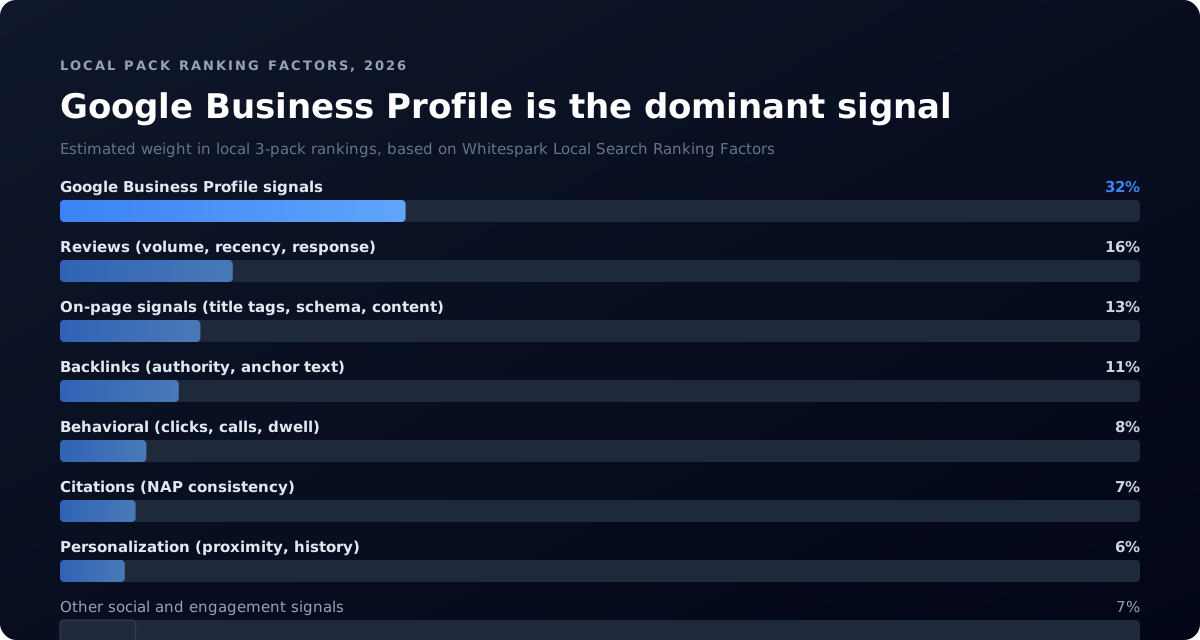
GBP is now the number one ranking factor for the local pack at 32% weight, according to Whitespark's 2025 Local Search Ranking Factors report. Reviews, proximity, and structured data follow. There is no shortcut left that doesn't carry suspension risk.
Why does NAP consistency still wreck local rankings in 2026?

NAP stands for Name, Address, Phone number. It's the trio of data points Google cross-references across the web to verify your business is real. One of the most overlooked local SEO issues in 2026 has nothing to do with spam. It's inconsistent business information scattered across the web.
NAP needs to match exactly across every directory, citation, and listing. Not approximately. Exactly. "St" versus "Street." A missing suite number. An old phone number still live on a directory you forgot you listed on five years ago.

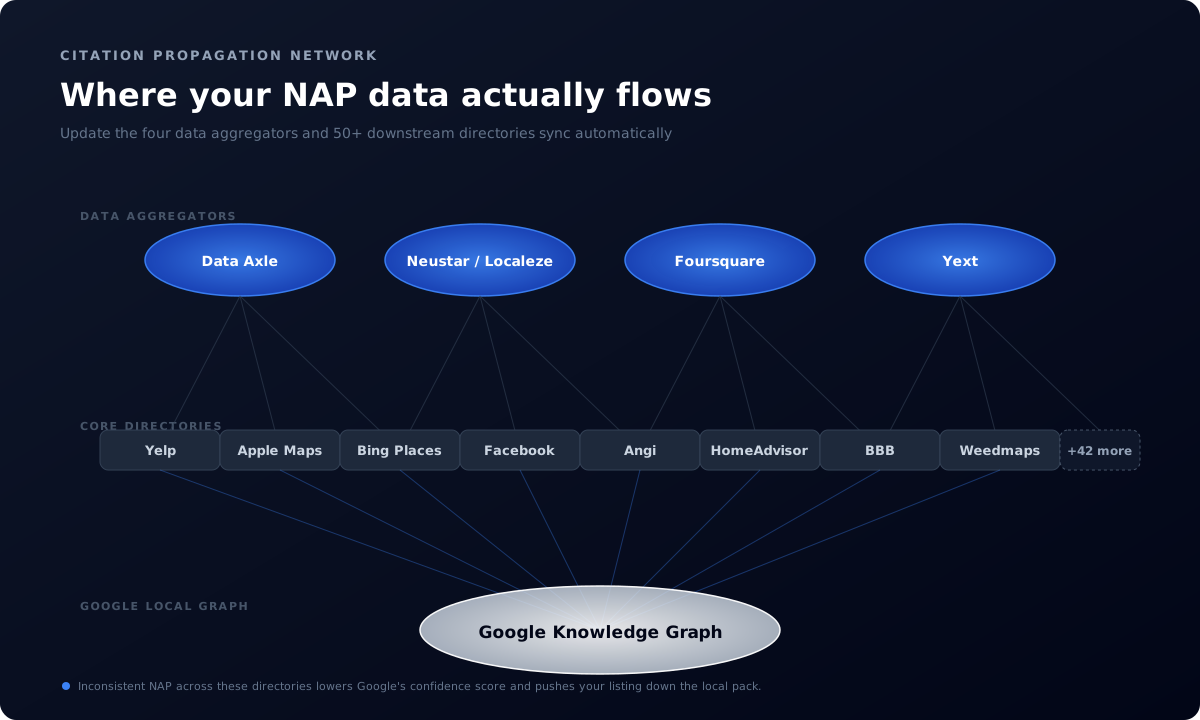
Google cross-references NAP data across 50+ directory sources when building its local knowledge graph. Conflicting signals suppress rankings. Not with a manual penalty, just with lower confidence scores that push a listing down in favor of competitors with cleaner data.
The current citation priority:
- Must-have: Yelp, Apple Maps, Bing Places, Google Business Profile
- High value: Industry-specific directories (Angi, HomeAdvisor for contractors; Weedmaps for cannabis)
- Foundational: Data aggregators like Data Axle and Neustar/Localeze, which feed dozens of downstream directories automatically
For cannabis businesses specifically, citation strategy carries extra weight because Google limits the content signals it can pull from cannabis sites. Reviews and NAP consistency end up doing more of the ranking work than they would for an unrestricted category.
"Review recency now matters more than raw count. A business with 50 reviews from the past 6 months will often outrank one with 300 reviews from 3 years ago." Pattern observed across local SEO practitioners through 2025 and 2026, consistent with BrightLocal's annual review data.
What does a clean local SEO setup look like in 2026?
There's a clear pattern in which businesses are weathering this without disruption. It's not the biggest businesses or the ones with the most reviews. It's the ones with the cleanest signals.
What clean looks like in practice:
Business name: Your actual legal business name. No city names, no service keywords, no modifiers. If your business is called "Rivera Plumbing," your GBP says "Rivera Plumbing." Not "Rivera Plumbing Chicago Emergency 24/7 Affordable."
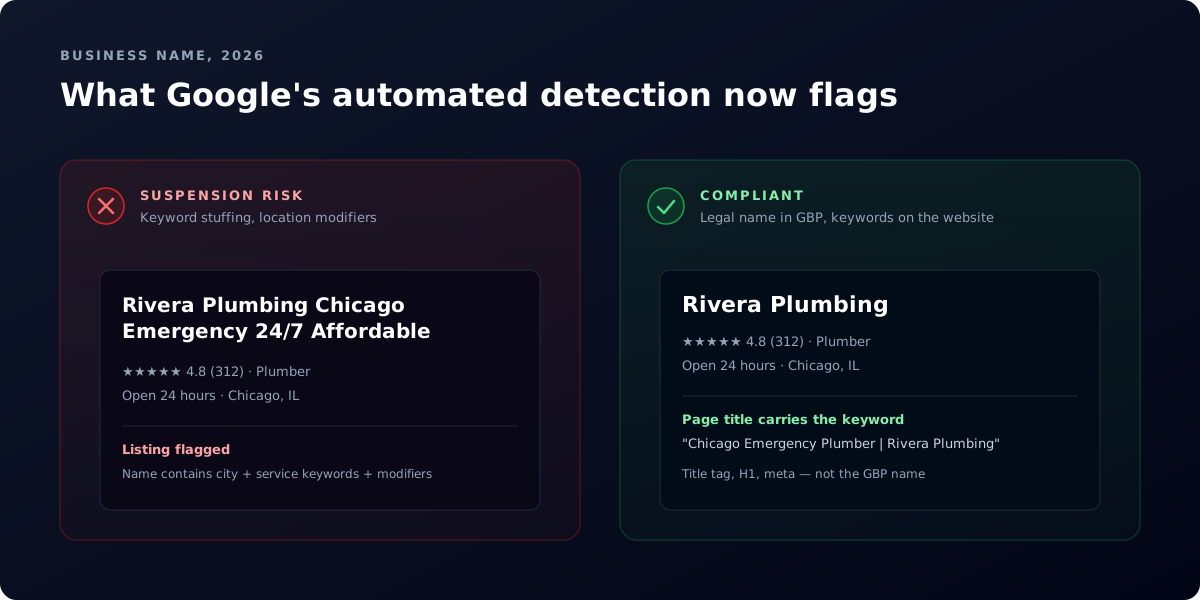
Title optimization on-site: Keywords belong in your website title tags, H1-H3 headers, and page descriptions. Not in your business name. A title like "Chicago Emergency Plumber | Rivera Plumbing" frontloads the keyword in the right place without violating GBP policy.
Review velocity: 5 to 10 new reviews per month is the baseline for competitive markets. Bulk review acquisition in short bursts is flagged. Consistent acquisition from real customers, encouraged through post-service prompts, is not.
Structured data: JSON-LD LocalBusiness schema feeding Google directly. Services, hours, service areas, contact info, all in machine-readable format that AI Overviews can parse without relying on the messy HTML of your website.
Response rate: Businesses responding to all reviews, including negative ones, within 48 hours show measurably higher local pack placement. Google interprets engagement as a trust signal.
Photo and post freshness: New photos and Google Posts updated regularly signal to Google that the business is active. Static profiles that haven't been touched in months rank lower against otherwise comparable competitors.
Editor's Note: We covered the citation-and-passage rules AI engines actually reward in SEO Changed. Most Teams Missed It. The local pack now plays by similar rules.
What does the crackdown mean for the broader local search market?
This crackdown is not a temporary enforcement surge. It's a structural realignment. Google's long-term incentive is to make local search results trustworthy, because trustworthy results drive more searcher behavior in Google's ecosystem. Every fake listing that gets surfaced above a real business is a small erosion of that trust.
The businesses that built their local visibility on spam tactics didn't just violate Google's terms. They borrowed against a loan they can't repay. The enforcement is the bill coming due.
For ethical operators, this is the best local SEO environment in years. The competition is being cleared. The businesses that show up consistently, collect real reviews, maintain clean profiles, and build local content are going to find 2026 considerably more favorable than 2024 or 2025.
That said, passivity is its own risk. "We've always done it clean" doesn't mean your profile is optimized. A clean profile that's incomplete, missing services, no photos, no structured data, inconsistent NAP, still loses to a clean profile that's fully built out.
How to audit your Google Business Profile in five steps
The audit your business needs right now:
- 1Search your business name on Google. Confirm the listing matches your actual legal name exactly with no extra keywords.
- 2Check for duplicate listings at your address. Request removal of any extras through GBP support.
- 3Run a citation audit using a tool like Whitespark or BrightLocal to surface NAP inconsistencies across directories.
- 4Check review recency. If your last review was more than 30 days ago, your acquisition process needs work.
- 5Audit your schema markup. Confirm your website has LocalBusiness JSON-LD, that it's accurate and complete, and that it's server-side rendered so AI crawlers can read it.
The businesses that do this work in Q2 2026 are going to be in a materially better position by Q3. The ones that wait will be competing against a cleaned-up local pack where their former advantages no longer exist.
FAQ
The most common cause in 2026 is keyword stuffing in your business name (for example, "Atlanta Emergency Locksmith 24/7" instead of your real legal name). Google's automated detection now flags this at scale. Other top causes are duplicate listings at the same address, incentivized or fake reviews, abusive service areas, and mismatched NAP data across directories. If you're suspended, audit each of those before submitting a reinstatement request.
Reinstatement timelines in 2026 range from a few days for clean-cut cases to several weeks for businesses in high-spam categories like locksmiths, movers, and contractors. Submit through Google's official reinstatement form, document your legal business name and address, and avoid submitting multiple parallel requests, which can extend the queue.
NAP stands for Name, Address, Phone number. Google cross-references these across 50+ directories to verify your business. Even small mismatches ("Street" vs "St", an old phone number on a forgotten directory) lower Google's confidence in your listing and push you down in the local pack. Aim for exact-match consistency across every citation.
No. The 2026 enforcement push specifically targets descriptors, locations, and service keywords appended to business names. Even if your competitors are still doing it, the risk-to-reward has flipped. Move keywords into your website title tags, H1s, and meta descriptions, where they belong.
Volume matters less than recency and velocity in 2026. A business getting 5 to 10 new reviews per month consistently will typically outrank a business with 300 old reviews and nothing recent. Bulk acquisition in short bursts is flagged, so build a steady, post-service review request flow.
Yes, increasingly. AI Overviews now appear on roughly 44.4% of searches, including many local queries. They pull from structured data, reviews, and verified business information, not from business names stuffed with keywords. A clean GBP and server-side LocalBusiness schema are the fastest way to feed AI Overview retrieval.
Three moves in order. Fix your business name to match your legal entity. Run a NAP citation audit and clean up the top 20 inconsistencies. Get five new genuine reviews in the first 30 days post-reinstatement. That sequence rebuilds Google's confidence faster than any single action on its own.