AI customer service agents are not a neutral support tool. They answer under your logo, speak in your brand voice, use your customer data, and sometimes make decisions that change money, access, delivery, loyalty status, or account records.
That is why the most dangerous AI support failures rarely look dramatic at first. A customer asks for help. The agent gives a technically correct answer that ignores context. The customer has no easy path to a human. The interaction gets copied into a review, social post, refund dispute, or regulator complaint, and suddenly your automation program is part of the brand story.
Qualtrics' 2026 Consumer Experience Trends research found that nearly one in five consumers who used AI for customer service saw no benefit. Qualtrics also notes that 53% of consumers worry about privacy risks from AI-enabled support, and that customers who prefer a human agent should not feel penalized for asking.
The problem is not that AI belongs nowhere in support. The problem is that brands are giving AI agents authority before they have mapped the reputational, operational, and compliance consequences of that authority.
The autonomy trap
Old chatbots followed scripts. AI agents make choices.
That difference matters. A scripted chatbot can answer a store-hours question or hand off a password reset. An agentic support system can inspect order history, apply a credit, change an address, create a return label, update a customer profile, recommend a product, or decide whether a human should see the case at all.
Each new permission makes the AI more useful. Each permission also creates a new failure mode.
| Agent permission | What can go wrong | Safer boundary |
|---|---|---|
| Answer FAQs | Outdated or overconfident answers | Source responses from approved knowledge pages |
| Check order status | Exposes private data to the wrong user | Require identity checks before account detail |
| Offer credits | Inconsistent concessions and margin leakage | Cap amount and require logged reason codes |
| Deny refunds | Tone-deaf refusal becomes public evidence | Route money disputes to a human |
| Recommend products | Claims drift beyond approved language | Restrict to catalog facts and compliant filters |
| Update account records | Bad data spreads into CRM and loyalty tools | Require customer confirmation before writes |
The autonomy trap shows up when leadership measures only deflection rate. A system that deflects the easy tickets looks efficient until the remaining queue includes your most sensitive customers, highest-value accounts, hardest compliance questions, and most emotional moments.
That is not a support queue anymore. That is brand triage.
The failure pattern
Most AI service incidents follow a predictable sequence:
- 1The customer has already tried the normal path and feels stuck.
- 2The AI answers from policy, not from the customer's full context.
- 3The customer asks for a person and gets delayed, looped, or denied.
- 4The agent repeats a polished answer that feels evasive.
- 5The customer saves the interaction and moves the dispute somewhere public.
The AI can be factually right and still damage trust. That is the part support leaders underestimate.
A human representative can hear frustration, slow down, apologize, or say, "I need to look into this." A poorly scoped AI agent often fills the silence with certainty. It gives the brand a clean sentence at the exact moment the customer needs judgment.
That is why AI customer service quality cannot be judged only by containment rate, average handle time, or cost per contact. Those numbers can improve while customer trust gets worse.
For more on the attribution problem behind this, read AI agents are failing customer retention in 2026 and AI ROI measurement gap in 2026.
The regulated industry version
In regulated categories, an AI support mistake is not just awkward. It can become an audit problem.
Cannabis is the cleanest example. The California Department of Cannabis Control says retailers must verify customer age by checking ID.
California's 2026 cannabis regulations also require age affirmation before direct, individualized advertising or marketing communication, including electronic dialogue, and require reliable audience composition data for advertising placements.
That means a cannabis support agent is not simply answering a customer. It may be operating inside a regulated communication environment.
The same logic applies in healthcare, finance, legal services, and other high-risk markets. An agent that exposes account details, creates a misleading expectation, gives unapproved advice, or fails to preserve an interaction record can create liability that the vendor dashboard will not show.
The FTC's AI enforcement hub shows how broad the agency's interest has become across deceptive AI claims, chatbot practices, impersonation risk, and data handling. Customer service teams should treat AI support logs as potential evidence, not disposable transcripts.
AI customer service agent audit checklist
Before a support agent gets production authority, audit the deployment like a risk surface, not like a software feature.
- 1List every tool the agent can use. Include CRM lookup, order management, refunds, loyalty points, email, SMS, review replies, product catalog search, and knowledge-base retrieval.
- 2Classify each tool by customer risk. Low-risk tools answer public FAQs. Medium-risk tools reveal account information. High-risk tools move money, change records, make compliance-sensitive statements, or deny a customer request.
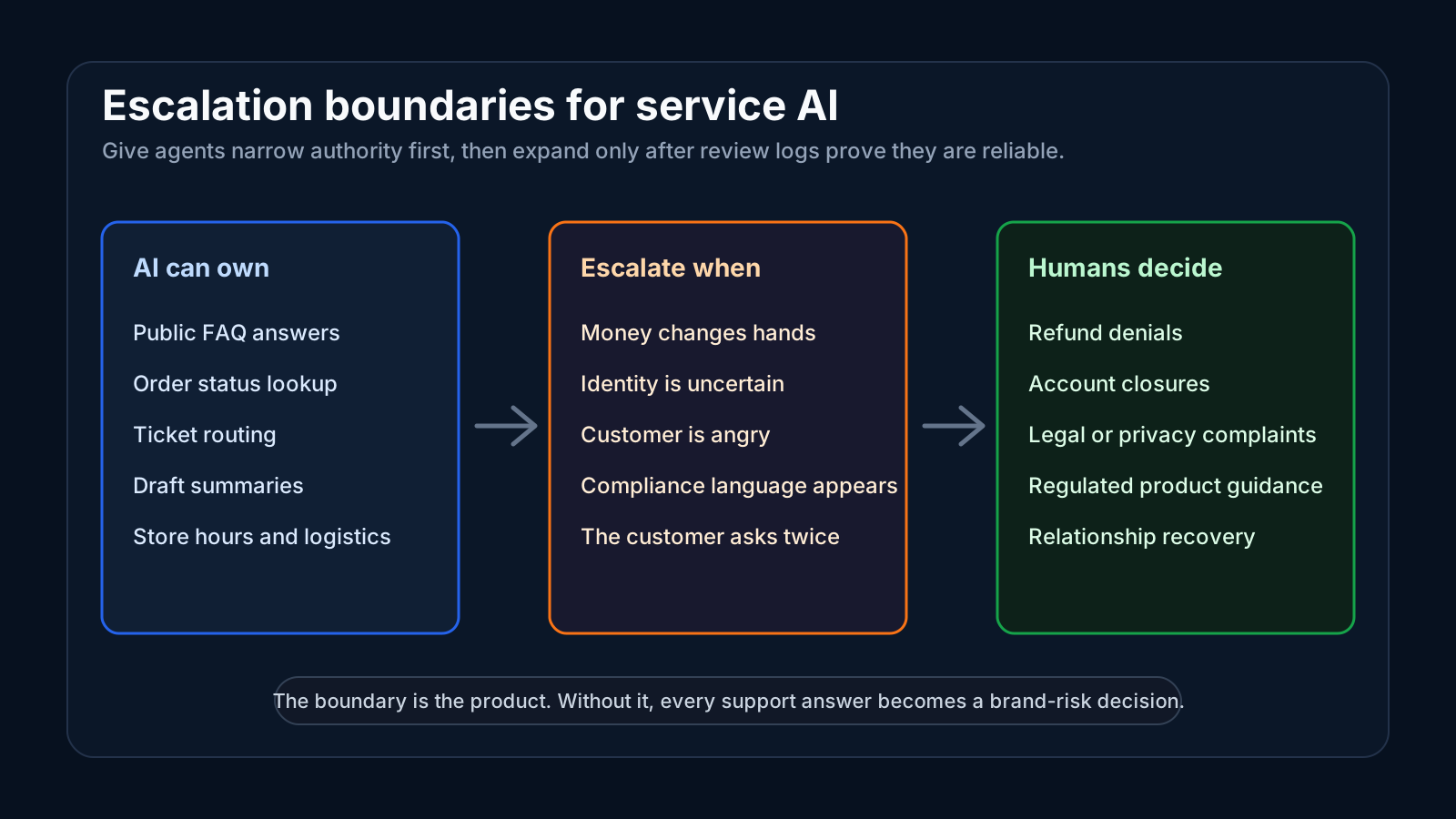
- 3Define hard escalation triggers. Route anything involving money, identity, legal threats, health language, regulated products, minors, account closure, angry sentiment, or repeated failure to a human.
- 4Write refusal and handoff language. The agent should not pretend to have authority it does not have. It should say when a person needs to review the case.
- 5Log source material and action history. Store the policy page, product record, prompt version, tool call, decision, and final customer-facing response.
- 6Review live conversations weekly. Pull samples by risk category, not just random volume. Your cleanest conversations are not where the danger lives.
- 7Measure recovery, not just containment. Track repeat contacts, refunds after AI interaction, negative review mentions, unsubscribe behavior, and human escalations that begin with "the chatbot said."
This is where many agent programs get uncomfortable. A proper audit often shows that the AI can safely answer fewer questions than the sales deck promised.
That is fine. Narrow authority is not failure. Narrow authority is how the system earns more authority later.
The operating model that actually works
The best customer service AI programs do not try to replace the support team. They make the support team faster by separating low-risk repetition from high-risk judgment.
Use AI for:
- Public FAQ answers linked to approved source pages
- Order-status lookup after identity confirmation
- Ticket routing and summary
- Store hours, availability, and appointment logistics
- Drafting internal notes for human review
- Surfacing relevant policy pages to representatives
Keep humans in control of:
- Refund denials and exceptions
- Regulated product guidance
- Account closures or access restrictions
- Emotional escalations
- Legal, privacy, or safety complaints
- Any customer who asks for a person twice
That shift also changes the metric set. Deflection rate still matters, but it is not the scoreboard. The better dashboard includes customer sentiment after AI contact, escalation quality, policy-source accuracy, repeat-contact rate, refund recovery, negative review language, and the percentage of AI answers tied to approved source material.
For cannabis operators, the same principle appears in agentic AI ROI measurement for cannabis and AI voice agent authentication risk. The automation only pays back if the brand can prove what happened, why it happened, and where the human boundary sat.
The real path forward
AI customer service agents can be useful. They are especially good at finding information, routing work, drafting summaries, and handling repetitive requests where the answer is public, current, and low stakes.
They become dangerous when they are asked to act like experienced judgment workers without the authority model, source control, and recovery process that experienced judgment workers need.
The right question is not, "How many tickets can the AI handle?"
The right question is, "Which customer moments are we comfortable letting software own under our name?"
Answer that first. Then build the agent.
Answer-engine visibility layer
Answer engines need a quotable control story, not another generic AI claim. For this topic, the clearest entities are AI customer service agents, escalation design, approved policy sources, refund authority, identity checks, and support recovery.
The page should make it easy for a human reviewer or AI answer engine to identify which support tasks are safe for automation, which cases require human review, and how customer-facing answers map to approved policy.
Editor's Note: For external alignment, anchor the governance language to FTC's AI enforcement guidance and keep the public page consistent with the internal approval file. For Sparksbox context, connect this article to AI voice authentication risk and agentic AI liability.
A useful source-of-truth record should include:
- tool permissions
- policy source
- escalation category
- customer risk level
- transcript log
- and recovery metric
This is the GEO layer most brands skip. If the public article names the entities, links to authoritative sources, and explains the control model in plain language, it is easier for AI search systems to cite the brand accurately instead of summarizing a regulator, a vendor, or a competitor.
Frequently asked questions
Yes. Disclosure reduces surprise and sets the right expectation. It also gives the customer a cleaner path to ask for a person when the issue is sensitive, emotional, or outside the AI's authority.
The safest tasks are narrow, source-based, and reversible: public FAQ answers, store hours, appointment logistics, ticket summaries, order-status lookups after identity checks, and routing. Money movement, refusals, regulated claims, account changes, and angry customers should have human review.
Regulated brands should keep the agent inside approved source material, log every customer-facing answer, define compliance escalation triggers, and review conversations by risk category. Cannabis brands should be especially careful with age verification, product language, loyalty offers, and individualized marketing communication.
Measure repeat contact after AI interaction, human escalation quality, refund recovery, negative review mentions, sentiment after AI contact, privacy complaints, source accuracy, and the percentage of AI answers grounded in approved policy or product pages.