In this postCollapse -Open +
For years, the worst thing a brand could find on Google was a bad review buried on page two of search results. It was there, but most people never saw it.
That math just flipped.
AI Overviews now appear in roughly half of all Google searches. They compress a brand's entire digital history, reviews, news coverage, forum threads, and old controversies into a single paragraph that sits at the top of the results page. And they have opinions.
New data from BrightEdge, the enterprise SEO platform used by 57 percent of the Fortune 500, analyzed hundreds of millions of AI-generated responses across three industries: apparel, electronics, and education. The findings are not subtle. Fortune covered the study in March.
Google AI Overviews surface negative brand sentiment 44 percent more often than ChatGPT. For every million queries, roughly 23,000 produce a negative brand response. Multiplied across three billion monthly users of AI search, the reach is no longer a rounding error.
What makes this harder to manage is that each engine has its own editorial personality. Google skews toward controversy. It pulls lawsuits, regulatory actions, data breaches, and product recalls into its summaries, even when those events are years old.
ChatGPT leans into product evaluation. It surfaces forum complaints, Reddit threads, and "is it worth it" style assessments. Same brand, same question, two different verdicts.
BrightEdge found that when both engines return negative sentiment about a brand in response to the same prompt, they are criticizing completely different brands 73 percent of the time. You cannot monitor one engine and assume the other is fine.
You cannot optimize for Google and expect it to translate to ChatGPT. Each engine is its own channel now, with its own sourcing, its own tone, and its own audience.
In this postCollapse -Open +
Two Engines, Two Verdicts
The BrightEdge data breaks the negativity into clean profiles.
Google AI Overviews surfaces negative sentiment in about 2.3 percent of brand mentions. ChatGPT comes in lower at 1.6 percent. Both numbers sound small until you remember scale.
Across billions of monthly searches, these fractions translate to millions of brand-negative exposures. And unlike a buried review that a user might scroll past, an AI-generated criticism sits at the top of the page, repeated every time someone asks a similar question.
The triggers are different. Google's negativity is overwhelmingly controversy-driven. Lawsuits, boycotts, regulatory enforcement, data breaches, and product recalls make up the bulk of what it surfaces.
ChatGPT is more likely to criticize a brand for feature gaps, compatibility problems, pricing complaints, or poor customer support. It acts more like a product reviewer than a news aggregator.
Industry matters too. In electronics, both engines show elevated negativity, with Google leading because of product recalls and tech controversies.
In education, Google is nearly twice as negative as ChatGPT, driven by institutional and political scrutiny. In apparel, the pattern reverses: ChatGPT is three times more negative because the category has fewer controversy triggers and more product-evaluation discussions sourced from forums and social media.
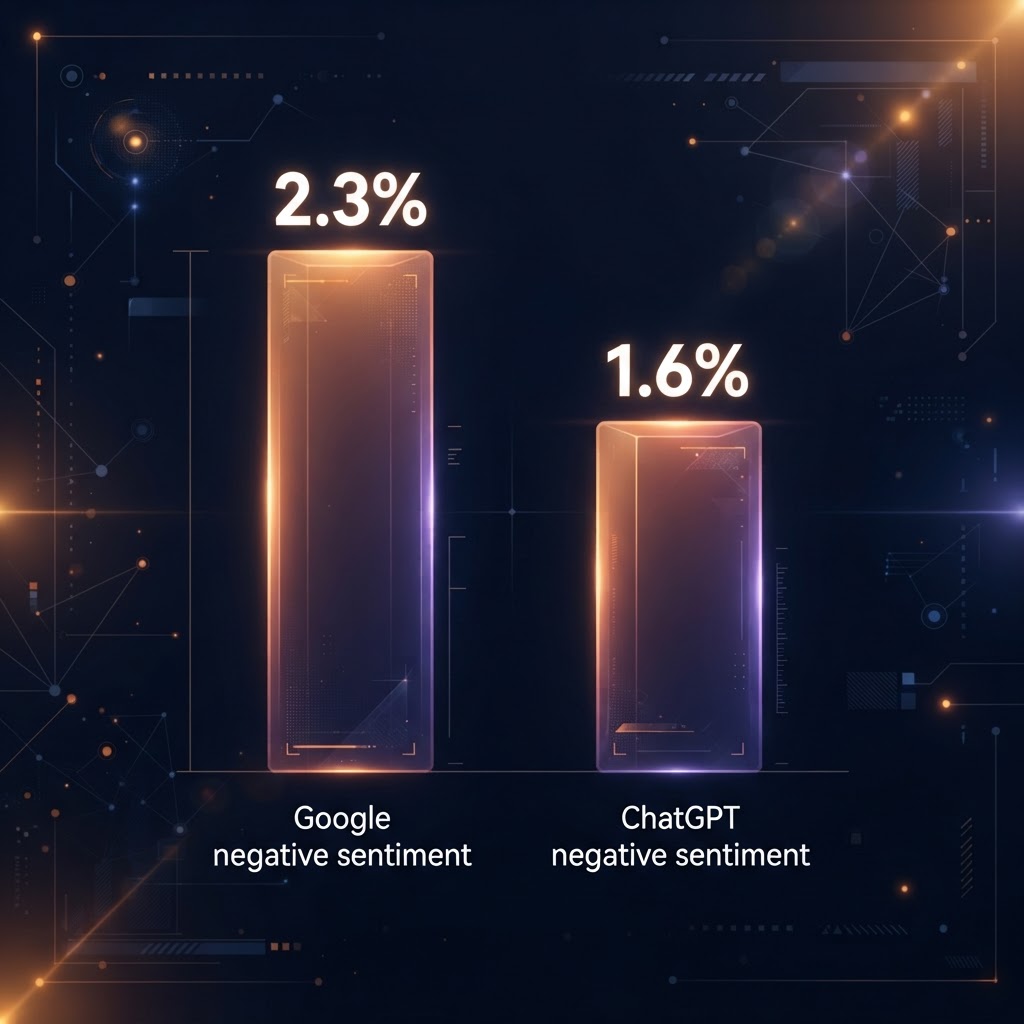
Each engine evaluates brands through fundamentally different source ecosystems
The Source Problem
The reason the engines disagree so often comes down to what they read.
Google AI Overviews pulls heavily from news sources, official statements, and regulatory filings. Its training data and real-time indexing prioritize recency and authority as Google has always defined it. But authority does not mean flattering.
A well-sourced news article about a lawsuit or a government enforcement action is exactly the kind of content Google's AI treats as high-quality. It gets summarized, compressed, and served to every user researching that brand.
ChatGPT draws from a different well. Its responses reflect product reviews, forum discussions, Reddit threads, and social media sentiment. It channels what actual buyers are saying, not what newsrooms are reporting.
This is why ChatGPT can praise a brand for product quality while simultaneously criticizing it for shipping delays or a confusing return policy. It is synthesizing user experience, not corporate reputation.
The practical problem for marketing teams is that neither engine cares about your brand's preferred narrative. Both are summarizing what the internet says about you, not what you say about yourself.
And the old SEO playbook of publishing more content to control the first page of results does not work when AI compresses everything into a single paragraph that may or may not include your own website as a source.
A separate BrightEdge analysis found that only 17 percent of AI Overview citations overlap with the traditional top 10 organic search results, down from 76 percent in mid-2024. The connection between ranking on page one of Google and appearing in AI-generated answers is weakening fast.
This is why agentic AI is destroying your brand safety rules, and the monitoring frameworks most teams rely on are not built for this reality.
Where It Hits the Wallet
The funnel analysis from BrightEdge reveals where each engine does its damage.
Eighty-five percent of Google's negative sentiment surfaces during informational queries, the research phase where opinions form and shortlists are created. A potential customer researching "best CRM for mid-size companies" might see your brand associated with a data breach from two years ago before they ever visit your website.
ChatGPT concentrates its criticism much closer to the point of purchase. While 68.5 percent of its negativity appears at the informational stage, a striking 19.4 percent surfaces during consideration-to-purchase queries. That is 13 times higher than Google's 1.5 percent at the same stage. Google gates the top of the funnel. ChatGPT kills conversions near the checkout.
For a chief marketing officer (CMO), the strategic implication is uncomfortable. You cannot allocate budget to a single AI reputation channel. You need separate monitoring, separate strategies, and separate content approaches for Google and ChatGPT, plus the growing list of other AI answer engines including Perplexity and Anthropic's Claude.
The brand visibility collapse in AI answer engines is already well documented. What the BrightEdge data adds is sentiment. Being invisible in AI search is bad. Being visible and negative is worse.
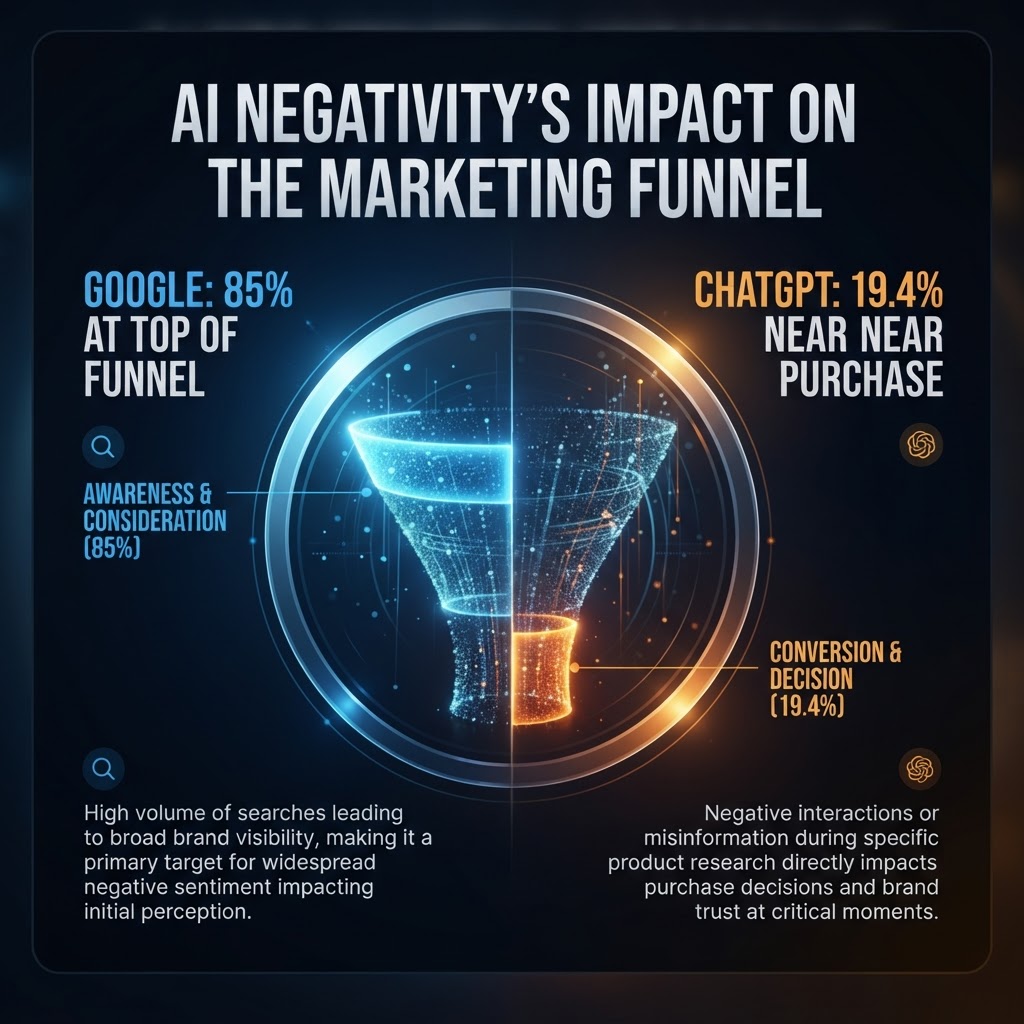
Google gates the top of the funnel. ChatGPT kills conversions near the checkout
The Fix Is Not More Content
The instinctive response to negative AI sentiment is to publish more positive content, flood the zone, and hope the engines pick up the good stuff. That instinct is wrong.
AI engines do not weigh content the way search rankings do. They synthesize across sources, looking for patterns and consensus.
Publishing ten blog posts about your great customer service does not offset a thousand one-star reviews on a third-party site. If anything, the mismatch between your content and third-party sentiment can make the AI's summary more skeptical, because it can see the contradiction.

Most marketing teams have no idea what AI engines are saying about their brand
Here is what actually moves the needle.
First, respond to negative reviews everywhere. Not just Google Business Profile and Yelp. Go to the forums, the subreddits, the niche review sites where your customers actually talk. AI engines crawl all of it.
A response that acknowledges the issue, explains what changed, and invites the reviewer to update their experience gives the AI more recent, more balanced material to work with. You are not just managing the reviewer. You are managing the training data.
Second, monitor AI sentiment specifically. Traditional brand monitoring tools track mentions, sentiment, and share of voice across news and social. Very few track what AI Overviews, ChatGPT, Perplexity, and Claude say about your brand.
This needs to become a dedicated function, not a side task for the SEO team. BrightEdge, Brandwatch, and a growing set of AI-specific monitoring tools are building this capability, but most brands are not using them yet.
Third, create content that answers the exact questions AI engines are pulling from. If your brand is getting criticized in AI Overviews for a product recall from 2019, write a page that directly addresses what happened, what you fixed, and what changed.
Make it the most comprehensive, honest answer on the internet. AI engines prefer to cite sources that directly answer the query rather than sources that dance around it.
Fourth, treat each AI engine as its own channel. Google needs controversy management and news-cycle awareness. ChatGPT needs review management and product-narrative consistency.
If your team only does one of these, you have a blind spot covering roughly half the AI search audience. SEO changed, and most teams are still optimizing for 2023.

Treating AI engines as separate channels is the new baseline for brand reputation
FAQ
Most standard SEO and social listening tools do not track AI-generated responses. You need to manually query Google and ChatGPT with brand-related prompts (product questions, comparison queries, reputation queries) on a regular cadence. Enterprise platforms like BrightEdge now offer AI sentiment monitoring, and several startups are building dedicated AI brand tracking tools. Start with manual queries across engines, document the results, and look for patterns before investing in software.
No. AI Overviews and ChatGPT synthesize publicly available information. Unless the underlying source content is factually incorrect and you can get it corrected or removed at the source level, the AI will continue to reference it. There is no "request removal" process for AI-generated summaries. The only sustainable fix is changing what the AI finds when it looks at your brand.
There is no industry standard yet, which is part of the problem. Start by assigning one person on the marketing team to own AI sentiment monitoring for 90 days. Track what they find, which engines are most problematic, and what actions produce measurable shifts. Use that data to make the case for a dedicated budget line. Most brands are underinvesting because they have not quantified the exposure.
Consumer brands with active review ecosystems and news coverage will be most affected because there is more source material for AI to pull from. But B2B brands are not immune. Enterprise software companies regularly face detailed product critiques in forums and on Reddit, and those discussions are exactly what ChatGPT surfaces during evaluation-stage queries. If people are talking about your brand online, AI is summarizing it.
Fast. AI Overviews appeared in roughly 6 percent of Google searches in early 2025. By mid-2026 they appear in close to half. Gartner projects they will reach more than 50 percent of queries by the end of 2027, with a corresponding 25 percent decline in traditional organic traffic. Every month that passes without an AI sentiment strategy is a month where more of your potential customers are forming opinions based on AI summaries you are not monitoring.
AI visibility measures whether your brand appears in AI-generated responses at all. AI sentiment measures what the response actually says about you. Both matter, but sentiment is the metric most teams are ignoring. A brand can have high AI visibility and still lose customers if the AI is systematically surfacing negative information. This is why AI copywriting flattens brand voice and why monitoring tone, not just presence, is the new baseline. The uncomfortable reality is that AI has become an editorial layer between your brand and your customers. It has opinions. It has preferences. It has source biases. And it answers millions of brand-related questions every day without any input from the brands being discussed. The CMOs who treat this as a search problem will keep optimizing for rankings and watching their AI sentiment degrade. The ones who treat it as a reputation problem will build the monitoring, response, and content infrastructure to manage how AI talks about their brand. The gap between those two approaches is where market share moves next.