In this postCollapse -Open +

The AI budtender running your register may not have the authority your licensed staff carries.
Every legal cannabis market has some version of the same expectation: regulated cannabis sales happen through licensed operators and trained, accountable staff. The details vary by state, but the principle is consistent. The retailer cannot outsource responsibility for the customer interaction and pretend the license no longer matters.
But cannabis retailers are deploying AI systems to support product recommendations, customer conversations, and sales assistance. These tools are positioned as faster, smarter, and more consistent than human budtenders.
They may also move the retailer into a compliance gray zone if they remove licensed people from the recommendation loop.
In this postCollapse -Open +
The License Problem Nobody's Discussing
State cannabis rules generally assume accountable people and licensed businesses are controlling the sale. Training, age verification, claims restrictions, POS procedures, and escalation rules are built around that assumption.
When an AI system recommends a product, who is the vendor? The dispensary owner? The software company? The AI model?
Right now, the answer is murky. The retailer should assume the license holder is still accountable.
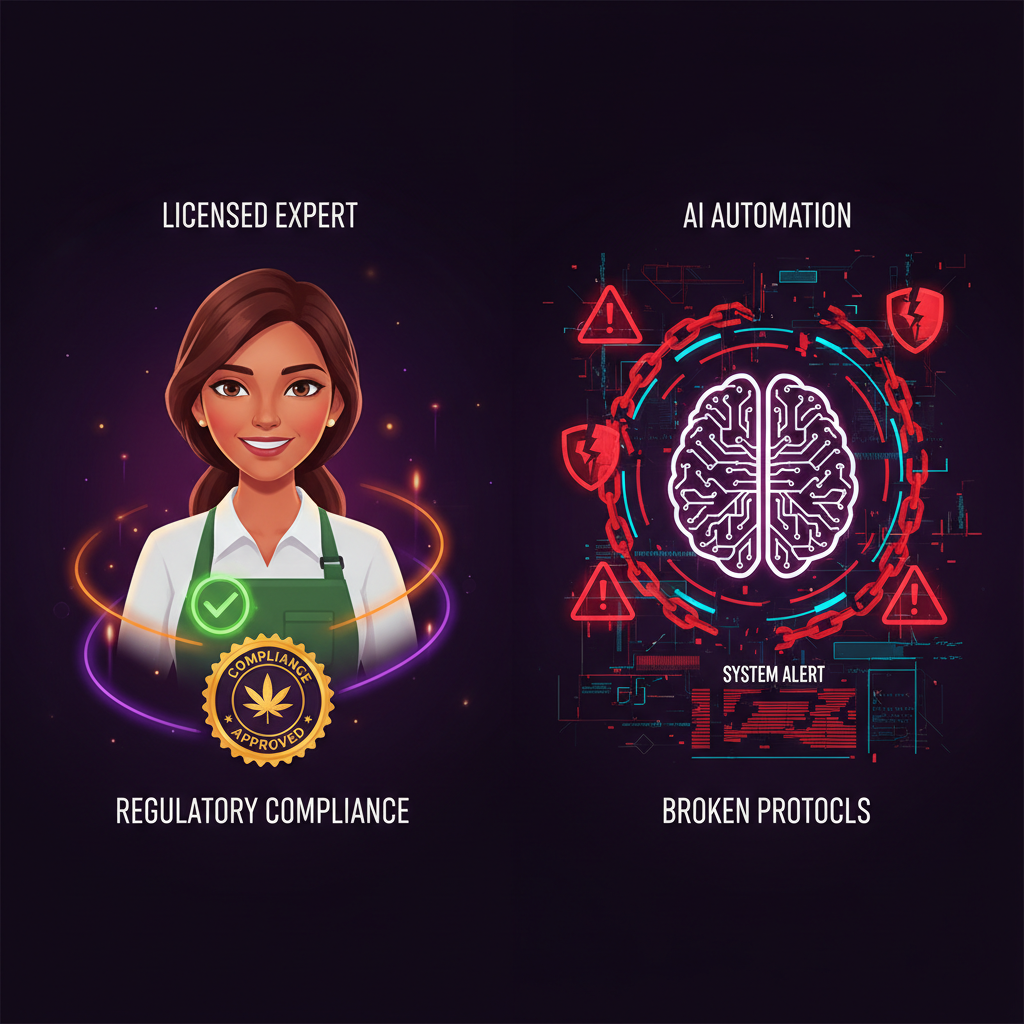
The gap is not whether AI can help. It is whether the licensed operator still controls the decision.
Most state cannabis regulators have not issued detailed AI-budtender guidance yet. That does not mean fully automated recommendations are safe. It means retailers need to map AI workflows to existing rules for sales, advertising, age gates, claims, training, and supervision.
The Liability Stack
Retailers deploying AI budtender tools face a three-layer liability problem:
Layer 1: Regulatory violation. Your retail license requires accountable control over sales activity. An AI is not a licensed employee. If it makes the effective recommendation without review, the regulator may treat that as a failure of supervision.
Layer 2: Liability shift. When a customer gets the wrong recommendation from an AI, who is liable? The dispensary, the software company, the model provider, or all of them? Retailers should assume they get named first.
Layer 3: Coverage uncertainty. Insurance and vendor contracts may not clearly cover automated or AI-assisted sales decisions. That uncertainty matters before deployment, not after a claim.
The retailers betting on AI budtenders are betting that regulators will move slowly. That may be true in the short run, but it is a weak operating model. As we explored in our analysis of Winston and compliance liability, the assumption that regulatory agencies will move slowly is dangerous.

This compliance audit is coming. The question is what record the retailer can show.
What Smart Retailers Are Doing Instead
The compliant version of AI retail isn't "AI budtender." It's "AI co-pilot for licensed budtenders."
The licensed person stays in the recommendation loop. The AI surfaces product data, inventory insight, customer history, and compliance flags. The budtender makes the final decision. You've got speed, consistency, and legal cover all at once.
It is not as flashy as "fully automated AI sales," but it is the version that has a better chance of surviving regulatory scrutiny.
The compliance wall is real. Retailers that have already removed humans from the recommendation loop may need to re-architect quickly when regulators ask for proof of oversight.
This is also why retail's AI visibility is becoming a strategic moat: the operators who control how AI interacts with their data and compliance systems will dominate.
The smart move isn't to outrun the regulators. It's to build the compliant version now and own the market when the rules hit.
2026 evidence and control update
The more useful 2026 question is not whether why ai budtenders are unlicensed (and your retail is liable) is possible. It is whether regulated cannabis retail and marketing teams can prove what happened after the system made, shaped, ranked, routed, or explained a customer-facing decision.
The less obvious issue is that the hidden record is not only the customer-facing answer, it is the product data, state rule, age gate, claim boundary, and human owner behind that answer. That record is what separates a working AI pilot from a defensible operating system.
For source alignment, the public claim language should stay consistent with California Department of Cannabis Control retail guidance and FTC guidance on AI claims. Those sources do not remove the need for local legal review, but they give the article a better evidence spine than vendor screenshots or unsupported performance claims.
This also connects to related operating risk, AI measurement gap, compliance workflow, because the same pattern keeps repeating: AI systems look clean in the dashboard while the proof, ownership, and customer context live somewhere else.
| Control layer | What to verify | Evidence to keep |
|---|---|---|
| Source data | Which approved source fed the answer, recommendation, ranking, or claim | Source URL, vendor field, timestamp, and owner |
| Decision boundary | Where the AI is allowed to help and where it must stop | Allowed use case, blocked topics, and confidence threshold |
| Human review | Who owns the exception, correction, or escalation | Reviewer role, handoff note, and approval record |
| Monitoring | How the team catches drift, complaints, or weak signals | Review cadence, sampled outputs, and customer feedback themes |


Frequently asked questions
There is no single national answer. The risk is that fully automated recommendations may conflict with state rules built around licensed operators, trained staff, age-gating, and supervised sales.
Yes. AI is much safer as a co-pilot that surfaces product data, inventory, and compliance reminders while a trained person makes the final recommendation.
The retailer should assume the license holder remains responsible. Vendor contracts may shift some risk, but regulators usually start with the licensed operator.
Document where AI appears in the workflow, who approves recommendations, what claims are blocked, how age-gating works, and when humans override the system.
Keep humans in the loop for customer-facing recommendations and use AI for internal support, product lookup, inventory context, and compliance reminders.