Cannabis retailers love a shortcut. So when Winston, a new AI platform built specifically for cannabis retail, arrived with promises of faster operations and smarter workflows, the industry took notice.
The problem: adopting AI in cannabis retail isn't like adopting Slack. Every AI-generated recommendation, every chatbot response, every inventory prediction carries regulatory weight. And most cannabis retailers have no idea.
The Winston Moment
Treez, a cannabis retail software company, positioned Winston as an AI teammate for cannabis operators. The pitch is solid. Retailers can get:
- Inventory and operations support
- Customer service assistance
- Promotion and ecommerce workflow help
- Reporting, payroll, and task coordination
What they don't get: clarity on who's liable when the AI breaks a state compliance rule.
Cannabis remains federally Schedule I as of June 27, 2026, while federal rescheduling remains proposed but not final. State-level regulations are still the daily enforcement mechanism. California, Colorado, Illinois, Massachusetts, and every other market have their own rulebook on claims, age verification, advertising, product data, and customer information.
Generic AI does not know state cannabis law unless the operator designs, configures, and audits it for that jurisdiction. A model may see "customer likes this category" and recommend accordingly. The retailer still has to prevent health claims, age-gate gaps, privacy issues, and state-specific recommendation problems.
The Liability Gap
Here's where it gets dark: retail operators are exposed for AI decisions made in their name.
If a Winston chatbot recommends a product to someone underage (failed age verification), the retailer gets cited. If an AI system stores customer purchase history in a way that violates state privacy law, the retailer pays the fine. If recommendations breach state claims rules, the state's cannabis regulator issues a violation.
The enforcement logic already exists. Regulators care about unsubstantiated claims, age-gating, privacy, and truthful advertising. AI does not change that. It only changes the scale and speed of the possible mistake.
Why Retailers Can't Wait to Use AI (Even Though They Should)
The pressure is real. Cannabis retail margins are thin. Labor costs are high. Inventory management is complex: different product types, batch tracking, state-mandated track-and-trace systems, expiration dates, and customer preferences all colliding at once.
AI promises to solve this. Faster transactions. Fewer staffing errors. Smarter recommendations that drive customer lifetime value.
But here's the trap: AI solves operational problems, not compliance problems. A well-trained staff member asking "are you 21?" can do a compliance check. A chatbot asking "are you 21?" can fail if it doesn't geo-verify, ID-verify, and create an audit trail for regulators to review.
This is the Winston moment the industry hasn't grappled with yet. The tool works. But the liability follows.
What Retailers Should Actually Do
If you're running a cannabis retail operation and you're eyeing Winston or similar AI tools, here's the framework:
- 1Audit your state's cannabis regulations first. Not your corporate compliance team's interpretation, the actual regulatory text. Especially rules around age verification requirements, medical and health claim restrictions, customer data retention, privacy rules, and recommendation frameworks.
- 1Map every AI touchpoint to a compliance risk. Chatbot recommendations? Risk. Inventory forecasting? Maybe fine. Customer email collection for marketing? Risk.
- 1Get legal review before deployment. This is not optional. A small review before launch is cheaper than defending an avoidable compliance failure afterward.
- 1Build an audit trail. If you're using AI for customer recommendations, you need to log what the AI recommended, why, and prove you have human oversight. Some retailers are building this, most aren't.
- 1Assume liability defaults to you. Your platform vendor (Treez, whoever) has a liability waiver in their terms of service. You don't. So act accordingly.
The Real Risk
The biggest risk is not that AI will break rules once. It is that AI can break rules consistently, at scale, and retailers may not notice until the regulator shows up.
A human budtender makes a recommendation mistake. It affects one customer. An AI system makes a recommendation mistake. It affects 1,000 customers. If that mistake violates state law, you've got 1,000 compliance violations, not one.
That's why the industry's race to adopt Winston, ChatGPT, Claude, and other tools feels premature. The tools work. But the guardrails haven't caught up.
The Real Decision
AI in cannabis retail is not only about whether to adopt. It is about whether you can afford to adopt without building compliance infrastructure first. Many retailers cannot. So before you sign up for Winston or any AI retail tool, answer this: can you explain to your state's cannabis regulator exactly how your AI system complies with every rule in their code?
If you can't, the shortcut isn't worth it. Not yet.
---
*See also:* Cannabis AI Retail: The Compliance Blindspot and Why AI Budtenders Are Unlicensed
2026 evidence and control update
The more useful 2026 question is not whether why cannabis retailers are racing to adopt ai tools (but shouldn't) is possible. It is whether regulated cannabis retail and marketing teams can prove what happened after the system made, shaped, ranked, routed, or explained a customer-facing decision.
The less obvious issue is that the hidden record is not only the customer-facing answer, it is the product data, state rule, age gate, claim boundary, and human owner behind that answer. That record is what separates a working AI pilot from a defensible operating system.
For source alignment, the public claim language should stay consistent with California Department of Cannabis Control retail guidance and FTC guidance on AI claims. Those sources do not remove the need for local legal review, but they give the article a better evidence spine than vendor screenshots or unsupported performance claims.
This also connects to related operating risk, AI measurement gap, compliance workflow, because the same pattern keeps repeating: AI systems look clean in the dashboard while the proof, ownership, and customer context live somewhere else.
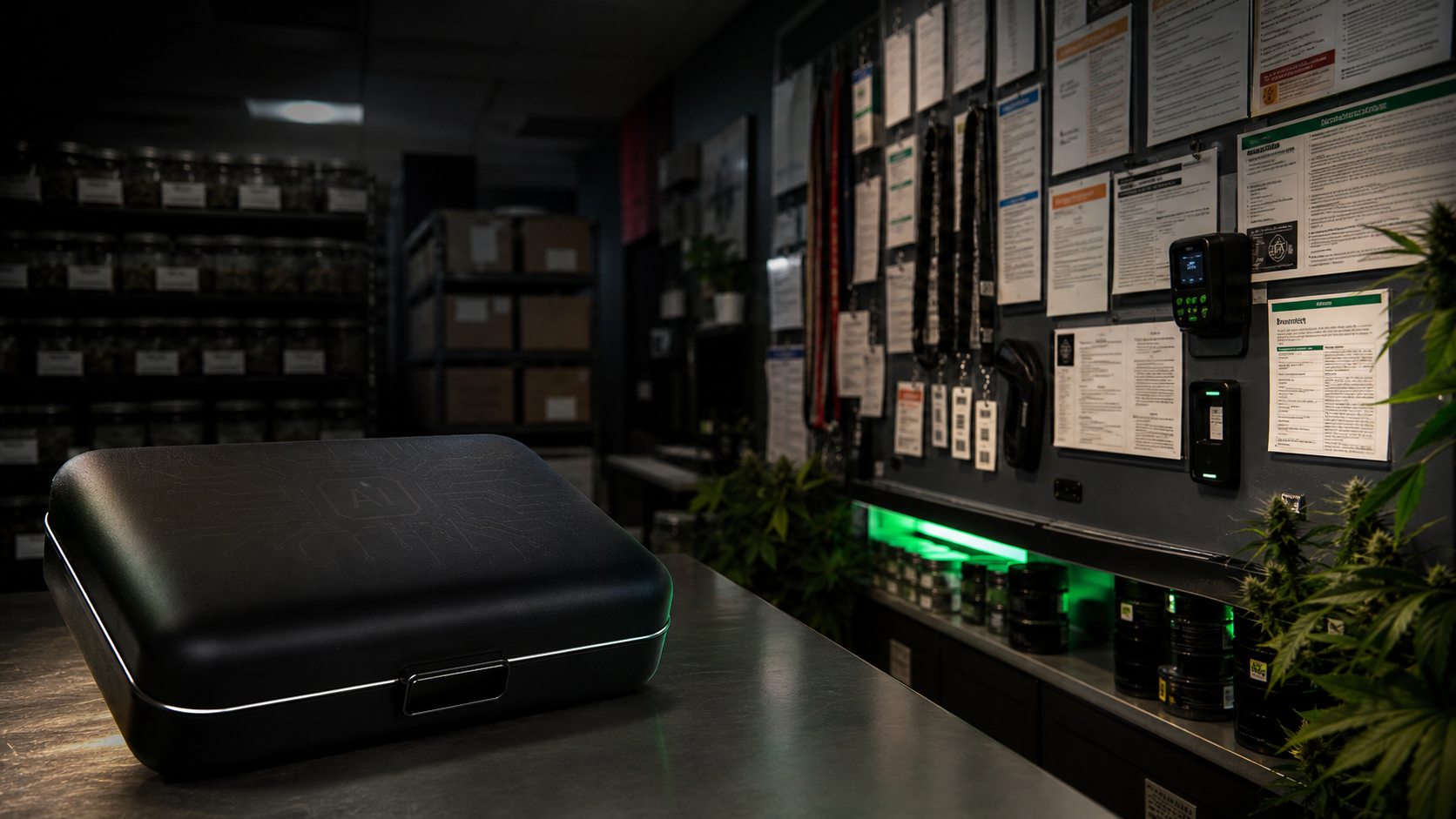
The cover image is reused here as an inline visual so the article has a concrete visual anchor, not only a hero background.
| Control layer | What to verify | Evidence to keep |
|---|---|---|
| Source data | Which approved source fed the answer, recommendation, ranking, or claim | Source URL, vendor field, timestamp, and owner |
| Decision boundary | Where the AI is allowed to help and where it must stop | Allowed use case, blocked topics, and confidence threshold |
| Human review | Who owns the exception, correction, or escalation | Reviewer role, handoff note, and approval record |
| Monitoring | How the team catches drift, complaints, or weak signals | Review cadence, sampled outputs, and customer feedback themes |


Frequently asked questions
They are trying to reduce operational friction in inventory, staffing, ecommerce, customer service, and reporting. The business pressure is real.
The tool can act faster than the retailer's compliance controls. If an AI output causes an age-gate, claims, privacy, or recommendation issue, the retailer still owns the licensed operation.
No. The risk depends on how a retailer configures, approves, monitors, and logs the tool. A compliant workflow can still be built around AI assistance.
Legal review, state-by-state rule mapping, human approval gates, vendor term review, logging, and a rollback plan.
Internal operations support is usually lower risk than customer-facing product recommendations, age-gated chat, or claims-related content.