Resemble AI, a Mountain View company that sells synthetic media detection software, published its 2026 Synthetic Advertising Report on October 22, 2026. The team scanned 37,768 image and video files from Facebook and Instagram ads collected from Meta's public Ad Library in September 2026, covering 509 companies in 26 industries.
It flagged 3,379 files as AI generated or manipulated. That is 8.9 percent, roughly one file in 11.
Two of those 3,379 files mentioned AI anywhere in their ad copy. That is 0.06 percent. None of the 971 files checked for provenance metadata carried any content credentials at all.
Read those three numbers together and the story changes. This is not one disclosure failure. It is three, stacked on top of each other, and each one needs a different fix.
The copy layer fails because almost nobody writes the disclosure down. The file layer fails because the files carry no machine readable proof of how they were made. The on screen layer is mostly unmeasured, because a copy search cannot see a label burned into a video.
An agency that fixes only the copy line will still ship files with no provenance and no visible label. An agency that fixes only the file metadata will still leave viewers reading a photoreal face with no warning on screen.
The audit, read straight
Start with what the scan actually measured, because the headline rate hides the shape of it. On brands' own pages, 1,971 of 28,463 files were flagged, a rate of 6.9 percent. More than half of the 389 brands with their own page files, 222 of them, ran at least one AI file.
At the same time, 167 brands ran none. Use is spread thin across many advertisers and concentrated in a few. Temu used AI in 64 of 100 sampled files, Wayfair in 56 of 100, Motel 6 in 50 of 80, and Lufthansa in 50 of 94.
Pages brands do not control tell a different story. Other advertisers, meaning retailers, affiliates, and creators who matched a brand name search, came in at 11.0 percent. Bait pages, meaning clickbait, search arbitrage, and scam pages that use a brand's name as a lure, ran 649 files, and 71.3 percent of them were flagged.
Bait pages made up 2 percent of all files and 14 percent of all fakes. Your own creative is only part of your exposure. The rest runs under your name on pages you never approved.
What the flagged files showed matters more than the rate. Of the 3,216 labelled fakes, 70 percent were photoreal, built to pass as a real photograph or real video. Nearly half, 46 percent, depicted a person.
The most common subjects were a realistic model at 26.1 percent, a product shot at 23.6 percent, and a scene or place at 14.6 percent. A selfie style person came in at 4.6 percent, small as a share and large as a risk, because a selfie style clip reads as a real customer talking about a real experience.
Industry rates follow the same pattern. Consumer packaged goods led at 13.4 percent, followed by consumer electronics at 12.6 percent. The regulated categories sat at the bottom: insurance at 5.0 percent, banking and financial services at 3.8 percent, nonprofits at 3.3 percent, and pharmaceuticals and health at 2.8 percent.
Categories built on product and lifestyle imagery use synthetic media the most. Categories with a compliance team watching use it the least, or at least use it more carefully.
Company size did not explain the pattern. AI rates stayed between 6 percent and 9 percent at every size, from companies with under 1,000 employees to companies with over 100,000. The report puts it plainly: AI use is not a resourcing story. A small team and a large team face the same disclosure question, and the large team has no excuse the small team lacks.

An audit that counts only your own page misses the pages running under your name.
Read the limits before you quote the rate
A vendor audit deserves a vendor audit. Every verdict in this report comes from Resemble Detect, Resemble's own detection product. The report publishes no false positive rate, no false negative rate, and no score threshold for a fake verdict.
Its examples range from 99.9 percent down to a 68.7 percent audio score, all counted as fakes. Treat the rates as a floor, not a verdict on any single file.
Three more limits shape how far the numbers travel. The study has no impression, reach, or spend data, so a file seen by ten million people counts the same as a file seen by a thousand. The main collection was scanned for visuals only, so a real video with a generated voiceover reads as authentic unless it sat in the betting and crypto set, the only set that got an audio scan.
And the headline totals do not fully reconcile: the executive summary heading refers to 37,786 files while every other page uses 37,768, and one chart sums to 37,540 files and 3,358 fakes against 3,379 overall. Those gaps are small next to the totals, and they do not erase the disclosure gap. They do mean a careful operator quotes the audit as evidence of a pattern, not as a precise count of any one brand's sins.
The report also contains no response from any of the brands it names, apart from Kalshi, and no comment from Meta. That absence is worth naming in client conversations, because a detector score is not a finding of wrongdoing. It is a reason to check a file, not a reason to accuse a competitor.
Copy is the weakest layer
Only one brand disclosed on its own ad in a way the report could name. Turkish Airlines, in an International Cat Day video for its Touristanbul programme, ended its copy with a footnote saying the visuals were created using artificial intelligence technology.
The note sat below the caption, after the hashtags in most feeds, according to the report. Resemble does not identify the second disclosing file.
A footnote after the hashtags is disclosure in the narrowest technical sense and invisibility in every practical sense. Nobody reads past the hashtags to learn how a video was made. A disclosure that arrives after the viewer has already believed the face is not a disclosure. It is a receipt filed where nobody looks.
The copy search has one more blind spot, and the report states it plainly. A copy search cannot see a label burned into the video itself. Resemble checked on screen labels for one advertiser only, Kalshi, and found that seven of eight AI made presenters in Kalshi's ads showed an on screen AI notice. The 0.06 percent figure is therefore a measure of written disclosure in ad copy.
How many of the other flagged files carried a visual label is not known. That unknown cuts both ways. It means the true disclosure rate is higher than 0.06 percent. It also means nobody can prove by how much, because nobody checked.
A disclosure after the hashtags is a receipt filed where nobody looks.
Metadata is empty
Provenance metadata told a starker story than copy. None of the 971 files checked carried C2PA content credentials. C2PA stands for the Coalition for Content Provenance and Authenticity, the industry standard for recording how a file was made. That includes every confirmed fake in the checked set.
The report does not say whether Meta preserves such metadata when it processes uploaded creative, which would decide whether the absence reflects what advertisers uploaded or what the platform served. Nor does it say whether Meta attached any AI label of its own to the flagged ads. Meta has had an AI labelling policy since 2024, when it said it would apply a Made with AI label to AI generated or significantly altered video, images, and audio, and in July 2026 it signed the European Union's Code of Practice on Transparency of AI Generated Content.
Google took a more visible route for ads on July 9, 2026, when it added a How this ad was made panel to My Ad Center across Search, YouTube, and Discover ads. Ads made with Google's own generative tools are disclosed automatically. Ads made with outside tools rely on a manual advertiser control.
For an operator, the platform question is secondary. If your file carries no credentials at export, no platform can read them at serving time, and no viewer can verify them later.
Provenance has to be set when the file is made, by the tool that made it, and preserved through every edit and compression step. A file that loses its history in export is a file you cannot defend later, even if the creative was honest.
The generated person is the risk
Not every AI file carries the same risk, and the report's most useful distinction is the one between a synthetic person and a synthetic backdrop. Resemble published four brand examples of testimonial style creative flagged with high confidence: a telehealth patient in a waiting room for Teladoc at 99.9 percent, a phone chat video for MoneyLion at 99.8 percent, a driver's selfie testimonial for a cash advance for Dave at 99 percent, and a selfie video for a tinted serum for Tarte Cosmetics at 99.9 percent.
Those are detector scores, not findings of wrongdoing, and the report includes no response from any of the four companies. It also does not say whether any of the clips carried an on screen label.
The reason those four matter is the format, not the score. A testimonial clip borrows the trust of a real customer. A viewer who believes the person believes the claim. A product shot made with AI misleads about a product. A fake customer misleads about other people. That is a different harm, and it is the harm the new rules are written around.
The Kalshi case shows the second half of the problem. On September 23, 2026, YouTuber Elliot Choy saw a Kalshi ad built from his 2025 apartment move video. The script, the room, and the framing matched his.
The man on screen did not: AI had replaced Choy with a man who does not exist. Kalshi told NPR the ad was old, that it no longer runs AI generated ads, and that it was reviewing its relationship with the agency that made it. The report's own scan of Kalshi's active United States ads on September 24 found eight AI made presenters, seven of them with on screen AI notices.
The report draws the line cleanly here. A label would have told viewers the Kalshi ad was generated. It would not have asked Choy before his video was used. Disclosure and consent are different duties. A label answers the viewer. Consent answers the person whose face, voice, or work was taken. An operator needs both, and a label never substitutes for permission.

A selfie style clip borrows the trust of a real customer, which is why it carries the highest disclosure duty.
The Interactive Advertising Bureau's AI Transparency and Disclosure Framework, version two, issued on August 18, 2026, draws the same line in industry terms. It requires disclosure for synthetic voices of living or deceased people and for photorealistic AI influencers, and it exempts generic synthetic voiceovers and background music. Under that framework, a generic voiceover describing a scene, the kind the report describes as an editing technique in the betting and crypto audio files, would not require a label.
A synthetic voice presented as a real person would. That distinction is the triage rule for every file in your library.
The triage, drawn
Use three questions at creation, before the file reaches an ad account. The answers decide the label, and the label decides the workflow.
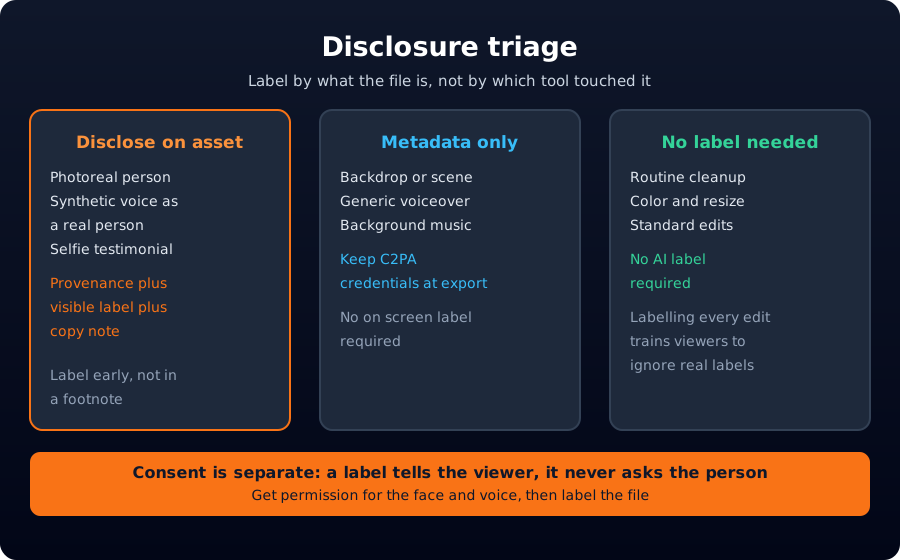
The first question is whether a viewer would take a person in the file for real. If yes, the file gets all three layers: provenance at export, a visible label on the asset itself, and a copy note where the law requires it. The label goes on the asset early, in the first seconds of a video, not in a footnote after the hashtags.
The second question is whether the AI work is a backdrop, a scene, a generic voiceover, or background music. If yes, provenance at export is enough, with no on screen label required under the framework. Keep the provenance anyway, because a backdrop today can be cropped into a testimonial tomorrow.
The third question is whether the AI work is a routine edit: cleanup, color, resize, or a standard post production pass. If yes, no AI label is needed. The framework exempts routine post production edits, and labelling every touched file would train viewers to ignore the labels that matter.
Write the answers into a disclosure log at creation: file name, tool used, triage answer, label applied, and date. That log is the document that answers a client, a regulator, or a reporter. It is also the document that decides who carries the blame.
An IAB Austria guide published in September 2026 concluded that the agency using the AI tool is normally the responsible deployer, not the client. If your agency made the file, your agency owns the label.
The three layer fix
A disclosure system has four jobs, and they run in order.
Inventory first. Pull every live file, including work produced by agencies and partners, affiliates, and creators running under your name. The audit found the highest rates where brands have the least control, so an inventory that covers only your own page is an inventory of the safest third of the problem. Search your brand name in the Ad Library the way Resemble did, and keep the bait page sweep on a monthly cadence.
When you find an impersonator file, report it and keep the report. Meta said in December 2025 that it removed more than 134 million scam ads during 2025, and a Frankfurt court ordered Meta in September 2026 to stop distributing fake Finanzfluss ads, with fines of up to 250,000 euros per future violation. Takedown works when the record is kept.
Tag second, at creation, using the triage above. Tagging after launch is archaeology. Tagging at creation is a field in the production template, next to the file name and the usage rights.
Export third, with provenance intact. Use tools that embed C2PA credentials, keep the original file, and check that the credentials survive the platform upload. If the platform strips them, record that fact, because it changes what you can claim about the file later.
Label fourth, on the asset where a generated person is involved, early and visible, plus a copy note where New York or European Union rules require it. New York's synthetic performer disclosure law has applied since June 9, 2026, and it requires conspicuous disclosure of a synthetic performer the advertiser knows about. Article 50 of the European Union AI Act has applied since August 2, 2026, with machine readable marking and visible labels on deepfakes.
Most rules in the report's jurisdiction table cover generated people, not AI music, voices, or scenery, and most put the duty on the advertiser rather than the platform. We covered the contract side of that duty last week, when Meta made advertisers solely responsible for its AI ad edits. This is the creative side of the same duty: you own what your own AI makes, too.
The click cost, priced honestly
Brands stay quiet for a reason the report does not hide. The Interactive Advertising Bureau framework cites New York University Stern research finding that adding an AI disclosure reduced click through rate by 31.5 percent. That number explains the silence better than any theory about laziness. A label costs clicks, and nobody volunteers for a 31.5 percent cut.
Hiding the label costs more, just in a different currency. New York's rule carries fines of 1,000 dollars for a first violation and 5,000 dollars for subsequent ones. European Union fines reach 15 million euros or 3 percent of worldwide annual turnover, whichever is higher.
For most brands, the larger cost is not the fine. It is the takedown, the press story, and the customer who stops believing the next real testimonial because the last one turned out to be generated. Trust is already the tax on AI content, and an undisclosed fake customer spends it faster than any other format.
The honest response is not to hide the label better. It is to design the label into the creative so it costs less. Put the disclosure in the opening seconds, in the same voice as the ad, as part of the story rather than as a warning stapled to the end.
Test label placement the way you test a headline, and measure downstream conversion, not just the click. A disclosed ad that converts a believing customer is worth more than an undisclosed ad that converts a deceived one and loses them on the second order. If the disclosed version truly cannot convert, that is information about the creative, not a reason to remove the label.
What to watch next
Five dates and one open question, in the order they will bite.
First, December 2, 2026, the deadline for generative AI systems already on the European Union market to meet Article 50 marking rules. Files made before that date do not get a free pass in practice, because the ads running in December will still need visible labels where they show deepfakes.
Second, November 20, 2026, when Meta's revised commercial terms take effect after the delay from October 30. The terms fight is about contract scope, not creative disclosure, but it sets the same pattern: the platform writes the contract, the advertiser carries the risk.
Third, Resemble's follow up, focused on user generated content and influencer content, with no date given. That report will test the exact format this post flags as highest risk, the selfie style testimonial, at larger scale.
Fourth, Denmark's bill tabled on October 8, 2026, which would require publishers to prove consent before releasing realistic digital imitations of a person from January 1, 2027, if passed. Consent, not just disclosure, is moving into law.
Fifth, the open question the report leaves unanswered: whether Meta attaches its own AI label to flagged ads, and whether platforms will start checking C2PA credentials at upload. Resemble proposes that advertisers select an AI disclosure at upload, the way political advertisers already declare digitally altered media, and argues that waiting for advertisers to volunteer has not worked. The audit is the evidence for that sentence.
Your move this week is small and unglamorous. Pull the live file list, tag every photoreal person, and put a visible label on the ones that need it. Do the bait page sweep while you are there. The brands that do that work now will not need to explain a detector score later. The brands that wait will explain it to someone else, on someone else's schedule.
Frequently asked questions
No. The duty follows what the file shows, not whether a tool touched it. A photoreal person, a synthetic voice presented as a real person, or a photorealistic AI influencer needs disclosure. A generic voiceover, a backdrop, background music, or a routine post production edit does not need an on screen label under the Interactive Advertising Bureau framework, though provenance at export is still worth keeping.
A person in an ad who was generated or materially altered by AI and who a viewer would take for real. That includes a fully generated model, a real person's face or voice replaced or altered, and a selfie style testimonial performed by a generated person. A stylised illustration nobody would take for a photograph is a different case, and the report counts only about one in nine flagged files as obviously AI.
It counts as written disclosure in the narrowest sense, and it fails in practice when it sits after the hashtags, where viewers do not read. New York requires conspicuous disclosure of a synthetic performer. A note nobody sees before believing the face is not conspicuous. Put the label on the asset itself, early in a video, and keep the copy note as a second layer, not the only one.
C2PA stands for the Coalition for Content Provenance and Authenticity. Its content credentials record how a file was made, in a form platforms and viewers can check. Zero of 971 checked files carried any credentials, which means the file layer of disclosure is empty across the sample. Without credentials at export, no platform label at serving time and no viewer check later can recover the file's history.
In practice, the party that made or deployed the ad. An IAB Austria guide published in September 2026 concluded that the agency using the AI tool is normally the responsible deployer, not the client. Most jurisdiction rules in the report put the duty on the advertiser rather than the platform. Keep a disclosure log at creation, with the file, the tool, the triage answer, and the label applied, so responsibility is documented instead of argued later.
They count against your brand with viewers, even though you did not make them. Bait pages ran 71.3 percent flagged files in the audit, using brand names as lures. Search your brand name in the Ad Library on a monthly cadence, report impersonator files, and keep the reports. A takedown record is the difference between a brand that was impersonated and a brand that looked away.