
On October 30, 2026, Google, Microsoft, OpenAI, and Anthropic backed one shared way to say no to AI training. Add a small group to robots.txt, name a policy token instead of a crawler, and every participating company reads it the same way.
The news coverage called it simple. It is not simple. It is three decisions wearing one line of code, and the wrong blanket version can cost you the AI citations you spent the year chasing.
So here is the direct answer. Do not copy the blanket line and move on. Decide training, grounding, and search separately, section by section, before Bing starts honoring the new signal on February 1, 2027. Training is about future models learning from your pages. Grounding is about live AI answers citing your pages today.
Search is about rankings and about AI Overviews and AI Mode, and it has its own control entirely. At Google, the shared training line also maps to a grounding control unless you write an explicit line to split them. At Bing, training and grounding are separate settings from the start. Write the three decisions down first. Then write the code.
What actually happened on October 30
The shared token is `__usage_ai-training`. It sits on the User-Agent line of an ordinary robots.txt group, followed by the familiar Allow and Disallow rules. A site-wide opt-out looks like this:
```
User-Agent: __usage_ai-training
Disallow: /
```
That token names a use, not a company and not a bot. No crawler ever sends it. It tells participating providers that the listed paths should not be used to train generative AI models. Training, in the vocabulary the draft borrows, means using content to change the learned parameters of a generative model.
That definition matters, because it draws the first boundary in this whole story. A training preference is about what happens to model weights later. It is not about whether a bot may visit your site now.
The specification behind the token is an individual Internet-Draft, draft-kelley-aipref-training-preference-signal-00, written by Kevin Kelley of Anthropic and published the same day. Individual means what it sounds like. No IETF working group has adopted it yet, and it is not a standard.
It is set to expire on May 3, 2027 unless it is revised. The four companies committed to honor it. The standards process has not finished, and that gap is your first reason to keep your existing per-company rules in place until each rollout actually lands.
The rollout dates are uneven, and uneven dates are where operators get hurt. Microsoft gave a firm date. It will honor the new training and grounding preferences from February 1, 2027, as Bing crawls each page. Google said it aims to support the shared control in 2027, and its crawler documentation says early 2027. Anthropic said it had started building support.
OpenAI said it will honor the shared signal. Neither published a firm start date in the coverage reviewed for this post. Until a provider reads the token, the token is a note on your door that nobody has agreed to read yet. Keep the controls that provider already reads.
That is why a visibility score has to measure being picked, not just being shown. A training opt-out that nobody reads yet changes nothing today. A grounding change that a provider does read changes what answers show tomorrow.
The three switches, explained plainly
Start with training. A training decision answers one question. May a future model learn from this page? If the answer is no, the provider should exclude the page from training data when it next trains. A training opt-out does not remove anything from a model that already trained on the page.
It does not unpublish the page. It does not stop a bot from fetching it. The draft states plainly that the token is not a crawl directive. Content use rules and crawl rules sit on different tracks, and this token only rides the use track.
Grounding is the switch most coverage skipped. Grounding means a live answer pulls your page in as input when it generates a response, usually with a link or citation back to you. This is the switch that decides whether your best explainer shows up inside an answer today, with your name on it, or whether the answer is built from someone else's page instead.
Training is about the next model. Grounding is about the next answer. An operator who confuses the two will make a decision about next year and feel the effect this week.
Search is the third switch, and it is the one people most often break by accident. Blocking a search crawler removes you from search. A training preference does not. Google says its Google-Extended control does not affect inclusion in Google Search and is not used as a ranking signal. Bing says the same about its new preferences for regular Bing results.
But AI Overviews and AI Mode sit in a different place again at Google. They have their own site-wide control in Search Console, under Settings and then Search generative AI. That control is separate from Google-Extended and separate from the shared training token. If your goal is to leave AI Overviews, the robots.txt training line is the wrong tool for that job.

Three switches. Training, grounding, and search answer different questions.
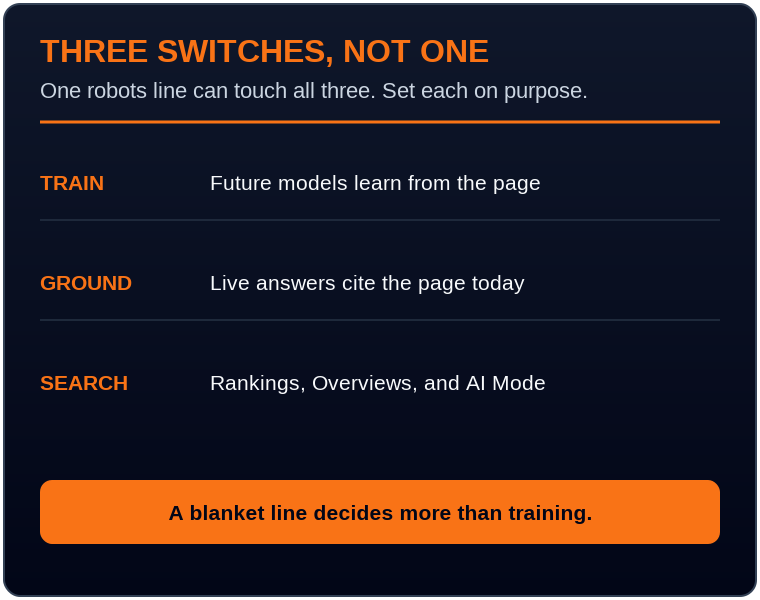
| Switch | The question it answers | When you feel the effect |
|---|---|---|
| Train | May a future model learn from this page | At the next training run, not today |
| Ground | May a live answer cite this page now | In the next answer that pulls it in |
| Search | May this page rank, and appear in AI Overviews and AI Mode | In the next search result |
Read that table before touching robots.txt. Every section of your site gets a row in it, and the rows will not all match. That mismatch is the whole point.
A training opt-out protects the next model. A grounding opt-out removes you from the next answer. Those are different jobs, and only one of them costs you traffic this week.
The Google trap inside the simple line
Google is where the simple line stops being simple. Google already has a control called Google-Extended. It covers Gemini model training and grounding in Gemini Apps and in Grounding with Google Search on Vertex AI.
Grounding, in Google's wording, means content from the search index handed to the model at prompt time. Google's Search Central post, written by John Mueller, says that when a site opts out of training with the shared token and does not explicitly specify Google-Extended, Google plans to treat that as if the publisher had disallowed Google-Extended.
Follow that sentence to its end. You write one line meaning no training. Google reads it, once its support lands in early 2027, as no training and no Gemini grounding, unless you also write an explicit Google-Extended line. Your pages can still rank in Google Search.
Google says so directly. But they can stop being handed to Gemini at prompt time, which is exactly the surface where a cited answer sends you a click. A publisher who wanted to protect training data and keep AI citations just traded one for the other without knowing it.
The split is possible, but only if you write it explicitly. Google says an explicit Google-Extended setting takes precedence where it is set. So the operator who wants no training and yes grounding at Google must write both lines and mean both of them: the shared token disallowing training, plus an explicit Google-Extended line allowing grounding.
Treat that split as the documented precedence rule, not as a promise that every Gemini surface will honor it the same way on day one. Test it after the rollout lands, and watch whether your pages still appear in Gemini answers. A rule you cannot verify is a hope, not a control.
This is also why the blanket line is dangerous for a brand chasing AI citations. If your whole GEO plan is to be the page an answer cites, a site-wide shared disallow at Google is a site-wide grounding withdrawal in disguise. The pages that teach, compare, and answer questions are the pages an answer wants to cite. Those are also the pages a blanket line removes from grounding.
Decide per section. Let the public teaching pages stay citable. Hold back the sections that actually need protection, like licensed data, client material, or original reporting you sell.
Recommendations now matter more than raw clicks, and grounding is where a recommendation is made. An answer that cannot ground on your page will recommend someone else's page instead, and it will not tell you it did so.
The Bing split, and why it is the better model
Bing, to its credit, split the decision in public. Its October 30 post, written by Krishna Madhavan, adopts the shared training token and then adds a separate grounding preference of its own. Training and grounding are two preferences, not one, and they are set in different places.
Training at Bing works two ways. The shared robots.txt token covers a site or a path. A page-level training setting, set with a Bingbot meta tag or an HTTP header, overrides the robots.txt setting for that page.
Grounding at Bing works only at page level. There is no site-wide robots.txt grounding preference at Bing. You set it with a Bingbot meta tag or header on each page that needs it.
Grounding at Bing has three values, and the middle one is the most useful setting in this whole announcement. Allow is the default. Disallow means the content is not used to inform generated responses. DisallowExtended limits grounding to Microsoft operated experiences, which Bing lists as AI Mode, AI Overview, Copilot, and Microsoft 365.
That middle setting lets a publisher stay inside the answers Microsoft shows directly, while staying out of grounding services Microsoft sells to other companies. If you sell data, that distinction is worth real money. If you run a local business, it is probably more control than you need, and Allow is the simpler answer.
Bing also set the calendar that forces the work. It honors the new preferences from February 1, 2027. After March 1, 2027, NoArchive and NoCache will no longer be read as training or grounding preferences at Bing.
A temporary grounding preference in Bing Webmaster Tools opens on December 15, 2026 for sites that were using NoArchive or NoCache as of that date, and that temporary preference expires on September 30, 2027. If your site still leans on NoArchive or NoCache to shape AI behavior at Bing, that crutch has a removal date. Migrate those pages to the new page-level tags before March 1, not after.
Note the asymmetry, because it decides your testing plan. At Bing you can split training and grounding cleanly, page by page. At Google you can split them only by writing an explicit Google-Extended line and trusting the precedence rule.
Same shared token, two different machines behind it. Any playbook that says set it once and forget it is describing neither machine accurately.
A decision matrix, not a site-wide verdict
Stop asking whether to opt out. Ask what each section of the site is for, and set the switches to match that job. Four common shapes cover most operators.
| Business shape | Training | Grounding | Why |
|---|---|---|---|
| Publisher selling original reporting or licensed data | No for paywalled and licensed sections | Yes for public summaries that earn citations | Protect the asset, keep the shop window citable |
| Product seller | Allow, or no strong view | Yes | Product copy is low risk to train on, and answers pick products from grounded pages |
| Local service business | Allow, or no strong view | Yes | Nobody trains a model on your service page to replace you, and answers need your page to recommend you |
| Brand chasing AI citations | Decide per page, never blanket | Yes for teaching and comparison pages | A blanket disallow at Google can pull teaching pages out of Gemini grounding |
Two edge cases deserve a line of their own. First, client and confidential material is not a marketing decision at all. If a page should never have been public, no robots.txt line fixes that.
Take it down or lock it behind login, and do not rely on a training preference to protect it. Second, regulated content has its own rules that sit above any of this. A training or grounding preference is not legal clearance, and it does not change what a regulator or a platform policy requires. Keep those decisions with the people who own them.
The matrix also answers the question every publisher asks first. Should I opt out to stop AI from stealing my work? If the work is the product, and the product is sold behind a paywall or a license, a training opt-out for those sections is a reasonable step, and it costs little, because those sections were never going to earn you answer citations anyway.
If the work is the marketing, and the marketing earns its keep by being cited, a blanket opt-out is self-harm with a principled label on it. Protect the product. Publish the marketing.

Sort the site into piles first. The code comes after the decision, not before it.
The playbook, in order
Work through these steps in order, and do not skip the first one. The first step is the decision. The code is step four.
First, inventory what you already have. Open robots.txt and list every AI related group already in it, including GPTBot, Google-Extended, and ClaudeBot if they are there.
List every page that carries NoArchive or NoCache, and note whether those tags were meant to shape AI behavior at Bing or were set for a different reason years ago. Most sites will find a mix, and the mix is the problem. A tag set for one reason in 2019 is about to stop meaning anything at Bing in March 2027.
Second, sort the site into sections and give each section a row in the three switch table. Public teaching pages, product pages, service pages, comparison pages, licensed data, client material, and internal pages each get their own row. If a section has no clear job, that is a content problem first and a robots.txt problem second. Fix the job, then set the switches.
Third, write the Google split explicitly if you need it. If a section is no training but yes grounding at Google, write the shared token disallow for that section plus an explicit Google-Extended line allowing it, and note in your own records that this split rests on Google's precedence rule. If a section is no to both, the shared disallow alone does the job at Google once support lands.
If a section is yes to both, write nothing for that section and leave the default alone. Defaults are decisions too, and Allow is the default at both Google and Bing for grounding.
Fourth, write the Bing page tags for any page that differs from the site rule. Remember that Bing grounding has no site-wide robots.txt form, so a page that needs a grounding restriction needs its own meta tag or header. A page-level training setting at Bing overrides the robots.
txt setting for that page, which makes it the right tool for the exception, not for the rule. Put the rule in robots.txt. Put the exception on the page.
Fifth, migrate NoArchive and NoCache before March 1, 2027. For each page that relied on those tags for AI behavior at Bing, replace them with the new training or grounding setting that actually states what you meant. If you need a bridge, Bing's temporary Webmaster Tools grounding preference opens December 15, 2026 for sites using those tags as of that date, and it expires September 30, 2027.
A bridge with an expiry date is not a permanent setting. Calendar the expiry.
Sixth, calendar the rollout dates and recheck after each one. February 1, 2027 is when Bing starts honoring the new preferences as it crawls. Early 2027 is when Google aims to support the shared token. May 3, 2027 is when the draft expires unless revised.
September 30, 2027 is when the temporary Bing preference expires. After each date, check that pages still appear in search as intended and still appear in AI answers as intended. A setting that nobody verified after the rollout is a setting you only think you have.
Seventh, keep the existing per-company rules until each provider's rollout is live and verified. GPTBot, Google-Extended, and ClaudeBot rules that work today keep working today. The shared token is an addition, not a replacement, until the provider reading it says otherwise. Deleting a working rule for a draft rule is the one move in this whole story with no upside.
What the line cannot do
Say the limits out loud before anyone in the room overpromises on this line. The shared token does not block crawling. Bots will still visit the listed pages. It does not remove a page from search results. It does not stop AI Overviews or AI Mode at Google, which have their own Search Console control.
It does not reach back into a model that already trained on your content. It does not bind any company that has not adopted it. And it does not, on its own, stop an answer from summarizing your ideas in different words. A training preference governs training data. It is not a copyright enforcement tool, and it is not a substitute for a license, a paywall, or a legal claim.
That list is not a reason to ignore the token. It is a reason to use it for the job it actually does. The token is a clean, shared way to state a training preference across providers that adopt it. That is a real improvement over writing a different rule for every company and hoping each one reads it the same way.
Use it for training. Use the grounding controls for grounding. Use the search controls for search. Three jobs, three tools, no confusion.
Accuracy is the part of AI search most operators skip. A page that is grounded accurately, with its name attached, is worth more than a page that is summarized from memory. Grounding is the accuracy switch, and it deserves its own decision.
Frequently asked questions
It is a robots.txt policy token, `__usage_ai-training`, that lets a site state a training preference once for every participating provider. Google, Microsoft, OpenAI, and Anthropic backed it on October 30, 2026. It is defined in an individual IETF Internet-Draft, not a finished standard, and each provider rolls it out on its own date.
No. The draft states that the token is not a crawl directive. Crawlers keep fetching pages normally. The token states a preference about how content is used for training, not whether a bot may access it. To limit crawling, you still need crawler specific rules.
No. Google says Google-Extended does not affect inclusion in Google Search and is not used as a ranking signal. Bing says the same about its new preferences for regular results. But at Google, a shared training disallow without an explicit Google-Extended line is planned to be read as a Google-Extended disallow, which covers Gemini grounding as well as training.
Write both lines explicitly. Disallow training with the shared token for the section, and write an explicit Google-Extended line allowing grounding for that section. Google says an explicit Google-Extended setting takes precedence where it is set. Verify after Google's early 2027 rollout that your pages still appear in Gemini answers, since this split rests on that precedence rule.
Bing treats them as two preferences. Training uses the shared robots.txt token, plus an optional page-level Bingbot setting that overrides robots.txt for that page. Grounding is page-level only, set with a Bingbot meta tag or header, with Allow, Disallow, and DisallowExtended as values. DisallowExtended limits grounding to Microsoft operated experiences like Copilot and Microsoft 365. Bing honors both from February 1, 2027.
After March 1, 2027, Bing will no longer read NoArchive or NoCache as training or grounding preferences. Sites using those tags should migrate to the new settings before that date. A temporary grounding preference in Bing Webmaster Tools opens December 15, 2026 for sites using those tags as of that date, and it expires September 30, 2027.
Not as a blanket site-wide line. Add it where the training decision is actually no, keep existing per-company rules until each rollout is live, and decide grounding separately. A site that wants AI citations should be especially careful, because a blanket disallow can pull teaching pages out of Gemini grounding at Google and out of grounded answers at Bing if grounding is also disallowed. The platforms finally agreed on one line, and that is progress. Progress is not the same as a decision. The line is only useful once you know which switch you meant to flip, for which section, at which company, and on which date it takes effect. Write those answers down first. The code is two lines. The thinking is the post, and it is the part nobody can copy from a news article. Life after AI Overviews still starts with pages worth citing, and a page worth citing is a page whose grounding decision was made on purpose.