Customer retention digital marketing is often reduced to emails, SMS, loyalty points, and win-back campaigns.
Those tools matter. But they are not the whole system.
A customer decides whether to return based on what happened before the first purchase, during the experience, and after the product or service delivered value. If the promise was unclear, onboarding was weak, expectations were wrong, or the customer never built a habit, a reminder campaign has too much work to do.
Retention is not a message schedule. It is the marketing system that helps a customer get enough value to come back.
The second purchase is not won by reminding people that the brand exists. It is won by giving them a better reason to return.
This is where retention connects to offer strategy. The first offer sets expectations. The retention offer proves the relationship has a next step.
Define what retention means for the business
Retention is not the same in every business.
For ecommerce, retention may mean second purchase, reorder, subscription, replenishment, bundle expansion, or category adoption. For a local service business, it may mean follow-up appointments, seasonal service, referrals, reviews, or membership. For B2B, it may mean renewal, expansion, faster adoption, stakeholder engagement, or continued usage.
If the team does not define the return action, the campaign becomes generic.
Useful retention goals include:
- Earn the second purchase
- Reduce time between purchases
- Improve onboarding completion
- Increase repeat appointment rate
- Win back recently inactive customers
- Increase product adoption
- Improve review and referral behavior
- Reduce churn or cancellation
Each goal needs a different trigger, message, offer, and measurement plan.
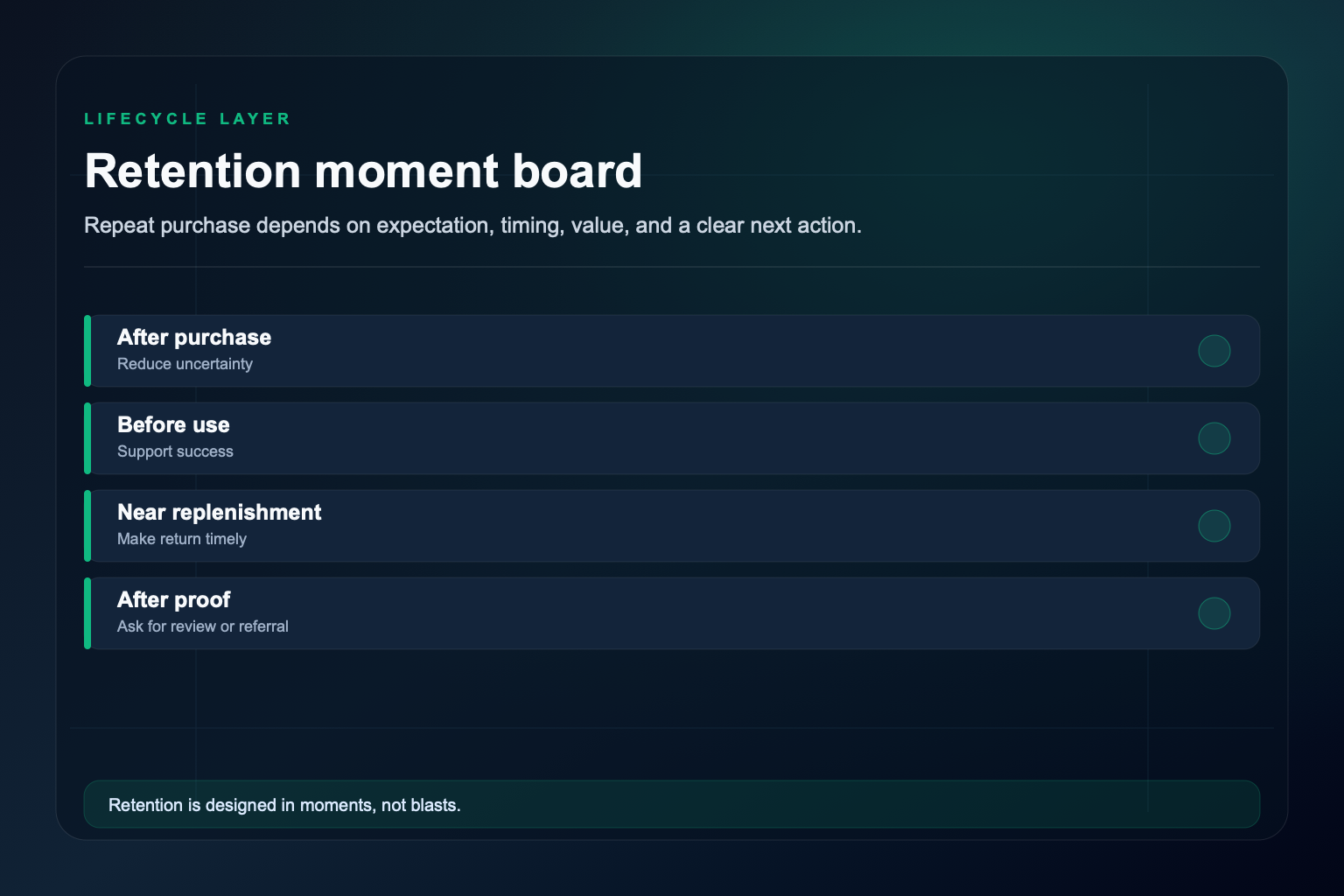
Retention planning should assign a job to each customer moment instead of blasting the same message to everyone.

Fix expectation gaps first
Retention often fails because acquisition overpromised.
If the ad makes the product sound effortless but the customer needs education, the second purchase is at risk. If the service page makes the process sound simple but onboarding is confusing, renewal is at risk. If a local profile creates expectations that the location cannot meet, reviews and repeat visits suffer.
The retention system begins with honest expectation setting.
That means:
- The offer describes the real next step.
- Product pages explain fit and usage.
- Service pages explain process and timeline.
- Confirmation messages reduce uncertainty.
- Onboarding helps the customer succeed.
- Support and review responses reveal recurring friction.
This is why retention should be discussed during acquisition planning, not only after the first purchase.
Build lifecycle around moments, not blasts
Lifecycle marketing gets better when messages are tied to customer moments.
A first-time buyer may need education. A customer near refill timing may need a reminder. A customer who purchased one item may need a complementary path. A customer who complained may need service recovery. A customer who browsed a category after purchase may need a comparison or proof asset.
The trigger should explain the message.
| Customer moment | Retention job | Example message |
|---|---|---|
| Immediately after purchase | Reduce uncertainty | What happens next and how to get value |
| Before expected use | Support success | Setup, routine, preparation, or appointment reminder |
| Near replenishment | Make return timely | Reorder, refill, or seasonal reminder |
| After satisfaction signal | Capture proof | Review, referral, or share request |
| After inactivity | Understand friction | Check-in, new path, service recovery, or fit reset |
This does not require dozens of automations. A few clear lifecycle moments are better than a crowded sequence that treats every customer the same.
The first lifecycle pass should usually be boring and useful. Confirm the order. Explain how to use the product or prepare for the service. Remind the customer at the moment timing actually matters. Ask for feedback after value has had a chance to show up. Then build more complexity only when the signals justify it.
That restraint matters because over-messaging can train customers to ignore the brand. Retention should feel like the business is paying attention, not like every purchase pushed the customer into a promotional machine.
Use segmentation that reflects behavior
Demographic segmentation is often less useful than behavior.
Retention improves when segments reflect what the customer did, what they bought, what they did not do, and what they may need next.
Useful behavior segments include:
- First-time buyers
- High-intent browsers who did not buy
- Customers approaching expected reorder timing
- Customers who bought but did not activate
- Customers who purchased one category but not the next logical one
- Customers with service complaints or returns
- Customers who respond to education but not promotions
- Local customers who visited once but did not come back

For a cannabis retailer, retention also has a compliance layer. The safest program avoids product health claims, respects age and platform rules, and treats loyalty as a service and experience system rather than a claims engine.
For broader dispensary marketing, menu accuracy, wait time, review confidence, and local communication can matter as much as another promotion.
Give customers a reason to come back
Discounts can drive return behavior, but they should not be the only reason.
Reasons to return include:
- Better routine guidance
- Timely replenishment
- New use case education
- Category expansion
- Local convenience
- Member access
- Service reminders
- Better support
- Community or event relevance
- Proof that the customer made a good choice
The strongest retention programs make the next purchase feel easier, safer, or more useful than starting over with another brand.
Measure repeat quality
Retention measurement should show whether the relationship is getting stronger.
Useful metrics include:
- Second purchase rate
- Repeat purchase rate
- Time between purchases
- Replenishment completion
- Subscription or membership retention
- Active customer rate
- Review rate
- Referral behavior
- Churn or cancellation
- Customer service issues
- Return or refund signals
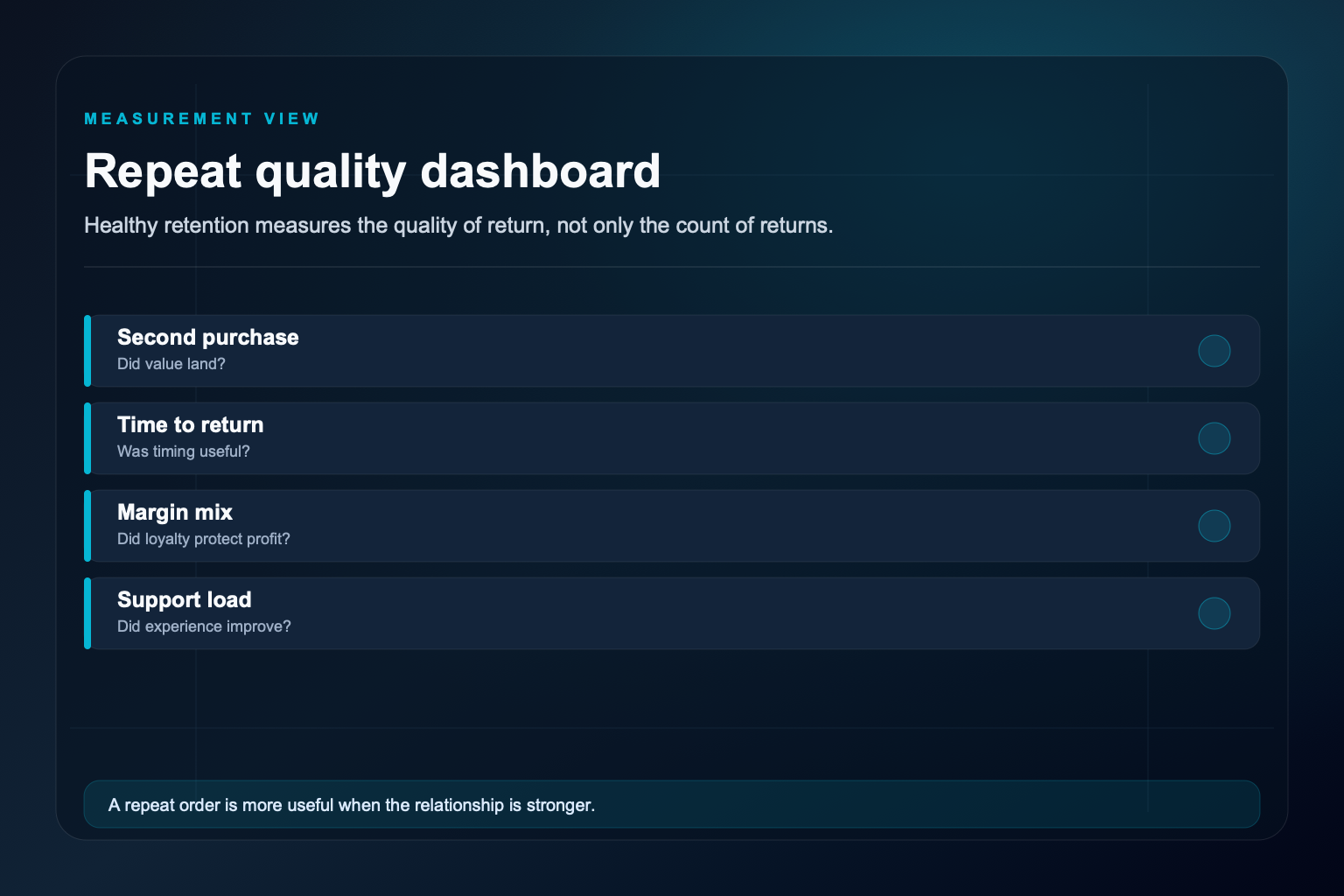
Retention measurement should show whether the relationship is improving, not only whether another order happened.
Do not isolate these from acquisition. A campaign that brings in low-fit customers may create weak retention later. A discount-heavy offer may inflate first purchase while training customers to wait for the next deal. A local campaign may bring visits but disappoint if operations cannot deliver.
Retention is a business signal, not just an email metric.
The review meeting should include marketing, operations, service, and sales where relevant. If repeat purchase is weak because fulfillment was late, marketing alone cannot fix it. If customers do not understand how to use the product, content and onboarding can help. If people keep asking the same support question, the retention system needs a clearer educational asset.
Retention improves when the team treats repeat behavior as feedback about the whole customer experience.
What this means for AI-native marketing
AI can help identify segments, summarize review themes, predict reorder timing, draft lifecycle variations, and surface customers who may need service recovery. That can make retention smarter.
The boundary is important. Retention should feel helpful, not invasive. Use AI to make the message more relevant and the timing more useful. Do not use it to pressure customers with assumptions the brand cannot explain or defend.
For Sparksbox, AI-native retention means using data to support the customer relationship, not just to increase message volume.
Frequently asked questions
Customer retention digital marketing is the use of lifecycle messaging, customer data, education, offers, service recovery, and experience signals to encourage repeat purchase, renewal, reactivation, or ongoing use.
The second purchase shows that the first experience created enough value for the customer to return. It is often a better signal of relationship strength than the first purchase because the customer has already tested the promise.
Email, SMS, loyalty programs, direct mail, local profiles, customer support, retargeting, owned content, and in-store or service follow-up can all support retention. The best channels depend on the customer moment and permission level.
Improve expectation setting, onboarding, usage education, timing, replenishment reminders, service recovery, reviews, membership value, product fit, and the clarity of the next step. Discounts can help, but they should not carry the whole strategy.
Yes. AI can help cluster customers by behavior, summarize friction, predict timing, draft lifecycle content, and identify service recovery opportunities. It should be used with clear data boundaries and a focus on customer usefulness.