The cannabis industry is at a crossroads that most observers are missing. Federal rescheduling remains proposed, but AI adoption is already moving. Dispensaries are building chatbots, recommendation engines, and personalization layers to compete with convenience and consumer experience.
But they're walking into a compliance trap that's built into how AI personalization actually works.
How Personalization Works (Everywhere Else)
In every other consumer industry, personalization requires one thing: historical customer data. Your e-commerce brand tracks purchases across months. Your CPG company knows when you bought their product last. Your streaming service remembers every show you watched. This history is the fuel that powers personalization AI.
Cannabis is fundamentally different. Because of state-level regulations, banking restrictions, privacy expectations, and the federal landscape, many dispensaries do not have clean, portable, centralized customer databases.
Some operators silo data by state, store, or platform. A customer who buys from Dispensary A on Monday and Dispensary B on Wednesday may not create the kind of unified customer profile a normal ecommerce brand expects.
Yet dispensaries are now trying to build the same personalization systems that other consumer brands use. This creates a structural mismatch: personalization requires data aggregation. Cannabis compliance often pushes toward minimization, consent, and tighter controls.
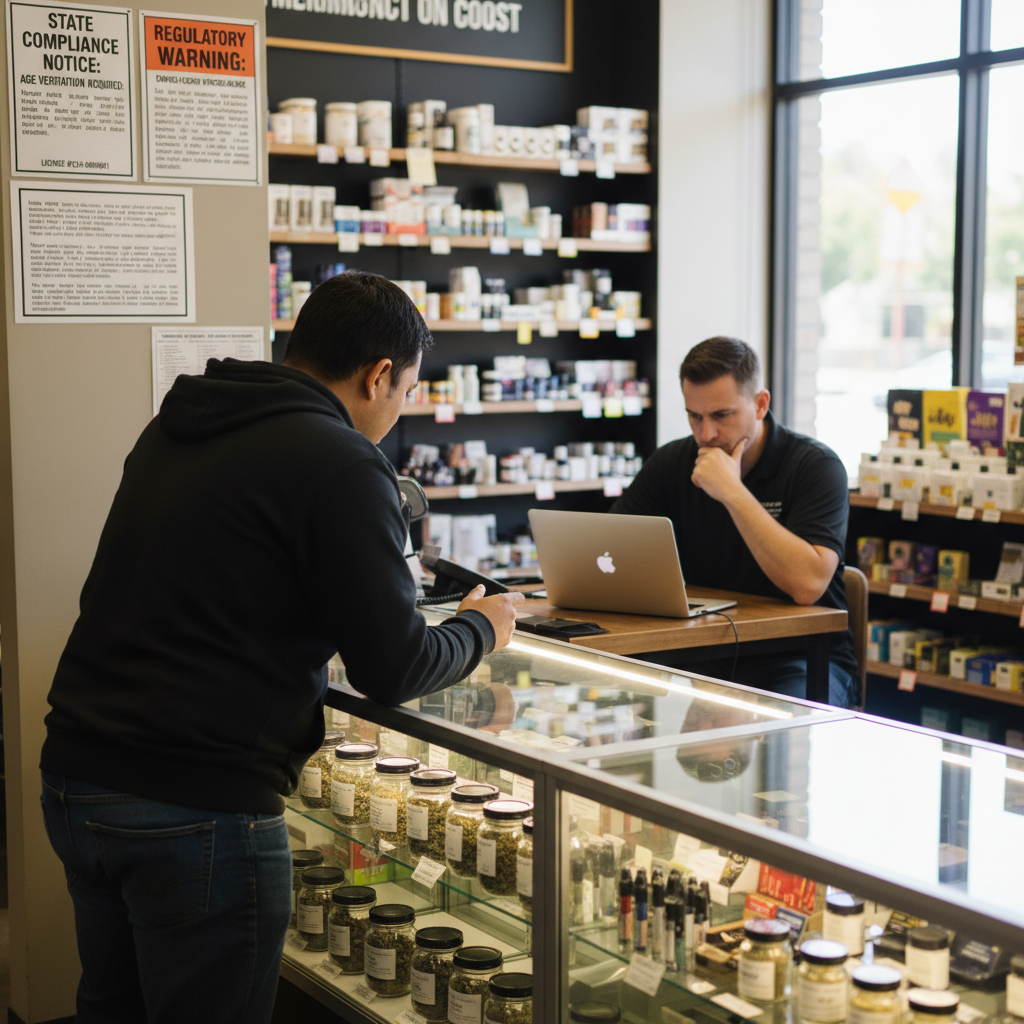
*Compliance isn't a checkbox. It's the difference between a working personalization system and a legal liability.*
The Synthetic Data Liability
The most common workaround is to use AI to *infer* customer preferences from interactions you're legally allowed to track: chat history, product browsing, wishlist additions, loyalty program clicks. You build a synthetic customer profile based on behavioral signals.
This sounds smart. It's not.
Privacy and cannabis compliance teams may classify inferred customer profiles as personal information, even when the customer never typed those preferences directly. The fact that the profile is inferred does not make it harmless.
When you use AI to generate a synthetic customer profile, you're creating something the regulation didn't anticipate. The profile itself is personal information. And if it goes beyond what the transaction requires, you're violating the rule.
But here's the trap: the regulations were written for human memory. A human budtender might remember that Sarah bought CBD flower last month and recommend a new CBD product. That's fine. But an AI system that builds a permanent, searchable, auditable profile of Sarah's preferences and recommends products based on it?
That's a different legal question. Some regulators say it's the same thing. Others say it's different because it's automated, permanent, and scalable.
No one has actually litigated this. So every dispensary with an AI personalization system is running an experiment in regulatory interpretation.
The Interstate Compliance Collapse
Some multistate operators (MSOs) are trying to solve this by building unified personalization systems that work across state lines. This sounds efficient. It's actually impossible.
Each state can create different requirements around privacy, advertising, consent, medical claims, loyalty data, and age-gated marketing. One state may be permissive about loyalty segmentation. Another may be more sensitive to retention, consent, or targeting. A third may treat AI disclosure as a separate issue.
An MSO trying to build one personalization system that works in all four states has to route every customer interaction through state-specific compliance filters. In practice, this means either building separate AI systems for each state (destroying economies of scale), building one system and violating some states' regulations (regulatory arbitrage), or giving up on real personalization entirely.
Most are choosing the third option. The result is that "personalization" in cannabis means a generic recommendation engine that doesn't actually personalize to the customer. It's just another version of "customers who bought this also bought that."

*MSOs that build compliant systems across states are discovering the hard way: unified personalization doesn't work when every state has different rules.*
The Vendor Liability Void
Some dispensaries are outsourcing personalization to third-party platforms: Klaviyo, HubSpot, cannabis-specific vendors like Brightside or Akerna. This looks like it transfers the liability to the vendor. It doesn't.
If your cannabis brand uses a vendor's AI recommendation engine and the system recommends a product in a way that violates state cannabis advertising, age-gate, or claims rules, who's liable? The dispensary is. The brand is. The vendor's terms of service likely has language that says they're not liable for recommendations that violate state law.
Most cannabis personalization vendors are quietly adding compliance certifications to their terms, but the certifications are vague and based on incomplete information. A vendor might certify that they "comply with state cannabis laws," but state laws change quarterly and vary by city. A compliant system in Denver might be non-compliant in Boulder.
What's happening now is vendors are requiring that cannabis clients sign agreements that essentially say: "You are responsible for ensuring our system complies with your state." This sounds reasonable. But it also means the vendor is passing all compliance risk to the brand while still profiting from the recommendation engine.
No brand actually has the technical expertise to audit an AI system for state compliance. They're signing agreements they can't verify.
Structure, Not Technology
This isn't about AI capability or vendor quality. It's about a fundamental mismatch between how personalization works and how cannabis regulations are written.
Personalization requires historical data. It requires learning from what customers did before. It requires building profiles that persist across time.
Cannabis regulations prohibit persistent, aggregated customer data. They minimize data retention. They restrict sharing. They require opt-in, not opt-out.
These two things can't coexist. You can't personalize without data. You can't collect persistent data in cannabis without violating regulations.
So the brands claiming to have "personalization" are often doing one of three things: using rules-based recommendations that look like personalization, collecting more data than their compliance team can defend, or using inferred profiles that sit in a legal gray area.
Option 1 is compliant but ineffective. Options 2 and 3 are risks.
What's Actually Winning: Zero-Party Data
The brands succeeding with personalization in cannabis aren't using customer history at all. They're using zero-party data: customers *choosing* to tell the brand what they want.
A dispensary with a loyalty program where customers explicitly fill out a preference profile ("I like high-THC sativas," "I prefer edibles over flower," "I'm sensitive to anxiety triggers") is collecting zero-party data. It's a first-party declaration. It's compliant. It's also limited , you're only personalizing on what the customer told you, not what you inferred.
But it works. And it's defensible.
Some brands are taking this further and using interactive zero-party data: chatbots that ask customers about their preferences, consumption style, and desired effects *during the current session*, then recommend based on that conversation, not historical behavior.
This is compliant. The customer is actively providing information in real time. There's no persistent profile. There's no inference. There's no regulatory risk.
The brands that adopt this approach can build more defensible personalization, partially because zero-party data is more accurate than inferred data, and partially because customers appreciate being asked rather than tracked.
The competitive advantage isn't coming from AI sophistication. It's coming from compliance-first design.
The Compliance Moat
Here's what none of the personalization vendors are talking about: compliance is now your competitive moat.
The dispensary that figures out how to deliver genuinely useful personalization within state regulations will own its market. Not because the AI is better. But because every other dispensary is stuck choosing between non-functional systems, legal risk, or giving up.
A brand that builds zero-party data personalization correctly becomes defensible against new regulations. A brand that collects synthetic profiles becomes obsolete when regulators clarify the law (and they will).
The personalization arms race in cannabis isn't about AI capability. It's about who can legally access customer preference data.
And right now, the most defensible path is zero-party collection.
The vendors that understand this will win. The ones betting on regulatory arbitrage will lose.
The brands that are compliant today will own their markets tomorrow.
2026 evidence and control update
The more useful 2026 question is not whether cannabis ai personalization: the data liability trap is possible. It is whether regulated cannabis retail and marketing teams can prove what happened after the system made, shaped, ranked, routed, or explained a customer-facing decision.
The less obvious issue is that the hidden record is not only the customer-facing answer, it is the product data, state rule, age gate, claim boundary, and human owner behind that answer. That record is what separates a working AI pilot from a defensible operating system.
For source alignment, the public claim language should stay consistent with California Department of Cannabis Control retail guidance and FTC guidance on AI claims. Those sources do not remove the need for local legal review, but they give the article a better evidence spine than vendor screenshots or unsupported performance claims.
This also connects to related operating risk, AI measurement gap, compliance workflow, because the same pattern keeps repeating: AI systems look clean in the dashboard while the proof, ownership, and customer context live somewhere else.
| Control layer | What to verify | Evidence to keep |
|---|---|---|
| Source data | Which approved source fed the answer, recommendation, ranking, or claim | Source URL, vendor field, timestamp, and owner |
| Decision boundary | Where the AI is allowed to help and where it must stop | Allowed use case, blocked topics, and confidence threshold |
| Human review | Who owns the exception, correction, or escalation | Reviewer role, handoff note, and approval record |
| Monitoring | How the team catches drift, complaints, or weak signals | Review cadence, sampled outputs, and customer feedback themes |


Frequently asked questions
It is the risk created when a cannabis brand uses customer data, inferred preferences, or behavioral profiles to drive recommendations without enough consent, minimization, logging, or state-specific controls.
An inferred profile can still be personal information. If a system concludes that a customer prefers certain products, times, formats, or wellness outcomes, that profile may need privacy and compliance controls.
Zero-party data is information the customer intentionally gives you, such as stated preferences, product categories, shopping goals, or communication choices.
It is easier to document consent, purpose, and customer intent. It also avoids building hidden profiles from behavior the customer did not know would be used for personalization.
Map personalization data by state, store, vendor, purpose, consent status, retention period, and recommendation use. Then block any cross-state personalization that lacks a defensible compliance basis.