The cannabis industry is adopting AI recruiting agents faster than it's adopting governance.
Over the past 18 months, major cannabis operators have quietly integrated AI-powered recruiting tools into their hiring pipelines. These agents screen resumes, rank candidates, conduct initial interviews, and even flag red flags in applications.
On the surface, this makes sense: cannabis hiring is expensive, heavily regulated, and prone to human error. What could go wrong with automating some of it?
Everything, if you're operating in a regulated market.
The problem isn't that AI recruiting agents are inherently bad. The problem is that cannabis operators are deploying them without the compliance infrastructure, documentation, or oversight frameworks that regulated industries actually require. They're moving fast in an industry where moving fast creates liability.
This is the compliance gap.
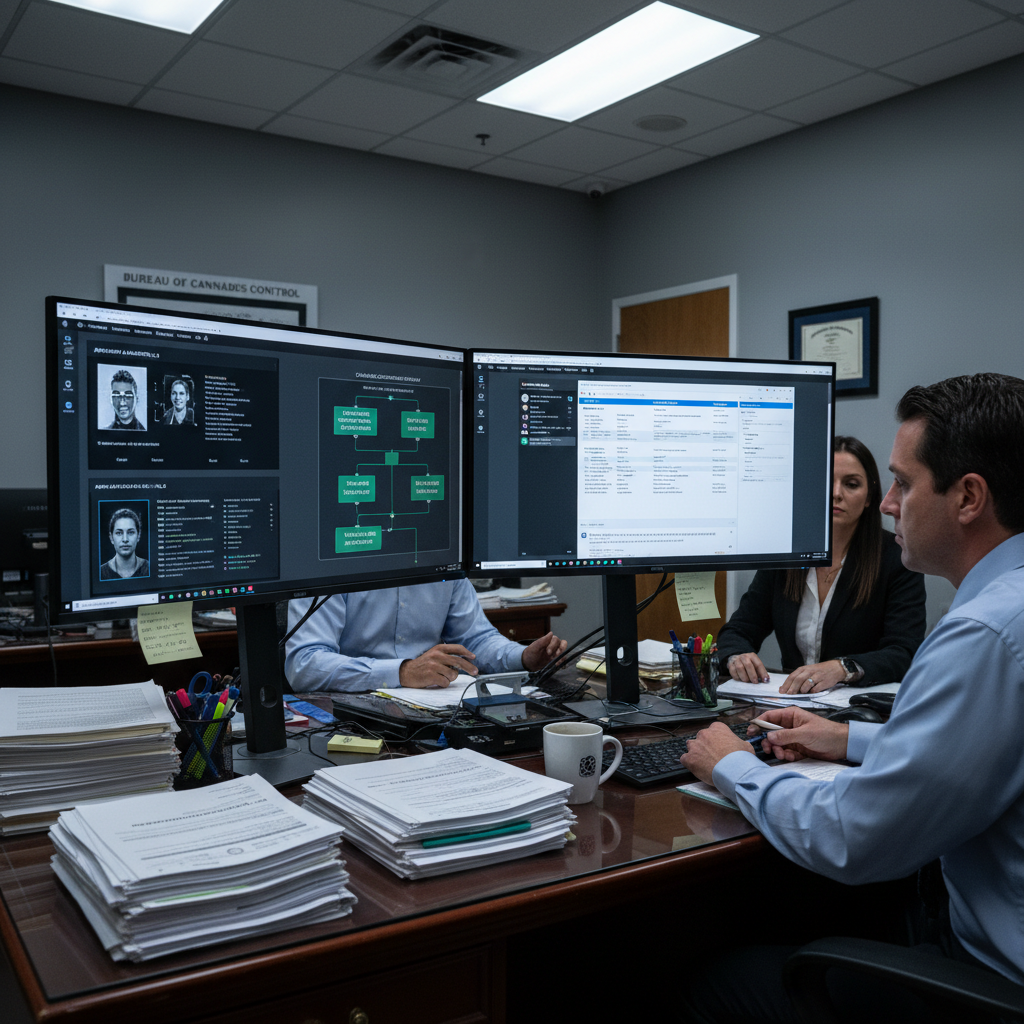
Recruiting AI can speed up screening, but cannabis operators still need a documented decision trail.
Why Cannabis Operators Are Adopting AI Recruiting
Cannabis hiring is uniquely complex. Operators must screen for criminal history (but not in ways that violate the Fair Chance Act), verify work eligibility across state lines, ensure diversity hiring practices, and maintain audit trails for state regulators. Most states have specific rules about who can work in cannabis.
In California, for instance, certain felonies are disqualifying, while others aren't. Different states have different thresholds.
Doing this manually is expensive. Doing it wrong is even more expensive. A hiring error can cascade: hire someone with a disqualifying background, and you can invite licensing scrutiny. Screen candidates in a way that creates disparate impact, and you're exposed to discrimination claims.

The tension between efficiency and accountability: automating hiring in a regulated industry.
*The tension between efficiency and accountability: automating hiring in a regulated industry.*
The Three Gaps in AI Recruiting for Cannabis
First gap: No documented decision logic. When a recruiting AI ranks candidates or flags someone as unsuitable, there's often no clear explanation of why. The model might have learned patterns that correlate with hiring success, but those patterns could also correlate with protected characteristics like age, gender, or neighborhood.
Without being able to explain what the model is looking at, operators can't audit it for bias. And if they get sued, they can't defend it.
In regulated industries like financial services, this is non-negotiable. Banks must be able to explain why an applicant was rejected for a loan. It's the law.
But in cannabis, operators are deploying recruiting AI without the slightest idea of what variables the model is actually weighting. A model can learn proxies such as age, geography, gaps in work history, or prior job titles. If those proxies correlate with protected characteristics, the operator may not discover the problem until a complaint lands.
Second gap: No continuous monitoring. Most cannabis operators deploy an AI recruiting agent, see that it "works" (candidates get hired, turnover seems normal), and move on. They don't monitor whether the model's recommendations are actually correlated with job performance. They don't track whether the model is filtering out disproportionate numbers of applicants from certain groups.
They don't measure drift. In financial services, ongoing bias monitoring is required by law. In cannabis, nobody's watching.
Third gap: No human oversight in high-risk decisions. When a recruiting AI flags a background check issue or recommends rejection, someone needs to review it before a hiring decision is made. Many cannabis operators treat AI recommendations as dispositive.
If the AI says no, the answer is no. This creates legal exposure if the AI makes a mistake, and it violates the spirit of most state hiring laws.
Together, these three gaps create a compliance risk that most cannabis operators haven't quantified. The longer they run without fixing them, the deeper the exposure.
What Regulators Are Watching
The EEOC has already signaled that AI-driven hiring decisions are in its crosshairs. Its AI selection-procedure guidance makes the core point plain: employers can be responsible when automated tools create unlawful disparate impact, even if a vendor built the tool.
The FTC is also watching AI claims. Its Operation AI Comply actions focused on deceptive AI claims and schemes, which matters for any operator relying on vendor promises about fairness, accuracy, or automated compliance.
At the state level, employment, privacy, and automated decision rules are developing faster than cannabis-specific AI hiring guidance. Illinois has rules around AI video interviews.
California, Colorado, New York City, and other jurisdictions are pushing broader automated decision, privacy, or employment-screening requirements. Cannabis operators cannot assume that silence from a cannabis regulator means silence from the law.
Cannabis regulators, however, are still playing catch-up. Most state cannabis regulators have not written specific guidance on AI in hiring. They're relying on general employment law, which is fine until something goes wrong. Once it does, they'll move fast. Cannabis regulators are reactive, not proactive. They set rules after problems emerge.
If a major operator makes a hiring error that stems from an AI agent, and a regulator investigates, the operator will face a choice: defend the AI's decision, or admit it was applying standards it couldn't explain. Most will have neither the documentation nor the technical understanding to do either well.

The reality: cannabis operators are using AI recruiting tools without the oversight frameworks other regulated industries...
*The reality: cannabis operators are using AI recruiting tools without the oversight frameworks other regulated industries have established.*
The Liability Cascade
Here's what happens next. A candidate is rejected based (in part) on an AI recruiting agent's assessment. The candidate sues, claiming discrimination. In discovery, the operator must produce documentation of how the AI makes decisions.
They discover that the model was trained on historical hiring data that reflected past hiring biases. Or the AI learned to penalize candidates from certain zip codes. Or it downranked women because the company's historical high performers happened to be men.
Now the operator is defending a decision it can't explain.
Meanwhile, state regulators ask: why is your hiring process opaque? Why can't you explain why certain candidates were rejected? Do you have documentation that this AI was audited for bias? The operator says no. The regulator starts asking about other candidates. The process expands from one complaint to a systemic review.
Now the operator is in discovery for both employment litigation and a regulatory investigation. The legal bill is six figures. The reputational damage is real. And if the regulator finds systemic issues, the operator could lose its license. That's existential risk.
This scenario is not far-fetched. Similar questions are already appearing in other regulated industries as employers, lenders, healthcare organizations, and platforms test automated screening systems. Cannabis operators with AI recruiting agents are exposed to the same class of risk, but with less cannabis-specific guidance and less documented best practice.
What Cannabis Operators Need to Do Now
If you're using an AI recruiting agent in your cannabis operation, here's what you should do immediately:
First: Audit the model for bias. Get a technical audit done by someone outside the team. You need to know what variables the model is actually using to make decisions.
Second: Document your decision-making framework. Write down what criteria the AI agent uses, how those criteria were chosen, why they matter for the role, and how you validate that the AI's recommendations align with those criteria. This documentation is your defense if something goes wrong.
Third: Implement continuous monitoring. Track whether the AI's recommendations are leading to successful hires. Track whether certain groups are being disproportionately filtered at any stage. Track model performance over time.
Fourth: Establish a human review process for any AI recommendation that results in rejection. That means someone reads the file, reviews the AI's reasoning, and makes a decision. That person documents their reasoning.
Fifth: Talk to your legal team about liability. If your lawyer hasn't asked you about your AI recruiting practices, ask them to. Get their assessment of your current exposure.
The pattern here mirrors what happened in other regulated industries when they first adopted AI. Some moved fast and paid the price. Others built governance first and avoided the liability trap. The ones that moved fast without oversight are the ones paying settlements now.
Cannabis operators still have time to choose the path that doesn't end in discovery. But that window is closing as more operators adopt these tools without documentation.
The Compliance Debt Is Accruing
Cannabis operators are moving fast on AI because they see efficiency gains. But they're accruing compliance debt.
Every day an undocumented, unmonitored AI recruiting agent runs in the background, the operator is taking on liability they haven't quantified. For a deeper dive into how AI is creating liability gaps in regulated personalization practices, this pattern extends beyond just recruiting.
This is manageable if you act now. Get the model audited. Document the logic. Set up monitoring. Create oversight. It's not impossible. Financial services has figured this out. Healthcare has figured this out. Cannabis can too.
But if you wait until a regulator shows up or a lawsuit lands, you're reactive. And in a regulated industry, reactive is expensive.
The window to address this is now. The cost of fixing it proactively is a fraction of the cost of fixing it after the fact. Most cannabis operators haven't realized that yet. That's the compliance gap.
And it's widening every day that another recruiting agent runs without oversight.
2026 evidence and control update
The more useful 2026 question is not whether ai recruiting agents and the cannabis compliance gap is possible. It is whether regulated cannabis retail and marketing teams can prove what happened after the system made, shaped, ranked, routed, or explained a customer-facing decision.
The less obvious issue is that the hidden record is not only the customer-facing answer, it is the product data, state rule, age gate, claim boundary, and human owner behind that answer. That record is what separates a working AI pilot from a defensible operating system.
For source alignment, the public claim language should stay consistent with California Department of Cannabis Control retail guidance and FTC guidance on AI claims. Those sources do not remove the need for local legal review, but they give the article a better evidence spine than vendor screenshots or unsupported performance claims.
This also connects to related operating risk, AI measurement gap, compliance workflow, because the same pattern keeps repeating: AI systems look clean in the dashboard while the proof, ownership, and customer context live somewhere else.
| Control layer | What to verify | Evidence to keep |
|---|---|---|
| Source data | Which approved source fed the answer, recommendation, ranking, or claim | Source URL, vendor field, timestamp, and owner |
| Decision boundary | Where the AI is allowed to help and where it must stop | Allowed use case, blocked topics, and confidence threshold |
| Human review | Who owns the exception, correction, or escalation | Reviewer role, handoff note, and approval record |
| Monitoring | How the team catches drift, complaints, or weak signals | Review cadence, sampled outputs, and customer feedback themes |


Frequently asked questions
Yes, but they need oversight. The tool should not make final rejection decisions without human review, documented criteria, bias monitoring, and records the operator can explain in an audit.
The employer can still be responsible. A vendor may build the tool, but the operator uses it to make employment decisions and needs evidence that the process is lawful.
Ask what data the model uses, whether protected-class proxies are tested, how adverse impact is monitored, how decisions are logged, and whether the vendor can export a regulator-ready explanation.
Most do not yet. That does not remove the risk. General employment, privacy, fair-chance, and automated decision rules can still apply to cannabis hiring.
Require human review and written reason codes for every AI-assisted rejection. That creates a basic decision trail before a complaint or regulator request arrives.