Here's what nobody tells you about AI in cannabis marketing: your model isn't static. It decays. Every day that passes without retraining, your AI recommendations get incrementally worse at predicting customer behavior, optimizing spend, and avoiding compliance landmines. For cannabis operators, that decay accelerates because your market moves faster than most.
Schedule III reclassification in April 2026 changed the legal ground. FTC disclosure rules tightened in June. State regulations in California and Nevada keep shifting. Your AI was probably trained on 2024 data. Do the math.

Your model doesn't know it's broken. It's just optimizing for a world that doesn't exist anymore.
What Model Decay Actually Looks Like
Model decay happens when the world your AI learned from stops matching the world it's predicting in. The technical term is *concept drift*. When the underlying patterns your model depends on shift, your model's accuracy drops without any change to the model itself.
In cannabis marketing, you might see it as:
- Your AI recommends customer segments that used to convert well but now don't. The model learned those patterns in a Schedule I world. Schedule III customers behave differently.
- Ad creative suggestions get flagged by platforms because they don't account for new disclosure rules. Your model trained before June 2026 compliance changes.
- Chatbots start making claims about effects or benefits that are now legally risky under tighter FTC enforcement.
- Email sequences optimize for engagement but miss new identity verification requirements in Nevada.
- Your model keeps suggesting promotional angles that worked pre-reclassification but now signal non-compliance.
None of this is because the AI broke. The model is working exactly as designed. It's just learning from a world that moved on.
Why Cannabis Decay Happens Faster
Three reasons cannabis AI degrades quicker than other industries:
1. Your regulatory ground keeps shifting. A typical e-commerce AI model can run for months or even years without meaningful concept drift. Cannabis operators deal with Schedule I to Schedule III reclassification, state-by-state compliance overhauls, FTC enforcement signals, and platform policy changes all within weeks. Each shift makes old training data less predictive.
2. Competitor AI floods the space with synthetic data. As more cannabis companies deploy AI, the models are training on AI-generated content, which itself degrades as described in recent research on model collapse. Your model starts learning from competitor models that were trained on degraded data. The signal weakens.
3. Your audience behavior actually changes. Post-Schedule III, customer intent shifted. People searching for cannabis information have different intent now that it's federally reclassified. Same keyword, different searcher mindset. Your model learned the old intent.
The Cost of Ignoring Decay
Most operators don't measure decay directly. Instead, they see the indirect signals: CPM increases while ROAS drops, compliance flags go up, customer acquisition cost climbs without obvious reason. Over six months, a decayed AI model can waste 15-25% of marketing spend by optimizing for patterns that no longer exist.
Worse, decayed models create liability exposure. If your chatbot is trained on 2024 brand claims and you haven't retrained it since April's Schedule III ruling, you're running a compliance risk that compounds daily. The FTC's July 2026 accuracy enforcement signals that companies will be held liable for outdated AI outputs.
How to Detect Decay (Before It Tanks Your ROAS)
You don't need advanced instrumentation. Here's what to monitor:
Performance threshold drop. Set a baseline for conversion rate, ROAS, or customer lifetime value at the segment level. If your AI recommendations consistently underperform that baseline over a rolling 2-week window, decay is likely. Flag it.
Regulatory compliance misses. Track how many AI-generated ads or copy pieces get flagged by platform compliance teams. An uptick in flags without a change in your review process signals the model is drifting into outdated territory.
Segment relevance shift. Pull the top 10 customer segments your AI targets. Are they the same personas who drive revenue now? If your model says 18-24 year olds in California are tier-one but your actual revenue is 35-50 year olds, concept drift is real.
Chatbot or recommendation engine performance. If your AI chatbot or email recommendation engine shows declining engagement or higher opt-out rates, the suggestions are stale.
Velocity of change in your market. This is the early warning. If regulations shift, competitor tactics change, or new platforms emerge, your model training schedule should accelerate. If it hasn't, decay is building.
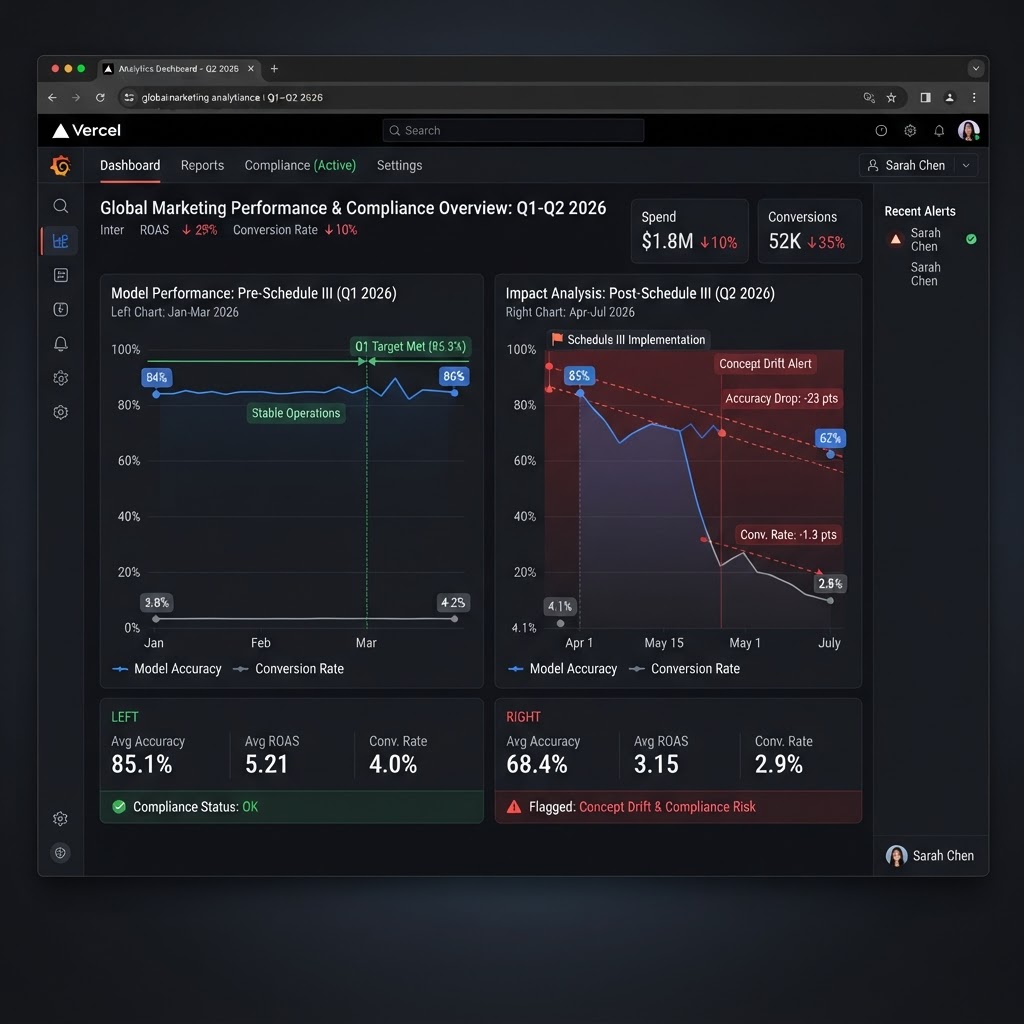
The decay looks like a flat line until it doesn't. When regulations shift, accuracy drops fast.
What to Do: Retraining, Monitoring, Governance
Retrain on current data. Don't retrain annually. For cannabis marketing, every 4-8 weeks is realistic depending on how much your market is moving. Post-April 2026 reclassification, if you haven't retrained since then, start now. Your model is running on increasingly stale patterns.
Layer human judgment back in. Decayed models should never make decisions alone. Compliance-first AI means a human (or rule-based system) always reviews recommendations before they go live, especially for copy, claims, and targeting. Your AI suggests, your compliance team confirms.
Monitor in production, not just in training. Set up automated alerts that track model performance in real time across your live campaigns. When conversion rate, CTR, or cost-per-acquisition drifts beyond a threshold, your system should flag it or throttle the model back.
Build a regulatory change calendar. FTC enforcement, state-level rule changes, platform policy updates, and Schedule III enforcement all impact your model's assumptions. When changes come, schedule a retraining cycle. Don't wait for ROAS to tell you something's wrong.
Hybrid workflows over full automation. The safest approach for 2026: let AI optimize within guardrails. Your model recommends segments, budget allocation, and creative angles. A human approves them against a compliance checklist. This catches decay before it wastes spend or creates liability.

The operators winning in 2026 aren't replacing humans. They're protecting them from decayed AI with a simple approval gate.
FAQ
A: Every 4-8 weeks minimum, depending on how fast your market moves. Post-Schedule III, accelerate to 4-week cycles. Regulatory changes, new compliance rules, or platform updates should trigger unscheduled retraining.
A: Yes, marginally. But decayed models waste more money than retraining costs. A $5,000 monthly ad budget with a decayed model can leak 15-25% of spend. Retraining costs a few hundred dollars. The math is clear.
A: Yes, but with caution. Third-party models decay just as fast. If you use ChatGPT for copy generation, you're dependent on OpenAI's retraining schedule, not your own. For cannabis compliance specifically, a custom model or a compliance-first wrapper is safer.
A: Agents multiply the decay risk. A single decayed model underperforms. A decayed agent makes autonomous decisions at scale and you might not notice for weeks. For cannabis, human approval gates are non-negotiable until your monitoring is tight.
A: Compare your AI performance against a baseline cohort that uses no AI, or track performance by segment. If AI recommendations outperformed benchmarks three months ago and now underperform, decay is real. If everything is declining equally, it's market-wide saturation.
A: For most operators, a competent analytics person who owns model performance reporting is enough. You don't need a full ML engineer, but someone accountable for "did our model stay accurate" is essential. --- Model decay is not an edge case. It's the default state of any AI system running in a changing market. For cannabis operators in 2026, your market is changing faster than almost any other vertical. If you're running AI and you haven't retrained it in more than 8 weeks, you're not running on current intelligence. You're running on educated guesses about a market that moved on. The operators who win in 2026 won't be the ones with the fanciest AI. They'll be the ones who retrain it regularly, who layer compliance checks on top, and who actually measure whether their model is still doing what it's supposed to do. Everything else is just decay with better marketing.