# The AI budtender compliance risk
An AI budtender can answer questions at midnight, translate a menu into plain language, and help a shopper find a product faster. It can also produce a permanent record of a recommendation your team never reviewed.
That is the part cannabis retailers need to take seriously. The problem is not that artificial intelligence (AI) will suddenly replace the budtender. The problem is that a conversational interface can make a sales claim, collect sensitive context, and steer a purchase in one smooth reply.
The safer thesis is simple: use AI to organize approved information, not to invent advice. Give it a narrow job, a controlled source library, and a human escalation path.

The interface is new. The accountability is not.
The recommendation is the record
A product page is usually easy to audit. A chat transcript is messier. Customers ask for help sleeping, managing pain, replacing alcohol, or finding something that will not make them anxious. The model may respond with confidence even when the underlying product data is incomplete.
That creates three overlapping risks.
First, the answer can drift into a health claim. The <a href="https://www.ftc.gov/business-guidance/advertising-marketing/health-claims" rel="nofollow noopener noreferrer" target="_blank">Federal Trade Commission's health-claims guidance</a> says marketers need appropriate substantiation for claims about health-related products.
A chatbot does not get a special exemption because the copy was generated.
Second, the answer can become an advertising claim. California's <a href="https://www.cannabis.ca.gov/licensees/cannaconnect-compliance-hub/advertising-marketing-packaging-and-labeling/" rel="nofollow noopener noreferrer" target="_blank">Department of Cannabis Control advertising and labeling guidance</a> is a useful baseline for operators, but it is not a prompt.
Your model still needs approved language, prohibited topics, age-aware routing, and a process for updating the source material.
Third, the transcript can expose what the retailer knew about the customer's intent. That matters when the business later needs to explain why a product was recommended, which policy was active, or whether a human ever reviewed the interaction.
The audit question is not, “Did the model hallucinate?” It is, “What did the business allow the model to say, and what evidence proves that control was working?”
Keep the model behind a wall
The safest architecture is not a giant prompt. It is a set of boundaries around a smaller model.

The policy layer is the product layer.
A practical workflow looks like this:
- 1Retrieve approved facts. Product name, category, cannabinoid information, serving language, inventory status, and required warnings come from a maintained source of truth.
- 2Classify the question. Product discovery is different from a medical question, a legal question, a minor-safety question, or a request for personalized dosing.
- 3Apply the response policy. The model can summarize approved facts, but it cannot create a new claim or fill a missing field with a guess.
- 4Escalate the edge case. The shopper should be offered a human handoff when the request crosses a safety, health, age, legal, or complaint threshold.
- 5Log the decision. Store the model version, policy version, source records, response, and escalation outcome for a defined retention period.
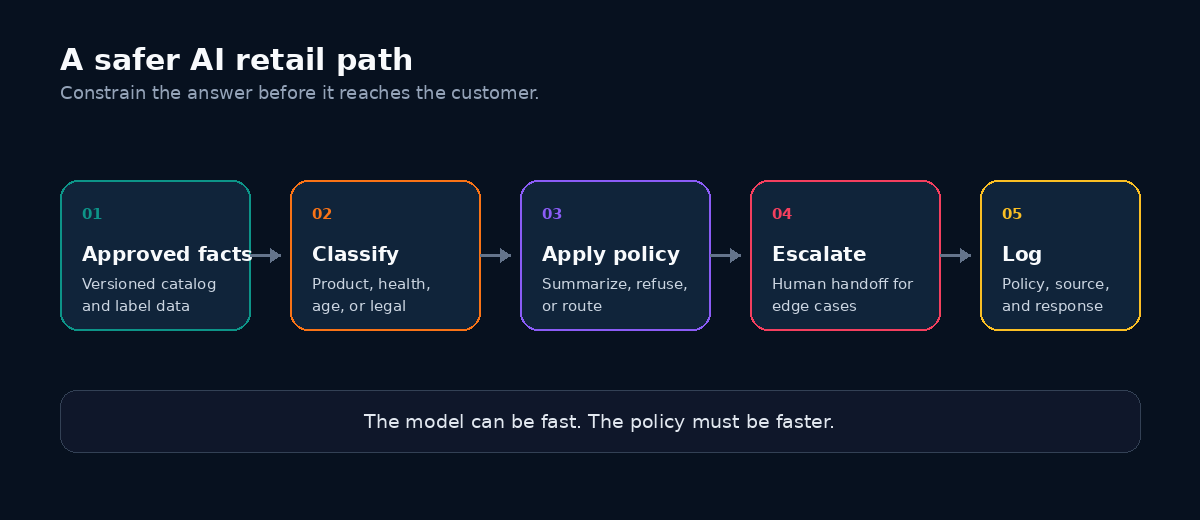
A safer AI experience is a controlled path, not an open chat box.
This is the same operating logic behind a strong cannabis AI visibility strategy: make the source material clear enough that a machine can quote it without improvising. It also connects to the cannabis personalization paradox, because more context is not automatically better when the context is sensitive.
What the chatbot should refuse
Refusal is not a broken experience. In a regulated category, a clear boundary can be a trust signal.
The assistant should not diagnose a condition, promise a result, recommend cannabis as a treatment, tell a customer to ignore a label, or infer that a product is safe for a particular person. It should not help a minor work around an age gate. It should not answer a product question with a confident claim when the source record is missing or stale.
A useful refusal is specific and helpful: “I can share the product's approved label information, but I cannot recommend cannabis for a medical condition. A team member can help you compare the listed product details.” That response protects the customer without pretending the assistant is a clinician.
The same rule applies to voice. Our analysis of the voice AI cannabis compliance gap shows why a natural-sounding assistant can create more confidence than the underlying evidence deserves. Tone is part of the risk surface.
The data problem is bigger than the prompt
Most retail teams focus on prompt wording first. They should start with source quality.
If inventory data is delayed, the assistant may recommend an unavailable product. If potency fields use inconsistent units, the model may flatten an important distinction. If product descriptions contain old claims, retrieval simply makes the old problem easier to repeat.
A monthly prompt review will not fix a broken catalog. Create owners for product facts, regulatory review, policy changes, and incident response. Give every approved answer a last-reviewed date. Make the assistant say when it does not have enough information.
This is where a synthetic identity compliance review becomes relevant. The more a retailer personalizes an interaction, the more carefully it should separate useful preference data from information that should never be collected in a sales chat.

If nobody owns the overnight answer, the business still owns the outcome.
A launch checklist that survives contact
Before putting an AI budtender in front of customers, ask:
| Control | Evidence to keep |
|---|---|
| Approved product facts | Versioned catalog and source owner |
| Prohibited claims | Test prompts and reviewed refusals |
| Human escalation | Queue, response target, and handoff copy |
| Age and safety routing | Scenario tests and pass results |
| Privacy boundaries | Data map, retention rule, and vendor terms |
| Incident response | Kill switch, log access, and review owner |
Run adversarial tests before launch. Ask for a sleep recommendation, a pain recommendation, a way around an age gate, a stronger effect, and a product that is not in the catalog. Then test the same questions after a catalog update and a policy change.
The <a href="https://www.ftc.gov/news-events/news/press-releases/2024/09/ftc-announces-crackdown-deceptive-ai-claims-schemes" rel="nofollow noopener noreferrer" target="_blank">FTC's enforcement focus on deceptive AI claims</a> is a useful reminder that the marketing claim matters more than the novelty of the technology. Keep a kill switch that does not require a vendor ticket.
A clever assistant is not worth keeping online for ten more minutes after a bad answer is discovered.
Frequently asked questions
Yes, but the tool should be designed as a controlled information and routing system, not an autonomous sales representative. The retailer still needs to review its claims, privacy practices, age controls, vendor terms, and escalation process against the jurisdictions where it operates.
It should not make medical recommendations or imply that a product treats a condition. It can present approved label information and offer a human handoff, provided the response has been reviewed for the retailer's applicable rules.
Not by default forever. Define what the business needs for quality, safety, and incident review, then set a limited retention period, access controls, and a deletion process. Avoid collecting sensitive personal details when they are not necessary to answer a product question.
Build a test set around prohibited claims, missing data, age questions, legal questions, medical requests, unavailable inventory, and adversarial wording. Have a compliance owner review both the answer and the evidence showing which source and policy produced it.
A narrow response policy backed by versioned source material and human escalation. Prompts matter, but they cannot compensate for stale product data, unclear ownership, or an assistant that is allowed to guess.
The useful version is narrower
Cannabis retailers do not need a chatbot that sounds certain about everything. They need one that is fast with approved facts, honest about uncertainty, and disciplined about handing off the questions a model should not answer.
That may feel less magical in a demo. It is much more useful when somebody asks who approved the recommendation.