Three days ago, Dutchie announced Consumer AI with voice calling. Treez launched Winston, an AI teammate platform. BLAZE is shipping Herbie, an AI budtender. All three are production-ready. All three are compliance minefields.
Voice AI and agentic commerce, where an AI actually takes action (not just chats), sound great in a demo. An AI answers your phone at 2 AM. Books a delivery. Upsells. Corrects product info on the fly. For a dispensary stretched thin, it looks like a miracle.
But in a regulated market where your state requires age verification, your customer data is sensitive, and a single hallucinated recommendation could violate product labeling law, "revolutionary" becomes "liability."
This is what operators need to know before they flip it on.
The Shift: From Chatbots to Agents
Chatbots answer questions. Agents take action.
An older chatbot says, "We have that product in stock." An AI agent actually places a reservation, updates your inventory system, and confirms it in real time. On the phone. While a human hears a voice they might not realize is synthetic. And suddenly you have liability questions your POS system was never designed to answer.
Here's what just shipped:
<a href="https://www.cannabisbusinesstimes.com/vendor-news/news/15827719/dutchie-launches-consumer-ai-featuring-voice-ai-agentic-commerce-register-copilot-and-consumer-pulse" rel="nofollow noopener noreferrer" target="_blank">Dutchie's Consumer AI</a> lets dispensary customers call or message and get an AI agent that handles questions, recommends products, and processes transactions. <a href="https://www.prnewswire.com/news-releases/winston-launches-ai-teammate-for-cannabis-other-regulated-industries-302793643.html" rel="nofollow noopener noreferrer" target="_blank">Winston</a> is a standalone AI teammate for cannabis operators that integrates compliance, inventory, and customer data. BLAZE's Herbie provides personalized product recommendations at checkout.
All three claim compliance as a selling point. All three create new failure modes regulators haven't ruled on yet.
That gap, between what the tech can do and what state regulators have explicitly allowed, is where operators are stuck.
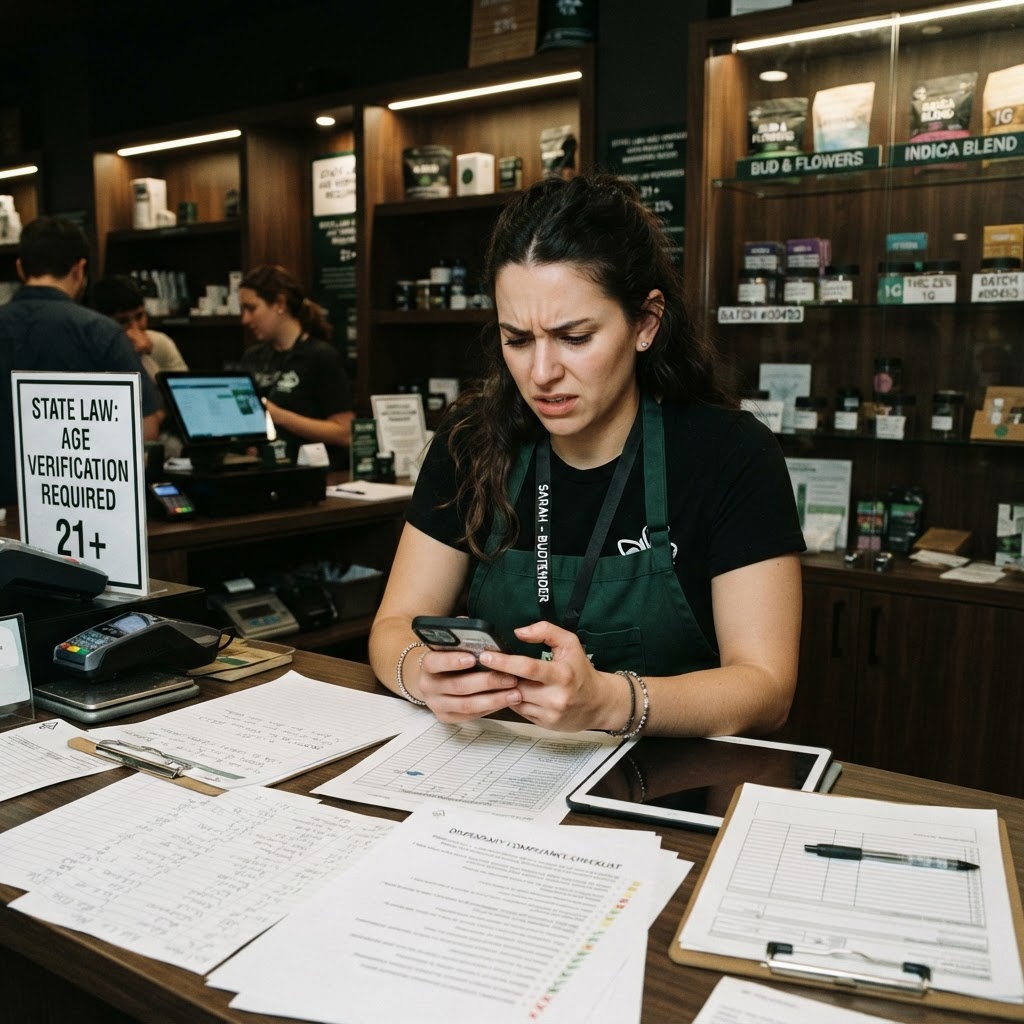
Your budtender isn't checking compliance. Your AI won't either, unless it's programmed to.
What Voice AI Actually Delivers
The pitch is clean, 24/7 availability without hiring overnight staff, faster recommendations than a human budtender, reduced labor cost per transaction, automated upsells, sentiment analysis that flags upset customers before they leave a bad review.
On paper, that's real ROI.
In practice:
- Product accuracy depends on your data. If your Metrc sync is slow or your inventory system is out of date, your AI will confidently recommend out-of-stock products or wrong THC levels. A human budtender would ask. An AI agent won't.
- Voice introduces identity uncertainty. When a customer calls and hears a voice, they may not know it's AI. They may believe they're talking to a human. If that AI misrepresents a product or age-gates incorrectly, who's liable?
- State rules are incomplete. Most states have not written specific disclosure rules for AI agents in cannabis retail. Some require written consent before AI contact. Others don't. You'll be the test case.
The reality is that voice AI is powerful but fragile. It works beautifully until it fails catastrophically.
The Compliance Paradox
California requires written consent before contacting a customer for marketing. It's unclear whether a voice AI leaving a voicemail counts. Colorado requires age verification at every transaction. If an AI agent misses an age gate or gets overridden, who violated state law? The dispensary, the platform, or both?
Schedule III reclassification (April 2026) was supposed to clarify federal rules. Instead, it created more uncertainty. States maintain their own enforcement, and the gap between state-to-state rules is where AI falls through.
Some states explicitly allow AI for product recommendations. Others are silent, which means operators are taking a risk.
Nevada, the other major market, requires clear audit trails for every recommendation and sale. An AI agent that can't produce a clear transcript of why it made a recommendation becomes non-compliant the moment someone questions the sale.
This is the paradox, voice AI is most useful in high-complexity scenarios (late-night calls, complex medical interactions, experienced customers), but those are exactly the scenarios where regulators are watching closest.
Private Data, Amplified Liability
Cannabis customer data is among the most sensitive in retail.
Unlike a coffee shop, your dispensary records who bought what and when. In many states, that data is legally protected, sometimes under medical privacy rules, sometimes under state privacy laws. If a customer's cannabis purchase history is exposed or misused, the liability isn't just reputational, it's potentially PIPA/FERPA-level contractual violation.
Voice AI platforms store call recordings (for quality, training, compliance review). Those recordings contain customer names, purchase history, medical conditions, and sometimes real-time location data. If that voice data is breached or sold to a third party, your dispensary is liable.
Dutchie claims encryption and compliance controls. So does every other platform. But a breach in their infrastructure becomes your breach. Your customer lawsuit. Your regulatory penalty.
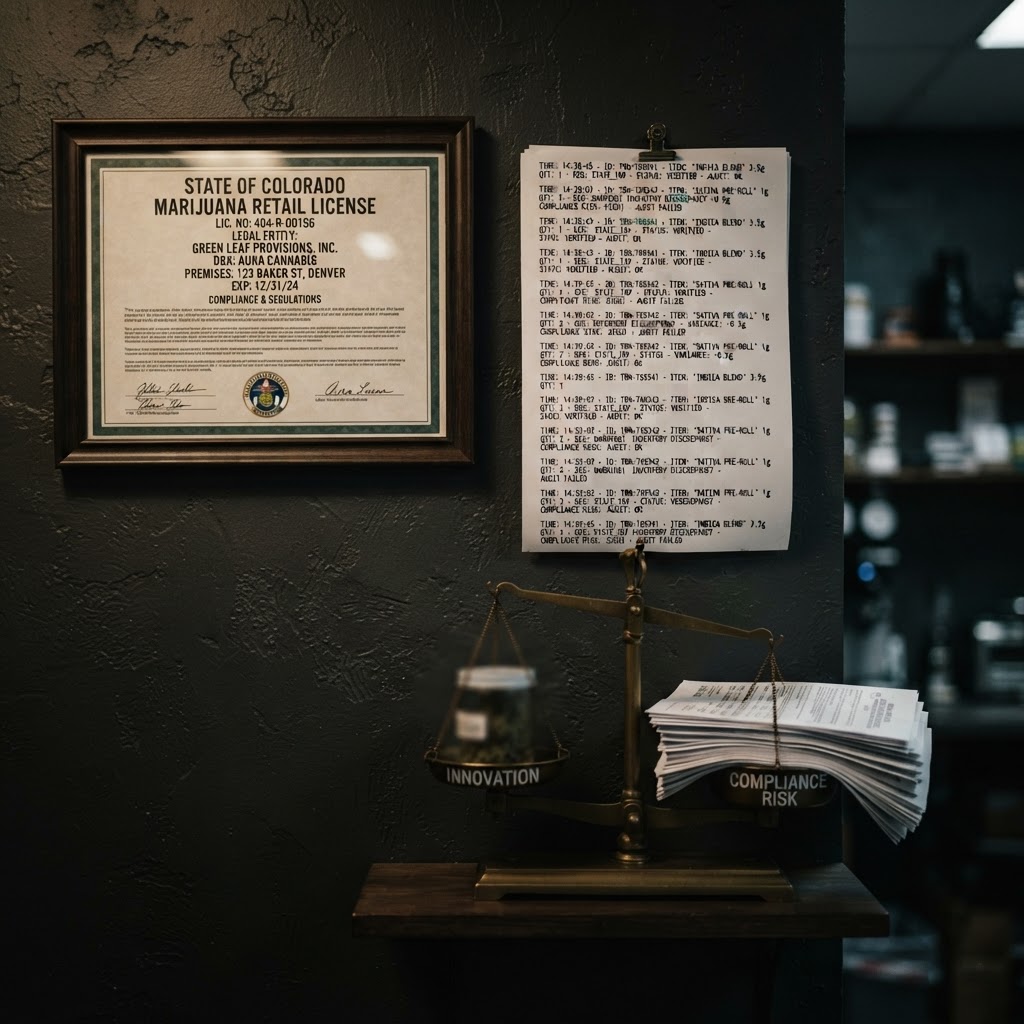
Your license is the collateral. The AI platform is not.
Before you deploy, ask these critical questions:
- Where does the voice data live?
- For how long?
- Who else in the platform ecosystem has access?
- What's the data breach disclosure timeline?
- What's your liability cap in the contract?
Most contracts have liability caps that don't cover the actual cost of a breach in a regulated market.
Hallucinations Hit Different in Cannabis
AI models hallucinate. They generate confident, wrong answers. In most industries, that's an embarrassment. In cannabis, it's a violation.
A hallucination example, an AI agent recommends a product "good for anxiety" without checking whether the product's package label legally allows that health claim. If someone relies on that recommendation and gets worse, you have a product liability case. If the state's attorney general finds it, you have a compliance violation.
Cannabis product labeling in regulated states is meticulous and deliberate. You can say "may provide relief" but not "treats" or "cures." AI models don't understand that distinction. They learn from training data that contains both compliant and non-compliant language, and they're very confident about all of it.
Treez's Winston and Dutchie's platform both claim "compliance guardrails." That usually means checking recommended products against an approved list. But what happens when a customer asks a variation the guardrail doesn't cover? Does the AI refuse or guess?
If it refuses, your customer gets frustrated. If it guesses, you get compliance risk.
What Operators Should Ask
Before your team gets excited about voice AI, think about the specific risks that apply when you're running a licensed business. If you've already read Sparksbox's <a href="https://sparksbox.com/blog/cannabis-data-privacy" rel="nofollow noopener noreferrer" target="_blank">guide to cannabis data privacy</a> or our <a href="https://sparksbox.com/blog/cannabis-age-verification" rel="nofollow noopener noreferrer" target="_blank">breakdown of age verification requirements</a>, you know that compliance gaps turn into liability fast.
Run through this checklist with the vendor:
- 1Disclosure and consent. Does your state require written or verbal consent before an AI contacts a customer? Does the platform bake that in or is it on you?
- 1Age gate. How does the system verify age on a voice call? If it can't, is there a human escalation?
- 1Audit trail. Can you export a complete transcript of every AI interaction, including why it made each recommendation?
- 1Data handling. Who owns the voice recordings and customer data? Where are they stored? For how long?
- 1Accuracy testing. Has the vendor tested hallucination rates against your specific product catalog?
- 1Liability and insurance. What does the contract say about your liability if the AI violates state law? Is it capped? Is the vendor's insurance sufficient?
- 1Operator override. Can your team quickly pause or disable the AI if something goes wrong?
- 1State-specific rules. Has the vendor validated compliance with your state's specific age verification, disclosure, and record-keeping rules?
Most platforms will say yes to all of these. Dig into the details. The word "compliant" without specifics is a red flag.
FAQ
It depends on your state. Most states haven't written explicit AI rules for cannabis retail, so you're operating in a gray zone. Some states require disclosure that you're talking to an AI. Nevada requires full audit trails. California requires written marketing consent. Before you deploy, check with your state's cannabis regulator and your compliance attorney.
Probably both of you. The customer's lawyer will sue the dispensary (you're the regulated business with assets). The dispensary's lawyers will then look at the platform vendor's contract. If there's a liability cap, the gap between actual harm and the cap could be your problem.
Not yet. Age verification requires ID verification, which requires seeing a government ID. An AI voice agent can't do that. Some platforms claim to check against a database of previous customers, but that's not age verification, that's identity lookup. If you rely on that alone, you're not compliant.
Depends on the contract. Usually, you own the data but the platform owns the service logs (call recordings, interactions, anonymized analytics). But "anonymized" doesn't mean private in a small market. A cannabis customer's purchase history can be re-identified. Make sure your contract prohibits resale and limits third-party access.
Your dispensary gets cited, not the platform. You're the license holder. The platform will argue it was a guardrail failure or that the operator should have caught it. Doesn't matter. Your license is at risk.
Depends on your risk tolerance. Some operators are deploying now and learning as regulators respond. Others are waiting for explicit rules. If you deploy, budget for compliance reviews and be ready to disable features quickly if regulators push back. Check your state's current rules first, and document what you checked and when.
Move Slow and Fix What Breaks
Voice AI in cannabis retail is real. It's shipping now. And operators who understand the compliance gaps will have an advantage over those who treat it like a consumer tech product.
The advantage isn't in being first. It's in asking hard questions before you flip the switch, documenting your due diligence, and being ready to disable features the moment a regulator objects.
Your state will rule on this eventually. Until then, the operators who move thoughtfully will be the ones who keep their licenses.