# Why Schedule III Won't Fix Your Cannabis Brand's AI Discovery
The cannabis rescheduling conversation ends the same way every time: "This will change everything."
It won't. Not for AI.
When you ask Claude, ChatGPT, or Gemini about cannabis products right now, you get answers pulled from a handful of sources. Curaleaf. Trulieve.
Green Thumb Industries. These three MSOs alone capture an estimated 17.5% of all cannabis-category AI citations across major LLM prompts. The rest of the cannabis market (hundreds of brands, thousands of dispensaries) fights over the scraps.
This concentration isn't a bug. It's the result of a two-year citation sprint that smaller brands missed. And rescheduling to Schedule III won't fix it.
Here's why, and what you can actually do about it.
The citation moat is real
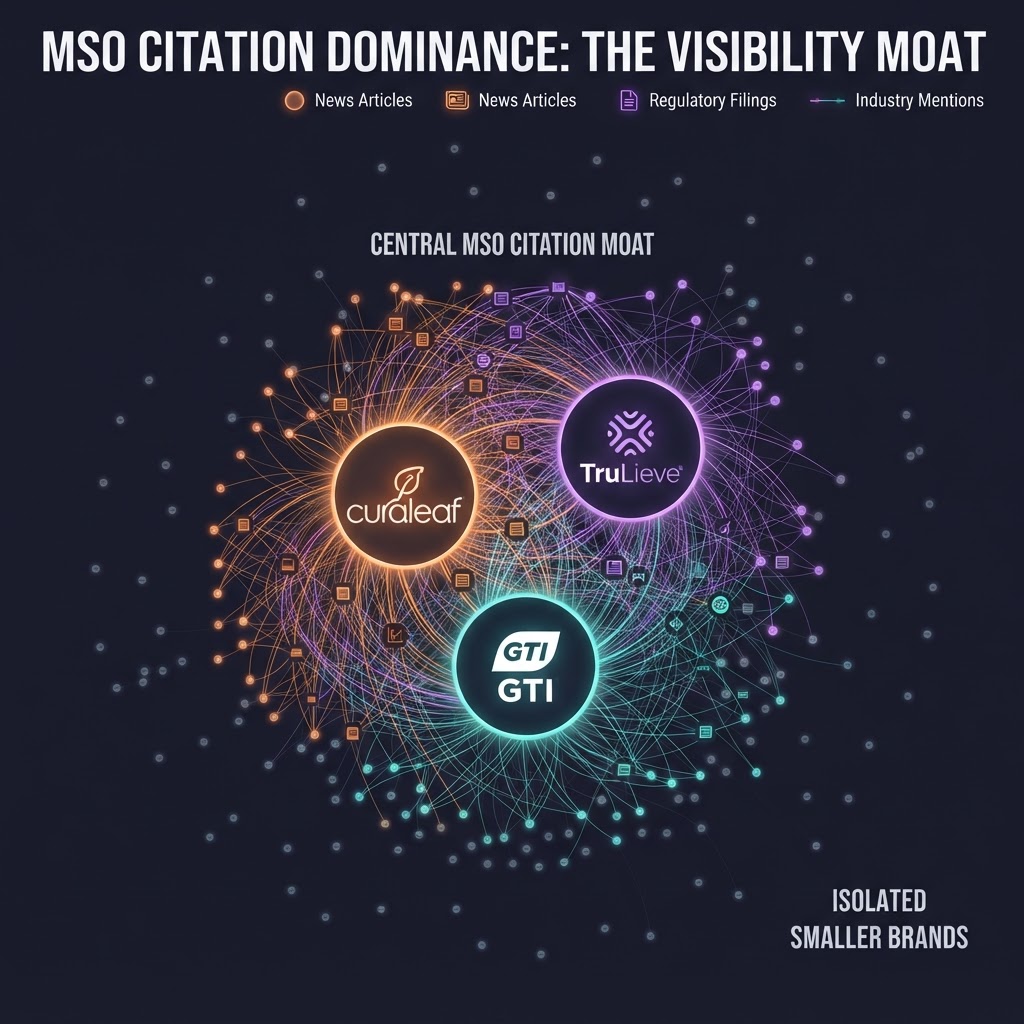
The citation moat: Large MSOs dominate AI discovery through accumulated authority and media mentions.
AI systems don't discover brands through search visibility alone. They pull from multiple sources that rank by topical authority. The 5W PR Cannabis AI Visibility Index 2026 revealed just how concentrated this is: three major MSOs capture 17.5% of all cannabis citations across LLM queries.
Large MSOs have been building citation authority since 2024:
- Dedicated PR firms filing stories to Wire Services
- Government Relations teams documenting rescheduling efforts
- Brand partnerships with major publications
- Regulatory visibility on state and federal level
When an AI system builds its knowledge base, it weights these sources by topical authority and recency. An MSO mentioned in a compliance paper carries more weight than a smaller brand's website. A regulatory filing from a multi-state operator signals to the AI model: "This entity is authoritative on this topic."
Smaller brands don't have that kind of signal weight. They're making great products, but they're invisible to the citation layer.
Schedule III doesn't reset the citation game
Yes, Schedule III will change some things. Marketing compliance rules will shift. Paid advertising on mainstream platforms will likely expand. The FDA might issue guidance on cannabis and AI.
What it won't do: give smaller brands a way to catch up on citations.
Why? Because the citation advantage compounds. Here's how:
- 1Rescheduling creates news coverage (but it's written about Curaleaf, Trulieve, and GTI because they're already established brands that journalists know). Smaller brands don't make the headlines.
- 1Regulatory access improves (but larger operators have the budget to hire lawyers and compliance consultants). Smaller operators are still figuring out which state rules even apply to them.
- 1AI systems update their training data (but they're pulling from the same news sources, industry databases, and regulatory filings where the large players already dominate).
The rescheduling moment feels like a reset. It isn't. It's an accelerator for operators who already have citation authority.
What actually moves the needle for smaller operators
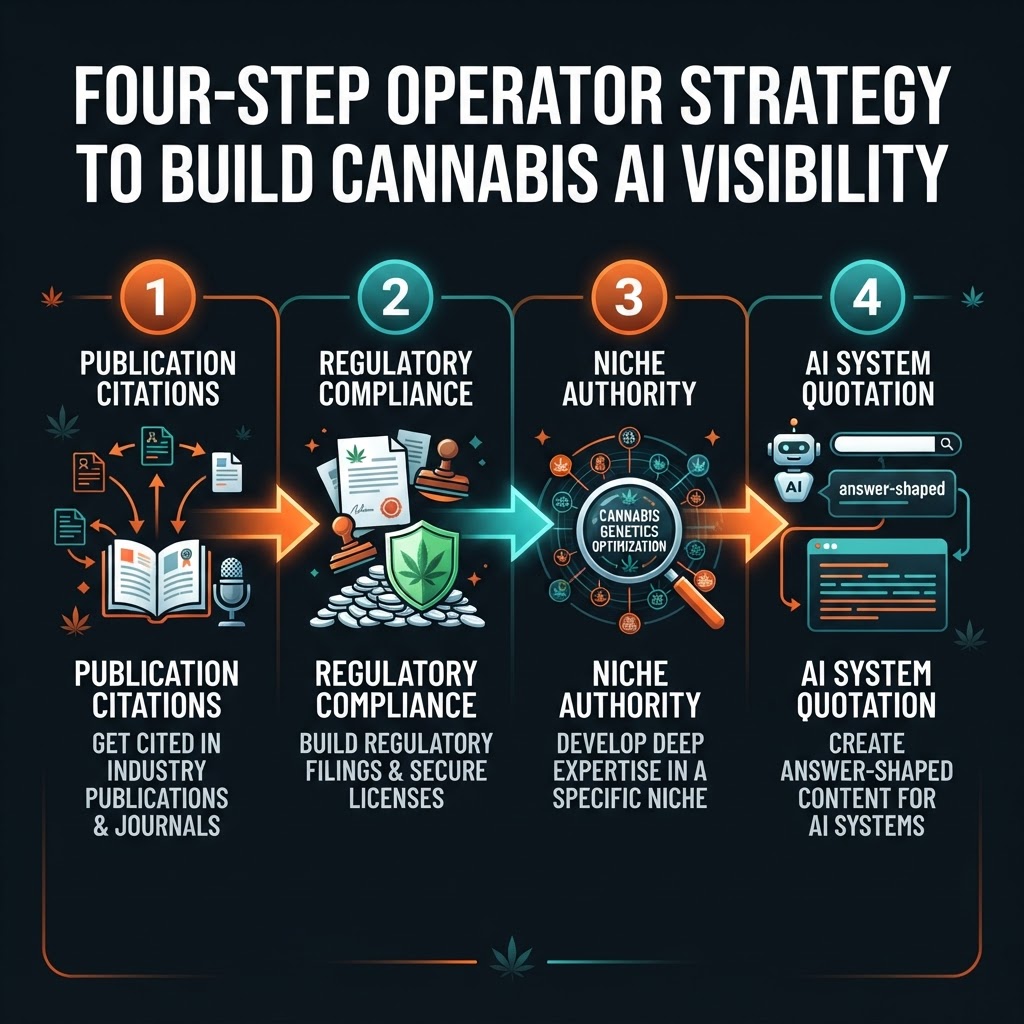
The operator playbook: Four steps to build AI discovery authority when you can't compete on brand awareness alone.
If citation authority is the moat, then the way in is credible visibility. Not flashy, not quick, but real.
1. Operator-first media placement
Skip general cannabis news. Go after operator-focused publications that AI systems treat as topical authorities. Get quoted, cited, or featured in:
- Industry trade journals (MG Magazine, Cannabis Business Times)
- Compliance and regulatory publications
- Operator guides and benchmarking reports
- Local business press in your state
An article titled "How One Colorado Dispensary Network Uses AI for Compliance" carries more weight to an AI system than general brand coverage.
2. Regulatory and legal visibility
File for any available registrations, licenses, or certifications that create public records. Get mentioned in state regulatory filings, industry associations, or compliance programs. These signals tell AI systems: "This operator is serious and documented."
3. Build topical authority in one thing
Don't try to rank for "cannabis marketing." Own a specific niche:
- Cannabis compliance in a specific state
- AI-compliant personalization for dispensaries
- Cannabis supply chain optimization
- Retail operations for independent operators
Depth beats breadth. An AI system will cite a source repeatedly if it trusts it on a specific topic.
4. Content that answers GEO queries
Create answer-shaped content that AI systems will actually quote. When someone asks "Can I use AI chatbots for cannabis recommendations in California?", you want your operator guide to be what the AI returns.
This isn't about ranking on Google anymore. It's about ranking in Claude, ChatGPT, and Gemini's training data for the next cycle. Start with [focused cannabis marketing strategies that work for your specific operator type](https://sparksbox.com/blog/ai-detection-evasion-regulated-2026/).
The real opportunity (and the real risk)
Rescheduling will accelerate cannabis AI applications in 2026 and 2027. More consumers will ask AI systems for product recommendations, dispensary info, and compliance guidance. The citation layer will become more valuable.
For operators who've already built citation authority, this is a profit moment. They capture more of the AI-driven traffic.
For operators building from scratch, the window is narrowing. The citation moat gets higher every quarter.
The risk isn't federal law. It's being invisible to the systems consumers trust. Sparksbox helps operators build visibility through operator-focused strategies that actually work in the AI era.
FAQ
A: Schedule III will accelerate AI adoption in cannabis marketing, but it won't change the AI discovery layer. MSOs that built citation authority first will strengthen their lead. Smaller operators need a different strategy focused on topical expertise.
A: AI models pull from news coverage, regulatory filings, industry publications, and review signals. They weight sources by topical authority. Brands with strong media presence and regulatory visibility rank higher in AI responses.
A: Not on brand awareness. But they can own a specific niche (a state, a compliance topic, a type of operator) and build topical authority in that area. Depth beats breadth in AI discovery.
A: Operator-focused media placement (not general cannabis news), regulatory visibility, deep expertise in one topic, and content shaped for AI systems to quote. Skip the flashy PR; focus on building real credibility with industry publications. Learn more about building compliance-first cannabis marketing.
A: Websites don't directly influence AI discovery. What matters is whether your content gets cited in news, regulatory filings, and industry publications that AI systems treat as authoritative sources.
A: Not soon. The next wave of AI model updates (late 2026 into 2027) will pull new training data. Citation authority will continue shifting. The advantage goes to operators who continuously build visibility, not those waiting for the next regulatory change. --- *This post reflects the current cannabis marketing landscape as of July 2026. Cannabis regulations, AI model updates, and industry consolidation continue to evolve. Always verify compliance requirements with your legal team.*