# The Ad Revenue Fantasy Killing OpenAI's Credibility
The gap between what OpenAI thinks will happen and what can actually happen isn't a forecast miss. It's a fantasy.
In April 2026, OpenAI projected $2.5 billion in ChatGPT ad revenue for this year, with a path to $100 billion by 2030. That's ambitious. That's also impossible. And eMarketer's latest research already proved it.
eMarketer's ceiling for the entire chatbot ad market is $5.41 billion. Not just ChatGPT. The entire category. Every model. Every platform. That's it.
OpenAI isn't off by a few percentage points. They're off by 90 percent. Their $100B bet assumes they can capture nearly 2,000% of a market that doesn't exist.
This isn't a problem with the forecast. It's a problem with the thinking.
When Ambition Breaks Math
The most generous interpretation is that OpenAI's leadership genuinely believes ChatGPT ads will become a major business. The reality suggests they're confusing TAM (total addressable market) with imagination.
Here's what's actually happening in ChatGPT advertising right now:
- OpenAI removed the $50,000 minimum spend threshold to attract smaller advertisers, which means the channel is shrinking, not growing
- Early adoption rates are flat, not rising
- Pricing pressure is forcing down what OpenAI can charge per ad impression
- Budget allocation from brands is happening elsewhere: toward search, social, video
The channel isn't growing. It's consolidating.
But OpenAI's 2030 projection assumes exponential growth, brand migration at scale, and margin expansion. All of these are happening in reverse.
Compare this to how smart brands handle AI marketing strategy. They test incrementally, measure real outcomes, and scale only when data justifies it. OpenAI is doing the opposite.
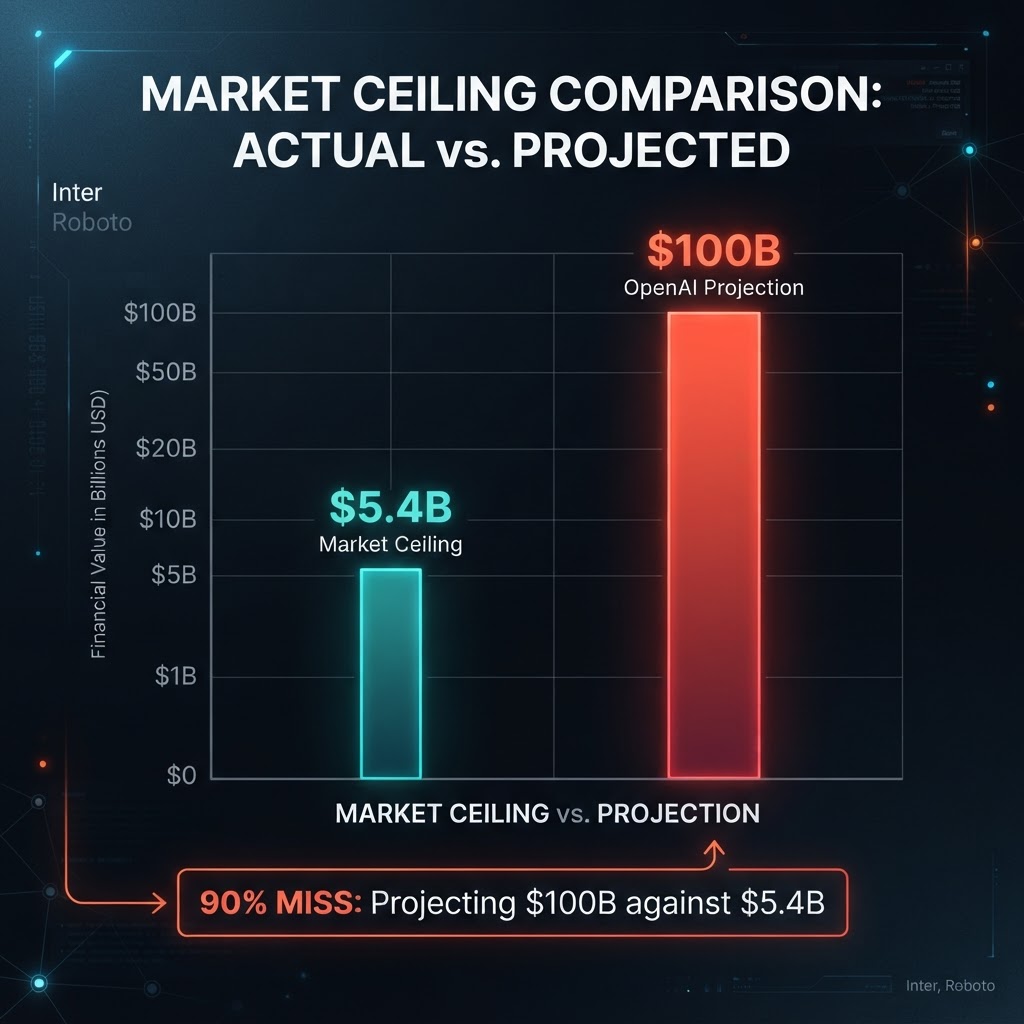
The 90% miss: eMarketer's market ceiling ($5.4B) vs. OpenAI's $100B projection for 2030
Why This Matters for Your AI Marketing
This isn't just about OpenAI's P&L. It's a signal about how the entire AI industry thinks about monetization.
When a company with OpenAI's resources, brand, and technology projects $100B in revenue from a $5B market, they're not wrong on a detail. They're wrong on a principle. They're assuming the market will warp to fit their ambition, rather than accepting that markets have gravity.
The same pattern is playing out across the AI advertising industry:
- Platforms are lowering minimum spends because adoption isn't meeting targets
- Attribution is collapsing, which means brands can't justify ad spend
- Performance decay is accelerating, which means the ads are getting worse, not better
Brands without clear ROI attribution typically cut 30-50% of their AI marketing budgets within 12 months of launch. That's not a growth rate. That's a retention problem.

The reality: teams scrambling to justify AI ad spend when traditional attribution breaks down
The Real Issue: Measurement Collapse
OpenAI isn't alone in this. Half the AI companies in martech right now are building their financial models on assumptions that have no basis in how marketing actually works.
The problem: You can't scale ad revenue in a market where attribution is broken.
If you can't measure ROI, you can't justify spend. If you can't justify spend, budget doesn't flow. If budget doesn't flow, revenue is capped by brand loyalty and sunk cost bias, not market demand.
OpenAI knows this. Their engineering team is world-class. So why are they projecting $100B?
The honest answer is probably this: because they have to. Investors demand growth narratives. If OpenAI walks into a meeting and says "ads will be a small, slow-growing revenue stream," the valuation takes a hit. If they say "$100B by 2030," suddenly there's a fairy tale to believe in.
But fairy tales don't scale to $100B.
What Actually Happens Next
OpenAI's ad business will probably hit $1-2B by 2030. That's real money. It's also $98B less than they're projecting.
When that gap becomes obvious, probably in 2028 or 2029, OpenAI will either:
- 1Quietly revise the forecast down
- 2Pivot and claim ads were never the real growth driver anyway
- 3Acquire some ad tech or marketing platform to make the numbers work artificially
The market will move on. Another AI company will make the same bet with the same math and get the same result.
Here's the pattern: AI companies are optimizing for investor narratives, not market realities. Until that changes, every "unicorn valuation" for an AI ad platform is just a bet on delusion.
That's why understanding your own AI marketing ROI is critical right now. When the industry's math falls apart, the brands who've been measuring real outcomes will have the only thing that matters: proof.
Read more about why AI attribution is hiding your real ROI and how agentic systems break marketing measurement.
Frequently Asked
It's growing relative to where it started (near zero), but it's growing slower than OpenAI projected. eMarketer's analysis shows adoption plateauing in Q2 2026. The channel hasn't hit a wall yet, but growth is decelerating, not accelerating.
Even then, it's $3.2B. Not the $100B they're projecting. And they're currently fighting for share with Google, Meta, and newer AI platforms. Capturing 60% would require displacing one of those incumbents entirely, which hasn't happened in digital advertising.
Test ChatGPT ads if you want. But don't allocate significant budget based on OpenAI's growth narrative. Measure what actually works in your category. Compare ROI to search and social. Move money where the data points, not where the story points.
Yes. Many are projecting growth that exceeds addressable market size. It's a Silicon Valley norm. But when the gap between projection and reality gets too wide, capital moves elsewhere, and the company has to justify much smaller growth rates to its investors.
Probably not until late 2027 or early 2028. Companies usually give themselves 18-24 months before admitting projections were overoptimistic. By then, investor expectations will have shifted anyway.
Not yet. Keep watching. Test small. But plan your 2026-2027 budget around channels with proven ROI and predictable unit economics. AI advertising channels are still too young to be a primary driver.