Cannabis retail has always been different because it has always been about the person behind the counter. The budtender who knows the difference between terpene profiles, who remembers that a customer prefers flower over edibles, who builds credibility through repeated interaction and genuine expertise.
That model worked when the store base was smaller, more concentrated, and easier for brand teams to influence through rep relationships. It breaks when the retail footprint becomes broader, more fragmented, and more dependent on digital recommendation surfaces.
The problem is not that budtenders are disappearing. The problem is that trust has become inconsistent. A knowledgeable budtender in Denver makes a brand's products more credible. A bored, undertrained budtender in Phoenix undermines that same brand's positioning. Margins get compressed, customer retention suffers, repeat purchase rates vary wildly by location.
What is social proof in cannabis retail?
Social proof is the credibility signal a customer relies on when they don't have personal experience with a product. In cannabis retail, social proof has historically come in three forms: the budtender's recommendation, peer word-of-mouth, and visible product velocity (what other people are buying right now).
For a long time, the budtender was the dominant form. They were the trusted gatekeeper who translated a confused customer's needs into a specific SKU. Brands built sales playbooks around influencing that gatekeeper. Sampling programs. Education portals. Rep relationships. Spiff incentives.
That playbook only worked while every budtender met a baseline competence level. As the dispensary count grew faster than the trained-budtender pool, the variance exploded. A brand could no longer count on every store delivering the same recommendation experience.

*Trust used to travel through people. Now it travels through algorithms. That is a different asset to protect.*
How is algorithmic curation filling the budtender gap?
What fills the gap is not better budtender training. It is transparent, consistent, algorithmically-curated social proof. Customer reviews, consistently displayed. Third-party lab results, always visible. Purchase history patterns, shown to similar customers. Ratings aggregated across locations.
The Silly Nice budtender education portal, launched this week in New York, is one signal of where retail is heading. The deeper trend is quieter. Retail locations are building recommendation engines that replace inconsistent human judgment with consistent data.
A customer walks in and sees not just what a budtender thinks they should buy, but what customers like them have actually bought. What works. What has the highest verified ratings. What pairs well with their purchase history.
The budtender does not disappear. Their credibility is no longer the sole input. It is one input, weighted alongside aggregate customer data, verified reviews, and algorithmic similarity.
Editor's Note: We covered the deeper version of this transition in AI Budtenders Are Quietly Replacing Cannabis Expertise. The social proof collapse is the customer-side mirror of what's happening on the recommendation side.
Why are regulated brands losing control of in-store recommendation?
For brands built on budtender relationships and retail rep relationships, this shift is uncomfortable. A budtender's personal recommendation was a controlled moment. The brand could influence it through sampling, education, relationship-building.
An algorithmic recommendation is transparent but opaque to brand control. If a competitor's product has better reviews, the algorithm surfaces it. If a customer's peers rated a different product higher, that becomes the visible recommendation. The brand's credibility is now dependent on aggregate customer behavior, not on relationships with gatekeepers.
Margin pressure in cannabis retail is partly a social proof problem. Brands that built trust through human gatekeepers are now competing with brands that have earned consistent customer approval. The dispensary becomes more like Amazon, where the algorithm is the trusted voice.
The playbook changes. You cannot control algorithmic curation the way you could control a budtender relationship. You can influence it by earning genuine customer loyalty and reviews.
You can support it with transparency, consistent product quality, and verifiable claims. The trust gap between budtender and AI is narrowing, and that narrowing favors brands with strong product-level signals.
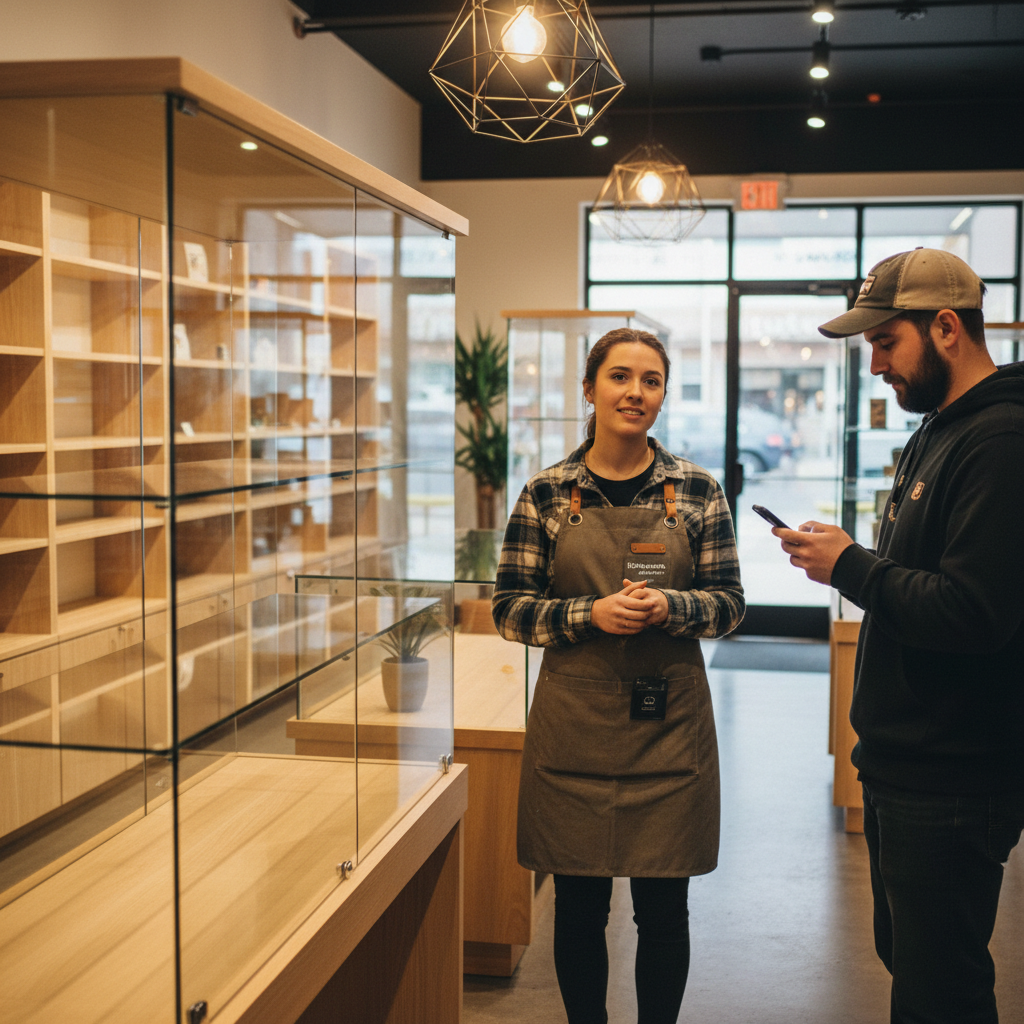
*When the recommendation comes from a screen instead of a person, the relationship changes.*
What does winning the new social proof look like?
There's a clear pattern in which brands are weathering this transition vs. which are getting compressed.
| Brand posture | What they're doing | Outcome |
|---|---|---|
| Doubling down on budtender relationships | Reps, sampling, spiffs, education portals | Slowing margin erosion, but not reversing it |
| Investing in customer experience | Genuine post-purchase follow-up, consistent product quality, review prompts | Algorithmic curation favors them |
| Lab data and transparency | Publishing terpene profiles, COAs, effect data | AI Overviews and dispensary algorithms surface them |
| Pretending nothing changed | Old playbook, no review velocity strategy | Margin compression, slow stockouts replaced by competitors |
The brands that get this are investing in customer experience that generates real reviews and repeat purchases. They are also being transparent about lab results, strain profiles, and effects data in a way that fills the void inconsistent budtender knowledge used to occupy.
Brands trying to hold onto budtender-relationship-dependent positioning are finding their advantage compressed. The inconsistent budtender who loved your product is no longer enough. The algorithm will show it to people who want that product type, but it will also show them the competitor's version with higher verified ratings.
The dispensary shelf is becoming a signal layer. Every placement, every review, every customer interaction feeds into the data that determines what appears as a recommendation.
The retail store is no longer separate from media and curation, and cannabis retail is proving it first. For brand teams thinking about how to operationalize this, our dispensary marketing approach covers the data architecture side.
How to rebuild social proof for the algorithmic era
If you're a regulated brand reading this and realizing your old playbook is breaking, here's the order of operations that's working in 2026.
- 1Audit your current review velocity. How many genuine, verified customer reviews are tied to each SKU per month? If it's under 10 across all dispensary listings, your algorithmic visibility is starving.
- 2Build a post-purchase review request flow. SMS or email, sent 2-7 days after purchase. Make it easy. Aim for a 20%+ response rate.
- 3Publish your COAs (Certificates of Analysis) and terpene data publicly. Algorithms can ingest structured data from your site. Buried PDFs do not count.
- 4Train budtenders to point customers toward review platforms, not just to recommend products. The smartest brands are turning the budtender into a review-velocity driver instead of a recommendation gatekeeper.
- 5Track algorithmic placement, not just budtender mindshare. The KPI that matters in 2026 is "where does my SKU rank in the dispensary's recommendation engine for similar customers." Most brands aren't measuring this.
The social proof collapse is not a problem to fix. It is a transition to embrace. Build credibility with customers, not just budtenders. Earn your ratings. The algorithm will do the rest.
FAQ
The shift away from budtender-as-trusted-gatekeeper toward algorithmic curation that aggregates customer reviews, lab data, and similarity matching. Caused by dispensary count outpacing trained budtender supply, leading to inconsistent recommendation quality across markets.
The cannabis retail footprint has become broader and more fragmented than the old relationship-led playbook was built to manage. Trained budtenders have not scaled evenly across markets, which means brands can no longer assume a consistent recommendation experience across their distribution footprint.
BDSA and Headset consumer data shows that a majority of dispensary shoppers now consult reviews or in-store ratings before purchase, even when a budtender is available. Review recency matters more than raw count. A SKU with 50 recent reviews often outranks one with 300 old reviews.
Yes, but on different signals. Small brands can win on review quality, COA transparency, and category-specific niches that MSOs don't optimize for. The MSOs win on data scale. The independents win on signal strength per SKU.
Review velocity per SKU per month, average review rating per SKU, share of dispensary recommendation surface (where does your product show up in algorithmic recommendations vs. competitors), and review recency. Branded search volume is also a strong signal because algorithms can't filter you out of branded queries.
No, their role is changing. Sales associates are becoming review-velocity drivers, education resources, and complex-consultation specialists. The transactional discovery moment ("what should I buy?") is increasingly algorithmic. The relationship and education moments remain human.
Realistic timelines are 6-12 months to establish meaningful review velocity per SKU, 12-18 months for that velocity to translate into consistent algorithmic placement, and 18-24 months for the new social proof posture to stabilize. There are no shortcuts.
2026 evidence and control update
The FTC's final rule banning fake reviews and testimonials makes provenance a marketing control, not a nice-to-have. Its review rule Q&A also keeps endorsement proof close to the claim.
For cannabis operators, California DCC advertising guidance adds the regulated-category layer: proof should show who said it, where it appeared, what claim it implied, and who approved reuse.
| Control area | Why it matters now | What to document |
|---|---|---|
| Data source | AI quality depends on the inputs behind the answer | Vendor feed, POS field, menu source, or policy document |
| Rule layer | Cannabis rules still vary by market and channel | State rule, platform policy, age gate, claim restriction |
| Human review | Edge cases should not be decided only by automation | Reviewer, escalation threshold, approval or rejection note |
| Evidence trail | Future audits need more than screenshots | Timestamp, prompt/output pair, creative version, final URL |

