The AI-native agency story gets told badly. Most people make it about tools, prompts, and how fast a junior person can make a draft.
That misses the actual math.
An AI-native agency is not a normal agency with ChatGPT open in another tab. It is a different operating model: fewer handoffs, more builders, tighter source systems, faster iteration, and pricing that rewards outcomes instead of time spent. The agency stops selling hours and starts selling production judgment.
That sounds clean until the client asks the only question that matters: can the system survive real work?

The economic shift is not only speed. It is what happens when production work stops moving through a long specialist queue.
The hour model breaks first
Traditional agency economics depend on time. A strategist scopes, a copywriter drafts, a designer designs, a media buyer launches, an analyst reports, and an account manager keeps everyone moving. That model can work, but it has one awkward problem: the value is tied to labor even when the client is buying outcomes.
AI exposes that mismatch.
If the same strategic brief, landing page, email sequence, creative variants, and reporting deck can be produced with a smaller senior team and a better system, billing by hours starts to punish the agency for being good. The agency that ships in 8 hours instead of 40 either bills less or starts hiding efficiency. Neither is a serious business model.
That is why large networks and consultancies are talking more openly about AI, output pricing, and outcome-based work. WPP's AI positioning is one signal from the holding-company side.
McKinsey's State of AI research points to the same broader shift: adoption is real, but the value depends on redesigning workflows, not sprinkling models over old processes.
The operating model changed
The best AI-native agencies are not replacing specialists with one prompt person. They are collapsing the distance between strategy, production, data, and technical implementation.
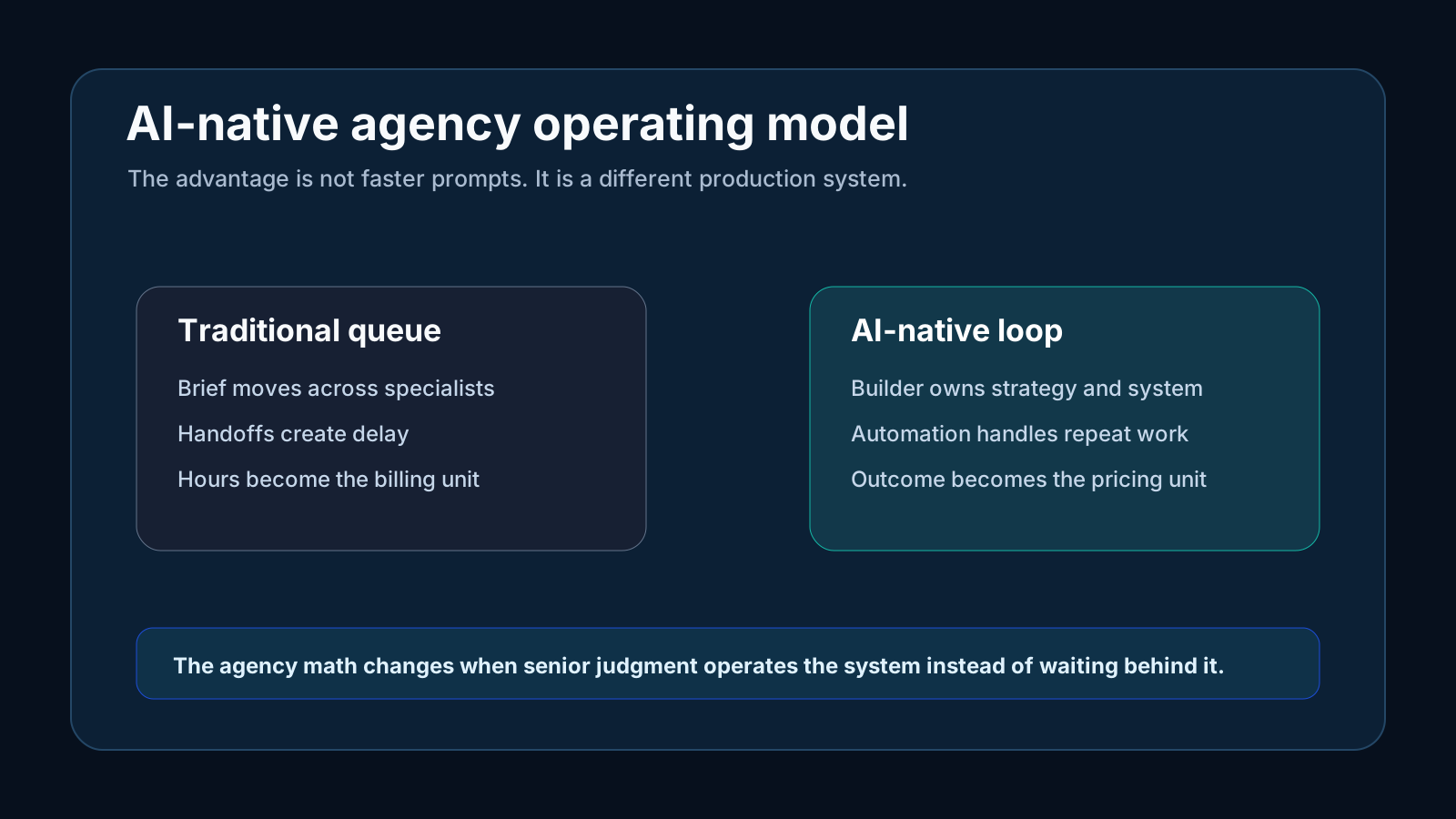
A traditional agency might route one campaign through five teams. An AI-native shop may put one senior strategist-builder on the system, supported by specialist review where it matters. That person can write the brief, build the research workflow, generate the first production set, wire the analytics, and inspect output quality.
The role is closer to a go-to-market engineer than a copywriter. It combines marketing judgment, automation design, prompt quality, light code, data hygiene, and client context.
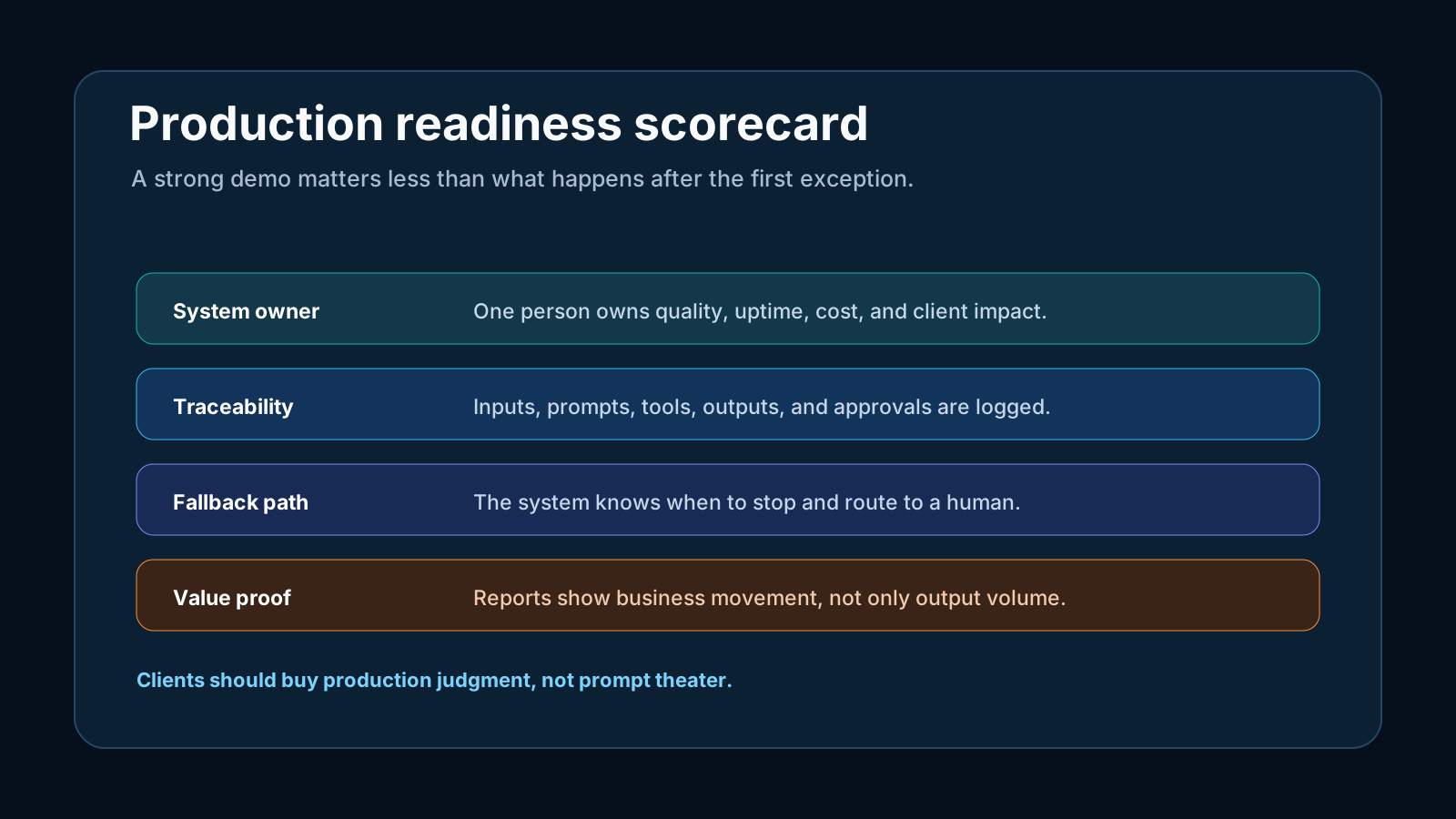
That combination matters because AI systems are brittle when they are detached from the real workflow. A prompt can produce a clever campaign. A production system needs source material, approval rules, fallback paths, measurement, and someone accountable when the output is wrong.
The demo-to-production gap
Most agency AI pitches still over-index on demos. A demo can make twenty campaign ideas, five landing page versions, and a synthetic research summary in minutes. That is useful, but it proves very little.
Production asks harder questions:
- Where did the source data come from?
- Which claims are allowed?
- Who reviews legal or compliance risk?
- What happens when the model misses context?
- How are costs tracked?
- What output improved the business?
Anthropic's guidance on building effective agents makes a useful distinction between workflows and agents. Predictable work should usually be a workflow.
Flexible work can justify agents, but only when the monitoring burden is worth it. OpenAI's Agents SDK documentation also treats tools, handoffs, guardrails, and tracing as first-class parts of the system.
That is the real agency opportunity. Clients do not need more people making magical demos. They need production-safe systems that keep running after the sales call ends.
Pricing follows accountability
AI-native pricing has three practical layers.
| Model | What the client buys | Where it works |
|---|---|---|
| System retainer | Strategy, workflow buildout, monitoring | Ongoing growth and operations |
| Deliverable pricing | Defined assets or launches | Content, landing pages, campaign packages |
| Outcome bonus | Shared upside tied to agreed metrics | Paid media, SEO, retention, pipeline work |
Pure hourly billing is the weakest fit because it does not reward system design. Pure outcome pricing sounds attractive, but attribution gets messy quickly. A client may want revenue accountability while giving the agency no control over sales follow-up, inventory, pricing, or approvals.
The stronger model blends the three. The agency gets paid to build and operate the system. The client gets predictable output. Both sides can attach bonuses to outcomes the agency can actually influence.
That is especially important for regulated categories such as cannabis, healthcare, legal, energy, and finance. The production system has to include review, source control, and claims discipline. Speed alone is not the value.
The new margin is judgment
AI does reduce production cost. But the best margin does not come from replacing every human touch. It comes from removing low-value touches so senior judgment can show up where it matters.

AI-native pricing works when the agency gets paid for system value instead of raw hours.
A weak AI-native agency uses tools to make more stuff. A strong one uses tools to make fewer, better decisions faster.
That difference shows up in the work:
- Research is tied to sources, not loose summaries.
- Brand voice is tested against examples, not vibes.
- Content is linked to search intent and conversion path.
- Paid media learns from closed-loop data, not vanity metrics.
- Reporting explains decisions, not only activity.
This is where Sparksbox's own model sits: AI-native marketing with operator-grade strategy and clear production standards, not generic automation for its own sake.
What changes inside the team
The team design has to change with the work. If the agency keeps the old role map and only adds AI tools, the process stays slow. Writers wait on strategists. Designers wait on writers. Analysts wait on media buyers. Account managers turn into traffic controllers for a system that should have been simplified.
AI-native teams need fewer pass-the-baton moments. They need people who can think across the whole chain: source material, customer insight, messaging, execution, measurement, and revision. Specialists still matter, but they should improve high-stakes work rather than touch every asset by default.
That is why the best AI-native teams feel smaller and more senior. They are not cutting quality. They are cutting idle motion.
What clients should ask
Before hiring an agency that calls itself AI-native, ask for proof that the system is operational.
- 1Show a workflow that has been running for at least 90 days.
- 2Show the logs or trace for one real output.
- 3Explain what happens when the system is wrong.
- 4Explain which work is AI-assisted and which work is human-owned.
- 5Show how the agency measures business movement.
If the answer is mostly about a proprietary platform, be careful. The platform may be useful, but the operating model matters more.
Good agencies can explain the boring parts. They know where the model fails. They know what should stay manual. They know which inputs are too messy. They know where clients must approve the system before it touches customers.
Why small teams can win
Small AI-native teams have one advantage the big networks struggle to copy: they can reorganize around the work without defending legacy staffing charts.
A ten-person shop can make every person more technical, every workflow more measured, and every client relationship closer to the strategist. A holding company can buy the tools, but it still has old incentives, old roles, old approval loops, and clients trained to expect a large account team.
That does not mean big agencies disappear. It means the middle gets squeezed. Generic production work gets cheaper. Senior strategy becomes more valuable. The strongest agencies move up into systems, measurement, creative judgment, and category expertise.
The AI-native agency math is not about doing the same work faster.
It is about changing what the agency is.
FAQ
An AI-native agency designs its workflows, production systems, research, measurement, and delivery around AI from the start. It does not simply add AI tools to a traditional agency process.
AI reduces the time needed for repeat production work, which makes hourly billing less aligned with value. Agencies increasingly need retainers, deliverable pricing, and outcome-linked incentives.
Look for production proof: running workflows, traceable outputs, quality controls, fallback paths, source discipline, and clear human ownership.
No. Many agency tasks are better handled by fixed workflows with AI assistance. True agents make sense only when the task needs flexible tool choice and the monitoring cost is justified.
Strategy, taste, client context, claims review, compliance judgment, relationship management, and final accountability still need people.