Cannabis brands have the data. They have loyalty programs, menus, purchase history, browsing behavior, store-level inventory, and a growing stack of AI tools promising smarter recommendations.
They still can't treat personalization like ordinary retail.
The mistake is thinking Schedule III changes that by itself. It doesn't.
As of June 27, 2026, marijuana rescheduling is still in the DEA hearing process. The Federal Register notice describes a hearing on proposed rescheduling beginning June 29, 2026, not a completed rule that makes cannabis personalization simple.
Even if marijuana eventually moves to Schedule III, the marketing problem remains. Cannabis AI personalization still has to pass federal claims scrutiny, state advertising rules, age-gating requirements, platform policies, privacy expectations, and vendor accountability.

AI personalization needs claims controls, age gates, state rules, and recommendation logs before it can safely guide...
The Recommendation Engine Wall
Every other retail category uses AI to recommend products. Fashion learns your style. Grocery learns your basket. Consumer electronics learns your budget. The engine works because the product claims are usually manageable and the compliance record is clear.
Cannabis is different because personalization can imply more than preference.
A generic cannabis menu can list product attributes. A personalized recommendation says, or at least suggests, that this product fits this person. That shift matters. If the recommendation is based on prior purchases, stated desired effects, loyalty behavior, or session history, the retailer is no longer just displaying inventory. It is shaping a regulated product decision.
The risk shows up in three places:
- 1Claims creep. The FDA says it has not approved cannabis for treating any disease or condition outside approved drug products. If the model turns product data into outcome language, the retailer has a claims issue.
- 2Age-gate friction. Personalized product content should not appear before a user is age-verified on that surface. That includes chat, SMS, app notifications, kiosks, and ecommerce menus.
- 3Data liability. The more personal the recommendation, the more the retailer has to explain which data was used, how long it was kept, and why the suggestion was allowed.

Late-night realization: the tools work, but you can't use them without the compliance layer.
Schedule III Isn't the Finish Line
The current rescheduling process matters, but it is not a marketing free-for-all. DEA's own marijuana rescheduling page and the April 2026 Federal Register notice make clear that the process is still formal rulemaking.
That means operators should stop building 2026 personalization plans around a rule that has not finished.
More important, Schedule III would not move cannabis into the same marketing posture as shoes, skincare, or snacks.
Federal scheduling is only one layer. A cannabis retailer still has to comply with state cannabis advertising rules, license conditions, age restrictions, required warnings, privacy commitments, and platform restrictions. The FTC can still challenge deceptive or unfair practices.
The FDA can still challenge product claims. State regulators can still discipline licensees.
The better planning assumption is simple: Schedule III may change tax, research, medical, and federal enforcement dynamics, but it won't make individualized cannabis recommendations low-risk overnight.
| Category | Personalization risk | Claims risk | Age-gate friction |
|---|---|---|---|
| Alcohol | Moderate | Mostly label and responsible-use controls | Purchase and delivery checks |
| Wellness | Moderate | Structure and substantiation controls | Usually lower than cannabis |
| Cannabis | High | Product-effect and implied-benefit risk | Surface-by-surface checks |
What the Data Should Show
Most cannabis personalization proposals talk about lift. Better cart value. Better retention. Better product discovery.
The compliance team needs a different dashboard.
Before a cannabis brand launches AI personalization, it should be able to answer:
- What percentage of recommendations were blocked for claim risk?
- Which product attributes are allowed to shape personalized ranking?
- Which data fields are excluded from recommendation logic?
- Which state rule set was applied to each recommendation?
- Was the customer age-verified on the exact surface where the recommendation appeared?
- How long are recommendation logs and behavioral profiles retained?
- Can the brand explain why a specific customer saw a specific product?
Without those answers, the ROI spreadsheet is pretending the hard part doesn't exist.
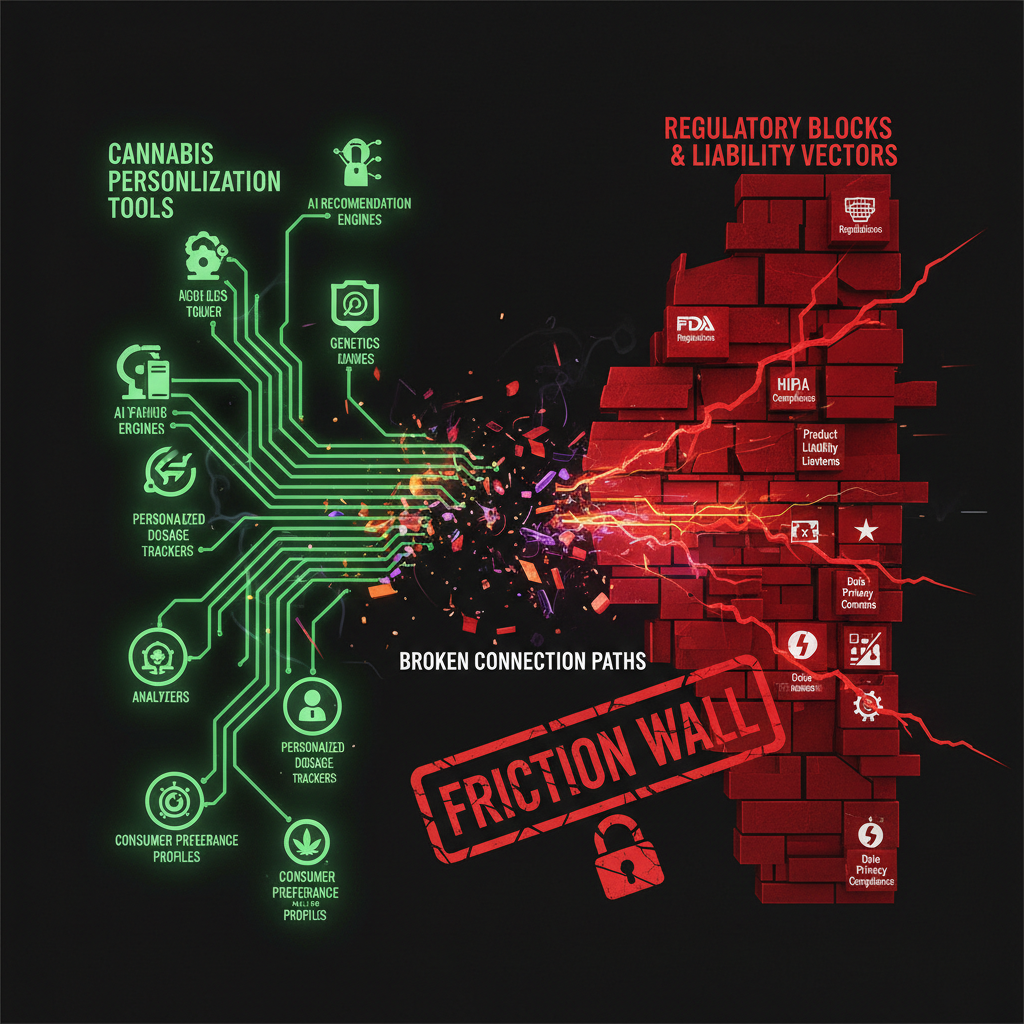
The regulatory wall isn't a bug. It's the operating environment.
Intent Is the Problem
The core issue is not that AI recommendations are bad. They can work.
The issue is that personalization creates intent. The system saw a person, used data about that person, and selected a product for that person. In regulated categories, intent matters because it can make the record easier to read.
Generic product copy says, "This product has these attributes."
Personalized cannabis AI says, "This product is relevant for you."
That second sentence is where the risk lives. Even if the model never uses medical words, it can imply fit, benefit, expected outcome, or behavioral targeting. The more confident and specific the recommendation sounds, the more the operator needs a clean record behind it.
Editor's Note: For the deeper FTC angle, see Cannabis AI Personalization Collides With FTC Disclosure Rules. For the retail-assistant version of the same risk, see AI Budtenders and Cannabis Compliance.
What Brands Are Doing Instead
The smartest cannabis operators are not giving up on discovery. They are moving toward safer forms of guidance that avoid one-to-one behavioral targeting.
- 1Category filters. Help shoppers browse by product type, price range, format, inventory status, or store availability.
- 2Staff curation. Use approved buyer picks or store-team recommendations instead of algorithmic claims about the individual.
- 3Education pages. Build product education that explains terms without promising outcomes. This also supports cannabis SEO.
- 4Compliance-safe chat. Let AI answer store hours, pickup rules, ID requirements, payment options, and product availability from approved source content.
- 5Rule-based recommendation labels. If a product appears because it is popular, new, discounted, locally available, or staff-selected, say that plainly.
None of this is as flashy as a model that says it knows what each shopper wants. It is also much easier to defend.
The Path Is Slower Than the Tools
There is a path to cannabis personalization at scale, but it starts with compliance infrastructure, not a better recommendation model.
Operators need approved knowledge bases, state-aware rules, claim blocking, retention policies, age-gate integrations, vendor documentation, and recommendation logs. They need to know what happens when a customer asks a sensitive question. They need to know who reviews the training data. They need to know whether their vendor can explain a recommendation after the fact.
That is why cannabis AI compliance automation and personalization should be built together. If the compliance layer comes later, it usually arrives as a blocker.
For most cannabis brands, legally defensible personalization is not a 2026 launch feature. It is a phased operating system: start with safe discovery, prove the audit trail, then expand only where the rules support it.
2026 evidence and control update
The more useful 2026 question is not whether why cannabis brands can't use ai personalization yet is possible. It is whether regulated cannabis retail and marketing teams can prove what happened after the system made, shaped, ranked, routed, or explained a customer-facing decision.
The less obvious issue is that the hidden record is not only the customer-facing answer, it is the product data, state rule, age gate, claim boundary, and human owner behind that answer. That record is what separates a working AI pilot from a defensible operating system.
For source alignment, the public claim language should stay consistent with California Department of Cannabis Control retail guidance and FTC guidance on AI claims. Those sources do not remove the need for local legal review, but they give the article a better evidence spine than vendor screenshots or unsupported performance claims.
This also connects to related operating risk, AI measurement gap, compliance workflow, because the same pattern keeps repeating: AI systems look clean in the dashboard while the proof, ownership, and customer context live somewhere else.
| Control layer | What to verify | Evidence to keep |
|---|---|---|
| Source data | Which approved source fed the answer, recommendation, ranking, or claim | Source URL, vendor field, timestamp, and owner |
| Decision boundary | Where the AI is allowed to help and where it must stop | Allowed use case, blocked topics, and confidence threshold |
| Human review | Who owns the exception, correction, or escalation | Reviewer role, handoff note, and approval record |
| Monitoring | How the team catches drift, complaints, or weak signals | Review cadence, sampled outputs, and customer feedback themes |


FAQ
No. As of June 27, 2026, marijuana rescheduling is still in the DEA hearing process. Even if marijuana is rescheduled later, cannabis AI personalization still has to comply with FTC rules, FDA claims risk, state cannabis advertising laws, age-gating requirements, and platform policies.
Regular ecommerce recommendations usually optimize preference and conversion. Cannabis recommendations can imply product fit, effects, or benefit in a regulated category. That makes the data, claim language, age gate, state rule, and recommendation log part of the compliance record.
Safer personalization starts with operational and low-claim surfaces: store availability, category filters, price range, staff picks, pickup rules, and approved educational content. One-to-one behavioral recommendations need stronger controls before launch.
It should show the user state or store market, age-gate status, data fields used, product attributes considered, claims blocked, rule set applied, recommendation reason, timestamp, and the version of the source content or model context.
For most operators, it will be ready when the compliance system can explain the recommendation as clearly as the recommendation engine can generate it. That means documentation, age gates, source control, state rules, claim filters, and vendor accountability have to come before broad personalization.