The promise was simple. Feed your historical sales data into an AI demand prediction engine, let the algorithm run, and your shelves would never be out of stock again. No more guessing. No more markdown hell. Just optimization.
That was the theory. In practice, regulated retailers are discovering that AI inventory systems don't predict demand so much as amplify it. When the algorithm gets it right, it's a masterpiece. When it gets it wrong (which is often), you're stuck with a cascade of problems no amount of algorithmic fine-tuning can fix.
Why does cannabis demand prediction break standard models?
Cannabis retail is uniquely brutal on forecasting systems. Unlike traditional retail with stable consumer preferences and predictable seasonality, cannabis demand shifts violently based on factors most demand models can't capture.
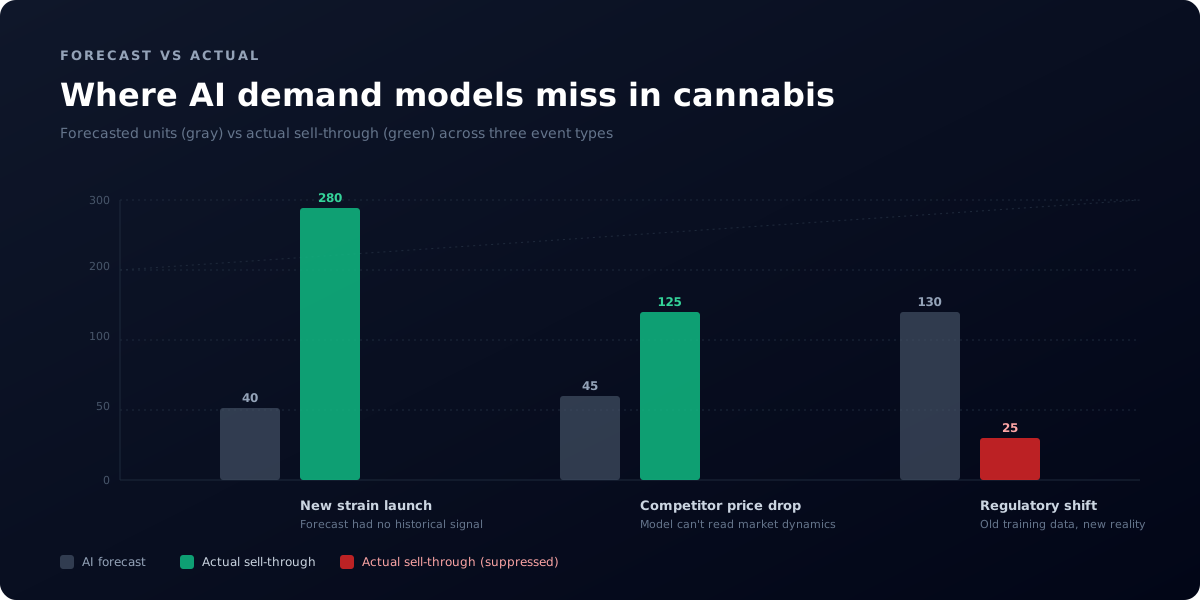
A new strain drops. Your database hasn't seen it before, so there's no historical pattern to learn from. The algorithm predicts conservative sales. Meanwhile, your marketing team has already promised 500 units to influencers and mega-retailers. Stockout by day three.
A competitor slashes prices on a category. Your demand model assumes consistent market conditions. It doesn't understand competitive dynamics. Your forecast sits at 40 units. Real demand spikes to 120. Your customers drive to a rival dispensary.
Regulatory changes happen overnight. Packaging compliance shifts. Testing requirements evolve. A strain gets flagged. Your system has no training data for these shifts. It keeps predicting yesterday's reality.
Worse: the AI system creates a feedback loop. It sees that premium quarter-ounces moved slowly last month, so it predicts lower demand this month and reduces orders. Suppliers respond by pulling allocation from you. When demand does materialize, you can't respond fast enough. The algorithm's conservative forecast becomes a self-fulfilling prophecy.
What assumptions do demand forecasting algorithms actually rely on?
Demand forecasting algorithms depend on three core assumptions, and cannabis violates all three.
Stable market conditions. Cannabis markets are anything but stable. A single social media trend can shift an entire category. A TikTok post about a specific terpene profile can double demand overnight. Your training data is obsolete before the model even deploys.
Rational price elasticity. In normal retail, price changes cause predictable demand shifts. In cannabis, pricing is constrained by regulatory caps in some states and premium positioning in others. Consumers buy based on potency, terpene profiles, brand loyalty, and influencer recommendations as much as price. The model can't capture that complexity.
Sufficient historical data. Cannabis retail is only 15 years old in legal markets. You're training on a decade of noise. That's not enough signal for an AI system to reliably predict human behavior, especially as the market matures and consumer preferences evolve rapidly.
Most demand forecasting systems (Salesforce, Microsoft, Amazon's retail AI) were built for stable, mature categories. CPG, grocery, home goods. They assume thousands of data points and years of predictable trends. Cannabis has neither.
What happens when a cannabis demand forecast actually fails?
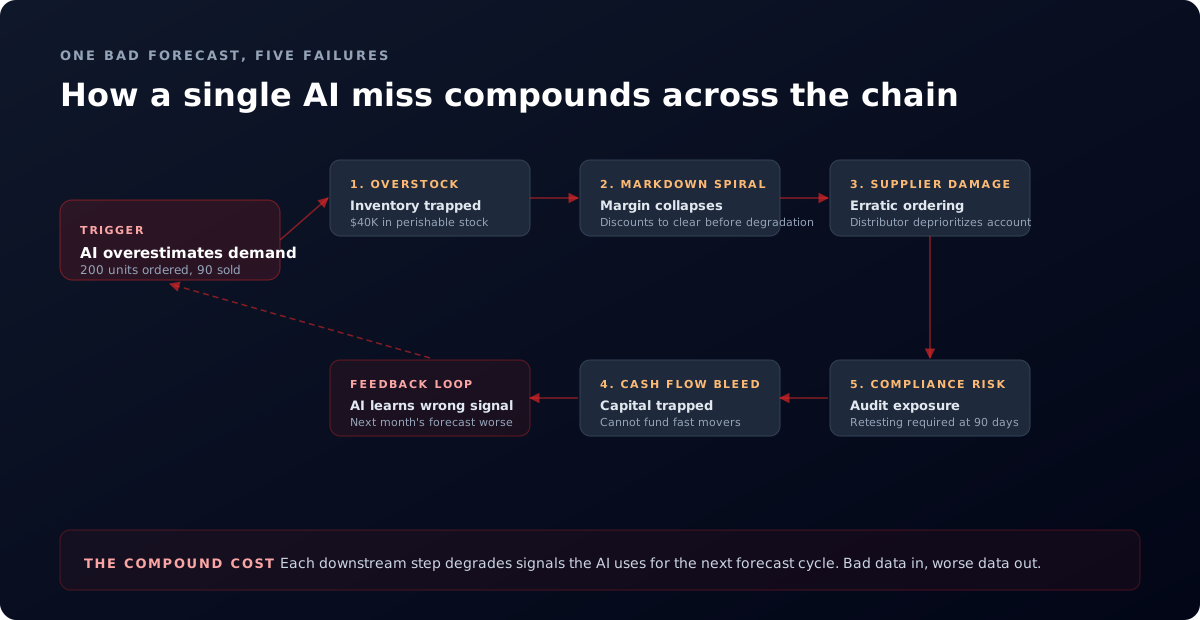
When a regulated retailer's demand prediction system fails, it doesn't just mean overstocking one SKU (stock keeping unit). It creates operational chaos that cascades across functions.
| Failure mode | Mechanism | Operational cost |
|---|---|---|
| Overstock trap | AI overestimates a premium strain, you order 200 units, demand underperforms | $40K stuck in perishable inventory, cannabinoid degradation, margin-killing markdowns |
| Understock spiral | AI underestimates a bestseller, customers bounce to competitors, system "learns" lower demand | Self-reinforcing cycle, lost LTV, abandoned SKUs |
| Supplier damage | Erratic forecasts make distributor production planning impossible | Deprioritized account, lost limited-edition allocation, weaker bargaining power |
| Cash flow bleed | Working capital trapped in slow movers, unable to fund fast movers | Compounds quarter over quarter, especially painful at 25-35% margins |
| Compliance exposure | Overstock triggers retesting requirements, understock means unfulfilled compliance-tracked orders | Audit risk, regulatory paperwork, possible fines |
The AI doesn't optimize for your cash position, only for theoretical demand accuracy. That's the gap that wrecks margins.
Why are regulated retailers still deploying these systems?

Despite the failure rate, regulated retailers are pushing forward with AI demand tools. Why? Because the alternative is worse.
Manual inventory planning in cannabis is a nightmare. Your head of operations is making gut calls based on hunches, sales rep feedback, and whatever they remember from last year. That system scales to maybe 50-100 SKUs. At 300+ SKUs (standard for modern dispensaries), it falls apart.
AI demand forecasting is bad. But it's better than chaos. So retailers are adopting it knowing it will fail, and building workarounds into their operations to soften the impact.
Editor's Note: The same data quality problem shows up in personalization, not just inventory. We covered the upstream version in Cannabis Personalization Has a Liability Problem.
The retailers who are actually winning with AI inventory are doing four things differently.
How to actually run AI demand forecasting in cannabis retail
This is the playbook the retailers I've worked with are running, and it is materially more durable than pure-AI deployments because it keeps human judgment, supplier context, and compliance timing in the loop.
- 1Treat AI as input, not gospel. The forecast gets reviewed by a human before orders ship. Your demand model might say 80 units. Your team knows that strain is trending on social media. They adjust to 140. The AI provides a starting point, not an answer.
- 2Segment SKUs by predictability. Bestsellers are predictable. Experimental strains are not. Use AI heavily on predictable tiers, use intuition and trend analysis for experimental. Different strategies for different categories.
- 3Build supplier relationships as buffers. If your distributor trusts you and has safety stock, they can fulfill rush orders when demand surprises spike. That relationship costs higher wholesale prices, but it's insurance against forecast failure.
- 4Focus on SKU velocity, not perfect accuracy. Instead of predicting exact demand, focus on which SKUs are accelerating vs. decelerating. Shift orders toward winners, deprioritize losers. AI gets velocity right far more often than absolute volume.
- 5Clean the data before you trust the model. Reconcile POS records with supply invoices. Standardize SKU naming across systems. Build at least 18 months of clean, consistent historical records before you let the model drive any meaningful order quantity.
What does a hybrid cannabis inventory system actually look like?
The future of cannabis inventory isn't pure AI. It's hybrid. AI plus category expertise plus real-time market intelligence.
The best systems combine AI pattern detection on historical bestsellers (what you know works), qualitative input from category managers (they know trends), real-time social listening on strains and brands (TikTok, Instagram signals), supplier allocation constraints (your distributor only has 50 units available, so forecast to 50), and compliance rules (some strains require retesting at 90 days, so don't overorder near that deadline).
This hybrid approach will not make forecasting perfect, but it is good enough to optimize inventory without pretending the model can see every promotion, substitution, testing delay, or supplier constraint on its own. Regulated brand teams thinking about this should also read about the AI search discovery shift reshaping how products get found, the retail compliance lag that appears when automation moves faster than controls, and our dispensary marketing approach for the data architecture side.
The retailers still chasing the "pure AI" dream are leaving money on the table. The algorithm is deterministic. Your market is not.
The retailers getting crushed by AI inventory systems made the same mistake. They thought the algorithm would solve a complex human and market problem. It can't.
It can only pattern-match against historical data, and your historical data is probably noisy. The cannabis market is moving too fast for pure algorithmic optimization. The retailers that win will be the ones who use AI to augment human judgment, not replace it.
FAQ
Cannabis demand violates the three core assumptions standard demand models rely on: stable markets, rational price elasticity, and sufficient historical data. New strains, regulatory shifts, viral terpene trends, and a 15-year-young legal market mean the training data is too noisy and the conditions too volatile for off-the-shelf forecasting tools.
Fast-moving, predictable SKUs can be forecast well when the model is paired with human review, promotion context, supplier constraints, and social signals. Pure AI deployments without those layers are usually less reliable than experienced category managers running a disciplined review process.
At least 18 months of reconciled, standardized POS data. That means SKU naming consistency, returns logged correctly, promotional pricing flagged, and POS records cross-checked against supplier invoices. Most retailers underestimate this and dump messy data in expecting the model to compensate. It can't.
At under 50 SKUs, manual planning still works. Between 50-300 SKUs, AI helps but human override is critical. Above 300 SKUs, AI is necessary but only as part of a hybrid system. Below the volume threshold for clean data, you're better off with disciplined manual processes than a misconfigured model.
Three moves. Pause the model's autonomous ordering and put a human review step before any PO ships. Run a 90-day data hygiene sprint to clean POS, returns, and supplier records. Then segment your SKUs into predictable vs experimental tiers and only let the model drive predictable-tier orders.
Yes, in two ways. Overstock can trigger retesting requirements as products approach 90-day or 180-day windows depending on state. Understock can mean unfulfilled compliance-tracked orders. Both create audit exposure. Your inventory AI needs to know your state's testing rules, not just sales velocity.
Not well. The best forecasts incorporate supplier allocation constraints, because you cannot sell what you cannot get, and supplier reliability, because late deliveries change demand signals. Bringing supplier intelligence into the model is what separates useful forecasting from spreadsheet theater.
2026 evidence and control update
Cannabis inventory is already an evidence system because California track-and-trace requirements and broader DCC regulations ask operators to preserve movement, delivery, and inventory records. AI forecasting should plug into that discipline.
The NIST AI Risk Management Framework is useful here because the forecast is not just a number. It is an input that should be mapped, measured, monitored, and challenged when the real world changes.
| Control area | Why it matters now | What to document |
|---|---|---|
| Data source | AI quality depends on the inputs behind the answer | Vendor feed, POS field, menu source, or policy document |
| Rule layer | Cannabis rules still vary by market and channel | State rule, platform policy, age gate, claim restriction |
| Human review | Edge cases should not be decided only by automation | Reviewer, escalation threshold, approval or rejection note |
| Evidence trail | Future audits need more than screenshots | Timestamp, prompt/output pair, creative version, final URL |

