Your cannabis AI just told a customer to use THC topicals for anxiety relief. No research backing it. No compliance check. Just a hallucination from a language model trained on general internet data.
That customer doesn't exist. But your liability does.
The gap between what cannabis operators think AI can do and what it should actually do has become the industry's biggest silent risk. You're not alone. According to the <a href="https://www.5wpr.com/ai-visibility-index/cannabis-ai-visibility-index-2026/" rel="nofollow noopener noreferrer" target="_blank">5W PR Cannabis AI Visibility Index</a>, approximately 28% of cannabis prompts tested produce AI engine refusals, hedges, or prominent disclaimers.
That's substantially higher than any other consumer category. Your competitors are deploying AI chatbots and content generators without compliance frameworks. Regulators are watching.
Here's what's actually happening in dispensaries and cannabis brands right now.
The 28% Problem Nobody Talks About
You know that moment when ChatGPT refuses to answer a question? When Gemini hedges with a disclaimer? When Claude says "I can't help with that"?
In cannabis, that's happening at 4x the rate of any other industry. Your AI is failing silently, and you're probably not noticing.
The reason is straightforward: cannabis compliance rules are hyperlocal, specific, and constantly changing. State by state. County by county. Platform by platform.
General-purpose AI models are trained on internet data that treats cannabis like a generic product category. They don't know California's advertising rules. They don't understand Nevada's age verification mandates. They can't distinguish between a health claim and a product claim.
So when a dispensary owner asks their AI chatbot to "write something about our topicals for pain relief," the model either:
- 1Hallucinates a health claim and sends it live
- 2Refuses to answer
- 3Writes something so generic it's worthless
All three are failures. The third just looks normal.
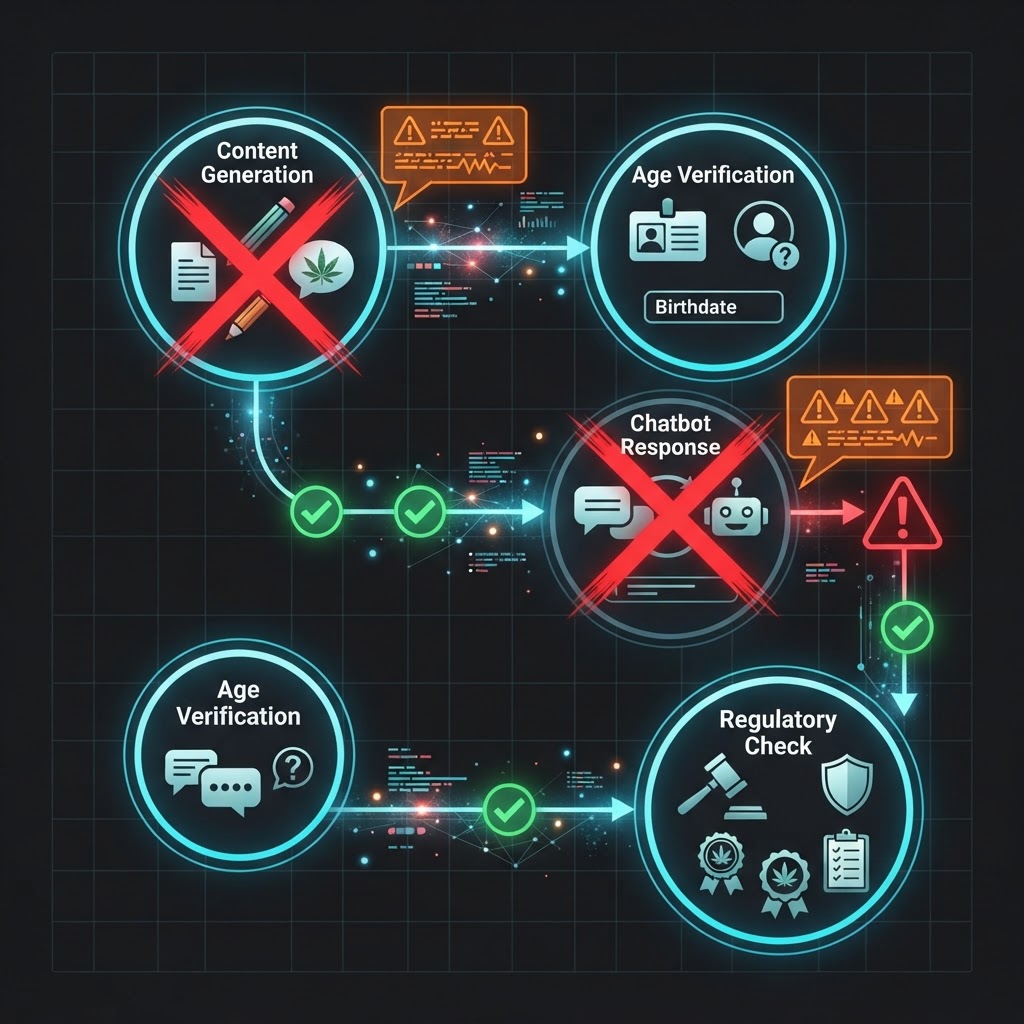
Cannabis AI compliance failure visualization
Where Cannabis AI Actually Breaks
It's not one problem. It's four.
Content generation becomes liability
Your AI writes product descriptions. But does it know California Health & Safety Code Section 11362? Does it understand Nevada's ban on unsubstantiated wellness claims? Can it distinguish between a topical applied to skin and an ingestible product with different compliance rules?
No. It generates what looks good. And what looks good often violates regulations you've forgotten existed.
Chatbots hallucinate compliance
You deploy a customer service chatbot to answer age verification questions and product information. The <a href="https://www.ftc.gov/news-events/news/press-releases/2025/09/ftc-launches-inquiry-ai-chatbots-acting-companions" rel="nofollow noopener noreferrer" target="_blank">FTC is currently investigating AI chatbots</a> for consumer harm. Your chatbot can't verify age reliably.
It can't explain <a href="https://www.nist.gov/publications/sp-800-63-4-digital-identity-guidelines" rel="nofollow noopener noreferrer" target="_blank">NIST SP 800-63-4 identity proofing</a> requirements. It makes up answers when it doesn't know something.
Social content moderation fails
Your AI auto-generates social media captions. But Instagram, TikTok, and Facebook have cannabis-specific rules your AI doesn't understand. You post. It violates platform policy. Your account gets restricted. Your AI kept going anyway, because it wasn't trained on platform compliance rules.
Age verification becomes theater
You deploy AI age verification on your website. The new standards under NIST 800-63-4 changed what "verified" actually means. Your AI does basic checks. It looks official. But if regulators audit it, it fails.
The Regulatory Reality Hit in 2026
This stopped being theoretical in January.
California's AI transparency law took effect on January 1, 2026. It requires disclosure when AI generates content.
Nevada is implementing stricter identity proofing standards for online cannabis sales. The <a href="https://www.ftc.gov/industry/technology/artificial-intelligence" rel="nofollow noopener noreferrer" target="_blank">FTC announced enforcement</a> against companies that misrepresent AI capabilities.
For cannabis operators, that means:
- You can't deploy AI content without disclosing it (California)
- Your age verification must meet federal identity standards, not just check a checkbox (NIST 800-63-4)
- Your chatbot is your liability if it gives false information (FTC)
- Regulators now have precedent for fining cannabis operators who use AI recklessly
Most operators know zero of this. They're copying ChatGPT prompts from industry forums. They're buying chatbot plugins that look professional but have zero cannabis-specific training. They're treating AI efficiency like the default assumption when compliance should come first.
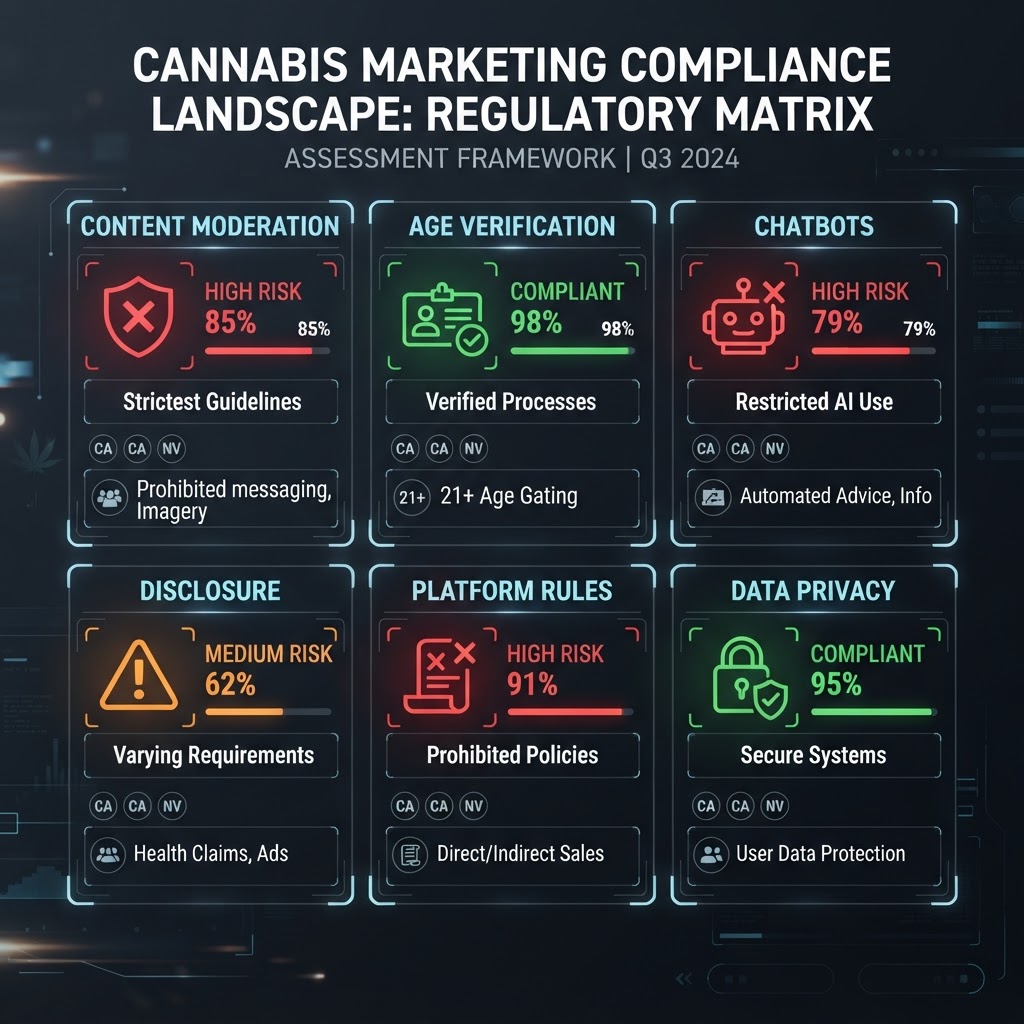
Regulatory compliance landscape matrix for cannabis AI
How Operators Are Fixing This
The operators winning are doing something different. They're not choosing AI efficiency over compliance. They're choosing results-accountable AI that survives regulatory scrutiny.
Here's what that looks like:
Start with compliance, not efficiency. Before deploying any AI tool, map what your state requires. Not what you think it requires. What the actual text says. California Proposition 64. Nevada Revised Statutes 444C. Your local ordinances.
Use state-specific training data. Don't train general-purpose AI on cannabis content. Use compliance-specific data. Regulatory documents. Your own audit logs. Historical content that passed review.
Build human review into your workflows. Your AI doesn't get the final decision. A human compliance person does. This takes time. That's the point. Efficiency that breaks a regulation is expensive.
Test against realistic scenarios. Your AI should fail gracefully. It should know what it doesn't know. When a question falls outside compliance guidelines, it should say so, not hallucinate.
Document everything. If a regulator asks why your chatbot said something specific, can you show the decision trail? If you can't, you're liable. If you can, you're protected.
This approach takes more effort upfront. It saves effort later when you're not hiring lawyers to explain what your AI hallucinated.
The Operator Playbook
If you're building or deploying cannabis AI right now, here's what you need to do:
- 1Audit your current AI usage. What AI tools are live? Chatbots, content generation, customer segmentation? Document each one.
- 1Map your compliance requirements. State-specific rules for advertising, age verification, product claims, and disclosure. Write them down.
- 1Test your AI against those requirements. Run realistic scenarios. Can your chatbot verify age correctly? Does your content generator avoid health claims? Can it explain why it did something?
- 1Add compliance checks to your prompts. Train your AI to recognize compliance boundaries. Make violations obvious.
- 1Implement human review. Someone reads what the AI produces before it goes live. That's not optional.
- 1Monitor and audit regularly. Compliance requirements change. Your AI training data becomes stale. Audit quarterly at minimum.
This is more work than just deploying OpenAI's API and hoping for the best. It's also the difference between running a regulated business and running a compliance liability.
FAQ
Not safely. ChatGPT is trained on general internet data and doesn't understand cannabis regulatory boundaries. It will hallucinate health claims, miss state-specific rules, and create liability. You need a compliance-first tool instead.
You're liable. The FTC holds companies accountable for AI they deploy, even if the AI made the mistake. Cannabis regulators hold operators accountable for all customer communications, including AI-generated ones. Fines range from $5,000 to $500,000 per violation.
Use solutions that meet NIST SP 800-63-4 standards, not just basic date-of-birth checks. Real identity proofing means verifying an actual government ID through a human-verified process. AI can assist, but legal standards require human verification.
Yes, with disclosure and compliance review. California requires disclosure that content is AI-generated. You must remove unsubstantiated claims regardless of how it was generated. Human review is required before anything goes live.
It's the federal standard for identity proofing in online transactions. If you're selling cannabis online or requiring age verification, your system should meet these standards. That means verified identity documents, liveness checks, and human oversight.
Test it against your state's specific rules. Run scenarios where it should refuse to answer. Check that health claims don't slip through. Verify age verification processes work correctly. Document the results and run tests quarterly. --- Your AI will keep getting smarter. Your regulations will keep getting stricter. The operators who win are the ones building compliance into their AI from day one, not bolting it on after deployment. The cannabis industry isn't moving toward less regulation. It's moving toward more. AI that survives that transition isn't optimized for efficiency. It's optimized for accountability.